This site is no longer updated
Please use the links in the sidebar to visit the new sites!
Showing posts with label Foreign Affairs. Show all posts
Tuesday, 28 February 2017
Tuesday, 31 January 2017
FMQs: Trump Ban, Cancer & Tidal Lagoons
By OwenTuesday, January 31, 2017ActTrav, Carms, Cons, DWP, Energy, FirstMin, FMQs, Foreign Affairs, FreeMove, Industry, Labour, Marine, Medicine, NRW, Plaid, Religion, Swansea, UKIP, USA, WGEconView Comments
For most of this afternoon's FMQs, you would think you were following a parliamentary session in an independent country: foreign policy, condemnation of foreign governments, state visits, discussion of immigration, how to win the battle against Islamic State – and Carwyn Jones was using the language of a Prime Minister, not a regional premier.
Thursday, 17 November 2016
Who are "The Establishment"?
By OwenThursday, November 17, 2016Borders, Brexit, Business, EmpSk, EU, Foreign Affairs, Industry, Pirate, Poverty, Racism, SNP, UK Press, UKIP, USA, WIssView Comments
![]() |
| Is the idea of a single monolithic Establishment a myth? (Pic : The Spectator) |
2016 will be marked by a revolt against the status quo in liberal democracies. In Wales we've seen the election of UKIP AMs for the first time, followed by Brexit. Earlier this year there was an inconclusive Irish general election. There's also the re-election of Jeremy Corbyn in the face of opposition from Labour's aristocracy and finally Donald Trump's victory last week.
Wednesday, 26 October 2016
What type of Brexit suits Wales?
By OwenWednesday, October 26, 2016Banks, Borders, Brexit, Business, Canada, EU, Farming, Foreign Affairs, FreeMove, Industry, IntLaw, Liechtenstein, Norway, Switzerland, Tax, Trade, Turkey, Unionism, WhitehallView Comments
![]() |
| Soft Brexit vs Hard Brexit - the same process but different end results. (Pic : buzzfeed.com) |
I said I wouldn't return to Brexit until something concrete happens. Now that we have a timetable for the activation of Article 50 , a recent ministerial meeting involving the devolved administrations and hints at what sort of Brexit the UK Government will pursue, it's worth coming back to it again.
Saturday, 24 September 2016
The Big Brexit To Do List
By OwenSaturday, September 24, 2016Borders, Brexit, Business, Cabinet, EU, EUCOM, EXT, Farming, Fiscal Policy, Foreign Affairs, FreeMove, Industry, IntLaw, Ireland, Northern Ireland, Scotland, Third Sector, Trade, Universities, WhitehallView Comments
![]() |
| Before Brexit can happen, we need to know what needs to be done beforehand. |
I'm getting as fed up with the endless hot air surrounding Brexit as much as you probably are. This will be my final post on Brexit for the foreseeable future. I'm also considering ignoring any future statements/questions on this in the Senedd as nothing's actually happened yet and nobody seems to be in a rush to make anything happen either.
Monday, 22 February 2016
EU Referendum : The Deal
By OwenMonday, February 22, 2016Banks, Borders, Business, Cons, EU, EUCOM, Foreign Affairs, FreeMove, InOutRef, Monetary Policy, PM, Regs, Trade, WelfareView Comments
![]() |
| (Pic : Reuters via BBC) |
As you're probably all more than aware, last Saturday the Prime Minister, EU Commission and heads of government of other EU member states (EU Council) reached agreement on a renegotiated UK membership of the EU – you can read the text of the agreement here (pdf).
Tuesday, 12 January 2016
EU Referendum : The IWA Debate
By OwenTuesday, January 12, 20164FirstMin, Borders, EU, Farming, Foreign Affairs, InOutRef, ITV, IWA, Labour, Nationalism, Northern Ireland, Norway, Regs, SteelSOS, Switzerland, Trade, UKIP, Unionism, Universities, Welsh PressView Comments
We still don't know when the referendum will be held on the UK's membership of the European Union but, to much fanfare, the first Welsh debate was hosted last night in Cardiff by the Institute of Welsh Affairs (IWA) and Cardiff University, with the First Minister lining up against UKIP leader, Nigel Farage MEP.
Thursday, 8 October 2015
Monday, 22 June 2015
Should the military recruit in Welsh schools?
By OwenMonday, June 22, 20154Assembly, 4INQ, 4PET, 4WGEd, Denbigh, EmpSk, Foreign Affairs, Merthyr, MHealth, Military, MoD, NATO, Poverty, Qualifications, Schools, UN, YPeopView Comments
![]() |
| (Pic : The Telegraph) |
Monday, 1 June 2015
The In-Out EU Referendum Bill
By OwenMonday, June 01, 2015Borders, Cons, EU, EU Parl, EUCOM, Foreign Affairs, Gibraltar, InOutRef, Labour, Lib Dems, Plaid, PM, UK Law, UK Parliament, UKIPView Comments
![]() |
| Forty years since the last time the question was put to the public, the UK is to be asked whether to remain a member of the EU. (Pic : The Telegraph) |
Saturday, 16 May 2015
Devolution : Last Stand of the Human Rights Act?
By OwenSaturday, May 16, 20154Assembly, 4Plenary, Civil Liberties, Cons, Courts, Foreign Affairs, Intelligence, IntLaw, Labour, Lib Dems, MoJ, Northern Ireland, Plaid, Policing, Scotland, UK Law, UK Press, WhitehallView Comments
![]() |
| (Pic : via Flickr) |
One Conservative manifesto commitment prior to their election victory was the repeal of the Human Rights Act 1998 and its replacement with a "British Bill of Rights" - possibly including a subsequent full withdrawal from the European Convention on Human Rights (ECHR) if certain demands aren't met. The task has been passed to new Justice Secretary, the shy and retiring Michael Gove.
Monday, 20 April 2015
Westminster 2015 : The Manifestos Part II
By OwenMonday, April 20, 2015Barnett, Borders, Crime, Drugs, Elderly, Election 2015, Energy, EU, Fiscal Policy, Foreign Affairs, Lib Dems, MANF2015, Military, Plaid, Powers, Tax, UKIP, Unions, Waste, WelfareView Comments
Following
yesterday's look at the party manifestos (linked
above), today it's the turn of the Lib Dems, Plaid Cymru and
UKIP.
Sunday, 19 April 2015
Friday, 17 April 2015
Westminster 2015 : The BBC Challengers Debate
By OwenFriday, April 17, 2015Barnett, BBC, Borders, Cons, Election 2015, Foreign Affairs, Greens, Housing, Labour, Lib Dems, Military, Nationality, Plaid, Poverty, Scotland, SNP, Tax, UKIPView Comments
Tuesday, 9 September 2014
Is Wales a principality?
By OwenTuesday, September 09, 2014BBC, Constitution, Cornwall, Crown, England, Foreign Affairs, Gwynedd, Independence, Nationalism, Tradition, UnionismView Comments
![]() |
| It may well be a good branding strategy or tagline, but it's wrong. (Pic : moneymarketing.co.uk) |
I suppose you're expecting a bit more than that.
Wales is often called a "principality", and even our great and good make that mistake. I don't think it's down to deliberate ignorance, just a result of centuries of old wives tales as well as a legacy left by Wales' own native monarchy.
Whether a country is a principality or not depends on the title of the head of state. The head of state is a different role to head of government (they're rarely combined) and is usually the highest-ranking position in a nation's constitution.
In short, a principality is a nation state where the head of state is a prince or princess. Liechtenstein, Monaco and tonight's football opponents for Wales, Andorra, are principalities. Luxembourg is a Grand Duchy because their monarch holds the title of grand duke (an old Germanic title that's more senior than a prince but less so than a king or queen).
Wales' head of state is whoever's monarch (king or queen) of the United Kingdom. Wales is no more a principality than England or Scotland are.
Wales could only ever be a principality if it were independent and the head of state were a prince or princess (see : A Welsh Monarchy). Even if Wales became independent and retained the current monarchy, it couldn't be a principality, it would be a kingdom.
As alluded to earlier, the situation in Wales is a little more complicated because a large part of Wales (what is now Gwynedd, Flintshire, Conwy, Denbighshire, Anglesey, Carmarthenshire, Powys and Ceredigion) used to be an independent state/collection of independent states ruled by a prince(s) – a true "principality".
After the Statute of Rhuddlan in 1284, the Prince of Wales retained a direct constitutional role in the governance of Wales. Wales was a semi-independent vassel state of England, and the Prince of Wales was the head of (what would eventually become) the Council of Wales and the Marches - a medieval form of devolution and a sort of "practice run" at ruling a country.
Following the Laws in Wales Acts, the principality, as a legal entity, was abolished. "Prince of Wales" became nothing more than the courtesy title given to the heir to the English throne, and the Council of Wales and the Marches was altered to be run by an appointed Lord President. Wales ceased being a principality at this point, but the name has stuck.
So Chuckles Windsor is a prince without a principality. However, as Duke of Cornwall he does enjoy some feudal rights that could be considered "constitutional" (Towards a Cornish Assembly?).
What is Wales?
![]() |
| What is this? Or, perhaps more importantly, what do we want it to be? (Pic : ITV Wales) |
- A nation state is internationally-recognised as the sole sovereign entity that governs a defined territory (aka. independent) with an internationally-recognised political border. The United Kingdom is a nation state; Wales, California, Catalonia and England aren't. If Scotland votes yes next week, they're due to become a nation state in 2016.
- A region is a defined geographical area within a nation state or country, usually for administrative purposes only. It may have some level of unique identity and culture, but it's often considered a local variance of a larger one. Gwynedd is a region of Wales, the Highlands are a region of Scotland, while Greater London or the South East are regions of England.
- A country has a level of affinity and identity above that of a region. That could included a unified culture (with regional variations) that's distinct from neighbouring countries, recognition or acknowledgement as a nationality, a language (not dialect), as well as political, legal, academic, civic and cultural institutions.
In 2011, thanks to lobbying from Leanne Wood AM (Plaid, South Wales Central), Wales was officially granted country status by the International Standards Organisation (ISO).
"Country" and "nation state" are sometimes used interchangably because countries are usually full nation states too. This doesn't mean a "country" has to be independent, as they can be part of a larger union of other countries to form a single nation state (like Spain, Russia and the UK).
So the most accurate description of what Wales is would be a country within a nation state (United Kingdom) or a "constituent country". Those of us who support Welsh independence believe Wales should become a nation state.
Saturday, 26 July 2014
Does Wales make the most of EU opportunities?
By OwenSaturday, July 26, 20144Assembly, 4EPB, 4INQ, 4WGEcon, 4WGFin, Anglesey, Conwy, EU, EUCOM, Film, Foreign Affairs, Ireland, Pembs, Rail, S4C, Scotland, Sea, Trade, Universities, WLGAView Comments
It's been a while. There've been many changes. Nick Ramsey has no doubt been stumbling through the Ty Hywel corridors to Every Rose Has Its Thorn.
However, I couldn't resist returning to the rock stars of the Assembly Committee world – Business & Enterprise – and their inquiry report into EU funding opportunities from 2014-2020, which was launched at Cardiff's Chapter Arts Centre last week (pdf).
A lot of this work overlaps with the Constitutional & Legislative Affairs Committee inquiry into the Welsh role in EU decision-making.While that inquiry focused on the political and constitutional situation, this one was more focused on the economic, cultural and financial side of things.
The one thing you can take from both inquiries is the need for a clear strategy on Welsh involvement with the EU. It's a point raised before, but Scotland and the Republic of Ireland have a "more joined up approach" than we do. Meanwhile, concerns that EU funds in Wales have been misused, or Wales being constantly "left off the map", mean a revision of the Welsh Government's EU strategy is long overdue – something Finance Minister Jane Hutt (Lab, Vale of Glamorgan) is considering.
There were 16 recommendations in total, summarised as :
- Ensuring any future EU strategy (Wales in Europe : What role do we play?) sets clear objectives and maximises Welsh involvement in EU programmes.
- Developing tailored support; including the creation of an EU Funding Champion, a central contact point for EU funds and specialist support for the youth, transport and education sectors.
- Addressing gaps in Welsh representation in Brussels (also raised in the Welsh EU role inquiry)
- Setting clear objectives for Welsh universities to promote both studying abroad and language courses as well as creating an alumnus of international students.
- Local Government should develop their own action plans to make best use of EU funds.
- Champion the Welsh creative sector in Europe, ensuring they're not disadvantaged in applying for EU funding because of the UK's strong TV industry.
- Develop a closer working relationship with DG Move and TEN-T executives in Brussels - as well as the Irish – to ensure Wales gets the most out of pan-EU transport programmes.
EU Programmes – What are they?
When discussing "EU Programmes" in Wales, you'll automatically think "Objective One" (Structural Funds) or the Common Agricultural Policy (CAP). There are, however, EU schemes that cover other activities and sectors worth up to €42billion. The inquiry focused on how Wales engages with these programmes and what can be done to ensure we get the most out of them.
These programmes include :
- Erasmus+ (€14.7bn)
- Connecting Europe/Trans-European Transport Networks (TEN-T) (€15bn)
- Regional Cooperation (INTERREG) (€8.7bn)
- Creative Europe (€1.46bn)
- Competitiveness of Small & Medium Sized Companies (COSME) (€2.03bn)
There's also the Horizon 2020 scheme which covers science and technology, but this wasn't within the inquiry's remit.
Welsh engagement with EU programmes
![]() |
| The EU Commission's Creative Europe programme helped fund Y Gwyll, but there were concerns that the strength of the UK's media sector may disadvantage Wales. (Pic : The Guardian) |
There are specialist European officers in local government and higher education – often with a presence in Brussels – but there's nothing similar for the youth, private and voluntary sectors. The benefits from participating in these programmes are potentially huge and such groups may be missing out unnecessarily.
In the Welsh Government's evidence they say some programmes are easier to work with and win funding from than others, so they often had to target their resources carefully. They intend to review how they interact with the EU, but with no set timetable. This led to the Committee supporting previous calls for a full EU Strategy, citing the Irish and Danish governments own successful strategies.
It was said Wales isn't "as switched on" as other countries, with an example given of one academic who was working with the INTERREG programme having no contact whatsoever with the Wales European Funding Office (WEFO). There was also a lack of proper communication with businesses, with calls for a "clear contact point" based outside Wales for foreign companies looking to work with Welsh partners.
There was a specific focus on the creative industries sector, and the EU programme Creative Europe. The EU Commission's media programme "provides support for film productions from pre-production through to distribution, primarily in the form of direct grants to companies and organisations". This scheme provided support towards the production of Y Gwyll/Hinterland.
Media Antenna Wales – part of the Welsh Government's creative industries team – provides support to companies and producers seeking to work with Creative Europe, often helping them negotiate the bureaucracy and form-filling that comes with EU programmes. This level of specialist support was praised and said to be something to emulate in other sectors.
There was, however, a worry that because the UK has a "strong audio-visual industry" overall, Welsh creative companies would be overlooked or disadvantaged when applying for EU funds. Better Together?
International Mobility
![]() |
| Although Wales attracts its fair share of Erasmus funding and participation, twice as many students are incoming as outgoing. (Pic : BBC) |
The benefits of participating in Erasmus are said to include : greater employability, improved self-esteem and there was evidence that academic performance improves too. There's also a knock-on impact to universities themselves, as Erasmus can leave a good impression on students studying here and could be adapted to provide a trade boost that runs into the tens of millions of pounds.
One big barrier is that there are twice as many incoming students to Wales as there are outgoing. Lower Welsh take-up rates are said to be down to numerous factors like : language barriers, lack of engagement by academics, lack of awareness, financial problems and lack of confidence. Also, participation was markedly lower from "new universities".
Cardiff University's Prof. Colin Riordan set a target of 17% of graduating students spending some study time abroad by 2017, having set up a £1.6million bursary fund to help achieve it. At the moment the rate is 12%.
Despite his ambition being praised, these levels of participation fall far short of Germany, which has a 50% target. Prof. Riordan said levels of engagement on this matter with the Welsh Government were "low" and that it wasn't afforded a high level of status.
Colegau Cymru suggested the creation of a "one-stop shop" within the Welsh Government for lifelong learning programmes, while Swansea University suggested the Welsh Government could do more to help universities and colleges access EU funding programmes.
There was also confusion over youth volunteering and youth work. The British Council no longer want to work with devolved bodies on this (in Wales' case Connect Cymru), but said that was because they're changing how they're working with them as there was little evidence of the benefits and effectiveness of youth work and youth volunteering programmes.
International Co-operation
![]() |
| A lot of the Welsh participation in INTERREG is wrapped up in the Ireland-Wales programme. (Pic : EU Commission) |
Colegau Cymru said there are specific challenges here, as in order to get funding, projects need to be managed not only across institutions but across borders around the EU. Milford Haven Port Authority also said there hadn't been enough engagement with the private sector.
Local councils say that while they've participated in programmes like INTERREG, much of their focus has been on structural funding (Objective One, European Social Fund) and rural development. They pointed towards the lack of Welsh Government advice and contacts, with Conwy Council adding – in rather parochial terms – that "their only priority is their own local area".
The Committee underlined the lack of a joined-up approach, but also a lack of ambition by local councils, which is "in marked contrast to the further education sector". They called on the WLGA to display leadership.
Trans-European Transport Networks (TEN-T)
![]() |
| Wales - left off an EU map....again. And the Welsh Government hasn't helped matters either. (Pic : ITV Wales) |
Wales isn't currently on any of the core network corridors, though Business & Economy Minister, Edwina Hart (Lab, Gower) said Welsh experts were sent as part of the UK team when drafting the maps. Milford Haven and the north Wales coast mainline were subsequently added at the request of the UK Government.
Milford Haven Port Authority say there's a significant amount of money that could be available to Wales to develop freight facilities, but too much focus has been on passengers. Holyhead was also excluded from TEN-T as a core port, despite its pretty important role in linking Great Britain to Ireland – though it falls short of Liverpool in terms of tonnage.The Committee say that the negotiating process between Cardiff, London and Brussels was "confused and opaque".
Also, in an astonishing admission, Wales didn't make any applications to, and secured no funding from, the TEN-T programme as of January 2014. Edwina Hart has confirmed, however, that a business case for improvements to the Crewe-Holyhead railway through TEN-T is underway.
The Answer : "Wales could do more"
To repeat myself, there's a clear need for some sort of high level strategy – as much as I loathe such things – and many of the Committee's recommendations make sense. EU programmes also have to be put in a much wider context than structural and agricultural funds as they have important cultural and educational aspects as well.
The lack of proper engagement with TEN-T, however, is a hidden national disgrace and signifies incredible laziness on the part of the Welsh Government. Even a slither of TEN-T funding could've gone a long way towards bringing forward projects like rail electrification or upgrading parts of the A55. I suppose they deserve credit for getting the ball rolling on the north Wales mainline at least.
I suppose in a way this is a complement or follow-up to my 2012 post -"What Wales gets from the European Union".
The answer is, quite clearly, "a lot". If the Welsh Government properly organised itself and started to put the work in the answer would be "even more" - and not just in monetary terms.
Saturday, 8 February 2014
A oes heddwch?
By OwenSaturday, February 08, 20144Assembly, 4FirstMin, 4INQ, 4PET, 4Plenary, Cardiff, Catalonia, Ceredigion, Cons, Flanders, Foreign Affairs, Germany, Labour, Lib Dems, Military, Plaid, UniversitiesView Comments
| The Temple of Peace is more likely to be used for exams or to film Doctor Who nowadays, but will its original vision find new life one day in a Wales Peace Institute? (Pic : BBC Wales) |
On Wednesday, the National Assembly debated a Petitions Committee report into a proposed Welsh Peace Institute. The report itself (pdf) was published in October 2013.
The original petition calling for a Wales Peace Institute received over 1,500 signatures, though it took four years from receipt of the petition to get this far. In the process, the Committee received more than 50 representations to their consultation, which they claim is the most responses they've ever had.
The Committee made only one recommendation - that the Welsh Government work to bring interested parties together to flesh out what such an institute would do and how it would work.
The Report's Findings
| The report cites three other examples of "Peace Institutes" across Europe, the Flemish one being all the more poignant considering the anniversary this year. (Pic : centenarynews.com) |
They envisage :
- A "relationship" with the National Assembly in order to judge how their actions impact human rights, in addition to Welsh and UK defence and foreign policy. They want the institute to become a "non- partisan authority on peace issues".
- A single reference point for information and education about peace, conflict resolution, disarmament etc. and developing links with other peace institutes and international agencies (like the UN) which deal with human rights.
- Freedom to seek independent funding by commissioning research, as well as becoming a consultee with respect to the National Curriculum.
The petitioners explicitly say they're not expecting state funding, they simply want a look into how practical it would be to set the institute up. The Committee say that without that extra detail they found it hard to come to a conclusion, and could've contributed to the length of time it took to get through the Assembly.
The Welsh Government's initial response focused on the academic side of things, like university research and collaboration. The petitioners saw the proposed institute's role being much broader, taking research into "peace studies" out into the public sphere.
The report cites three examples of other "Peace Institutes".
- Flemish Peace Institute – Established in 2004 after powers relating to licensing the arms trade were devolved to the Flemish Parliament (could you imagine Westminster doing that!?). The remit was broad and covered international relations, polemology ("war studies") and peace in society. The Institute is fully financed by the Flemish Government and can also seek external funding.
- International Catalan Institute for Peace – Established via a Catalan law in 2007 following a public campaign. Its remit broadly covers conflict resolution and research relating to it. It's fully funded by the Catalan Government and has to publish an annual report to the Catalan Parliament. It's governing body includes Catalan MPs.
- Peace Research Institute Frankfurt – Established by the Landesrat (State Parliament) of Hesse in 1970, its funding comes partly from both the Hesse State Government and the German Federal Government. It undertakes research and practical work, and is the "leading adviser in Germany" to the German Government on some aspects of policy.
The Committee say there are three main things they can take from the other Peace Institutes.
- Political Independence – Many of the institutes stressed the importance of being arms length of their respective governments, but despite this there have been suspicions that such organisations are "leftist" (in my opinion, those suspicions are sometimes valid). This was overcome by trying to include more conservative politicians in discussions and undertaking academically rigorous research.
- Funding – All three stress that structural funding is more important receiving funding on a project-by-project basis. The Frankfurt institute even suggests funding could be based on an endowment (donations by individuals to a trust, with or without restrictions on how it could be used) in order to ensure independence. The Committee say it would be "difficult to assess how much a Welsh Peace Institute would cost", and that the Welsh Government would be reluctant to foot the bill.
- Regional Parliaments – All three were established by regional parliaments, which aren't responsible for defence or foreign affairs. So there shouldn't be any reason Wales couldn't establish such an institute either, in principle, as the same applies here.
Many of the consultation responses came from individuals
and religious groups - Welsh non-conformist churches have a history
of pacifism, for example. Many organisations believe a peace
institute would be "desirable" – including the Welsh
Refugee Council, their reason being that it would provide an independent voice for
refugees and asylum seekers.
However, Higher Education Wales rejected the idea, saying many universities already have research programmes into peace that were "held in high regard".
The Committee concluded that although they can't map out what such an institute would look like, they "support it in principle", believing it could help "add value to the Assembly's work and wider civic society".
The Assembly Debate
A large chunk of the Assembly debate itself (available here) went over many of the points raised in the report, so there's no need to go into much detail.
Christine Chapman AM (Lab, Cynon Valley) said that while peace, human rights and things like foreign policy aren't devolved, there's room for the Assembly and Welsh Government to get involved in this. She said that there's no need to "replicate exactly what they (other peace institutes) do", though there's no reason peace couldn't become a "cross-cutting theme" in Welsh public policy.
There was lots of support, including from (as you might expect) Bethan Jenkins AM (Plaid, South Wales West), Julie Morgan AM (Lab, Cardiff North) and Simon Thomas AM (Plaid, Mid & West Wales) – the latter needing some help in the cause of peace at the moment.
Support also came from unexpected quarters – Janet Finch-Saunders AM (Con, Aberconwy) for instance, who recalled hopes that the horrors of the First World War would create a culture of peace that, as we now know with the benefit of hindsight, didn't materialise.
There were dissenting voices. Nick Ramsey AM (Con, Monmouth) said he didn't support a Welsh Peace Institute, though – slightly strangely – the rest of his speech set out a backhanded case for one, and that "any discussion about peace is a good one to have in the long term".
Minister for Communities & Tackling Poverty, Jeff Cuthbert (Lab, Caerphilly), responded on behalf of the Welsh Government by saying any further work should be "undertaken by an independent body", effectively rejecting the Committee's recommendation, albeit not rejecting the idea of peace playing a role within public policy completely.
This echoes the Welsh Government's official response (pdf). The First Minister said despite the fact he "wholeheartedly supports the promotion of peace on our society", there was too little detail as to how such an institute would work, noting that the petitioners hadn't agreed on what an institute would do, so the case for it was "inconclusive".
He also believes any further work needs to be done by the petitioners themselves – not on behalf of the Welsh Government - as any formal Welsh Government involvement could give the petitioners false hope that an institute could be established.
Peace in our time?
It's not over, but it
could be a while before anything gets done. I don't want to stick the
boot in, but this account from Caerau Greens perhaps indicates the size of
task ahead, as there appears to have been some sort of disagreement between the alliance of peace groups which backed the
petition in the first place.
Any further work will probably have to be undertaken by the Assembly's Cross-Party Group on Human Rights in order for a serious proposal to be put forward.
Arguments that resort to violence as the first option are almost always on shaky ground, and far from being a sign of weakness, seeking peaceful resolutions to difficult problems is often the harder option and possibly, in some cases, a sign of strength.
However, the very concept of a world free of violence is depressingly out of reach.Violence is something that happens, is a natural behaviour and is sometimes necessary.
I'd support an independent Wales being a "neutral state" (more here) – which is very different from a pacifist state - oppose NATO membership (for practical rather than ideological reasons), and believe Wales should only get involved in various adventures abroad either in self-defence, as part of a mutual defence agreement, or under an internationally-agreed mandate - after all attempts at negotiation have failed.
Any future Welsh troops should be taught "soft" military skills - like dealing with natural disasters, disarmament, negotiation skills and humanitarian issues - as much as "hard" military skills.
If Wales is going to make a serious go at this, it should be linked to a university/universities and produce credible academic research – not just on international relations, but things closer to home like domestic abuse, alcohol-related violence, extremism, cults, football hooliganism, Carmarthenshire Council, organised crime and bullying.
That could be very useful for the Welsh Government, AMs, social services, schools and the police. Some Welsh universities are already doing that – Aberystwyth for the international side of things, Cardiff for things like alcohol-related violence, and Prifysgol Cneifiwr for Carmarthenshire.
A Peace Institute could bring all that together under one umbrella and link it to wider civil society instead of it being stuck in an academic bubble. I think that's what the petitioners were aiming for.
I have to agree with the First Minister though that this needs a clear "vision" to be credible, instead of becoming a "club" for committed activist groups who are perhaps just as motivated by politics and individual causes as promoting peace generally.
An interesting and novel idea, but the case perhaps just wasn't strong enough.
However, Higher Education Wales rejected the idea, saying many universities already have research programmes into peace that were "held in high regard".
The Committee concluded that although they can't map out what such an institute would look like, they "support it in principle", believing it could help "add value to the Assembly's work and wider civic society".
The Assembly Debate
| The Welsh Government rejected the idea of a Welsh Peace Institute, but broadly supports the concept of peace within public policy. (Pic : Flakt Woods) |
A large chunk of the Assembly debate itself (available here) went over many of the points raised in the report, so there's no need to go into much detail.
Christine Chapman AM (Lab, Cynon Valley) said that while peace, human rights and things like foreign policy aren't devolved, there's room for the Assembly and Welsh Government to get involved in this. She said that there's no need to "replicate exactly what they (other peace institutes) do", though there's no reason peace couldn't become a "cross-cutting theme" in Welsh public policy.
There was lots of support, including from (as you might expect) Bethan Jenkins AM (Plaid, South Wales West), Julie Morgan AM (Lab, Cardiff North) and Simon Thomas AM (Plaid, Mid & West Wales) – the latter needing some help in the cause of peace at the moment.
Support also came from unexpected quarters – Janet Finch-Saunders AM (Con, Aberconwy) for instance, who recalled hopes that the horrors of the First World War would create a culture of peace that, as we now know with the benefit of hindsight, didn't materialise.
There were dissenting voices. Nick Ramsey AM (Con, Monmouth) said he didn't support a Welsh Peace Institute, though – slightly strangely – the rest of his speech set out a backhanded case for one, and that "any discussion about peace is a good one to have in the long term".
Minister for Communities & Tackling Poverty, Jeff Cuthbert (Lab, Caerphilly), responded on behalf of the Welsh Government by saying any further work should be "undertaken by an independent body", effectively rejecting the Committee's recommendation, albeit not rejecting the idea of peace playing a role within public policy completely.
This echoes the Welsh Government's official response (pdf). The First Minister said despite the fact he "wholeheartedly supports the promotion of peace on our society", there was too little detail as to how such an institute would work, noting that the petitioners hadn't agreed on what an institute would do, so the case for it was "inconclusive".
He also believes any further work needs to be done by the petitioners themselves – not on behalf of the Welsh Government - as any formal Welsh Government involvement could give the petitioners false hope that an institute could be established.
Peace in our time?
| There's a long tradition of pacifism amongst radical and religious groups in Wales. But this idea looks as though it's - barring more detailed proposals - going to rest for now. (Pic : indymedia.org) |
Any further work will probably have to be undertaken by the Assembly's Cross-Party Group on Human Rights in order for a serious proposal to be put forward.
Arguments that resort to violence as the first option are almost always on shaky ground, and far from being a sign of weakness, seeking peaceful resolutions to difficult problems is often the harder option and possibly, in some cases, a sign of strength.
However, the very concept of a world free of violence is depressingly out of reach.Violence is something that happens, is a natural behaviour and is sometimes necessary.
- See also : Defending Wales Parts 1-10
I'd support an independent Wales being a "neutral state" (more here) – which is very different from a pacifist state - oppose NATO membership (for practical rather than ideological reasons), and believe Wales should only get involved in various adventures abroad either in self-defence, as part of a mutual defence agreement, or under an internationally-agreed mandate - after all attempts at negotiation have failed.
Any future Welsh troops should be taught "soft" military skills - like dealing with natural disasters, disarmament, negotiation skills and humanitarian issues - as much as "hard" military skills.
If Wales is going to make a serious go at this, it should be linked to a university/universities and produce credible academic research – not just on international relations, but things closer to home like domestic abuse, alcohol-related violence, extremism, cults, football hooliganism, Carmarthenshire Council, organised crime and bullying.
That could be very useful for the Welsh Government, AMs, social services, schools and the police. Some Welsh universities are already doing that – Aberystwyth for the international side of things, Cardiff for things like alcohol-related violence, and Prifysgol Cneifiwr for Carmarthenshire.
A Peace Institute could bring all that together under one umbrella and link it to wider civil society instead of it being stuck in an academic bubble. I think that's what the petitioners were aiming for.
I have to agree with the First Minister though that this needs a clear "vision" to be credible, instead of becoming a "club" for committed activist groups who are perhaps just as motivated by politics and individual causes as promoting peace generally.
An interesting and novel idea, but the case perhaps just wasn't strong enough.
Tuesday, 3 December 2013
A slice of frozen PISA
By OwenTuesday, December 03, 20134WGEd, Canada, EmpSk, England, Finland, Foreign Affairs, Israel, Labour, Northern Ireland, NZ, Poverty, Qualifications, Schools, Science, Scotland, Sweden, USA, YPeopView Comments
Climb into your bath, track your arteries with a razor blade and bring on The Smiths.
It's PISA time, and there's nothing the Welsh enjoy more than a good moan, revelling in the doom as we all – once again - rubber neck the slow motion car crash that is the Welsh education system.
PISA, as you know, is an OECD initiative. Since 2000, it's tested 15 year olds in 60+ nations and territories every three years in reading, mathematics and science.
Although Wales has been included as part of regional statistics before, Wales has only sat the PISA tests separately since 2006, so today's results are the third set where Wales has featured specifically.
They're important because PISA is the closest we have to a direct international comparison in terms of education, as all pupils sit the same test at near enough the same time. It's not perfect, but it's the best measure we have and its results shouldn't be dismissed out of hand.
2012's Results
![]() |
| How Wales has performed in the last three PISA tests. (Click to enlarge) |
You can find all the data here, but the specific part relevant to Wales is here (pdf).
One crumb of comfort is that reading performances have improved slightly - up 4 points from 476 in 2009 to 480 in 2012. However, this still lags behind England (500), Scotland (506) and Northern Ireland (498). Northern Ireland was the only Home Nation to have seen a decline.
The bad news is that performances in maths and science in Wales have again declined – though not as sharply as 2009. Maths scores dropped by 4 points from 472 to 468, while science scores dropped by 5 points from 496 to 491. Again, the other Home Nations outperform Wales, with a ~20 point gap between Wales and the rest of the UK that shows no signs of closing.
For want of comparison, 2009 saw a 12 point drop in maths and 9 point drop in science. So the latest figures are hardly as "alarming" as The Western Mail screamed today.
Wales also remains below average compared to the rest of the OECD, placing an equivalent of 41st out of 65 for reading, 43rd for maths and joint 36th place for science.
The changes to the raw scores are barely significant enough to make a big difference - we're talking 1% falls compared to 2009 (or a 1% rise in case of reading) - so it's fair to conclude that Welsh results have stagnated or frozen.
Examining Welsh Performances
International Comparisons
![]() |
| The Welsh education system is roughly as "awful" as Sweden's, based on the 2012 results. (Pic : Aberdeen University) |
- Wales' score in maths places us in the bottom half of the table alongside Israel (466) and Croatia (471) but well ahead of Greece (453), Malaysia (421), UAE (434) and Qatar (376).
- In reading, Wales scored similarly to Sweden (483), Israel (485), Iceland (483) and Slovenia (481).
- In science, Wales scored similarly to Croatia (491), Italy (494), Luxembourg (491) and Russia (486) and was just 10 points off the OECD average.
However, in addition to being
behind the other Home Nations on the whole, Wales is light years behind many
other similar nations like New Zealand, Finland, Ireland and Slovenia.
That's before mentioning far-east nations like Singapore, Taiwan and South Korea who are in a league of their own, due to very intensive, competitive education systems and heavy use of private tuition. Those bring their own problems - like high suicide rates.
So, internationally speaking, Wales is a "C student who needs to buck their ideas up" and needn't sport a dunce's cap, while the UK as as whole isn't doing that much better. There are plenty of developed nations in the same boat we are.
To make a significant jump up the rankings, Welsh performances would have to improve by up to 10% (~40points).
Judging the overall figures, Welsh education standards are directly comparable with Israel, Sweden and Croatia.
You know...."third world" Sweden. Where the UK Conservatives went to get ideas for their school policies.The same Sweden which has an education system that's near enough as "awful" as Wales', just to put things in much-needed perspective.
Economic Performance
This is the first thing people point to when they analyse the results, (somewhat) logically deducing that PISA influences international investors when deciding where to invest, or impacts the economy in some great way.
Is there a correlation between good PISA scores and higher economic productivity?
Using the mathematics scores in isolation - no. There's no strong correlation at all. If there is one it's incredibly weak.
All PISA does is compares test results, giving you a good idea of the strength of respective education systems. As pointed out, Wales scored similarly to Sweden, and performed better than many nations we've lost foreign direct investment to over the years, including parts of eastern Europe.
There's a whole host of factors that determine whether businesses make an investment. Education and skills is one key part of that, but it's not the be all and end all.
There is, however, a clear correlation between socio-economic background and good PISA scores. According to Volume II of the report itself (p38), the difference in performance – on average - between the top advantaged quarter and bottom disadvantaged quarter is up to 90 points, with disadvantaged students twice as likely to wind up in the bottom quarter than advantaged students.
In economies where there is greater "resilience" (pupils who perform better than their socio-economic background suggests they would), the scores are higher. That means in order to improve performances, more chances need to be given to disadvantaged students.
If you are interested I suggest you read the whole report. However, it cements the link between individual motivation, deprivation (not money spent on schools) and poor educational performance.
The Welsh Education System
As ATL's Philip Dixon explained on Click on Wales, turning
this around doesn't come down to selective schools, the Welsh
language, not enough time teaching "the Three Rs" or whatever knee-jerk response the media and commentators
want to come up with to explain things.
The report says higher performing nations "allocate school resources more equitably amongst advantaged and disadvantaged schools" and "grant more autonomy over curricula and assessments".
They also value teachers more. We see them as workhorses who can never do their job properly.
Policies outlined to improve educational equity include :
That's before mentioning far-east nations like Singapore, Taiwan and South Korea who are in a league of their own, due to very intensive, competitive education systems and heavy use of private tuition. Those bring their own problems - like high suicide rates.
So, internationally speaking, Wales is a "C student who needs to buck their ideas up" and needn't sport a dunce's cap, while the UK as as whole isn't doing that much better. There are plenty of developed nations in the same boat we are.
To make a significant jump up the rankings, Welsh performances would have to improve by up to 10% (~40points).
Judging the overall figures, Welsh education standards are directly comparable with Israel, Sweden and Croatia.
You know...."third world" Sweden. Where the UK Conservatives went to get ideas for their school policies.The same Sweden which has an education system that's near enough as "awful" as Wales', just to put things in much-needed perspective.
Economic Performance
This is the first thing people point to when they analyse the results, (somewhat) logically deducing that PISA influences international investors when deciding where to invest, or impacts the economy in some great way.
Is there a correlation between good PISA scores and higher economic productivity?
![]() |
| 2012 mathematics scores for the 65 nations/territories plotted against GDP per capita. (Click to enlarge) |
Using the mathematics scores in isolation - no. There's no strong correlation at all. If there is one it's incredibly weak.
All PISA does is compares test results, giving you a good idea of the strength of respective education systems. As pointed out, Wales scored similarly to Sweden, and performed better than many nations we've lost foreign direct investment to over the years, including parts of eastern Europe.
There's a whole host of factors that determine whether businesses make an investment. Education and skills is one key part of that, but it's not the be all and end all.
There is, however, a clear correlation between socio-economic background and good PISA scores. According to Volume II of the report itself (p38), the difference in performance – on average - between the top advantaged quarter and bottom disadvantaged quarter is up to 90 points, with disadvantaged students twice as likely to wind up in the bottom quarter than advantaged students.
In economies where there is greater "resilience" (pupils who perform better than their socio-economic background suggests they would), the scores are higher. That means in order to improve performances, more chances need to be given to disadvantaged students.
If you are interested I suggest you read the whole report. However, it cements the link between individual motivation, deprivation (not money spent on schools) and poor educational performance.
The Welsh Education System
| Time to invest more capital in the classroom, not on classrooms? (Pic : Wales Cnline) |
The report says higher performing nations "allocate school resources more equitably amongst advantaged and disadvantaged schools" and "grant more autonomy over curricula and assessments".
They also value teachers more. We see them as workhorses who can never do their job properly.
Policies outlined to improve educational equity include :
- Targeting low-performance schools, or low-performing students within schools - This could include a special curriculum, early prevention programmes or, in some circumstances, grade repetition ("holding students back a year").
- Targeting disadvantaged students – This includes, once again, a special curriculum, including disabled students in mainstream classes, and conditional financial incentives to make sure children regularly attend school. Technically, Wales is already doing some of this through the Flying Start scheme and Pupil Deprivation Grant.
- Raising standards for all students – Altering the curriculum, increasing class time, changing the length of the school day and improving teacher training.
I'm not convinced this is something you can "throw money at", as the Welsh Government and opposition parties might be minded to do. Clearly the answers don't lie in things like selective schools either.
The answer, in Wales' case, probably lies in the curriculum and how subjects are taught. It's no good just "teaching to the test", the curriculum itself is going to have to change fundamentally and teachers are going to have to be given the freedom, and trust, to innovate.
You can still do all that while setting down national guidelines and targets. The control freakery in Cathays Park needs to stop.
PISA puts theory in a practical, problem-solving context making it different from any other exam. Welsh schools generally just teach the theory and give straight-forward number/word-only questions, which are never placed in their practical, "real world" use. So when pupils come across a real world example, they might not fully understand the question or might miss key bits of information.
Successive Welsh Governments might well have pumped a lot of money into new schools, but they've clearly neglected the teachers and the curriculum itself. There's no point having lots of shiny new buildings if they're not properly equipped in terms of trained teachers who can deliver a meaningful curriculum.
So if there's one area I would expect more money and policy capital to be spent on, it would be professional development for teachers and developing a brand spanking new National Curriculum – not deprivation grants and school extensions.
And, of course, all the existing measures need to be given time to work too. Big changes take time to filter through though in education – perhaps up to a decade or more. Any measures taken in the last 5-10 years might not make a noticable impact until the 2020s.
Burnt by melted cheese? Let it cool first
There's nothing in this worth getting excited about, and we're pretty much in exactly the same place we were last time around. Wailing and gnashing teeth without offering any practical solutions isn't going to help anyone. That's going to take time and thought.
Yes, it's disappointing news, and the Welsh Government/Welsh Labour deserve to be roundly criticised. The First Minister should be pretty red-faced right about now. I suspect if Leighton Andrews were still in his old role, when you add the tuition fee stuff to this, he would be looking at the sack.
However, the decline isn't as pronounced as 2009's and there's been a noticeable turnaround in reading. The worst of it might be over, and once various policies like the Literacy and Numeracy Framework begin to filter through, I suspect we might see modest improvements in scores (but not rankings) in 2015.
Luckily (or conveniently) for Welsh Labour, the results of 2015's tests won't be made public until after the 2016 National Assembly elections. Having said that, it also means there's no opportunity for an improvement between now and then to put on election leaflets.
The backdrop to that election campaign in terms of education is now boiling down to two areas - PISA and higher education funding.
It's all well and good that I can take a step back and look at it as part of the "big picture". Try telling parents that.
Everyone's going to have to take a deep breath, think rationally and think of long-term, transformative changes. Policy makers are going to have to look beyond England for inspiration, and I would recommend Finland and Estonia as the best places to start.
Unfortunately, as the media and political reaction to this has proven, there's plenty of knee-jerk politics out there, but precious little patience.
Tuesday, 14 May 2013
Wales : The Green and Grey Desert
By OwenTuesday, May 14, 2013Blogosphere, Business, Conserv, Elderly, Energy, Foreign Affairs, Greens, Housing, Industry, Mining, Plaid, Planning, Poverty, Powys, Universities4 comments
| What are we trying to do to Wales through "sustainable development?" (Pic : btaoregon.org) |
Following on from my look at census demographics, and three excellent Click on Wales articles, it's worth considering the future of the Welsh economy and fitting that around sustainable development.
Former Plaid MP and AM, Cynog Dafis, wrote about squaring sustainable development with economic development. Cardiff University economics professor Calvin Jones addressed economic growth itself, mooting a "steady state" economy for Wales. Subsequently, Dr Kelvin Mason added to the debate, focusing on sustainable development activism.
No country for young men and women
It's an uncomfortable fact, but the Welsh (or people living in Wales) are amongst the most pig-headed, small-c conservative, cantankerous people in Europe. We generally oppose things for the sake of opposing them because we're used to someone else – historically the British state apparatus – taking whatever they want. In response, we try to "protect what's ours" by keeping things exactly how they are; pristine, green, damp and largely dead.
In many respects, anti-Welsh/anti-Welsh language comments are the same thing with different criteria. There's something in the Welsh psyche about wanting to be the Llywelyn statue in Cardiff City Hall – a raised fist against "something", just not knowing precisely what, and not really knowing why.
Nothing that threatens, as Cynog puts it – the "priceless and unsullied landscape....preserved from development and radical change" - is allowed. Nothing to ruin views from expensive ex-farmhouses. Nothing to make a country seem "alive". So it seems nothing always wins, and a few people get to raise their fists in defiance to make it so.
What remains is a massive folk museum. A slowly fossilising nation that exists like a pensioner sitting in a chair waiting for the Grim Reaper. It's not a country for the young, but – as the census statistics show – we're going to need them.
The only way to keep them is having a functioning economy, coupled with a high standard of living for young families. The former doesn't matter to the retired, their toiling days over and they understandably don't want any excitement. That excitement being anything from wind farms, a new bypass, houses or constitutional change. True, it isn't just the retired either, that's just a stereotype. It's also true that economic prosperity shouldn't be the only measure of well-being.
Sometimes those worries are justified. Open-cast mines are nothing but giant holes that make the land unusable for decades. You can still do things around wind farms, the footprint of which consists largely of the turbine bases themselves.
Nuclear energy has side issues - like waste and decommissioning - that makes it nothing but an expensive, panicked stop gap due to poor long-term energy planning. Nuclear's proven technology, but I'd take biomass or tidal as sloppy seconds every time.
The jury's out on fracking. Based on providing communities with a steady supply of gas over several decades, it might qualify as "sustainable". If it's burnt as quickly as possible in the National Grid to make quick profits (based on Welsh experience, that's what'll happen) then it most certainly doesn't qualify.
Is there room for compromise between "sustainability" and economic development? Is that even desirable? As Prof. Jones points out, should we rethink "growth" itself?
Economy or Ecology?
"Sustainable development" generally means balancing what's taken out – like natural resources - with what's put back (i.e. greenhouse gas reductions) enabling it to be managed at that level indefinitely.
Call me cynical, but "sustainable" has become a meaningless slogan to smooth through unpopular policies. Search any Senedd debate and see how many times "sustainable/sustainability" pops up – regardless of relevance. As a word, it's been raped.
Nothing quite representes the battle between sustainability, conservation of the landscape and economic development in Wales quite like wind farms.
As Cynog Dafis says, the fact we can generate clean energy directly from wind, sun or tides is a miracle of modern technology – even if we've used wind and watermills routinely before.
You can see two wind farms from prominent north-facing hills in Bridgend on a clear day – Heol y Cyw and I think the other's Fforch Nest. They neither add or take anything away from the landscape as most of the time they're shrouded in low cloud. That's different if you're right next to them, of course.
As for noise and health, pylons carrying electricity from Aberthaw can be pretty noisy, and it's unclear if they have a health impact. There's one less than 200m from me while it's practically in the back garden of someone living on the local estate.
I accept it because it keeps the lights on, just as wind turbines play their small part in doing so too. Likewise, agriculture is probably the single most damaging activity humanity's done to the environment, but we accept that because it keeps bellies full and fields full of animals and crops. So, as you might expect, I don't see the point of keeping otherwise unproductive upland moors as they are for the sake of it.
Using the wind farm example, if they're manufactured, replaced and maintained by Welsh companies, and if the energy generated is supplied by Welsh companies or co-owned by local communities, that means jobs and economic benefits for Wales with minimal impact on the ecosystem - "sustainable development".
Lights on, factories working, jobs, money, "engineering graduates required", clean energy, community ownership. No massive holes in the ground. No grey blocks built next to the sea full of burning coal or submerged uranium.
However, as wind farms spring up, the "Welsh/community economic element" is missing – perhaps because no Welsh companies took advantage in the first place because they knew what the reaction would be from the locals.
Environmental protection should be a top consideration for sustainable development, but if you don't match that with economic sustainability too – that means rural and urban Wales paying its way - it doesn't work. It's too one-sided. All you would be left with is the equivalent of a garden full of weeds and rocks. It'll be overgrown with life, but slowly choked off and dying as a result.
Not everybody's happy with change, as opposing it keeps the noise and excitement – subsequently the youthful vitality - well away. I don't know what point it proves, other than leaving Wales an unkempt future graveyard.
I don't fancy living in a graveyard. Look at "brain drain" figures and many others my age have forsaken the vaunted "peace" and "tranquillity" and decided they don't fancy it either.
Post-Growth Problems : The "War on Stuff"
| A world without growth is likely to be a world with less "stuff". Try telling them that. (Pic : Lunson Mitchenall) |
Economic growth – by and large – is a mirage anyway. London's the wealthiest part of the UK thanks in main to global financial institutions, but that means diddly squat to those living in poverty around Canary Wharf. Ditto areas of rural Wales with sustained below average levels of economic inactivity - thanks in main to the public sector - but low productivity.
It's an economic pulse. It's a good indication of whether an economy's thriving or not, but you can't use it alone to tell if it's well overall.
A lot's been said about Wales benefiting from the green economy because we have the natural assets to take advantage of it. Prof. Jones makes a strong case that these developments aren't enough to meet either "sustainability" or economic growth.
I don't think his argument was Luddite or Malthusian, in fact it made sense. We don't have an ecosystem in isolation. Technology can meet our national targets, but pointless if our half-dozen fossil fuel plants get supplanted by thirty coal-fired power stations elsewhere in the world.
Technology can help, but only if we're smart about it. That could be to develop and export it – proving schemes like the Swansea Bay lagoon work - and show emerging economies currently reliant on fossil fuels that there are viable alternatives. That has to be coupled with global moves to stabilise the population, as well as local actions like energy conservation and changes to how and why we buy and use things.
The chase for "endless growth" is no doubt causing global unsustainability. However, thinking like that makes economics seem a mystical force, not an artificial human construct. Throughout history, when something doesn't work to our benefit, we change how it works – that applies to economics as much as energy generation and manufacturing.
We've seen moves towards practical steps in Wales, like Leanne Wood's Greenprint for the Valleys and The Collective Entrepreneur. But those approaches are still – largely – based on growth, just redefined and repackaged.
With regard "post growth economics" - as mooted by Prof. Jones and others - several problems arise.
Firstly, it's a generational "War on Stuff", and the Welsh like "stuff" as much as anyone else. I loath consumerism, I can't emphasise that enough, but it's hard to picture returning to "the simple days of old" that those acting as Wales' curators are perhaps keen to cling to.
It's twee to believe Welsh people - amongst all others - are going to give up their "stuff" so we can dance through the forest like The Smurfs and live in ecovillages. We'll need to be told to, maybe forced to once exhausted supplies of "stuff" can't meet demand. All that has unfortunate implications.
Next, the elephant in the room – global population growth.
Europe's population is stabilising and ageing, which has problems in itself. It's under-developed nations who'll get shafted (or not as the case may be). That's where population growth – and demand for food, energy and resources - is driven from. The poorest have large families because children die of preventable diseases, and bring in an income via more heads working for very little.
Also, they're not to blame for global unsustainability, but they'll have to be told to have fewer children so we in the developed world can feel more smug about saving them from themselves. Those emerging economies who've spent a century catching up to us will have to take our calls for them to stop with a straight face too.
Then there's the problem of innovation. It's not that a "post growth" economy wouldn't innovate, it's that any viable innovation – no matter how small - will result in some sort of growth.
What would a steady state economy look like? Would growth in one economic sector have to be offset by an engineered decline elsewhere to maintain artificial equilibrium? Hasn't Wales been living through a version of "steady state economics" since the 1980s? Look where it's got us.
I like the idea of rethinking why we work, and the concept of "useful work" – so much so I might come back to it another time. But people doing "useful work" will still want to get paid and buy "stuff" unless they've undergone a mass re-education.
Useful work will be assigned a value. That could be done via a virtual, inflation-proof or negative interest currency, the value of "useful work" based on factors including effort, resources used and (mental & physical) sacrifice. Your nurse could be paid more than a footballer, and your politician can be paid less than a binman.
It works in Star Trek because they have infinite resources via molecular resequencing - the ultimate version of recycling - and infinite energy sources unknown to modern science. "Money" and "wealth" are useless concepts in an economy like that.
Except, we still have finite resources, and scarcity generates "worth" in itself. The only workable, but massively imperfect way of managing that in human history is the market. So far from throwing in the towel on growth, we should probably ensure sustainable products and concepts become cheap, desirable and marketable.
For example, housing. I'd prefer to see low-carbon, modular homes made out of fast-regenerating materials like timber (and "smart materials"), built along walkable grid pattern streets, close to public transport hubs, replace sprawling estates of brick and mortar cul-de-sacs. Keep the individualist concept of "what is mine", but change how that looks and works.
Those advocating stable state economics need to be careful they don't end up on the same side, philosophically speaking, as those opposed to development for the sake of opposition or to "preserve something" - a country photographed for the front of chocolate boxes. A country stuck in a glass bottle, full of tiny waxworks for people to gawp at. A nice country to die in.
We couldn't be bothered to maintain it properly as it was "too hard work". We'd rather sit and stare at it through the window, maybe getting someone in to trim things back every now and again. In the end, Wales ends up a weed-ridden garden.
We'll think the neighbours will sit back and admire that too, and our commitment to letting nature reclaim its own, but instead it's practically an invitation to chuck whatever rubbish they have over the fence.
Saturday, 27 April 2013
The rise of Europe's far-right
By OwenSaturday, April 27, 2013BNP, Borders, Civil Liberties, Communists, Cons, EmpSk, EU Parl, Flanders, Foreign Affairs, France, Greece, Housing, Hungary, Monetary Policy, Nationalism, Netherlands, Racism, Russia, UKIP14 comments
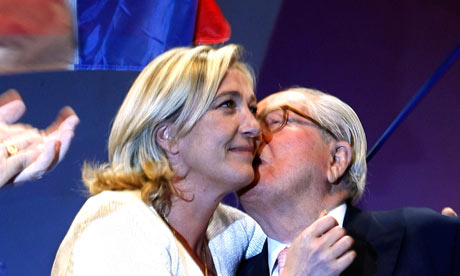
| Has a shift on the fringes of politics to far-right and populist conservative parties in Europe been a recent phenomenon? Or is it more complicated than that? (Pic : The Guardian) |
Back in January, Human Rights Watch warned that far-right politics in Europe were becoming more mainstream. No specific causes were outlined, however this has – in my opinion – inevitably come about as a result of the European economic crisis, as well as more localised problems which haven't been properly dealt with since the end of the Cold War.
Goose steps over Europe
It's worth pointing out that shifts to far-right, or populist hard right politics in Europe aren't recent. Since the threat of Islamic fundamentalism was brought to the fore post-9/11 attacks, countries in Europe with small, unintergrated minorities have seen a noticeable shift to the right, perhaps in a panicked attempt to "protect themselves" through limiting things like immigration.
The first major shift in modern times was probably the Austrian Freedom Party (Freiheitliche Partei Österreichs [FPÖ]) under the leadership Jörg Haider, who was killed in a car accident in 2008. The Freedom Party won 27% of the vote in the Austrian federal elections in 1999, winning 52 seats, and eventually formed a governing coalition with the conservative Austrian People's Party.
| Did the success of the FPO in 1999 "legitimise" the far-right in European politics? (Pic : Der Standard) |
Although the FPÖ at the time were more populist that outright fascist, Jörg Haider had expressed sympathy for select Nazi policies, was accused of anti-semitism as well as having links with Holocaust deniers. The election of the FPÖ shocked Europe so much, that 14 nations introduced temporary diplomatic sanctions against Austria via the European Union. Eventually, the EU was forced into a rather humilating climb-down, but the precedent has been set, and it more than likely played a role in Haider stepping down from his role as party leader.
Despite an ongoing "professionalisation" of far-right parties like the French Front National and the BNP, this was probably the first time the far-right had been "legitimised" in Europe since the 1920s and 30s. This will, in my opinion, have had a knock on impact on other nations too.
Between 1998 and 2001, the populist anti-immigration Danish People's Party (Dansk Folkeparti) made a major breakthrough in the Folketing, winning 22 seats – a rise of 9. That's roughly the level of support they've remained at since, peaking at 25 seats following the Jyllands-Posten Mohammed cartoon controversy. They played ”kingmaker” in 2001, offering their support to enable a right-wing coalition government to be formed, in exchange for changes to Denmark's immigration rules – now amongst the strictest in Europe.
The right-wing Flemish nationalist Vlaams Blok (now Vlaams Belang) were effectively disbanded. They breached Belgian anti-racism laws, once proposing a form of segregation in parts of public life and expulsion of non-European immigrants. They peaked at 32 seats – near enough a quarter of all seats - in the Flemish Parliament in 2004.
| The populist anti-immigration PVV played "kingmaker" following the 2010 Dutch general election. A trend seen in other European countries. (Pic : BBC) |
Further north, in the Netherlands, the Party for Freedom (Partij voor de Vrijheid [PVV]) managed to win 24 seats in the lower house Dutch general election of 2010. Under the leadership of the charismatic Geert Wilders – something of a hard line spiritual successor to the assassinated right-libertarian Pim Fortuyn - they adopted a strong stance on Europe, Islam and immigration. Like the Danish People's Party, they were instrumental in government formation through something akin to a confidence and supply agreement.
The hilariously-named Liberal Democratic Party of Russia – whose policies, which are neither really democratic or liberal, hint that they would try to hunt down and eat our Lib Dems – somehow have 56 seats in the Duma. They want the Russian Empire back, and they wouldn't be afraid to use nuclear weapons to get it back either.
In the present, however, two of the more significant far-right movements are perhaps the most worrying.
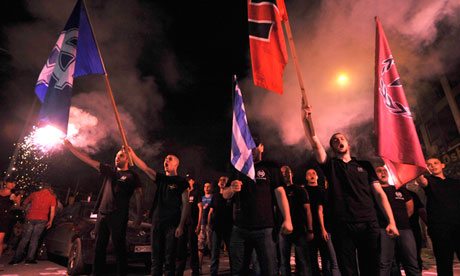
| Golden Dawn - the first Nazis freely-elected in Europe since the 30s? (Pic : The Guardian) |
Between 2006 and 2010, Jobbik of Hungary came from nowhere to win 47 seats in the Hungarian Parliament. They once had a ”uniformed group” that probably fell short of an outward paramilitary organisation, though they were disbanded by the Hungarian courts. Although they strongly deny any racism against minority groups – including the Roma - in 2012, a Jobbik MP called for the creation of a ”list of dangerous Jews” who ”pose a threat to Hungarian national security.”
In Greece, since the torturous collapse of the country's economy, Golden Dawn won 18 seats in the Greek Parliament. They have links to hooliganism, and have been implicated in violent attacks against political opponents and ethnic minorities. Their election slogan in 2012 was, "Rid this land of filth." They're probably the closest Europe has come to freely-elected Nazi's since 1933.
It isn't all rosy
Despite all this, far-right parties and populist right-wing parties very rarely get into "power". They generally, at best, end up as small players in coalitions. Or – as in the Netherlands and Denmark – remain outside of government entirely, only popping up to get a few concessions to prevent centre-right governments collapsing. So, I think there is a natural "glass ceiling" when it comes to the far-right or populist conservatives.
Many of the parties I've mentioned have fallen back in recent elections. The PVV lost 9 seats in the last Dutch elections in 2012 for example. They were also responsible for that early election by withdrawing support for the ruling coalition, after a disagreement over austerity measures. Geert Wilders was blamed by the coalition partners and, ultimately it seems, the Dutch public for it.
| Despite grabbing headlines, the overall performance of far-right parties in many European nations states is poor. (Pic : The Guardian) |
Germany's National Democratic Party (Nationaldemokratische Partei Deutschlands [NPD]) have never performed well at all levels of government in Germany - perhaps understandably - with only a dozen or so elected representatives in state legislatures. In France, despite high-profile, highly-visible successes in Presidential and European elections, the Front National perform poorly at local, regional and national level, with only two Deputies. In Austria, the Freedom Party have never really attained the heights they did under Haider.
That's before mentioning the abject electoral performances of far-right parties closer to home.
I don't think there's anything more damning for liberal politicians than for the public to turn around and choose a far-right candidate over them. Barring legitimate concerns over some policy areas, it's the ultimate protest vote, boiling down to, "I'd rather vote for a Nazi(ish politician) than you." But I don't think many people voting for them really want a far-right (or in many cases far-left) politician to represent them, more give the "usual lot" a very big kick up the backside.
The far-right in Wales and the UK
| Have the EDL been and gone? (Pic : The Telegraph) |
Something both far-left and far-right parties and organisations share is a lack of ideological unity, or splits in support by people seeking an "ever purer" version of their politics.
Internal problems within the BNP have led to them suffering said splits in support. Some joined or forming new parties, with the National Front seeing a teeny-weeny resurgence, and the English Defence League probably stealing the BNP's thunder as the most vocal "far-right" organisation on the island of Great Britain. Even the EDL have probably come and gone, as attendances at their rallies - which once mobilised thousands - have been reduced to a hardcore.
The performance of far-right parties in Wales has been historically atrocious – though not quite as bad as Scotland – and I don't see that changing any time soon. There was a poorly-attended "White Pride" march in Swansea a few weeks ago, which is absolutely hilarious in context. Swansea is 94% white and that's one of the lowest percentages.
However, in terms of the "populist hard right", things might be changing and it would threaten the Welsh Conservatives more than any of the other parties.
With UKIP presenting a - you could almost say "secular" - non-racist way to express disapproval over policy areas like Europe and immigration, as well as a strident British Nationalism, I don't think the future of the far-right in Wales or the UK is rosy at all. Beyond Nigel Farage, UKIP don't really have much, though that could change. However, Nigel Farage could well be the BNP's executioner if he can convince enough people concerned over policy areas like immigration that he presents a creditable and socially-acceptable voice for them. That's probably the reason why there may be ex-BNP in UKIP.
| The BNP's executioner? Do UKIP offer a "softer", "secular" more socially-acceptable voice for those concerned about immigration and Europe? (Pic : BBC) |
But in my opinion, all that would be is a shift to a "populist hard right" similar to Denmark and the Netherlands. That would be much more preferable than a move to neo-fascist organisations seen in parts of eastern and southern Europe.
Again though, I don't think there's any chance of UKIP being in position to run anything larger than a rural English district council. Their aim will likely be to drag the Conservatives to the right, and the rest of us out of the EU.
The EU : A last defence against fascism?
| This is the first major economic downturn parts of Europe will have faced since the end of the Cold War....and they're struggling. (Pic : Wall street Journal) |
Many younger people in eastern Europe of voting age, will not have grown up under the iron jackboot of Soviet Communism, which was nothing more than fascism with a heart. They'll have probably been told stories of how brutal and repressive it was, and how its collapse left their newly-emerging nation states in a weak position.
Those in eastern, and perhaps southern Europe, look to relics of long-dead glorious empires and the social order that used to "exist" under ultra-nationalist dictatorships. Remember that the Axis in WWII consisted of more than Germany, Italy and Japan; it included plenty of puppet regimes in eastern Europe and the Balkans too.
This resurgence of the European far-right is not only the fault of the global financial sector, but the mainstream, technocratic Christian and social democrats who dominate European politics.
In the west and south, they've failed to get a grip on issues like the high cost of living, they helped to prop up and create housing bubbles and in some circumstances they've mortgaged the future of their younger generations to pay off the mistakes of the present.
In the east, while the cost of living remains low compared to the west, they're just getting through the first major economic downturn since the fall of Communism. In some countries like Latvia, it's caused property bubbles to burst, while elsewhere they're experiencing double digit unemployment rates and high levels of poverty, used to exploit inter-ethnic tensions.
Meanwhile, EU institutions have become cumbersome and wasteful – perhaps in some circumstances causing more problems than they're supposed to solve.
The trouble is that as soon as mainstream politicians and parties are seen to be failing to address issues like those, at a time when things are tough and people are scared, charismatic individuals come to the fore offering simple soundbite solutions to complex issues. Sometimes they only offer a closed fist and a jackboot. When you've exhausted all avenues with "traditional" parties, what else have you got to turn to?
There's one firewall though. All those nations, by and large, still want to be "part of the club" when it comes to the EU, even if levels of scepticism and uncertainty about the EU itself are on the rise. If they shift towards fascism rather than a populist, UKIP-style "tough on crime and immigration" stance, it would generate enough disgust within the EU to trigger sanctions – be they economic or social – and that would play a role in bringing them back into line.
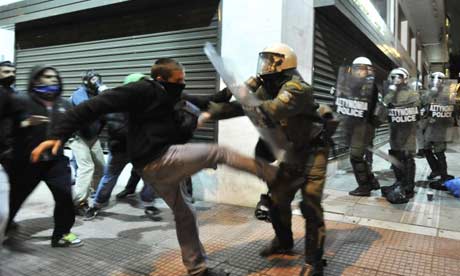
This is going to sound ridiculous, but for all its faults, we should start to position the EU in terms of it being the last line of defence for European liberal democracy.