|
The Temple of Peace is more likely to be used for exams or to film Doctor Who nowadays,
but will its original vision find new life one day in a Wales Peace Institute?
(Pic : BBC Wales) |
On Wednesday, the National Assembly
debated a Petitions Committee report into a proposed Welsh Peace
Institute. The report itself (pdf) was published in October
2013.
The original petition calling for a Wales Peace
Institute received over 1,500 signatures, though it took four years
from receipt of the petition to get this far. In the process, the
Committee received more than 50 representations to their
consultation, which they claim is the most responses they've ever
had.
The Committee made only one recommendation - that the
Welsh Government work to bring interested parties together to flesh
out what such an institute would do and how it would work.
The
Report's Findings
 |
The report cites three other examples of "Peace Institutes" across Europe, the
Flemish one being all the more poignant considering the anniversary this year.
(Pic : centenarynews.com) |
The petitioners provided some outline of
what they wanted an institute to do, backed by Plaid Cymru MEP, Jill
Evans.
They envisage :
- A "relationship" with
the National Assembly in order to judge how their actions impact human rights,
in addition to Welsh and UK defence and foreign policy. They want the institute to become a "non- partisan authority on peace
issues".
- A single reference point for information and
education about peace, conflict resolution, disarmament etc. and
developing links with other peace institutes and international agencies (like the UN) which deal
with human rights.
- Freedom to seek
independent funding by commissioning research, as well as becoming a
consultee with respect to the National Curriculum.
The
petitioners explicitly say they're not expecting state funding, they
simply want a look into how practical it would be to set the
institute up. The Committee say that without that extra detail
they found it hard to come to a conclusion, and
could've contributed to the length of time it took to get through the
Assembly.
The Welsh Government's initial
response focused on the academic side of things, like university
research and collaboration. The petitioners saw the proposed
institute's role being much broader, taking research into "peace
studies" out into the public sphere.
The report cites
three examples of other "Peace Institutes".
- Flemish Peace Institute – Established in 2004 after powers relating to
licensing the arms trade were devolved to the Flemish Parliament
(could you imagine Westminster doing that!?). The remit was broad
and covered international relations, polemology ("war studies")
and peace in society. The Institute is fully financed by the Flemish
Government and can also seek external funding.
- International Catalan Institute for Peace – Established via a Catalan law in 2007
following a public campaign. Its remit broadly covers conflict
resolution and research relating to it. It's fully funded by the
Catalan Government and has to publish an annual report to the Catalan
Parliament. It's governing body includes Catalan MPs.
- Peace Research Institute Frankfurt – Established by the Landesrat (State
Parliament) of Hesse in 1970, its funding comes partly from both the
Hesse State Government and the German Federal Government. It
undertakes research and practical work, and is the "leading
adviser in Germany" to the German Government on some aspects of
policy.
The Committee say there are three main things they can
take from the other Peace Institutes.
- Political Independence –
Many of the institutes stressed the importance of being arms length
of their respective governments, but despite this there have been
suspicions that such organisations are "leftist" (in my opinion, those suspicions are sometimes valid). This
was overcome by trying to include more conservative politicians in discussions and
undertaking academically rigorous research.
- Funding – All three
stress that structural funding is more important receiving
funding on a project-by-project basis. The Frankfurt institute even
suggests funding could be based on an endowment (donations by
individuals to a trust, with or without restrictions on how it could
be used) in order to ensure independence. The Committee say it would
be "difficult to assess how much a Welsh Peace Institute would
cost", and that the Welsh Government would be reluctant to foot
the bill.
- Regional Parliaments – All three were established by
regional parliaments, which aren't responsible for defence or foreign
affairs. So there shouldn't be any reason Wales couldn't establish
such an institute either, in principle, as the same applies
here.
Many of the consultation responses came from individuals
and religious groups - Welsh non-conformist churches have a history
of pacifism, for example. Many organisations believe a peace
institute would be "desirable" – including the Welsh
Refugee Council, their reason being that it would provide an independent voice for
refugees and asylum seekers.
However, Higher Education Wales
rejected the idea, saying many universities already have research programmes into peace that were "held in high
regard".
The Committee concluded that although they can't
map out what such an institute would look like, they "support it
in principle", believing it could help "add value to the
Assembly's work and wider civic society".
The Assembly
Debate
 |
The Welsh Government rejected the idea of a Welsh Peace Institute, but
broadly supports the concept of peace within public policy.
(Pic : Flakt Woods) |
A large chunk of the Assembly debate itself (available here) went over many of the points raised in the report, so there's
no need to go into much detail.
Christine Chapman AM (Lab,
Cynon Valley) said that while peace, human rights and things like
foreign policy aren't devolved, there's room for the Assembly and
Welsh Government to get involved in this. She said that there's no
need to "replicate exactly what they (other peace institutes)
do", though there's no reason peace couldn't become a
"cross-cutting theme" in Welsh public policy.
There
was lots of support, including from (as you might expect) Bethan
Jenkins AM (Plaid, South Wales West), Julie Morgan AM (Lab, Cardiff
North) and Simon Thomas AM (Plaid, Mid & West Wales) – the
latter needing some help in the cause of peace at the moment.
Support also came from unexpected quarters – Janet Finch-Saunders AM
(Con, Aberconwy) for instance, who recalled hopes that the horrors of
the First World War would create a culture of peace that, as we now
know with the benefit of hindsight, didn't materialise.
There were dissenting voices.
Nick Ramsey AM (Con, Monmouth) said he didn't support a Welsh Peace
Institute, though – slightly strangely – the rest of his speech
set out a backhanded case for one, and that "any discussion about
peace is a good one to have in the long term".
Minister
for Communities & Tackling Poverty, Jeff Cuthbert (Lab,
Caerphilly), responded on behalf of the Welsh Government by saying any
further work should be "undertaken by an independent body",
effectively rejecting the Committee's recommendation, albeit not
rejecting the idea of peace playing a role within public policy completely.
This
echoes the Welsh Government's official response (pdf). The First
Minister said despite the fact he "wholeheartedly supports the promotion of
peace on our society", there was too little detail as to how
such an institute would work, noting that the petitioners hadn't
agreed on what an institute would do, so the case for it was
"inconclusive".
He also believes any further work
needs to be done by the petitioners themselves – not on behalf of
the Welsh Government - as any formal Welsh Government involvement
could give the petitioners false hope that an institute could be
established.
Peace in our time?
 |
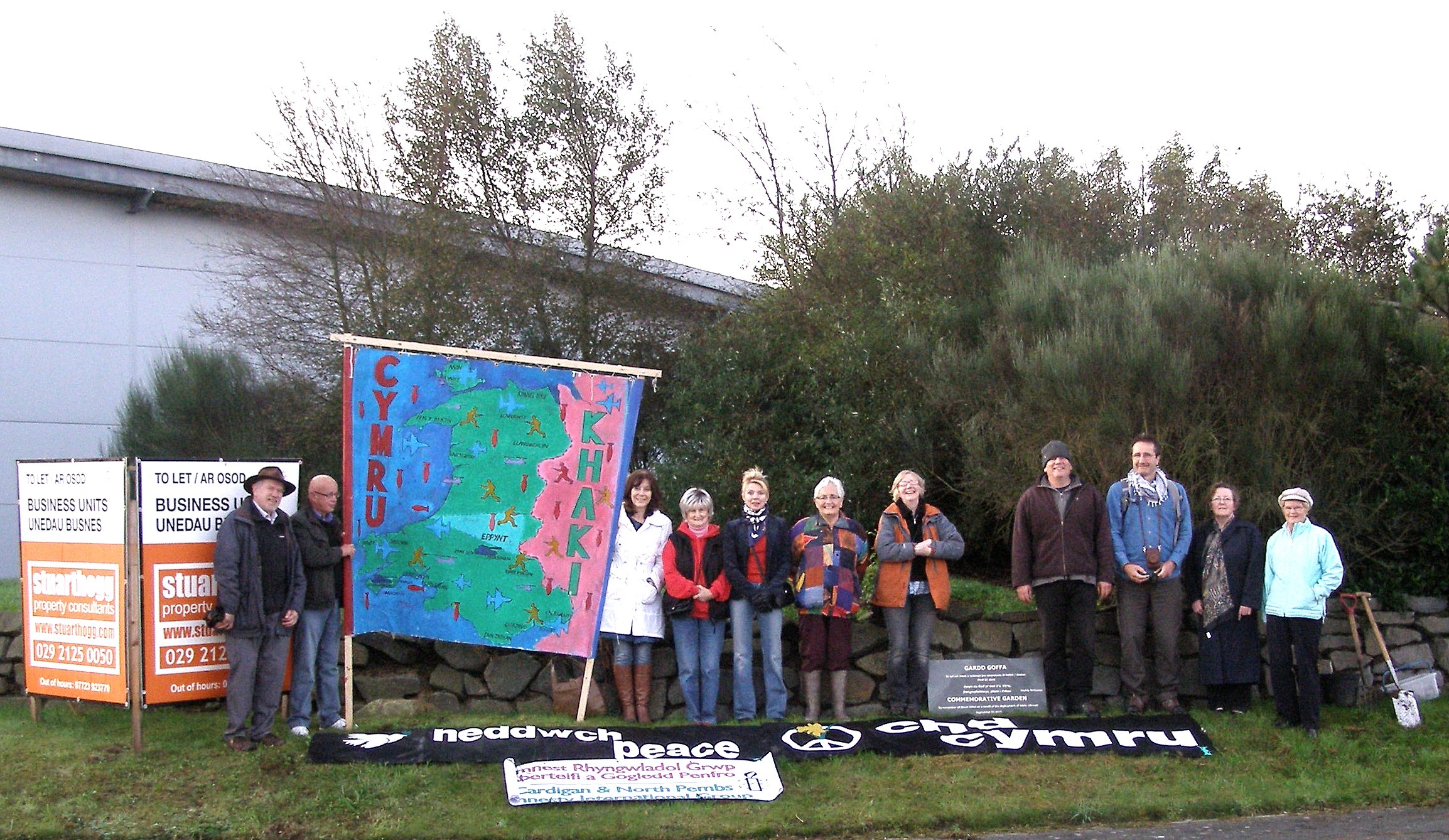
There's a long tradition of pacifism amongst radical and religious groups in
Wales. But this idea looks as though it's - barring more detailed
proposals - going to rest for now.
(Pic : indymedia.org) |
It's not over, but it
could be a while before anything gets done. I don't want to stick the
boot in, but this account from Caerau Greens perhaps indicates the size of
task ahead, as there appears to have been some sort of disagreement between the alliance of peace groups which backed the
petition in the first place.
Any further work will probably have to be undertaken by the Assembly's Cross-Party Group on
Human Rights in order for a serious proposal to be put
forward.
Arguments that resort to violence as the first option
are almost always on shaky ground, and far from being a sign of weakness, seeking peaceful resolutions to difficult problems is often the harder option and possibly, in some cases, a sign of strength.
However, the very concept of a world free of violence is depressingly out of reach.Violence is something that happens, is
a natural behaviour and is sometimes necessary.
I'd support
an independent Wales being a "neutral state" (more here) – which is
very different from a pacifist state - oppose NATO membership (for
practical rather than ideological reasons), and believe Wales should
only get involved in various adventures abroad either in
self-defence, as part of a mutual defence agreement, or under an
internationally-agreed mandate - after all attempts at negotiation
have failed.
Any future Welsh troops should be taught "soft"
military skills - like dealing with natural disasters, disarmament,
negotiation skills and humanitarian issues - as much as "hard"
military skills.
If Wales is going to make a serious go at
this, it should be linked to a university/universities and produce
credible academic research – not just on international relations,
but things closer to home like domestic abuse, alcohol-related
violence, extremism, cults, football hooliganism, Carmarthenshire Council, organised crime and bullying.
That could be
very useful for the Welsh Government, AMs, social services,
schools and the police. Some Welsh universities are already doing
that – Aberystwyth for the international side of things, Cardiff
for things like alcohol-related violence, and Prifysgol Cneifiwr for Carmarthenshire.
A Peace Institute
could bring all that together under one umbrella and link it to wider
civil society instead of it being stuck in an academic bubble. I
think that's what the petitioners were aiming for.
I have to
agree with the First Minister though that this needs a clear "vision"
to be credible, instead of becoming a "club"
for committed activist groups who are perhaps just as
motivated by politics and individual causes as promoting peace generally.
An interesting and novel idea, but the case perhaps just wasn't strong enough.