This site is no longer updated

Please use the links in the sidebar to visit the new sites!

Showing posts with label NPT. Show all posts

Thursday, 20 July 2017

Cardiff-Swansea electrification zapped by UK Government


Rail electrification between Cardiff & Swansea (including Bridgend) was promised by a Conservative-led government in 2012. Five years later they've scrapped it.

I'm not surprised as we've been softened up for this news. It's happened the same week the first round of contracts (worth £6.6billion) for the (estimated) £56billion High Speed 2 project in England – to which Wales will be paying our share of at least £2.7billion – were announced.

The Welsh Secretary, Alun Cairns, slimed his way through the issue earlier this week by talking up the benefits of the new trains. You know what contempt rail passengers are held in when the replacement of 40+-year-old trains that are frequently overcrowded during rush hour is seen as a gift instead of a basic necessity.

Alun clearly knew what was coming, but there's been dishonesty and shadow playing on this from the start. Extending electrification from Cardiff to Swansea is something the Conservatives were reluctantly talked into by the Lib Dems in 2012. They've never really wanted to do it, having wrangled over who was going to pay for it and dragging their feet. It was even omitted from their 2017 manifesto, which should've set alarm bells ringing.

The English transport secretary, Chris Grayling (who also has responsibility for rail infrastructure in Wales), argues the benefits of electrification can be delivered with the new Hitachi intercity express trains, coming into service in south Wales later this year. Fortunately, the new trains are both electric and diesel powered meaning they can run on tracks without overhead lines.

This also means they're more expensive to build, heavier, more things can go wrong with them, are less environmentally-friendly and noisier. That means higher maintenance costs for the track, inefficient engines, no real difference in journey times between Swansea and Cardiff, as much noise as today....it's almost as if there'll be absolutely no difference to things as they are now.

It's a typical solution of a government, party and nation-state that does everything by spreadsheets, divorced from both how things work on the ground and long-term thinking.

Hitachi has built a new maintenance facility in Swansea for the new trains. If you've gone past it recently you will have noticed it's come complete with the infrastructure for overhead power lines. They're going to get rusty.

Electrification between Cardiff and London is still going ahead, but you've got to wonder – with the current state the UK Government's in – what other plans they have in store for us. As Prof. Stuart Cole has argued, this project can't simply be restarted if the expertise and resources are moved. If it's scrapped now it's unlikely anything will happen for a long time; in 15-20 years when we're still talking about this we'll wonder, "Why didn't we do something back in the 2010s?"

I suppose the only question is why has it been scrapped?

We haven't been told because the Conservatives know we won't like the answer: the money and resources for electrifying Cardiff-Swansea are needed in England.

The budget for current electrification work has over-run and if the UK Government are going to deliver pledges in parts of England, "less important" projects need to be ditched.

On an EnglandandWales scale, this is an easy to write-off project between two small provincial cities and should be placed behind the likes of Bath, Liverpool and Manchester. It also means some English cities miss out, like Nottingham and Sheffield - so it's not just Wales being left behind.

At a Welsh level, it's about providing electrified rail services between the capital, one of the most important industrial centres (Neath Port Talbot & Bridgend) and the country's second and third largest cities (Swansea & Newport respectively), as well as being a springboard for electrification in north Wales. Westminster doesn't see this.

Wales has about 6% of the UK's rail network, yet receives around 1-1.5% of Network Rail funding. Scotland gets a population-based share because rail infrastructure is devolved. It isn't devolved here because if Wales received a ring-fenced 4.9% share of UK rail spending, it would mean less money to spend in England London.

As they've significantly underestimated the costs involved, yet again Network Rail's bungling will hamper a major infrastructure project in Wales. It doesn't bode well for the new Wales & Borders rail franchise, Metro, north Wales electrification and pretty much any significant project you can think of either.

Network Rail is really good at putting new shelters in stations, painting lines, fixing bridges and installing new signalling, but beyond that, they're not looking fit for purpose when it comes to running Welsh railways.

The first rule of politics is "Don't make promises you can't keep", but that doesn't seem to apply here. So we've been lied to and let down again. The most depressing thing is you know we're going to sit back and take it because we've got no cards to play and we're used to it.

I can't wait to see what happens with the Swansea Bay tidal lagoon! Fingers crossed!

Tuesday, 21 March 2017

FMQs: City Deals, IndyWales & Rough Sleeping


It was a rather sedate edition of FMQs this afternoon (not that it's different to any other week) with today also marking Carwyn's 50
th birthday 🎉 - to the jocularity of opposition leaders.

Tuesday, 17 January 2017

FMQs: Brexit, Trains & Disability


There are two big non-FMQ related stories today. Firstly, the Senedd voting on a Legislative Consent Motion (LCM) for the Wales Bill. It's expected to pass and there's little to add. Just cross your fingers and hope AMs haven't been sold magic beans (either way).

Tuesday, 22 November 2016

FMQs : Circuit of Wales, Water & Tolls


The big story this afternoon is the emergence of a potential "cash for access" scandal. I stress "potential".

Tuesday, 18 October 2016

FMQs : Trains, Cash & Arts


AMs donned windbreakers and proverbially hung around platforms as the future of rail services dominated proceedings this week. It's also a week that marks the 50
th anniversary of the Aberfan disaster on Friday – with commemorations due at the Senedd tomorrow. It's budget week too and I hope to have something on that for tomorrow (Thursday at the latest).

Saturday, 3 September 2016

Why was the Commonwealth Games bid ditched?

Not coming to a town or city near you....
(Pic : ITV Wales)

Towards the end of July, Economy & Infrastructure Secretary, Ken Skates (Lab, Clwyd South), announced that a speculative Welsh bid to host the 2026 Commonwealth Games would not go ahead following a feasibility study - a 12-page summary of which was released on July 26th (pdf).

Monday, 4 April 2016

Ta-ra Tata : What future for Welsh steel-making?

(Pic : The Independent)

This is an immediate follow-on from the National Assembly debate held earlier today. This post will look in more detail at some of the options facing Tata and other interested parties (like the UK and Welsh governments), as well as what the next steps might be.

Ta-ra Tata : Senedd Recalled

(Pic : BBC)

Following last week's sudden announcement that Tata are actively considering a quick sale of its UK steel-making business, the National Assembly was recalled from Easter recess for an extraordinary plenary session this afternoon.

Thursday, 25 February 2016

Locals Know Best?

(Pic : cardiffcityhall.com)
Yesterday, the Welsh Conservatives held a debate on the issue of local accountability amidst proposals for local government reform, as well as the campaign to trigger a referendum to introduce a directly-elected mayor in Cardiff (A Mayor for Cardiff?).

Thursday, 3 December 2015

Assembly Calls for Steel Industry Support

(Pic : South Wales Argus)
The latest topical Members' Debate in the Senedd takes place amidst growing concerns about a slow down in the global steel market and the influx of cheap, low-grade steel from China.

Monday, 21 September 2015

State of the Nation's Health

(Pic : Wales Online)

As reported from Wales Online towards the end of last week, the latest National Health Survey results, for 2014, were published by the Welsh Government. It comes as the Assembly scrutinises the Public Health Bill (Tattoos, Bans & Bogs).

Thursday, 10 September 2015

Road to Somewhere?

With the latest section of the A465 dualling project set to fully open soon,
it's worth reflecting on the short-term and long-term impact.
(Pic : a465brynmawr2tredegar.co.uk)

The latest section in the long-running project to dual the Heads of the Valleys road (A465) between Abergavenny and Hirwaun is due to fully open imminently (it's been partially open for a few weeks now). Section 3, which runs between Tredegar and Brynmawr, has cost £158million, with £80million of that coming from the EU.

Thursday, 21 May 2015

Bridge Over Troubled Water

While the Welsh Government and CBI have said the Newport M4 "Hart Bypass" will boost the economy,
does the Port of Newport - which supports 3,000 jobs - stand to be one of the economic losers?
(Pic : South Wales Argus)

After Friends of the Earth Cymru's recent unsuccessful bid to stall the Newport M4 bypass, you would've thought that would be that. However, projects of this scale will always generate their fair share of problems, and I suspect the hurdles this particular project has to clear (political and physical) are beginning to become more obvious.

Friday, 24 April 2015

The Abyss Staring Back at Wales

The National Assembly has voted in favour of a moratorium on opencast mining.
Whether there'll actually be a moratorium is a different issue.
(Pic : The Guardian)
As promised on Wednesday, I come back to another members debate, this time on opencast mining, which is a controversial issue in the South Wales Valleys in particular. There's a map of current and former sites available from the Assembly Members Research Service blog (here).

A cross-party motion called for the Welsh Government to :
  • Introduce a moratorium on opencast mining to allow for a strategic review into whether current measures are properly protecting communities.
  • Respond to research into opencast restoration failures, addressing concerns about MTAN2 (the official guidance) and the recommended 500 metre "buffer zone" between mines and homes.
  • Support local authorities that undertake legal action to force restoration.


Lynne Neagle AM (Lab, Torfaen) started by applauding the cross-party support for a moratorium on opencast mining during an election campaign (clip). A pause on opencast mining was needed to give space and time for the Welsh Government to undertake a strategic review on the impact of mining, with the cost of lengthy public inquiries leaving planners "stuck between rock and a hard place".

Lynne mentioned the Varteg proposals, where despite more than a decade of protest, mining companies propose to opencast 100m away from homes and a primary school. Although the original application was rejected, another application (near enough unchanged) has been submitted, so MTAN2 isn't meeting the needs of constituents. Alun Davies AM (Lab, Blaenau Gwent) made a point that the Assembly voted through the Wellbeing of Future Generations Act 2015, and opencast mining was contrary to the spirit of the law.

The Assembly are waiting for a Petitions Committee report into whether MTAN2 should be made law, and although there are disagreements, we can't afford the current confused situation to continue. She cited Garn Lakes near Blaenavon as an example of where restoration has worked, so she didn't want to tar all mining companies with the same brush. However, the "dodgy dealings" have "cast a shadow on the industry", and companies shouldn't be allowed to develop new sites to cover the cost of existing obligations.

William Graham AM (Con, South Wales East) reminded everyone that the motion called for a moratorium, not a ban on opencasting, and a pause will allow time to consider amendments to the Planning Bill (clip). He listed a number of sites in his region - including Ffos-y-fran in Merthyr and Varteg – as well as their controversial planning histories.

William said the 500m buffer zone was agreed by the Assembly, but Welsh Government draft policy proposed a 350m buffer zone; and although the government has said the buffer has to be given appropriate weight in planning applications, words were not enough. He suggested local authorities should be able to reject retrospective applications so developers are aware that the buffer is an absolute condition, not optional. William proposed that sub-standard restoration can be resolved through the use of restoration insurance bonds to prevent companies avoiding their liabilities towards restoration.

William Powell AM (Lib Dem, Mid & West Wales) started by paying tribute to the United Valleys Action Group (clip). It was vital to see a "consistency of approach" in planning, particularly technical advice notes, and proposals that breach planning conditions need to be properly justified. The market conditions for coal have changed, leaving "colossal" shortfalls in funding for restoration, meaning companies are "unable to finish projects they've started".

He called for greater public consultation with regard mine closures and their after-use, listing come of the common knock-on impacts nearby residents face such as poor air quality, noise, and declining property prices. He ended by saying the motion consistent with commitments to develop renewable energy.

Gwenda Thomas AM (Lab, Neath) said her constituency was built on coal, and it defines the area's past, but if carbon capture technology is proven viable, coal could have a future (clip). She doesn't oppose responsible mining but supports the motion anyway. Gwenda previously called for a presumption against new mining applications unless communities are properly protected, and subsequent events reinforced her views.

Gwenda described the legal actions between cash-strapped local authorities and mining companies - who can afford £250,000 for a single barrister's view - as a David vs Goliath battle. The people of Cwmllynfell, which borders East Pit, have been promised restoration for three generations, but now they're told "there's no money" and they must have a lake, which involves constructing a wall to hold back tens of thousands of cubic metres of water.

Celtic Energy and Oak Regeneration have made a string of promises relating to
restoration of former mines - like East Pit above - but they've all fallen flat.
(Pic : Wales Online)
David Rees AM (Lab, Aberavon) also acknowledged the historical and current importance of coal, though despite providing jobs, it contradicts carbon reduction policies (clip). He described how Parc Slip has been off limits since 1947 (technically incorrect as the eastern half has been restored), and how the ownership transferred from British Coal to Celtic Energy in 1997, who in turn transferred ownership to offshore company, Oak Regeneration, which has caused more problems in trying to recover costs. David also questioned what has happened to levies raised from coal privatisation?

Natural Resources Minister, Carl Sargeant (Lab, Alyn & Deeside), accepted that opencast was an "emotive issue", acknowledging the context of a moratorium (clip). Although he was sympathetic, he said it wouldn't resolve the situation or secure restoration. Opencast isn't a new industry, unlike fracking, and is "deeply embedded in communities" with live planning applications.

The Minister placed the blame on "market-driven" privatisation of the coal industry, which was rushed through with no consideration given to the effect it would have on communities. Companies retain the rights of a state-owned company but with none of the obligations. Peter Black AM (Lib Dem, South Wales West) said Scotland was pursuing the UK Government for restoration funds, and Carl agreed that the UK Government can't shirk its responsibilities.

He praised some aspects of MTAN2,  described as "wide-ranging" in a number of factors, including taking the track record of the company and future restoration plans into consideration with regard planning applications. David Rees intervened to say he believed there had to be upfront guarantees of restoration, as Parc Slip was more expensive to restore than was predicted.

Carl said the Welsh Government couldn't take action which "results in restoration solutions being taken off the table" simply because people live in close proximity to the mines. He did confirm that the Welsh Government will support councils taking legal action, and that he would host a summit with "stakeholders" on the future of opencast.

In reply, Bethan Jenkins AM (Plaid, South Wales West) called for a "fit for purpose system" that's made in Wales, rejecting comparisons with Scotland as Welsh communities generally live closer to pits (clip). The findings from Welsh Government research were imperfect but its call to strengthen MTAN should be enacted, even if the report "pities developers" and doesn't address communities.

In terms of policy proposals, Bethan suggested creating a mineral planning centre of excellence, ex-miner liason panels to provide technical assistance unavailable to planners and compel local authorities to retain minerals planning officers – despite having four mines, Neath Port Talbot has no expert planners. In the longer-term, workers should be retrained in renewables, saying Plaid Cymru would support creating a Green Skills College.

On specific cases, in particular Parc Slip, she said companies should own the land they mine as it's hard to hold an offshore company like Oak Regeneration to account, with Celtic Energy only acting as an operator and subsequently refusing to take responsibility. Bethan also said the exceptions in MTAN2 are too broad, like "economic development", which could mean anything to anyone.

Although welcoming the proposed summit, Bethan revealed that a FOI request (I presume it's this - pdf) showed there has been no correspondence between the UK and Welsh governments
on opencast mine restoration for five years.

The motion was agreed by 36 votes to none with 16 abstentions from the Labour frontbench and some backbenchers (recorded vote here).

Where next?

If you went to the Parc Slip nature reserve today, you wouldn't believe you were walking
on a former opencast mine. When you reach the other end of the reserve, you see this.

It's a non-binding vote. The Assembly agrees that a moratorium should happen, but the Welsh Government isn't obliged to follow through with that - just as there were premature celebrations over a fracking moratorium earlier this year. As William Graham said, it's right to remember that the motion called for a temporary pause on opencasting to allow for a review, not an outright ban, which would be a knee-jerk reaction.

Nevertheless there's a serious issue here that's failed to be addressed adequately by local authorities, Welsh and UK governments. The mining companies have them by the proverbial balls, and with so many tricks and loopholes, they've done them up like kippers.

It's highly likely Parc Slip will never be restored to how it was. The stark contrast between Parc Slip nature reserve and the void tens of metres away serves as a perfect historical artifact, marking the difference between state-ownership and regulation of the mining industry, and privatisation, where companies have figuratively "f**ked 'n' chucked" the land.

If the mining companies had a good track record of restoring sites, boundaries were properly enforced and the law was robust enough to ensure all that happened, opencasting would be less controversial. Now, it's not unreasonable to say opencast mining deserves to die out in Wales.

The remaining problem is that we still need coal. Wales and the UK retain coal-fired power stations and everyone except David Rees and Bethan Jenkins forgot that coal is a vital ingredient in steel-making (Assembly takes a ride on Heavy Metal) – Parc Slip supplied Port Talbot steelworks; Ffos-y-fran, Cwmgrwach and Tower supply Aberthaw power station and the steel industry.

As Bethan was also keen to point out on Twitter, only a fraction of the coal Port Talbot steelworks is obtained via opencast, the rest is imported (along with iron ore etc.)

The best hope for opponents is closure of Aberthaw power station and replacement with a renewable scheme (like a second tidal lagoon in Cardiff Bay) or something like gas or biomass. I'm also sure none of the AMs advocate closing steelworks, but if you want to "keep coal in the ground" permanently, that's what has to happen.

Digging coal up safely, locally and moving it by rail is better than importing it, which just shifts the problem elsewhere and increases the carbon footprint. Despite improvements to mining techniques and underground safety, I doubt anyone other than reactionary socialists want to see a return of shaft mining either.

This issue could turn out to be an important milestone in the decarbonisation of the Welsh
economy, but politicians should be honest about the hit Wales would take as a result.
(Pic : © Copyright Robin Drayton and licensed for reuse under this Creative Commons Licence)

So which way are we going to go? It would be a mistake to rely wholly on the green economy to replace jobs lost during the de-carbonisation of Wales.

Even though the numbers employed in opencast are a fraction of those employed in deep mining, very few forms of renewable energy are as labour intensive as fossil fuels or heavy industries like steel-making or chemicals. You put up a wind turbine, fit solar panels, insulate a home or build a tidal lagoon and apart from routine maintenance that's it – job done. The same goes for nuclear. The number of jobs required to run a station are a fraction of those needed to build it.

One of the reasons deep mining collapsed is because while demand for coal was holding up, the industry employed so many people it became uneconomical. Green technology has the opposite problem in that it employs too few people and often requires government subsidy.

Although its true to say opencast costs jobs too - in agriculture/land management (obviously), and more abstract cases like the Richards & Appleby cosmetics factory in the Rhymney valley - politicians should at least be honest and say that the main goal of renewables is clean energy production and energy efficiency, not long-term mass job creation or traditional economic growth. How they sell that is their problem.


Thursday, 26 March 2015

Assembly takes a ride on Heavy Metal

Heavy metal? Or no metal at all?
(Pic : Paul Webb via pickledimages.co.uk)
The last plenary session before Easter recess was held yesterday, and I've picked out two debates to cover. Today, I'll look at a members debate on the steel industry, while the Assembly also went south of heaven - I'll (hopefully) return to that tomorrow.

Sunday, 4 January 2015

The Parc Slip Monster

Celtic Energy's inability to fill a hole they dug has left
a murky "lake" for local communities to deal with.
(Pic : BBC Wales)

Just before Christmas, the issue of open-cast mining in south west Wales reared it's head again after an intervention by a group of Assembly Members, worried about faltering restoration plans at two former mines.

Caerphilly-based Celtic Energy – listed on the recent Western Mail Top 300 as the 56th largest company by turnover in Wales - transferred ownership of four open-cast sites to British Virgin Islands registered subsidiary, Oak Regeneration. The two largest sites are Parc Slip near Kenfig Hill - which straddles the border between Neath Port Talbot (NPT) and Bridgend (BCBC) – and East Pit near Cwmllynfell in the Amman Valley.

Oak Regeneration are tasked with restoring the two sites following the expiration of mining licences. They propose to develop a garden village at Parc Slip and a resort at East Pit. In order to fund these works, Oak Regeneration were pressing for further extensions to mining licences.

There's a huge coal seem stretching from Margam to Pencoed. Most of it is under the Cefn Hirgoed Common and Sarn, so the only realistic extraction point is towards the Margam end, which has either been open-cast already or is farmland.

Extensions to mining licences are often highly-controversial and strongly opposed in local communities as it's a particularly dirty and noisy industry and renders previously open-access land useless for decades (more at the end of Digging deep into deals done dirt cheap).

Perhaps Oak Regeneration hoped the "ambitious" restoration proposals would swing licence decisions and public opinion in their favour, to the point that some local councillors were won over by the plans. Both NPT and BCBC dilly-dallied on issuing enforcement notices (as the respective planning authorities), which would legally-bind the company to immediately start work on restoring the sites back to normal. Mining even continued at East Pit after the licence expired.

The Serious Fraud Office (SFO) intervened and several Oak Regeneration directors found themselves in court accused of attempting to defraud Bridgend, NPT and Powys councils. In February 2014 the case was dismissed, and an attempt to restart the case failed late last year. By the looks of it the SFO tried altering the charges after the case went to court, but because no money changed hands there was little hard evidence to implicate the defendants.

The cost of restoring both mines is estimated to be £157million, but Oak Regeneration are reported to have only set aside a paltry £8million. Unless extensions to mining licences are granted, it's likely that the resulting enforcement notices would bankrupt Oak Regeneration, and the cost of restoring the mines will fall on NPT, BCBC and the Welsh Government.

Although she wasn't mentioned in relation to the intervention, Bethan Jenkins AM (Plaid, South Wales West) is one of the few AMs who has spoken out consistently on this and has campaigned on open-cast mining since she was first elected.

It's also right to say she's often given short shrift by Welsh Government ministers – usually Carl Sargeant (Lab, Alyn & Deeside) and previously John Griffiths AM (Lab, Newport East) – when pressing for answers in the Assembly.

Since it's become more obvious that the sites are unlikely to be restored, the rest of the AMs in South Wales West have caught up Keystone Cops style – up to and including Carwyn Jones himself (though he did know about this).


The AMs are calling for Celtic Energy - Oak Regeneration's parent company - to stump up the restoration money. Celtic Energy have sung from the same hymn sheet as Oak Regeneration : extend mining licences to raise restoration funds. In light of falling coal prices it's unlikely to raise enough.


It isn't limited to this part of Wales either. Although Bethan's the most prominent campaigner on this issue in the Assembly, others – like Lynne Neagle AM (Lab, Torfaen) - have expressed concerns about a proposed open-cast mine near Fart Egg in her constituency, while protests against the Ffos-y-fran mine on the outskirts of Merthyr have rumbled for the best part of 25 years.

This isn't a particularly popular industry, regardless of whether it provides jobs or not.


This is why Wales can't have nice things....

Is this what we're getting?
Nope, think again....
(Pic : bridgendbites.com)

There's been a clear lack of foresight by the local authorities, the mining companies and the Welsh Government which - unless a solution is found - could leave a scar on the landscape that will last generations.

Open-cast mines can be and are restored successfully, demonstrated (ironically) at Parc Slip.

The eastern half of Parc Slip open-cast, on the outskirts of Tondu, was fully restored in the 1980s-1990s and is now a popular nature reserve (pictured above). If you went there today you would barely know it used to be a mine. To the west, there's a poorly fenced-off moonscape and a massive hole filling with water. I don't know what East Pit is like, but I'm presuming it's similar.

There are obvious safety concerns.
Depending on the rocks around it, the water is likely to be either very acidic or very alkaline, so there's no way it can be treated to become a pleasant "lake". It'll either have to be back filled or pumped out and disposed of properly. The water's also so blue it looks like a tropical lagoon, but anyone tempted to take a dip during the summer would be swimming in bleach.

Back in 2013, Cllr. Luke Ellis (Lab, Pyle) warned people to stay away after reports of trespassing, but the water's even higher now. So greater efforts will need to be made to keep people away.

Then there's the flooding risk. It's taken about 5 years to fill 60-70 metres of mine workings. Judging by what I've seen there's only another two to three years left until there's a real threat the "lake" will be over-capacity.

If the "lake" breached, the River Kenfig (which is right next to the mine and the only obvious place for the water to go) is too small to cope, so it could cause flooding downstream in Pyle and North Cornelly. That's bad enough on it's own, but it would be an ecological disaster too, as polluted water will head for Kenfig Burrows - a Site of Special Scientific Interest.

Open-cast mining is safer than drift and deep mining at the expense of the environment. Having said that, as long as power stations like Aberthaw and key industries like the Port Talbot steelworks continue to need coal, it's better to source that coal locally and move it by rail than import it.

In the medium to long-term, Aberthaw power station (and other coal-fired power stations around the UK) will either be replaced or close due to poor emissions standards, while TATA are/were considering opening a drift mine in Margam. Therefore, it looks as though open-cast doesn't have much of a future.

Celtic Energy and Oak Regeneration have been underhand, having sold NPT, BCBC and the Welsh Government magic beans. The latter can't say they weren't warned either.

This has always been about extending mining licences. The regeneration projects are a pipe dream that companies are under no obligation to deliver.
Housing developments, which Celtic Energy have been plugging since the AMs' intervention, are moot. Nobody seriously thinks Oak Regeneration - a company without a pot to piss in - would be able to oversee a garden village (which would probably cost £450-500million) at Parc Slip, do they? We'll be lucky if they grow trees there again.

So you can see what's going to happen. It'll either be left as it is for the foreseeable future and become a potential serious environmental hazard. Or, there'll be no choice but to extend mining licences to prevent NPT and BCBC, probably the Welsh Government too, being left with a massive clean up bill as Oak Regeneration go bust. I wouldn't want to see that happen because costs will be be passed on to taxpayers.

A Machiavellian part of me does want that to happen though, because the Welsh Government have been complacent on open-cast mining for years (minerals policy is devolved - MTAN). A nice big bill to bail out a dodgy offshore company would be just the kick up the backside they desperately need.


This is why I get annoyed when politicians say "sustainable" because, as the Welsh Government often prove, they don't practice what they preach. There's absolutely nothing "sustainable" about what's happening at Kenfig Hill.
Maybe they won't see open-cast as such a neighbourly industry anymore and start to think about proper regulation, including absolute cast-iron guarantees (perhaps backed by legislation) of financing for restoration projects before mining licences are granted.

Ultimately, the reason why governments introduce so much of the "obstructive red tape" businesses complain about is because some companies continuously breach the trust of local communities this way.


Right, what are we going to call it?

"
Lake Sargeant"? "Llyn Carwyn"?

Tuesday, 2 September 2014

NHS Wales : Who watches the watchers?

Welsh Labour might've been concerned about Ann Clwyd MP giving
evidence to an Assembly committee, but the inquiry produced
productive and sensible proposals for the NHS complaints system.
(Pic : BBC Wales)

While there's a lull in Assembly activity until AMs return from recess, it's worth returning to the committees and what has become one of the more high-profile and contentious inquiries of the Fourth Assembly due to the dirty laundry it aired and embarrassment caused to the Welsh Government.

The Assembly's Health & Social Care Committee undertook a short inquiry on the last day of the Assembly year (16th July) into the NHS Wales complaints system. As a result, Committee chair David Rees AM (Lab, Aberavon) sent a 17-page letter (pdf) to Health Minister Mark Drakeford (Lab, Cardiff West) on August 5th outlining the key issues raised during their investigation.

The inquiry made headlines for more than one reason, the most notable headline being that Labour MP for Cynon Valley, Ann Clwyd, accepted an invitation to give oral evidence following well-publicised personal experiences of patient care at Cardiff's University Hospital.

It was doubly pertinent as the complaints system was one of the main grievances arising from the Andrews Report into care standards at the Princess of Wales Hospital and Neath Port Talbot Hospital in Abertawe Bro Morgannwg Local Health Board (Abertawe Bro Morgannwg : Trusted to care?).

The Key Issues

Fear of reprisals against whistle-blowers and inadequate resources to deal
with complaints were just a few of the concerns thrown up by the inquiry.
(Pic : Daily Mail)
Insufficient independent regulation of complaints – The police, for example, have the Independent Police Complaints Commission (IPCC), but there's no similar body for NHS complaints. The need for such a body was highlighted for those cases where complaints handled by local health boards (LHBs) don't result in any concrete actions. LHBs accept the need for an independent regulator, while the Welsh Government have launched a review of the functions of Healthcare Inspectorate Wales (HIW) as a result of a previous committee inquiry. The Committee recommended that independent complaints regulation be considered by the Health Minister if LHB governance arrangements are "inadequate".

The role of Community Health Councils (CHCs) – This was another area picked out for criticism in the Andrews Report and I've often said myself that I consider CHCs to be largely useless; both as a mechanism of accountability for LHBs and as a result the paralysis caused by a Welsh obsession with setting up committees instead of coming up with new policies. The performance of CHCs was "variable", and there were calls for improved training, improved leadership and greater public awareness of what CHCs are supposed to do (represent patient's views).

Accountability & Leadership – There were two parts to this. The first part dealt with local health boards and trusts. It's said there've been insufficient resources made available to improve management, and a "gap" had developed between the complaints process and boardrooms. Ann Clwyd agreed that the responsibility ultimately lay with LHBs, calling for more openness in how they operate and use of easy to understand language. LHBs have taken steps to improve matters down the years, such as : "ward walks", proactively encouraging patient and staff feedback, meeting with complainants etc. This was welcomed, but the Committee recommended that LHBs take complaints more seriously.

The second part looked at the Welsh Government's role. It was agreed that complaints handling should be considered alongside financial and clinical targets when evaluating the performance of individual LHBs.

Sharing best practice – Due to the variation in performance between individual LHBs, the importance of sharing examples of good complaints handling was flagged up. LHBs said they were keen to learn from each other, but there were concerns that the structure of NHS Wales prevented quick sharing of new ideas.

Staff concerns – UNISON warned that complaints handlers were "under-resourced" and subsequently "under immense pressure". Staff need to be highly trained due to the complex situations they deal with, ranging from dealing with bereaved relatives to co-ordinating complicated clinical information. Cardiff and Vale LHB were, therefore, open to the idea of a national complaints team to deal with the most complex cases. Poor communication from front-line staff was also flagged up as a reason for complaints relating to poor customer service.

Primary care complaints – The current complaints system didn't adequately cover GPs and dentists. LHBs and the British Medical Association (BMA) said that the focus was often on secondary (hospital) care and was therefore not useful enough for primary care. The Committee asked for reassurances from the Health Minister that recommendations from various reviews will apply to all levels of the NHS.

Recording of incidents and complaints – Ann Clwyd said many minor complaints could be "resolved by the bedside". It was also said that lots of minor complaints could be a symptom of bigger issues that could lead to "catastrophic disasters" down the line. The BMA, however, added that logging every minor complaint would be "burdensome". The Committee recommended comment books as a way to log smaller complaints.

Staff support – It's said a "blame culture" in the NHS makes staff afraid to speak out when things are going wrong, with nurses said to be reluctant to fill out incident reports or give their names. Abertawe Bro Morgannwg LHB have subsequently instituted a "See it, say it" campaign to encourage staff, patients and relatives to report issues. Ann Clwyd added that honesty was important so everyone feels they're empowered enough to speak out if something is wrong. Staff should also be able to raise issues openly, but it's said 44% of staff would think twice before whistle-blowing for fear of reprisals.

Complaints data – There's little analysis of complaints data at an all-Wales level and such data is rarely made public. There was support for making complaints data available to the public via the My Local Health Service website – as long as individuals can't be identified.

Response times to complaints – LHBs recognise their response times (there's a 30 day target to issue a final response to a complaint) simply aren't good enough. However, they say quality of response is as important – if not more so – than speed. Face-to-face contact with complainants was said to be important too, as well as maintaining communication with complainants throughout the process. In Powys LHB they've tried to do this by contacting complainants as soon as a complaint has been received to tell them it's being dealt with.

Time for an Independent NHS complaints regulator?

After the committee's recommendations, has the time now come for a national
NHS complaints system to help prevent sad scenes like this being repeated?
(Pic : Wales Online)
The Health Minister hasn't responded to the letter yet, and I presume he'll respond to the committee once the Assembly returns from recess. Most of the recommendations and suggestions from the inquiry are common sense and it's depressing and frustrating that a lot of this hasn't already been done. It could've saved the Welsh Government, AMs, LHBs and families a lot of trouble.

The Public Services Ombudsman is supposed to act as an independent regulator (of sorts), but I suppose we should consider whether all but the most minor NHS complaints need to be dealt with independently at an all-Wales level - perhaps as part of Healthcare Inspectorate Wales' remit. I don't think LHBs and CHCs can be trusted to deal with complaints anymore as too many people have been let down by the current system and there's too much variation between health boards. It's also putting too much pressure on front line staff.

All that was hinted at in the inquiry, and having a team of fully-professional complaints handlers and analysts might take the heat off front-line staff and make it easier to notice trends and patterns which indicate deeper problems at specific hospitals. Making senior charge nurses (aka. matrons) the single point of contact for minor complaints on each ward might make things easier too.

Hopefully it would all feed in to a single transparent complaints system that people know won't be bogged down and shuffled around on bits of paper in board meetings, will be independent of LHBs and won't victimise either staff or complainants.

If the Welsh NHS can start to deal with complaints with candour - and, more importantly, actually deal with problems no matter how small - maybe it'll begin to rebuild the trust that's been lost over the last few years.

Tuesday, 21 January 2014

Williams Commission : Council shake-up revealed


Arrivederci, Anglesey! Bon voyage, Bridgend!
Local government in Wales is due to undergo reforms following the
publication of the findings of the Williams Commission.
(Pic : Bevan Foundation)
It was the worst-kept secret in Welsh politics, but....

Yesterday, the first of the "big commission reports" of 2014 was released. Chaired by former NHS Wales Chief Executive, Paul Williams, the Commission on Public Service Governance and Delivery has proposed a near-halving of Welsh local authorities, an overhaul of management training in the Welsh public sector, and changes to some aspects of funding and scrutiny.

Local government reorganisation is something many have anticipated for a long time in their own nocturnal commissions; waking up at the very thought of it feeling all sticky and warm.

As regular readers will know, last year – about a month before the Williams Commission was established – I outlined my own thoughts on local government reform, coming up with :
  • Scrapping community councils , replacing them with ~300 "cantrefi" run via a form of direct democracy.
  • Bringing back up to 30 of the pre-1996 districts, granting them powers over "small ticket" local matters (development control, licensing, leisure etc.) and headed up by directly-elected mayors, in turn scrutinised by significantly smaller councils.
  • The creation of at least 4 provincial/regional assemblies, with many public bodies - like local health boards - folded into them and made democratically accountable. They would take responsibility for running "big ticket" items like health services, policing (if devolved), strategic planning, fire services, social services, education, National Parks etc.

As the great and the good are now questioning the impact of the Commission's proposals -  whether it will disengage people from local democracy, and whether the proposed local authorities will be too large for local issues, but too small to cover health and education - it was a wasted effort, I suppose.
I'm only a blogger, after all.
The full report is available here (pdf), but it's a whopper, coming in at over 350 pages. I'm basing most of this post off the summary report, which is "only" 105 pages long (pdf).

To the lay person, the report itself - even its summary - will be impenetrable, full of public sector buzzwords (step-change, sustainability, delivery, resilience, partnership, collaboration, tackle etc). I realise it was always going to be, though as a result this is a long post.

Before you complain or leave, summarising the review's details in 3,000-odd words this soon was hard work and nothing short of miraculous. Don't thank me all at once.

The Challenges

The review didn't stop and start at local councils, but
included other public bodies like local health boards and fire authorities.
(Pic : BBC Wales)
The Commission highlighted three key long-term challenges facing public services in Wales : austerity, demographic change (resulting in more people reliant on public services) and higher expectations from the public in terms of performance. They outline that there's an increasing "funding gap" that could last until the mid-2020s.

The Commission believe that to meet these challenges, and more, "some structural changes are....necessary and urgent. But they will achieve nothing without changes to governance, scrutiny, accountability" etc.

The first issue was complexity. If you want an idea of how complicated current governance arrangements are in Wales, take a look at the "accountability map" provided (pdf). They say this isn't "unique to Wales", and that new bodies have simply been created as new policies have developed. The Commission even suggest that some complexity is desirable in the public sector because some issues can't be contained within single organisations. I'd say it's because of managers and third sector empire building in an attempt to make themselves "indispensable", so I'm not convinced of that argument at all.

Next, there's the issues of scale. The Commission say there are 935 public sector organisations in Wales - listed here (pdf) - one for every 3,200 people. Smaller organisations are said to face greater risks and costs, though that has no bearing on performance. However, smaller local authorities have problems in capacity (lack of resources), are unable to attract higher-calibre managers, spend up to £50 per person more in some areas compared to a larger authority and are disproportionately affected by demographic changes (Anglesey and Monmouthshire picked out specifically).

On the issues of governance, scrutiny and service delivery, the Commission believe current systems neither provide enough internal challenge, or respond to citizen's voices. Citizens aren't strongly engaged in scrutiny (I wonder why), and there's a culture of defensiveness in the public sector.

Next, the Commission turns to issues of leadership and culture in public services. They say there's an urgent need for an overhaul of leadership in the public sector; both in producing managers who can deal with uncertainties and in terms of greater collective responsibility. They go as far as to suggest a "new type of leader is necessary", as current quality of leadership is inconsistent. There are also long standing problems with "silo working", parochialism, short-termism and lack of innovation (explored more in Wales : State of innovation?).

Finally there's perhaps the biggest issue of all - public service performance. The Commission believe performance is directly-related to all the other issues above, which creates a "public sector that's....not performing as well as it needs to." Performance is patchy and poor compared to countries of a similar size, with few improvements over time across education, health and social services. The Commission believe lessons should be learnt from services that have performed well – for example,  fire services and recycling, where Wales excels compared to the rest of the UK.

Their overall conclusions were summed up as :
  • The Welsh public sector is too complex and crowded to cope with the pressures placed on it.
  • Many public organisations in Wales are too small, placing them at severe risk of governance failure.
  • Organisations are slow to respond to pressure for change, and internal governance arrangements are inadequate.
  • The culture in the Welsh public sector isn't well-suited to face challenges.
  • Public sector performance is "poor and patchy", and inadequate in the face of the big challenges ahead of it.

The Recommendations

"Scrutiny should be valued" was a key recommendation - a message
that falls on deaf ears in Welsh local government at present.
(Pic : Broken Barnet)

There were a total of 62 recommendations, which I'll summarise by theme.

Reducing Complexity
  • Simplified funding arrangements - focusing on achieving outcomes, with funding based on whether policies actually deliver or not.
  • Review legislation to ensure it streamlines public sector decision-making.
  • Community Health Councils should ensure the concerns of patients are at the heart of governance, and should scrutinise objectively, with the Welsh Government expanding their remit to include advice and advocacy roles, reinforcing their independence from Local Health Boards.
  • National Park Authorities should collaborate with each other, with the Welsh Government co-ordinating and providing national-level leadership. Local authority members to National Park Boards must represent wards within the National Parks.
  • Fire Authorities should be reconstituted to scrutinise Chief Fire Officers, and the Chief Fire Officer should be legally responsibly for planning, managing and delivering fire services. Fire Authorities should also scrutinise joint-working between fire and ambulance services, raising the possibility of new bodies to scrutinise all emergency services – subject to devolution of the relevant powers.
  • Local authorities and local health boards should prepare plans to integrate their services. Specifically, Powys Council and Powys Local Health Board should fully merge, with the Welsh Government legislating to bring that forward.
  • The Welsh Government should legislate to merge Cadw and the Royal Commission on Ancient & Historical Monuments (recently rejected by the Culture Minister).

Increasing Scale and Capability
  • Current local authorities should merge into larger units of either 10, 11 or 12 local authorities (I return to this later).
  • Arrangements for mergers must be agreed by Easter 2014, with the process completed by 2017-18.
  • Some community and town councils should be merged, while local authorities should adopt a neighbourhood management approach to identify and help deal with community issues.
  • The Welsh Government and local authorities should review regional delivery of public services, and figure out which changes are no longer needed as a result of the recommendations above.
  • The four education consortia should be aligned with the proposed local authorities.

Improving Governance, Scrutiny and Delivery
  • Scrutiny should be valued by all people involved in public services – including officers and elected members. Decisions should be publicised clearly and invite scrutiny.
  • Local government scrutiny committees should engage more with the public, including the co-option of people from advocacy groups.
  • Auditors, inspectors, regulators etc. must report directly to the relevant scrutiny committee.
  • Council Leaders, especially where it's unclear what they stand for (i.e. Carmarthenshire and Pembrokeshire style "Independents"), should produce a written manifesto and present it to the full council, with an annual statement of progress towards achieving its aims.
  • The Welsh Government should review independent appointments to Local Health Boards by December 2014, while LHBs themselves should review their own scrutiny and governance arrangements.

Improving Leadership and Changing the Culture
  • The Commission propose the Welsh Government establishment a public service leadership and development centre, owned by, and accountable too, the Welsh public sector as a whole, funded by contributions and charges.
  • It should replace Academi Wales, be outside of the Welsh Government, would "bring together the best leadership programmes" and provide training. It should be established by the end of 2014-15.
  • The Welsh Government should consider the creation of an Appointments Commission to fill senior public sector leadership positions.

Improving Performance
  • Performance measures should be based on effectiveness of policies/outcomes, not on efficiency of services. Performance criteria should be clearer and more distinct.
  • Performance should be driven forward – based on the success of recycling – by changing delivery practices and through public awareness campaigns.
  • All public bodies should engage with staff to aim for continuous improvement and the intelligent use of information.
The Commission recommend the Welsh Government start work on addressing these issues "immediately", lasting 3-5 years, and in collaboration with public bodies. They also recommend the Welsh Government maintains a register of all public bodies in Wales.

The Main Event : Local Authority Reorganisation

Many people might question the need to reform local authorities, especially as other countries have smaller local authorities which produce better outcomes. The Commission justified their proposed changes to local authorities, in response to that, because "policies differ from one country to the next".

If I'm honest, that was a little non-sensical and the Commission didn't properly explore the reasons why different local government arrangements work. I bet they didn't because if they did, two-tier authorities would come out on top. That would be a little "too radical".

As for the proposed changes themselves, the new local authorities should be co-terminus with (can't cross) :
  • the European Union NUTS2 regions (East Wales & West Wales and Valleys) due to how EU funds are distributed – the gerrymandered and artificial "Rich Wales" and "Poor Wales".
  • local health board areas
  • police force areas
  • the four education consortia areas
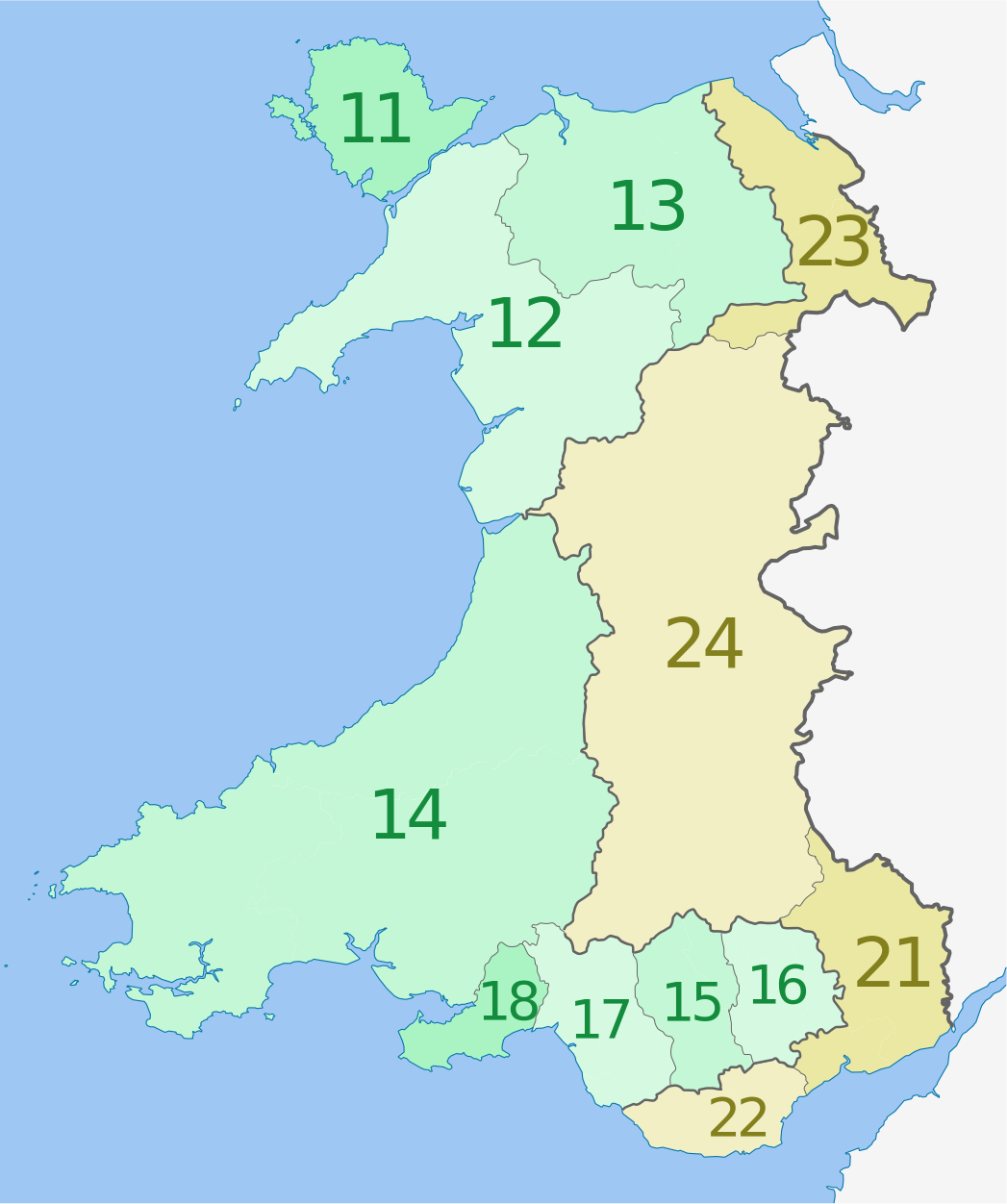
Here's a map of the proposed 12 local authorities, with their populations as listed in the full report :

The headline recommendation for local authority reorganisation
- to be in palce by 2018
(Click to enlarge)
Apart from a merged Gwynedd & Anglesey and a stand-alone Carmarthenshire they would be identical to the EU's NUTS3 areas.

The Commission included a scenario of 11 local authorities – where either Carmarthenshire, Ceredigion and Pembrokeshire merge; or Bridgend, Swansea and NPT. A scenario of 10 local authorities includes both those mergers.

If the headline option of 12 local authorities is implemented, and based on a presumption that a cap of 75 councillors would be in place, the total number of councillors in Wales would fall by 370 to 894 (p320 of the full report).

A few of these proposed local authorities cross fire authority boundaries, especially in the Swansea area (NPT is Mid & West Wales, Bridgend is South Wales). So fire authorities, regional transport consortia and police forces would probably need  moderate reorganisations too.

The inclusion of Carmarthenshire as a stand alone authority seems odd (more from Y Cneifiwr). Pembrokeshire-Carmarthenshire would be a more natural merger - if unpleasant for anyone living in either
Democratic People's Republic - or even the proposed reincarnation of Dyfed.

We can now look forward to the bun fights over where they should be based and what they should be called. That's unless they're going to do something monumentally stupid, like moving council meetings between two or three grand, fully-maintained civic centres in a manner as wasteful as the European Parliament.

Then there's all the other "little problems" to iron out :
  • Council tax and business rate arrangements, plus the formula used to determine the annual settlement. An equalised NPT-Bridgend council tax bill could mean a tax rise for Bridgend residents and a tax cut for NPT residents (p320 of the full report).
  • How much will it cost? The WLGA say £200million, with a potential 15,000 redundancies. The Williams Commission say £100million, with savings of between £60-80million per year afterwards. That's before you add issues relating to pensions and job evaluation.
  • The status of local development plans and housing projections. There's good cause to rip both up as the dynamic would change dramatically.
  • The status of existing joint arrangements and collaboration, like between Bridgend and Vale of Glamorgan for civil parking enforcement, and possibly other things in future.
  • The certain need for another local authority ward boundary review and significant reduction in the number of councillors, plus dealing with the opposition - from within Labour in particular - this will create.
  • Will it actually improve services? We don't have a clue, and won't know until afterwards.

There's no problem with 12 unitary authorities, as I see it, providing there was; a proportional voting system for local elections; a review of council procedures and practices to ensure service delivery is scrutinised properly; and the option of directly-elected mayors to provide more accountable leadership and replace chief executives. We didn't get any of that, so there are issues with these proposals - speaking personally - but they'll have to do.

Also, it'll be politically difficult to get this process completed by 2018.


I doubt every AM will agree on this for a start. It looks like the Welsh Conservatives are leaning towards opposing this if it costs a significant sum of money (notwithstanding the fact they'd never run a Welsh local authority alone again under these boundaries). Plaid Cymru and the Lib Dems are both cautious and lukewarm, while former Swansea Council leader, Mike Hedges AM (Lab, Swansea East), has often spoken against reorganisation. That's before you factor in councillors too. Angry letters from Blaenau Gwent inbound.


The familiar droning chorus of the good ol' Welsh moan at any change to the status quo has already begun, while this will inevitably cause a period of uncertainty for local government employees - precisely what they don't need right now.Meanwhile, getting local authorities to agree on mergers by this Easter seems optimistic, bordering on an attempt to rush things - which would be dangerous. That's unless some of this was agreed informally beforehand and the whole process was used to support a pre-determined conclusion. Nah, that wouldn't happen in Wales, would it?

Wales being Wales, this could get very nasty, very quickly and requires a strong arms at the top. The Local Government Minister, Lesley Griffiths (Lab, Wrexham), better start pumping iron.

Conclusion : Halfway there?

 Should it have gone further? Will it be watered down?
Let the games begin.
(Pic : Wales Online)
I'll admit it. After the initial coverage, I was expecting to go into this finding nothing but a fudge. I'm pleased to say that's not the case.

There are a lot of good proposals in relation to measuring progress, scrutiny and leadership. There's also a comprehensive analysis of the current issues and problems facing Welsh public services. However, it only went halfway to where it should've been.

That's not the Commission's fault. On the contrary, whenever this happens – like Silk I, Holtham and Richards before it, presumably Silk II too - I'm more annoyed that we waste the time and talents of those involved.

The Commission were given a remit that sounded broader than actually it was, and too little time to do a "deep review". This process should've lasted 2-3 years and been Welsh local government's equivalent of the Richard and Holtham Commissions combined.

Subsequently, this barely scratched the surface. Merging local authorities is a slightly lazy conclusion. However, it was the absolute maximum the Commission could realistically propose - minus a wider mandate.

The best single idea to come out of this is the creation of a public sector leadership centre. Possible collaboration between fire and ambulance services, as well as intergration between social services and health, also sound interesting and could have a big impact on service delivery.

However, for all the focus on delivery and management, there's very little in the way of absolute changes. It's more a shopping list of, "It would be really nice if local councils did X,Y,Z" - basically telling councillors, managers, board members, officers etc. to do things they should've been doing in the first place.

In the long-term, these proposals will lead to fewer managers, fewer councillors, fewer chief executives and generate migraines for local government administrators.

All current problems regarding delivery will persist, just in new branding.
We'll settle back into "old ways" as soon as the dust settles, because this review didn't look at what local authorities should do, or what level is appropriate for service delivery, just some aspects of the how.

I'll stick my neck out and predict, firstly, that there'll be a struggle to hit the 2018 "deadline". This Welsh Government are small-c conservatives who don't have the cojones to do anything this drastic (by their standards), and despite the language of determination coming from Cathays Park, might find opposition from within local government too much to handle. We'll need a new generation of ministers and AMs with few ties to local government to push it through.

Next, I predict we'll get a watered-down version – a compromise of 16-18 local authorities - where only the smallest local authorities, or those persistently in special measures, will merge with larger neighbours (Merthyr, Anglesey, Blaenau Gwent etc). We'll still get the inevitable harumphing from councillors and officers in the Welsh press, but it'll keep costs and redundancies to a minimum. We'll lose under 100 councillors, which won't spook the parties too much.

Any compromise will be justified on cost grounds, following successful lobbying from various public bodies, WLGA and the bigger local authorities in the south and west.
We'll still have 900+ public bodies, and we'll return to this again in 15-20 years time, because simple mergers won't solve the complexity problem and won't improve scrutiny.

They correctly saw what the problem was, they formed a committee, they chickened out of making the big calls.

"How Wales works" in a nutshell.