This site is no longer updated

Please use the links in the sidebar to visit the new sites!

Showing posts with label Film. Show all posts

Monday, 16 November 2015

Groundhog Day : Auditing the Welsh Media


(Pic : BBC Wales)
Last week, the Institute of Welsh Affairs (IWA) published a thorough review of the state of the media in Wales....and it makes typically grim reading.

The IWA's online organ, Click on Wales, released drafts of the report's sections throughout October, but the full and final report is now available at around 150 pages long (pdf). It's an incredibly useful analysis, but not anything we haven't heard before.

The state, and decline, of the Welsh media has been discussed on and off for the best part of a decade – such discussions being even more important this year in the context of negotiations on the BBC's Charter renewal. This site's no exception :

As you would expect me to do, I'm going to summarise what the audit found. Overall, it's an incredibly useful analysis, but not anything we haven't heard before.

Television & Public Service Broadcasting (PSB)


  • Digital terrestrial television reach in Wales (97.8%) is marginally below the UK average (98.5%). Virgin Media's cable services only reach 23% of Wales and hasn't changed since 2004, this is well below the UK average of 44%.
  • Wales has the highest proportion of HD-ready televisions and take-up of HD services of the Home Nations (Wales = 76%; UK average = 73%).
  • Made in Cardiff – currently Wales' only local TV station – has a weekly reach of 196,000 viewers.
  • Overall viewing minutes have fallen consistently across the UK – particularly amongst children and the under-35s - but Welsh viewers spend longer watching PSB than any other part of the UK.
  • Over a third of viewers in Wales used "catch-up" services in 2014. BBC iPlayer, Sky, ITV Player and 4OD are the most popular services. Netflix has grown significantly in popularity since 2012. A majority of catch-up services are viewed on television, but increasingly on tablet computers too, while there's a decline in PC/desktop views.
  • BBC Wales, ITV Wales and S4C spent a combined £215.35million on PSB services in 2014-15, a decline of £19.25million (8.2%) on 2008.
  • Since 2008, there've been 545 fewer TV hours produced (all BBC and ITV; S4C saw an increase) and 1,187 fewer hours of radio programming since 2008.
  • BBC and ITV produced 17.5 hours of English language output per week in 2015, compared to 24.5 hours in 1990 – a 48% reduction. ITV Wales now only produces 5.5 hours, compared to 15.5 in 1990.
  • 63% of BBC's English language output was current affairs, news or politics. Just 2.8% was comedy, drama and the arts.
  • S4C's funding fell from £104.4million a year in 2010 to £85.7million in 2014-15 – a reduction of 18.4%. They spend, on average, about £31,000 per hour, though drama productions can cost up to £140,000 per hour.
  • In 2014, 3.2% of PSB network production spend was in Wales, compared to a population share of 4.9%. 65.4% was spent in London and Southern England.
  • BBC Wales and independent producers provided £60.3million worth of UK network shows in 2014-15, primarily dramas.

Radio


  • Average listening hours per week in Wales fell from 24.4 hours in 2007 to 22.4 hours in 2014 – however weekly listening hours are the highest of the Home Nations. Radio also had a bigger reach at 94.5% of the adult population, compared to 89.4% across the UK.
  • Wales has the highest share of BBC Network listeners in the Home Nations at 49% of listeners.
  • Reach figures for BBC Radio Wales and Radio Cymru have shown steady declines, from 435k and 155k respectively in 2008-09 to 418k and 119k respectively in 2014-15.
  • Ownership of digital radios (DAB) is also highest in Wales amongst the Home Nations at 47% (UK = 43%). This brings Wales very close to the 50% threshold set by the UK Government whereby they would consider a digital radio switchover.
  • BBC Radio Wales and Radio Cymru spent a combined £20.6million on programming in 2014/15 and cost per hour was near enough the same for each (£1.5k-1.6k).
  • Commercial radio has the lowest listening share in Wales amongst the Home Nations at 39%, compared to the UK average of 43%. Wales also generated the lowest commercial radio revenues of the Home Nations at £14.9million.
  • Only three companies control commercial stations in Wales – Global Radio, UTV and Town & Country Broadcasting. Digital switchover may mean commercial stations are "released entirely" from their local obligations.

Internet & Broadband


  • 78% of premises in Wales have taken up broadband services, compared to 42% in 2006.
  • 79% of Welsh households have access to super fast broadband – more than Scotland (73%) and Northern Ireland (77%).
  • 3G mobile broadband outdoor services reach 97.9% of Welsh households. However, outdoor 4G services currently only reach 62.8%, compared to the UK average of 89.5%.

Press & Online Media


  • Welsh newspapers have seen massive declines in daily circulations since 2008, ranging from falls of more than 50% for the Western Mail, South Wales Argus and South Wales Echo to just a 6.3% fall for the south Wales version of Metro.
  • These numbers are, generally, in line with declines in newspaper sales elsewhere, with some UK papers suffering even steeper declines.
  • Online there's said to be a "more level playing field" between Trinity Mirror and BBC, with Wales Online and Daily Post websites being competitive with BBC Wales Online services in terms of unique browsers. Use of Wales Online has grown by 586% since 2006.
  • 59% of adults access BBC online services, and online services are significantly more popular amongst those aged 16-24.
  • 27% of people said Facebook was now their main source of local news.
  • BBC Wales spent a total of £2.541million on their online services (£399,000 was spent on Welsh language services/BBC Cymru Fyw).
  • S4C Clic viewing sessions had increased by 232% since 2013-14, with an additional 500,000 downloads of S4C mobile apps.
  • With Trinity Mirror agreeing a takeover of Local World, most of the major national, regional and local newspapers in Wales are owned by just two companies - Trinity Mirror and Newsquest.
  • The number of journalists in south Wales has fallen from over 700 in 1999 to 108 in 2013.
  • There are said to be 46 "hyperlocal" websites active in Wales, and research has suggested around half of hyperlocal site owners in the UK have had some form of journalistic training – though most were self-funded and only 13% generated more than £500 a month income.
  • £1.85million in grants were made available to Welsh language publications in 2013-14, compared to £748,000 for English language publications. 50 papurau bro receive grants of up to £1,900 a year from the Welsh Government.
  • S4C launched a £1million digital fund in 2012 to create interactive media and other apps.

Key Recommendations


  • The Welsh Government should establish an independent media panel to monitor media trends and commission studies, working with relevant academic departments.
  • Investment in BBC Wales' English language services should increase by £30million a year, ideally via an increase in the licence fee. This must include programming other than news and current affairs.
  • S4C's funding and editorial independence must be maintained to avoid slipping into a "cycle of decline". Collaboration between BBC and S4C should be maintained, however.
  • BBC 2 Wales and S4C should be broadcast in high-definition.
  • The effectiveness of DAB coverage should be assessed before any decision is taken on a digital radio switchover.
  • Radio regulation should be devolved to the Welsh Ofcom advisory commission.
  • The abandonment of local radio obligations should be reconsidered.
  • BBC Radio 1 and 2 should provide an opt-out news service for Wales.
  • The UK Government should support BBC establishing an interactive online service for Wales.
  • Responsibility for broadcasting should be shared between the UK Government and devolved administrations.
  • BBC Audience Councils should be replaced with National Broadcasting Trusts, which would help shape the delivery of a national service licence.
  • All PSB broadcasters should lay their annual reports in front of the National Assembly.
  • The Welsh Government and Ofcom should commission a joint study into the future of local media in Wales, embracing community radio, papurau bro, hyper-local news websites and local newspapers.
  • The Welsh Government should create a "challenge fund" administered by the Arts Council for Wales and Wales Books Council to help develop new local news services.


What the audit missed


Magazines - Including (ironically), the IWA's own Agenda, Planet as well as others like Cambria, Barn, Golwg and New Welsh Review. It does mention "publications", particularly with regard papurau bro, but there was little evidence provided on the impact of grant funding cuts on English language magazines or their long-term prospects.

Films & Music - The Welsh film production industry only gets passing mentions, along with music. You would've expected music to have been in there considering recent rows between Radio Cymru and Welsh language musicians. Although this certainly crosses into "the arts", it seems the definition of "media" has been set rather narrowly.

"Citizen Journalism"/The Blogosphere – It's admittedly a grey area, reportedly written off by Culture Minister Ken Skates (Lab, Clwyd South) as "opinion-driven" during the suit-and-sandwich conference because, as we all know, there's little political bias in the mainstream media.

There was a throwaway line about the number of blogs increasing but being "about lifestyle rather than news" - thanks a bunch. I can only speak for myself, and I might get 2% of the South Wales Evening Post's unique browsers on a good day; but I don't know whether being left out is an insult or compliment (sites like Carmarthenshire Planning certainly do count as hyperlocals).

It doesn't really matter because in the absence of public funding, political backing, advertising or publicity it's clear the blogosphere is (relatively) successful and performs a unique function. The Welsh blogosphere's still languishing in the shadows of Scotland's fifth estate; it would take me 20-30 years to match what Wings Over Scotland gets in site metrics in a single year. There's also a high turnover; Green Dragon being the latest political blog to leave the stage. I'm probably not going to be too far behind.

Gaming – The Welsh games industry has grown over the last few years from being practically non-existent to including some breakout companies. It's also one of the most popular mediums around, and as big as, if not bigger, than the film and television industries at present. I'm surprised the IWA and politicians haven't cottoned on to that yet. What do they think people, particularly those under the age of 35, are doing if they're not watching television, listening to the radio or reading newspapers? (See also : More than just a game).

A Warning on Funding


Time for some mathematical gymnastics to serve as a warning on how to interpret the funding figures in the report and how that fits from a "value for money" perspective. The easiest way to do that is to compare the ratio of amount of money spent versus the audience.

Based on the figures provided for BBC's English language web services, for every £1 they spend, they get 85.5 unique browsers. BBC Cymru Fyw gets 11.5 unique browsers for every £1 spent.

For every £1 I spend directly on Oggy Bloggy Ogwr - without a publicly-funded newsroom, television and radio network to back me up and whilst only posting a few times a week - I get 5,272 unique browsers.

Oggy Bloggy Ogwr is, therefore, 62 times greater value for money than BBC Wales Online and 458 times greater value for money than BBC Cymru Fyw. *Jazz hands*


Not bad for opinion-driven non-media. 

Technically speaking, if I put more money into this site its "value for money" would mathematically decrease because the audience is naturally limited and no amount of extra money would change that. Hence that's why complicated political and investigative stories tend to cost a lot of money and get poor returns for broadcasters and publishers, which leads to a downward spiral in coverage.

It also, theoretically, means the "true value" of non-current affairs, non-mainstream television (i.e children's), radio programmes as well as blogs and hyperlocals is likely to be significant in terms of what they bring to the table - perhaps more so than was reflected in the report and in general discussions on the Welsh media.

It's therefore not entirely a funding issue because it doesn't buy you viewers or readers. It's an audience issue and comes down to the quality of the product and how efficiently it's produced.

When you compare what Wales gets from our broadcasters and publishers compared to what the Republic of Ireland gets – utilising similar sums of money and with a similar set up - we're clearly doing something wrong here.


Conclusions


It's an incredibly useful analysis, but not anything we haven't heard before.

Individual AMs have made their own concerns known down the years, but it'll take the closure of one of the major Welsh newspapers – probably The Western Mail – or the subsuming of S4C into BBC Wales to actually force the Welsh Government into action. Calls for challenge funds and independent panels (yet another bloody committee) will fall on deaf ears as ministers can, justifiably, say it's not their problem as broadcasting is a non-devolved issue.

We can never, realistically, expect the UK Government to do anything constructive either; as long as UK-wide network shows continue to be watched or made in Wales, as far as they'll be concerned that's job done. A market failure – and that's essentially what this report implies very strongly – is just something that happens.

So it's worth saying again that it's an incredibly useful analysis, but not anything we haven't heard before.

Television and newspapers will remain important for the time being. However, the only rays of hope for the future, it seems, are online – even though Wales Online is close to becoming a parody of itself, and doesn't generate anything close to the same revenues as Media Wales' print productions – and community radio, which is holding up particularly well and isn't getting the attention it deserves in this debate.

I'm concerned there's too much hand-wringing over Wales being seen at the UK level in network shows when major broadcasters and newspaper publishers can't even harness a captive audience at a Welsh level. The success of Y Gwyll/Hinterland has happened by accident because melodramas about troubled detectives with names like Smegm
ä Smegmässon are in vogue at the moment (to saturation point). That won't last forever, neither will network shows like Casualty and Doctor Who.

Nobody has really explained what they want either. Do they really expect a Welsh political story affecting less than 5% of the UK's population to be given equal treatment to an English one affecting 85% on network news? News bulletins would end up three or four hours long.

There are only two reasons you'll see Wales on the front pages or in the main news bulletins: human tragedy and sport. The murders of April Jones and Tracey Woodford, as well as the Welsh national rugby and football teams, have probably got more coverage and column inches in the UK media than the Welsh Government and Assembly have in 10 years. A BBC network radio news opt-out - recommended in the report - or "Welsh Six" on TV might go some way towards addressing that.

As cynical as it sounds, maybe we just have to come to terms with the fact very little of interest happens in Wales. That's reflected in our politics, our economy and the small-c conservatism that forms the fabric of Welsh society. That's very well represented in our media – including this blog.

So to conclude, the report is an incredibly useful analysis, but not anything we haven't heard before.

Saturday, 26 July 2014

Does Wales make the most of EU opportunities?


It's been a while. There've been many changes. Nick Ramsey has no doubt been stumbling through the Ty Hywel corridors to Every Rose Has Its Thorn.

However, I couldn't resist returning to the rock stars of the Assembly Committee world – Business & Enterprise – and their inquiry report into EU funding opportunities from 2014-2020, which was launched at Cardiff's Chapter Arts Centre last week (pdf).

A lot of this work overlaps with the Constitutional & Legislative Affairs Committee inquiry into the Welsh role in EU decision-making.While that inquiry focused on the political and constitutional situation, this one was more focused on the economic, cultural and financial side of things.

The one thing you can take from both inquiries is the need for a clear strategy on Welsh involvement with the EU. It's a point raised before, but Scotland and the Republic of Ireland have a "more joined up approach" than we do. Meanwhile, concerns that EU funds in Wales have been misused, or Wales being constantly "left off the map", mean a revision of the Welsh Government's EU strategy is long overdue – something Finance Minister Jane Hutt (Lab, Vale of Glamorgan) is considering.

There were 16 recommendations in total, summarised as :
  • Ensuring any future EU strategy (Wales in Europe : What role do we play?) sets clear objectives and maximises Welsh involvement in EU programmes.
  • Developing tailored support; including the creation of an EU Funding Champion, a central contact point for EU funds and specialist support for the youth, transport and education sectors.
  • Addressing gaps in Welsh representation in Brussels (also raised in the Welsh EU role inquiry)
  • Setting clear objectives for Welsh universities to promote both studying abroad and  language courses as well as creating an alumnus of international students.
  • Local Government should develop their own action plans to make best use of EU funds.
  • Champion the Welsh creative sector in Europe, ensuring they're not disadvantaged in applying for EU funding because of the UK's strong TV industry.
  • Develop a closer working relationship with DG Move and TEN-T executives in Brussels - as well as the Irish – to ensure Wales gets the most out of pan-EU transport programmes.

EU Programmes – What are they?


When discussing "EU Programmes" in Wales, you'll automatically think "Objective One" (Structural Funds) or the Common Agricultural Policy (CAP). There are, however, EU schemes that cover other activities and sectors worth up to €42billion. The inquiry focused on how Wales engages with these programmes and what can be done to ensure we get the most out of them.

These programmes include :
  • Erasmus+ (€14.7bn)
  • Connecting Europe/Trans-European Transport Networks (TEN-T) (€15bn)
  • Regional Cooperation (INTERREG) (€8.7bn)
  • Creative Europe (€1.46bn)
  • Competitiveness of Small & Medium Sized Companies (COSME) (€2.03bn)

There's also the Horizon 2020 scheme which covers science and technology, but this wasn't within the inquiry's remit.

Welsh engagement with EU programmes

The EU Commission's Creative Europe programme helped fund Y Gwyll, but there were
concerns that the strength of the UK's media sector may disadvantage Wales.
(Pic : The Guardian)
Although Wales engages with many of these programmes – like INTERREG, Creative Europe and some of the education programmes - a recurring theme is that the high priority and narrow focus given to structural funds (Objective One and CAP) has limited Welsh involvement elsewhere.

There are specialist European officers in local government and higher education – often with a presence in Brussels – but there's nothing similar for the youth, private and voluntary sectors. The benefits from participating in these programmes are potentially huge and such groups may be missing out unnecessarily.

In the Welsh Government's evidence they say some programmes are easier to work with and win funding from than others, so they often had to target their resources carefully. They intend to review how they interact with the EU, but with no set timetable. This led to the Committee supporting previous calls for a full EU Strategy, citing the Irish and Danish governments own successful strategies.

It was said Wales isn't "as switched on" as other countries, with an example given of one academic who was working with the INTERREG programme having no contact whatsoever with the Wales European Funding Office (WEFO). There was also a lack of proper communication with businesses, with calls for a "clear contact point" based outside Wales for foreign companies looking to work with Welsh partners.

There was a specific focus on the creative industries sector, and the EU programme Creative Europe. The EU Commission's media programme "provides support for film productions from pre-production through to distribution, primarily in the form of direct grants to companies and organisations". This scheme provided support towards the production of Y Gwyll/Hinterland.

Media Antenna Wales – part of the Welsh Government's creative industries team – provides support to companies and producers seeking to work with Creative Europe, often helping them negotiate the bureaucracy and form-filling that comes with EU programmes. This level of specialist support was praised and said to be something to emulate in other sectors.

There was, however, a worry that because the UK has a "strong audio-visual industry" overall, Welsh creative companies would be overlooked or disadvantaged when applying for EU funds. Better Together?


International Mobility

Although Wales attracts its fair share of Erasmus funding and
participation, twice as many students are incoming as outgoing.
(Pic : BBC)
Erasmus, now reformed into Erasmus+, is a general exchange programme aimed at all aspects of the university sector. The British Council is in charge of this at a UK level and says Wales is "attracting its share of the budget in relation to population size" (€11million between 2006-07 and 2012-13).

The benefits of participating in Erasmus are said to include : greater employability, improved self-esteem and there was evidence that academic performance improves too. There's also a knock-on impact to universities themselves, as Erasmus can leave a good impression on students studying here and could be adapted to provide a trade boost that runs into the tens of millions of pounds.

One big barrier is that there are twice as many incoming students to Wales as there are outgoing. Lower Welsh take-up rates are said to be down to numerous factors like : language barriers, lack of engagement by academics, lack of awareness, financial problems and lack of confidence. Also, participation was markedly lower from "new universities".

Cardiff University's Prof. Colin Riordan set a target of 17% of graduating students spending some study time abroad by 2017, having set up a £1.6million bursary fund to help achieve it. At the moment the rate is 12%.

Despite his ambition being praised, these levels of participation fall far short of Germany, which has a 50% target. Prof. Riordan said levels of engagement on this matter with the Welsh Government were "low" and that it wasn't afforded a high level of status.

Colegau Cymru suggested the creation of a "one-stop shop" within the Welsh Government for lifelong learning programmes, while Swansea University suggested the Welsh Government could do more to help universities and colleges access EU funding programmes.

There was also confusion over youth volunteering and youth work. The British Council no longer want to work with devolved bodies on this (in Wales' case Connect Cymru), but said that was because they're changing how they're working with them as there was little evidence of the benefits and effectiveness of youth work and youth volunteering programmes.

International Co-operation

A lot of the Welsh participation in INTERREG is wrapped up in the Ireland-Wales programme.
(Pic : EU Commission)
There were 89 INTERREG projects in Wales during the 2007-13 funding period, attracting €41.5million in EU funding. Most of this went towards Irish-Welsh co-operation.

Colegau Cymru said there are specific challenges here, as in order to get funding, projects need to be managed not only across institutions but across borders around the EU. Milford Haven Port Authority also said there hadn't been enough engagement with the private sector.

Local councils say that while they've participated in programmes like INTERREG, much of their focus has been on structural funding (Objective One, European Social Fund) and rural development. They pointed towards the lack of Welsh Government advice and contacts, with Conwy Council adding – in rather parochial terms – that "their only priority is their own local area".

The Committee underlined the lack of a joined-up approach, but also a lack of ambition by local councils, which is "in marked contrast to the further education sector". They called on the WLGA to display leadership.

Trans-European Transport Networks (TEN-T)

Wales - left off an EU map....again.
And the Welsh Government hasn't helped matters either.
(Pic : ITV Wales)
TENT-T is described as a "set of strategically significant road, rail, air, water transport networks" identified by the EU as particularly important to the internal market.

Wales isn't currently on any of the core network corridors, though Business & Economy Minister, Edwina Hart (Lab, Gower) said Welsh experts were sent as part of the UK team when drafting the maps. Milford Haven and the north Wales coast mainline were subsequently added at the request of the UK Government.

Milford Haven Port Authority say there's a significant amount of money that could be available to Wales to develop freight facilities, but too much focus has been on passengers. Holyhead was also excluded from TEN-T as a core port, despite its pretty important role in linking Great Britain to Ireland – though it falls short of Liverpool in terms of tonnage.The Committee say that the negotiating process between Cardiff, London and Brussels was "confused and opaque".

Also, in an astonishing admission, Wales didn't make any applications to, and secured no funding from, the TEN-T programme as of January 2014. Edwina Hart has confirmed, however, that a business case for improvements to the Crewe-Holyhead railway through TEN-T is underway.

The Answer : "Wales could do more"

To repeat myself, there's a clear need for some sort of high level strategy – as much as I loathe such things – and many of the Committee's recommendations make sense. EU programmes also have to be put in a much wider context than structural and agricultural funds as they have important cultural and educational aspects as well.

The lack of proper engagement with TEN-T, however, is a hidden national disgrace and signifies incredible laziness on the part of the Welsh Government. Even a slither of TEN-T funding could've gone a long way towards bringing forward projects like rail electrification or upgrading parts of the A55. I suppose they deserve credit for getting the ball rolling on the north Wales mainline at least.

I suppose in a way this is a complement or follow-up to my 2012 post -"What Wales gets from the European Union".

The answer is, quite clearly, "a lot". If the Welsh Government properly organised itself and started to put the work in the answer would be "even more" - and not just in monetary terms.

Saturday, 8 September 2012

Wales : An Economic Profile III - Services

The Welsh service sector (not including the public sector) is much smaller than the UK as a whole.
What's the Welsh service sector's make up? Where are the Welsh success stories of the future?
(Pic : Webaviation.co.uk)

Financial Services

Wales doesn't have a massive financial/professional service industry that stands shoulder to shoulder with what London, Edinburgh - or even Belfast - have. We all know that. Maybe this is a leading reason as to why Welsh GVA is sluggish. The nature of financial services means billions of pounds churn around every single day, it's a high-value global business and it's incredibly well remunerated.

The (non-public) service sector by percent of GVA (2009)
Wales compared to the UK as a whole
(Click to enlarge)

Financial, professional, real estate and scientific services made up 16.7% of the Welsh economy in 2009 (~£7.45bn), compared to 25.1% for the UK as a whole.

Financial and insurance services made up £2.3billion of that – just 5.2% of the Welsh economy, compared to 10.3% for the UK.

Our largest high street financial service company is Principality Building Society, which is still small by UK standards - roughly the 7th/8th largest building society. Principality is a big player within Wales, with a turnover of £222million in 2011, and assets totalling £6billion. Other major Welsh building societies include Swansea Building Society (assets £183million) and Monmouthshire Building Society (assets ~ £700million), based in Newport.

Principality Building Society are Wales' only significant  "high street"
financial service company, with around £6billion in assets.
(Pic : BBC Wales)

In terms of banking, there are no Welsh high street banks. Julian Hodge Bank, based in Cardiff, is Wales' only commercial bank as far as I know. There was once a "Bank of Wales", also founded by Julian Hodge. It was taken over by Royal Bank of Scotland in 1988, managing to build £460million in assets.

In terms of banking operations in Wales, ING, RBS and Lloyds TSB have significant operations, mostly based in and around Cardiff and Newport. This doesn't include the traditional high street bank branches, which, although being closed in some parts of Wales, are still quite prominent in most town and city centres. GMAC, based in Cardiff, provides wholesale and retail car finance, with a turnover of £122million in 2011, employing more than 300 people.

In Wales, we also, quite excitingly, have a rapidly expanding network of credit unions. Credit unions offer banking services like loans and savings – some even offer current accounts and insurance. The different is that they're owned by members, usually invest in their local communities and are run on a not-for-profit basis. North Wales Credit Union, with centres across the region, are Wales' largest such business, forming from a merger of several smaller credit unions in 2011.

Wales' Top 10 Financial & Professional Service companies (2011)
(Click to enlarge)
Credit Unions (and cooperatives) enjoy a healthy level of political support from the Welsh Government, and most parties - in particular Labour and Plaid Cymru (See also : The Collective Entrepreneur and Leanne's Greenprint for the Valleys).

One of my first blog posts back last year was about insurer Admiral Group, based in Cardiff. They are arguably the crowning business success story in Wales in the last decade. Admiral are Wales' second largest company by turnover (£1.58bn in 2011), and Wales' only FTSE-100 listed company. The company spread out across south Wales down the years to open regional centres in Newport and Swansea, both of which are due for expansion. Admiral are also currently constructing a brand new headquarters in the centre of Cardiff.

Admiral Group have several brand/subsidiaries, including : Elephant.co.uk, Diamond (specialising in women's car insurance), Gladiator (commercial vehicle insurance) and price comparison website Confused.com. They've expanded abroad to run several online car insurance/price comparison services in France, Spain, Italy as well as an IT support company in India.

Admiral Group are the major Welsh success story of the
last decade, but there are other home-grown insurance firms
making a name for themselves.
(Pic : South Wales Evening Post)

Other major insurers that have a Welsh base include Zurich, Black Horse (part of Lloyd Group) and Legal & General.

Although Admiral are the largest, Wales also has several up-and-coming "home-grown" insurers, such as Motaquote, based in Williamstown, Rhondda Cynon Taf, who employ more than 100 people and had a turnover just under £50million in 2009.

Moorhouse, based in Caerphilly, have made numerous appearances on the Fast Growth 50 list in the 00s by specialising in business and professional indemnity insurance. Insurance brokers Thomas Carroll, also headquartered in Caerphilly, employ more than 100 people and recently celebrated their 40th birthday.

Professional Services

The professional service that Wales has probably become most associated with in the last decade or so has been the "customer contact centre". There are probably too many to mention here, but they include contracted operations, like those from shadowy uber-conglomerate, Serco, to established companies like Lloyds TSB and British Gas. Directory enquiries company The Number (118 118) are based in Cardiff, employ more than 350 people and had a turnover of £115.7million in 2011.

It's become a trope for these jobs to be "outsourced to India", but in recent times, we've started to see some of these jobs come back. Indian company, Firstsource, are opening a new call centre in Cardiff Bay. However, despite the First Minister's excitement at announcing it, it appears most jobs will simply be transferring from existing sites in Cardiff.


The recruitment industry in Wales has seen some significant growth and expansion in recent years, and Wales punches above its weight. Acorn Group, based in Newport, part of the French conglomerate, Synergie, train or place up to 8,500 people every year. They had a turnover approaching £100million in 2011. They have branches across the UK, but most of them are based in south Wales and south west England.

24/7 Recruitment, based in Wrexham, were large enough to make the top 10 companies in this section, with a turnover of £73.6million in 2011. Gap Personnel, also based in Wrexham, had a turnover of £60million in 2011, with ambitions of reaching £100million by 2015.

Further down the "food chain", the recruitment industry has a healthy presence amongst professional companies in the Fast Growth 50 list, with several names popping up in recent years. For example, Bridgend-based Smart Solutions topped the list in 2009 (600+% increase in turnover). Cardiff-based Linea Resourcing and Cardiff/Bristol based CPS Group have also appeared, but there does seem to be a trend that recruitment firms only make one appearance in the Fast Growth 50 then disappear.

Training companies have also been a mainstay of the Fast Growth 50. There are obvious reasons for the growth in this niche – a way for the unemployed and employed to attain new skills, with contracts from state agencies as well as private companies. Tydfil Training Consortium have centres throughout south Wales, while Abercynon-based Educ8 provide training for health and social care workers, as well as general training.

Service-related exports (2005-2011)
Basically all the figures that didn't fit  in previous parts.
(Click to enlarge)

In terms of service-related exports, it's generally accepted that Wales is likely to import more of these than export, unlike the other sectors, or it's simply to hard to determine or define.

One other "growth" niche here are price comparison websites. Three of the biggest in the UK – Moneysupermarket.com, Confused.com (part of Admiral Group) and GoCompare.com are based in Wales.

Flintshire-based Moneysupermarket.com are the largest, with a turnover approaching £150million in 2011. Newport-based Gocompare.com, founded by former Admiral emplyoee, Hayley Parsons, has experienced tremendous growth with turnover passing the £100million mark in 2011.

I'm sure Wynne Evans is a decent enough bloke
out of character, and however annoying "Gio Compario" is,
Gocompare.com are one in a line of Welsh
price comparison success stories.
(Pic : Arronchild's Blog)

French insurance group, Covea, are seeking to launch a new price comparison operation near Llantrisant, utilising expertise and former employees that had built up from existing price comparison sites in Wales.

Public relations have also been another growth industry in recent years. Cardiff-based Freshwater have expanded to include offices across the UK.  Public affairs consultancies (aka. "lobbyists") and think-tanks have sprung up since the advent of devolution - trying to link various interested parties/people to the Assembly and the Welsh Government. Positif Politics are probably the most prominent, but there's also Good Relations Wales, Welsh-branches of major lobbyists like the CBI, British Medical Association and Federation of Small Businesses, and more recent introductions like Deryn Consulting. Almost all of them, as you might expect, are based in Cardiff.

Legal services are another, rather overlooked, sector. Most of these are, again unsurprisingly, based in Cardiff – Eversheds, New Law, Capital Law and Hugh James for example.  Hugh James are by some way the largest independent legal firm in Wales, with a turnover of just under £30million in 2011. Personal injury specialists, New Law, have experienced rapid growth, and made the Fast Growth 50 list in 2010 by increasing their turnover by more than 300%. The Welsh Government are actively trying to encourage London law-firms to open back-office functions in Wales.


The possible development of a separate Welsh legal jurisdiction, and the future devolution of criminal justice powers at some point in the future, might provide a boost for this sector in Wales. Any legal work in Wales would need to be carried out by Welsh legal firms who specialise in "Welsh law" – they would also (initially) have the additional advantage of having a full understanding of English law.

Retail

The £650million St Davids 2 development in Cardiff, briefly pushed
the city into the top 10 retail destinations in the UK.
(Pic : UKS Group)

Retail is proportionally as important to the Welsh economy as the UK as a whole, making up 11% (£4.9bn) of GVA in 2009. In the last decade or so, the consumer-led boom resulted in several major retail scheme investments in Wales such as : the £650m+ St Davids 2 development in Cardiff, McArthur Glen Designer Outler in Bridgend, St Catherine's Walk in Carmarthen, Eagle's Meadow in Wrexham and - in future - Friar's Walk in Newport and Talbot Green Town Centre.

At the end of 2010, there were 97,800 people employed in "sale and customer service operations" in Wales, with just under 70% of these being women.

Iceland, based in Flintshire, is Wales' largest company, with a turnover of close to £2.4billion in 2011, employing 22,900 people across the UK. Probably because they specialise solely in frozen food, Iceland only have a 2.1% share of the wider UK grocery market. Also in the grocery sector, Filco Foods, based in Llantwit Major, run several stores across south Welsh Wales as part of the Nisa brand.

UK chains are major employers in some areas, in particular major supermarkets like Tesco. Independent stores are said to have come under increasing strain because of this. The Welsh Government recently carried out a review of non-domestic rates, and one suggestion raised was to create special "business improvement districts" in town centres, which could benefit smaller retailers.

In the convenience sector, Pontyclun-based Capper & Co run/ran the Spar franchise in Wales, and had a turnover of £289million in 2011, employing well over 2,000 people. They were recently taken over by England-based Blackmore Wholesale, in a move that consolidates Spar franchises in England and Wales.

Wales' Top 10 retailers (2011)
(Click to enlarge)

High street fashion retailer Peacocks, based in Cardiff, were saved from liquidation by Edinburgh Woollen Mill earlier this year. Peacocks is another major Welsh retailer, specialising in value-end high street fashion, with a turnover of £526.6million in 2011. Employment numbers will have changed since then though, and Peacocks is a best-case exemplar of the phrase "turnover is vanity, profit is sanity" having built up large debts due to private equity investments. In recent days it's been announced that the fashion chain Jane Norman - also part of the Edinburgh Wollen Mill group - will move its headquarters to Cardiff.

A large chunk of Welsh retail is dominated by major car dealerships – such as Swansea's Day's Motor Group, Mon Motors of Cwmbran and Sinclair's of Port Talbot. Many of these have exclusive/authorised deals with major car brands, and run franchises across Wales. This is in addition include single "car megastores" like Trade Centre Wales and The Car Shop.

One of Wales' fastest growing retail "brands" is children's/maternity fashion retailer JoJo Maman Bébé , based in Newport, which had a turnover pushing £30million in 2011, and employs more than 300 people.

Logistics & Distribution

Arriva Trains Wales are Wales' largest logistics/transport
company, with a turnover of more than £250million in 2011
(Pic : Via Flickr)
Wales has, perhaps unfairly, been seen as somewhere you pass through on the way between England and Ireland. However, there are several significant Welsh haulage companies, such as Owen's Road Services, based in Llanelli are probably the largest independent haulage firm. They have depots across Wales and England, and more than 200 vehicles, with a turnover of more than £32million in mid-2011.

There are several other independent haulage firms, too many to mention, as well as major distribution centres for international logistics companies. Internet retailer, Amazon, has a major distribution centre in Swansea, which opened in 2008 and employs around 1,000 people, though many of these jobs are likely to be seasonal/Christmas rush. German grocery retailers, Lidl and Aldi, have major regional distribution centres in Bridgend and Cardiff respectively.

Arriva Trains Wales, based in Cardiff but with maintenance centres/depots around Wales, operate the all-Wales passenger rail franchise, and some services in the Welsh Marches. Sunderland-based Arriva were taken over by Deutche Bahn in 2010. They employ around 2,000 people, and posted a turnover of £258.6million in 2011, making them the largest transport company in Wales. Arriva Trains Wales receive around £170million annually from the Welsh Government to run the rail franchise.

First Great Western run intercity services between Swansea and London, and have a major train maintenance depot in Swansea, which is due to be upgraded with rail electrification. Freightliner have a major inter modal rail freight terminal in Cardiff.

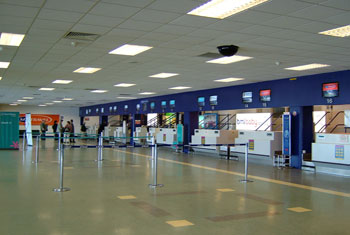
Cardiff Airport is Wales' only airport scheduled offering scheduled international and internal flights. The airport is owned and operated by Catalan company, Abertis. Concerns have been raised following the failure to attract a low-cost airline, competition from Bristol Airport, the withdrawal of several airlines and a major decline in passenger numbers - from 1.9 million in 2004, to just 1.2million in 2011.

Recently, the airport operated at a half-year loss due to another significant fall in passenger numbers, with the airport on course to serve fewer than 1million passengers in 2012. The Welsh Government have set up a Airport Taskforce to look at the issues, but is this too little, too late?

Catalan-owned Cardiff Airport has come under heavy
criticism recently, due to rapidly falling passenger numbers.
(Pic : Holidayextras.co.uk)

There are no Welsh airlines (a peculiarity in the UK - even the Isle of Man has an airline), despite previous attempts at creating and sustaining them. Cambrian Airways were incorporated into British Airways in the 1970s, while Air Wales operated scheduled services between Cardiff and several destinations between 2000 and 2006. There have been rumours that a Welsh-based low-cost airline, "Flyforbeans", would base itself out of Cardiff Airport, but information has been scant and the project - for now - appears to be dead.

In terms of ports, as mentioned in Part II, Milford Haven is the UK's fourth largest port in terms of tonnage handled. The Port of Port Talbot is capable of handling ships of up to 170,000 metric tonnes, and for obvious reasons is a major port for ores. The Port of Cardiff handles around 2million tonnes annually – a far cry from its heyday during the "coal era". The Port of Newport handles around 1.5million tonnes of metals, recycling and general cargo every year. Other smaller commercial ports (in terms of tonnage) include Barry and Swansea.

Holyhead, Fishguard (and until recently, Swansea) are key ferry terminals between the Republic of Ireland and Wales. The Port of Holyhead alone handles around 2million passengers per year.

Transportation and storage made up 4% of the Welsh economy in 2009, less than the UK as a whole (5%), worth around £1.78billion.

Tourism, Leisure & Hospitality

There were 33million visitor trips to Wales
from the rest of the UK in 2010
(Pic : Meetup.com)
Accommodation and food services made up 3.3% (£1.5billion) of Welsh GVA in 2011, a higher proportion than the UK as a whole (2.9%). Recreation and leisure exports were worth £96million. The Welsh Tourism Alliance quotes a report by Oxford Economics, that tourism directly supported 86,000 jobs in Wales, and indirectly supported up to 172,000 jobs.

Visit Wales are the Welsh Government arm responsible for tourism promotion, running a network of up to 80 full and part-time tourist information centres across the country.
In 2010, there were 33million UK domestic tourist trips to Wales, with visitors spending £1.45billion. In addition, the same year, there were 890,000 visitors from outside the UK - with most of them (647,000) coming from Europe and 116,000 from North America.

By hosting the 2010 Ryder Cup, it's believed that Celtic Manor resort generated up to £42million in golf-related tourism, and a total of £82.4million in "economic impact" for Wales. The Welsh Government has its own "major events" strategy, which includes an ambition to bid to host the Commonwealth Games at some point in the future.

Oakwood, based in Pembrokeshire, is Wales' largest theme park, and attracts around 400,000 visitors per year between March and November. The £60million Bluestone holiday village, located nearby, is made up of around 300 holiday chalets, hosting around 65,000 guests in 2011, with a further expansion being mooted.

It's been estimated that Swansea City's promotion
to the English Premier League is worth around £30million
to the city's economy.
(Pic : BBC)

Sport and leisure have other economic benefits. The Welsh Rugby Union, by itself, had a turnover of £54.2million in 2011, and it's been estimated that the Grand Slam match in March 2012 attracted 250,000 people and boosted the Cardiff economy by up to £10million. It's been estimated that the Scarlets, based in Llanelli, will be worth £32million annually to the local economy by 2016, while Swansea City's promotion to the English Premier League in 2011, was estimated to be worth between £30-40million to the city. In terms of more traditional leisure, Bingo hall chain Castle Leisure, had a turnover of over £20million in 2011, and employ more than 500 people.

SA Brains is Wales' largest hospitality business, with a turnover of just under £100million in 2011, employing 1,907 people across it's chain of pubs and restaurants. The company has also recently launched a high-street coffee chain "Coffee #1", which intends to expand to 30 outlets by 2015.

If there's one weakness in the hospitality industry in Wales, it's so-called haute cuisine. Despite having fine produce on land and at sea (Part I), and seeing increases in food exports to mainland Europe and beyond, there are only four Michelin Star restaurants in Wales – two in Monmouthshire, one in Powys and one in Denbighshire - and none in Cardiff. Edinburgh alone has 5.

However, in some good news, 81 Welsh restaurants made the coveted Good Food Guide 2012, and there were a record number of new entries.

Media & Creative Industries


Creative Industries have been highlighted the Economic Renewal Plan as a special/growth sector. The Welsh Government and regeneration specialists, Igloo, are currently developing a new creative industries "hub" at Porth Teigr in Cardiff Bay, which is now home to a new BBC drama studio. Broadcasting and media regulation are not devolved to the Welsh Assembly.

There are three major television broadcasters based in Wales. BBC Wales, based mostly in Cardiff, with satellite studios elsewhere, who provide public service radio and television programmes as part of the UK-wide BBC. In addition to this, they employ the National Orchestra of Wales. In recent years, they've become a centre of excellence for drama, producing major UK network shows like Dr Who, Torchwood and Casualty. They employ around 1,000 people directly, and are rumoured to be looking to build a new headquarters somewhere in Cardiff in the next few years.

Welsh language broadcasting commissioning body, S4C, are will be funded (from 2013) by a combination of the licence fee and direct grants from the UK Government. As S4C are a commissioning body, they only employ around 150 people directly. Most of their productions are made independent television companies (as well as statutory obligations by the likes of the BBC and ITV Wales). A report for the UK Government in 2010, suggested that S4C supports around 2,100 jobs.

Despite derisory comments about "zero viewers",
many S4C-commissioned children's programmes - like
Meees - have been picked up by larger markets.
(Pic : S4C)

S4C have produced marketable children's programming in particular, such as Superted, Fireman Sam, Meees and Sali Mali. 1992 biopic Hedd Wyn - distributed by S4C - was nominated for Best Foreign Language film at the Academy Awards.

Independent television producer, ITV Wales, are based just outside Cardiff. Though technically there's only a single "ITV", ITV Wales (formerly HTV) provide national opt-out programming. This includes national news, as well as public service programmes like The Ferret, Sharp End and Wales this Week.

Tinopolis, based in Llanelli, are Wales' largest (independent) media company, with a turnover of £71.3million in 2011. They produce countless hours of television, and cover live events - for numerous broadcasters - with several subsidiaries as part of the Tinopolis Group.

AIM-listed Boomerang+ (now Boom Pictures), a TV production company also based in Cardiff, is a regular feature in the Fast Growth 50 list, and had a turnover of £21.5million in 2011.

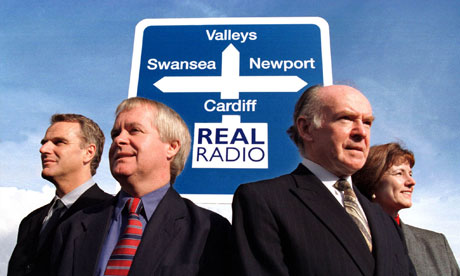
Real Radio have become another Welsh media company
absorbed into a larger one with a decrease in
distinctively "Welsh" output as a result - even sports coverage.
(Pic : The Guardian)


There are several Welsh commercial radio stations, both national and local, and of all shapes and sizes. Real Radio – arguably the largest independent radio group based in Wales - were recently taken over by Global Radio, after owners Guardian Media sold their radio businesses. Town & Country Broadcasting, based in Cardiff, run a network of local radio stations across Wales. UTV Radio operate The Wave and Swansea Sound in the Swansea, Neath Port Talbot and Carmarthenshire areas.

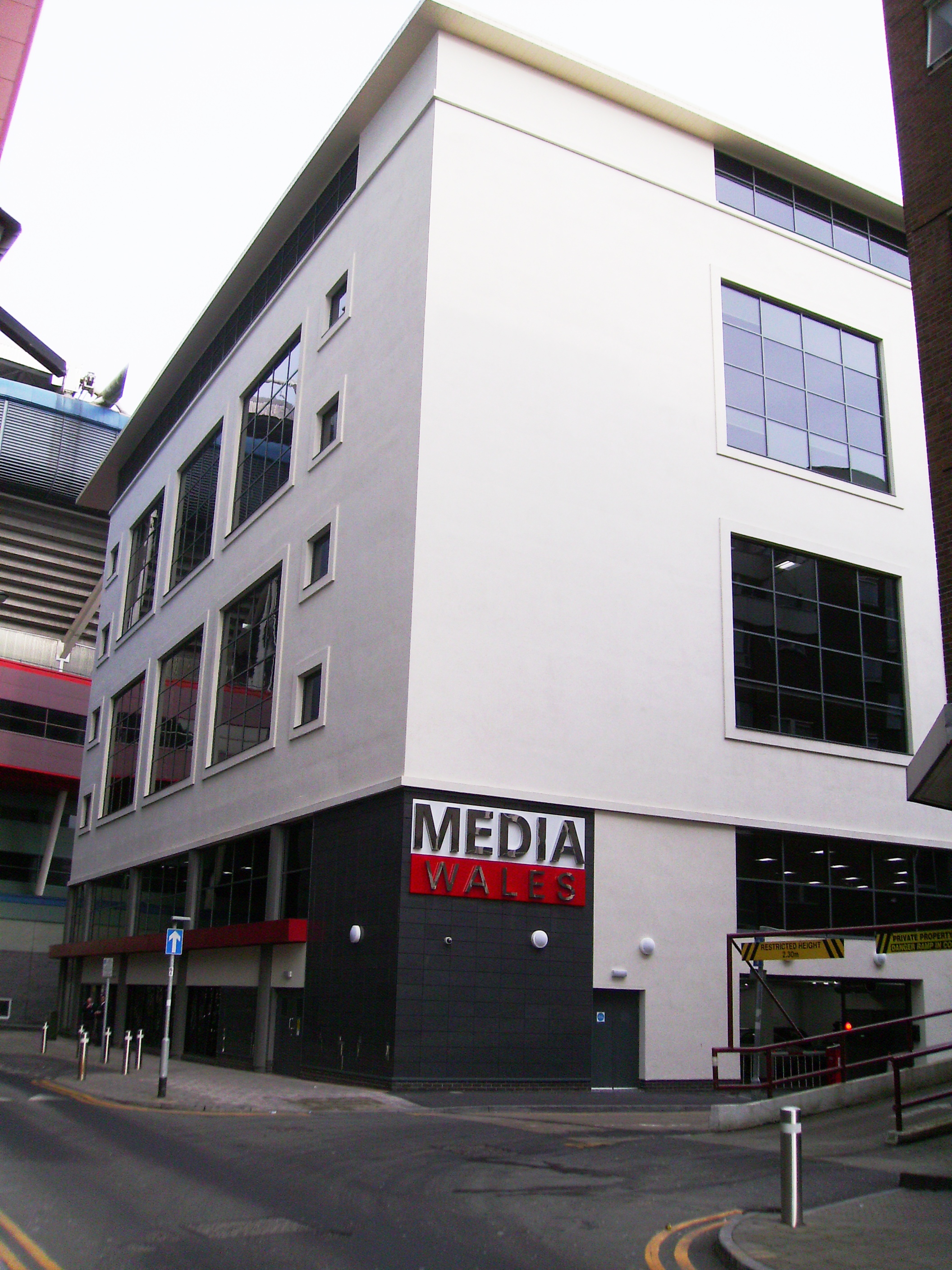
The circulation of local and national newspapers in Wales has been in a persistent decline, however traditional journalism still makes an impact on the Welsh economy. Media Wales - whose larger publicatrions include The Western Mail, Wales on Sunday and South Wales Echo - are the pre-eminent newspaper publisher in Wales, with a turnover of £32.3million in 2011. However, the company have seen turnover and the number of employees fall, despite posting pre-tax profits of £5.81million. Media Wales are part of the Trinity Mirror group, based in London. The Daily Post, sold in north Wales, is produced by Liverpool-based Trinity Mirror subsidiary Post & Echo.

South West Wales Publications, based in Swansea and part of Northcliffe Media, produce several local and regional newspapers in the Swansea region, including The South Wales Evening Post, which is Wales' best selling "Welsh" newspaper in terms of circulation.

Major studios have used Wales as a location, but despite
developing creative industry skills,  the Welsh film, and
gaming, industries are practically non-existant.
(Pic : The Film Review)

Wales has been used as a filming location for major studios in the last few years (Ironclad at Llanilid, and Robin Hood in Pembrokeshire), but the Welsh film industry borders in inconsequential, employing around 200 people. This could change in the future with investment in things like the University of Glamorgan's Atrium campus in Cardiff.

Big companies like Tinopolis aside, the creative industries sector is growing, but is still very, very small. It's been estimated that there are as many as 600 creative sector companies in Wales, employing up to 13,000 people, and a combined turnover of £350million. However, only 50 people are estimated to be working in computer games, while the vast bulk are employed in facilities, television, interactive media, photography and publishing.

There is an issue here about media ownership (more, in relation to the Real Radio issue above, by Marc Webber) and the direction of the Welsh creative industries - especially the domestic media. Media guides and shapes public opinion of various things, including sport, politics and culture. This isn't an independence issue really, but about having a media that reflects Welsh life, not something a company based far away decides we want to hear.

Lady Justice is sometimes portrayed as blindfolded, representing
objectivity. However, are we all blindfolded by simply not having
the media capacity to properly scrutinise Welsh politics?
(Pic : Via fotothing)

Most Welsh people read newspapers that barely cover Welsh issues. They probably listen to radio stations that are part of faceless conglomerates, focused on expansion and balance sheets instead of providing a good national service in Wales. And they also probably prefer Hollyoaks to Wales Today - nothing you can do about that really, people have a choice.

The Welsh public probably hear more about Michael Gove than Leighton Andrews, despite the former having very little influence on Welsh education. I doubt many people outside of the Rhondda, anoraksphere or the Bay Bubble know who Leighton Andrews is, what he does, or what he proposes to do.

I don't want to drag politics into an economic piece, but we really need to get a grip on this or we have a serious problem. How can we hold local councils and the Assembly to account properly if we don't hear about them? How can there be the prospect of tax powers - for example - if the public at large don't know what's on the table?

Part IV, which will be posted on Tuesday, will look at the public sector, public spending and a glance at the role universities play in the Welsh economy.

Tuesday, 15 May 2012

Future of the Welsh media report

The Assembly's inquiry into the future has reported back -
with some interesting suggestions.
(Pic : Wikipedia)

It's a point raised time and time again – does Wales have the media necessary to hold our civic institutions to account?

With pressure being exerted on Welsh media outlets - for various reasons - it's vital that the perceivable decline is halted and turned around. No media. No accountability. No democracy.

The cross-party Task & Finish Group on the "future outlook for the media in Wales" reported back last week.

There were 23 recommendations, summarised as:
  • The establishment of an independent media forum, drawing on expertise from across the sector, to advise on all matters relating to the Welsh media. The devolution of broadcasting should be "kept under review". The forum should also consider alternative business models for the Welsh print media.
  • The Welsh Government should fully engage with the UK Government on matters such as the Communications Bill and non-devolved broadcasting issues - including introducing specific Welsh-language duties to Ofcom and laws relating to intellectual property rights.
  • The Welsh Government should make representations to the UK Government regarding the Channel 3 (ITV) licence, with the existing requirements to be kept as an absolute minimum for any company to be awarded the licence. The introduction of a Wales-specific Channel 3 licence should be considered.
  • The Assembly should keep the amount of political coverage provided by BBC Wales, and the funding arrangements for S4C, under review.
  • The Welsh Government should ensure, via the UK Government, that there is 97% digital radio coverage in Wales before any switchover, and they should continue to support community radio stations.
  • The Welsh Government should work with universities to foster innovation, define a purpose for the Creative Industries Sector panel and continue to implement the recommendations of the Hargreaves Review (about gaps in the creative industries sector).

Many of the responses to the group reveal interesting nuggets of information and ideas, including :
  • Issues surrounding the "fragmentation of audiences" with innovations like Smart TV
  • Broadcasting hasn't kept pace with the realities of devolution
  • The lack of accountability with regard the media in Wales
  • The negative impact of budget cuts at the BBC and changes to the running of S4C

Print Media

A lot of the publicity around this report surrounded the future of the print media. The National Union of Journalists (NUJ) were pessimistic, saying Welsh newspapers were "fighting for survival". There were a wide range of views from publishers, some suggesting reading habits have simply changed, while others trumpet weekly local newspapers as the future. Cymdeithas yr Iaith continue to call for a daily Welsh-language newspaper.

There were concerns expressed that newspapers have been far too optimistic when chasing online revenues, so consumers have now come to expect "free media".

Bloggers - sorry, "citizen journalists" - get a nod. We're "inadequate", and will never have the ability to "replace professional public interest journalism." I agree with that. Hobbies never trump something you get paid to do.

Golwg360 say that they aim to try and "combine professionalism with citizen journalism" and provide a "multi-media platform". That would be fantastic for the Welsh-language media, but we really need a counterpart (or several counterparts) in English.

The NUJ suggests that newspapers be considered "public assets" to which the Welsh Government can step in to rescue when threatened with closure. Bethan Jenkins AM (Plaid, South Wales West) suggested something similar on Wales Home, which prompted my last piece on this. Something I suggested then – a public subsidy for the press based on the Norwegian model – is given short shrift by the Minister for Housing, Regeneration and Heritage, Huw Lewis (Lab, Merthyr Tydfil & Rhymney), who says it would be a "difficult arena to become involved with." However, he doesn't rule it out, saying it could be "possible in the future."

Cuts, Broadcasting & Devolution

Could a Wales-specific "regional" ITV
licence be making a comeback?
(Pic: TV Ark)

On budget cuts, Huw expressed his concerns that the BBC's local services in Wales are under a "potentially disproportionate threat" in the broadcaster's "Delivering Quality First" initiative. More interestingly, he doesn't believe that the development of a media hub in Porth Teigr is "justification" for this reduction in investment.

There were particular concerns raised about S4C, Huw Lewis calling for a joint Welsh-UK independent review into the channel (not an entirely unwarranted suggestion), but remaining sceptical of "local TV", saying that it "detracts from what should be the centre of our concerns (national coverage)."


On accountability, many witnesses believed that it was important that public service broadcasters reported to the Assembly (it's suggested annually).

The recommendation of "keeping the devolution of broadcasting under review" is something of a cop-out. The NUJ expressed tacit support, Prof. Tom O'Malley (Media Studies, Aberystwyth University) called for the devolution of "a large part" to the Welsh Government, Prof. Ian Hargreaves (Digital Economy, Cardiff University) talked of a "federal opportunity" to reflect the "fact of devolved governments". Tinopolis' Ron Jones said that "meaningful and expressive scrutiny is best achieved at a local level". In his oral evidence, however, he said that devolution of broadcasting was, "not going to be politically deliverable" but that the current arrangements could be modified over several years in a way that "works for you (Assembly)".

Huw Lewis remained coy on the prospect of the devolution of broadcasting, giving a rather verbose deflection, tying the issue up in knots with typical Labour finesse without directly saying that he didn't want the powers (page 19 of the report) – Who? What? Where? Why? When? Johnny Ball reveals all.

A lot of what Huw Lewis said or suggested became recommendations in the report. For example, it was his suggestion that there needed to be 97% digital radio coverage before any switchover, and that the current minimum provisions in the Channel 3 licence should remain as a condition for licence renewal.

The suggestion of a Wales-specific ITV licence is interesting. It happens in Scotland and Northern Ireland (STV and UTV respectively), it's long overdue in Wales. Could the old HTV be making a comeback in the long term?

Creative Industries and the Economy

Could Porth Teigr in Cardiff compete with Media City UK?
(Pic : Porthteigr.org)
Wider economic issues are also addressed in the report, mainly referencing what the previous Welsh Government did regarding creative industries. Ieuan Wyn Jones (Plaid, Ynys Mon) established a Digital Wales Advisory Board, a Creative Industries Sector Panel (as part of the Economic Renewal Plan) and a Creative Industries Team to take this work forward. All this was largely in response to Prof. Ian Hargreaves report (linked above in the summary of the recommendations) which identified gaps in Welsh creative industries.

Many witnesses are described as being "concerned with the progress made by the Welsh Government". Cube Interactive said that the "pace of change has been slow by private sector standards." The lack of support for the Welsh film industry is also highlighted, with calls for an independent production fund. The current Business Minister, Edwina Hart (Lab, Gower) highlighted several of her own priorities for the creative industries in Wales, largely ensuring there was "bang for buck" from investment.

Edwina also said that the Welsh Government's high-speed broadband scheme was at the procurement stage, but that it should ensure 30Mb across Wales instead of "being sidetracked....into an immediate need for 100Mb."


The Institute of Welsh Affairs and Huw Lewis seemed excited by the possibility of a single "media hub" at Porth Teigr in Cardiff Bay, suggesting that it needs to be more than just "bricks and mortar" and needs to become a "critical mass" comparable to Media City UK in Manchester. There were reservations from Ron Jones, implying that media companies shouldn't be forced to base themselves in a single place because the government tells them to.


Conclusions

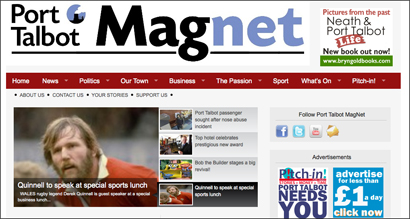
Co-operatives like Port Talbot Magnet prove
that alternative models of media ownership are viable.
(Pic : blogs.journalism.co.uk)
This is a pretty extensive, detailed and highly readable report. I recommend that if you want more expansion on my own summary, and other bits I haven't covered, then you should read it yourselves to make up your own mind.

Most of the recommendations are positive. The Assembly is now taking the issues and problems affecting the Welsh media much more seriously than any of us probably expected them to. There's broad agreement that "something needs to be done" and many of the witnesses - in particular Golwg360 and the Port Talbot Magnet - have shown that alternative models of media ownership are completely viable.

What I hope though, is that the Assembly and Welsh Government don't consider this report as "job done".


A lot of it comes down to money. Huw Lewis said himself that Wales is likely to be "disproportionately" affected by cuts to BBC local services. If anything, that should be a motivator for the devolution of broadcasting in the medium term. But as I said, the committee seemed reluctant to come out and say it, preferring instead to "keep it under review".

We also have to remember that "creative industries" and the "media" encompasses much more than TV, radio and newspapers. It includes films, gaming (which I've blogged about before), music/music production, advertising, general web design and classics such as magazines and literature. Those areas probably should have been included in more detail within the scope of the report.

The Welsh are a relatively creative people, but sadly we've always looked eastwards for vehicles of delivery, or to seek justification or approval. That doesn't mean that there needs to be a drawbridge mentality when it comes to the Welsh media. I think what we want most of all is to be noticed. It's a pretty damning indictment that nobody from the "British" print press - by which most Welsh people get their news - seems to have been called, or responded, to the committee.

Until the realities of devolution are acknowledged at the UK level, I don't think we'll ever get the kind of coverage we need to hold the Assembly, or other civic institutions, to account. Therefore, like many other things, we're probably going to have to do this one ourselves. That's better than waiting forever and a day for validation from the London Bubble, but it brings its own set of problems and issues that need addressing before we can think about devolving broadcasting or separate Channel 3 licences.

This report could - in the medium to long term - form the foundations for a Welsh broadcasting and media policy, but as always it comes down to will, incentives and innovation – both political and economic.