Here's my second summarised round-up of some of the Assembly's committee inquiries over the last few months, including: domestic violence, the National Infrastructure Committee, the state of broadcasting, statutory advocacy services for vulnerable children and implementation of the new National Curriculum.
This site is no longer updated
Please use the links in the sidebar to visit the new sites!
Showing posts with label ITV. Show all posts
Wednesday, 8 February 2017
Committees Bite Size #2: February 2017
By OwenWednesday, February 08, 2017BBC, Care, COM, CULT, Curriculum, EDU, EIS, Fiscal Policy, INQBrief, ITV, Local Gov, Radio, S4C, Welsh Law, WGCom, WGEd, WIss, YPeopView Comments
Here's my second summarised round-up of some of the Assembly's committee inquiries over the last few months, including: domestic violence, the National Infrastructure Committee, the state of broadcasting, statutory advocacy services for vulnerable children and implementation of the new National Curriculum.
Tuesday, 12 January 2016
EU Referendum : The IWA Debate
By OwenTuesday, January 12, 20164FirstMin, Borders, EU, Farming, Foreign Affairs, InOutRef, ITV, IWA, Labour, Nationalism, Northern Ireland, Norway, Regs, SteelSOS, Switzerland, Trade, UKIP, Unionism, Universities, Welsh PressView Comments
We still don't know when the referendum will be held on the UK's membership of the European Union but, to much fanfare, the first Welsh debate was hosted last night in Cardiff by the Institute of Welsh Affairs (IWA) and Cardiff University, with the First Minister lining up against UKIP leader, Nigel Farage MEP.
Monday, 16 November 2015
Groundhog Day : Auditing the Welsh Media
By OwenMonday, November 16, 20154WGCulTor, 4White Papers, BBC, Blogosphere, BT, BudgetUK, DCMS, Film, Gaming, Iaith Gymraeg, Internet, ITV, IWA, Radio, S4C, UK Press, Welsh PressView Comments
![]() |
(Pic : BBC Wales) |
The IWA's online organ, Click on Wales, released drafts of the report's sections throughout October, but the full and final report is now available at around 150 pages long (pdf). It's an incredibly useful analysis, but not anything we haven't heard before.
The state, and decline, of the Welsh media has been discussed on and off for the best part of a decade – such discussions being even more important this year in the context of negotiations on the BBC's Charter renewal. This site's no exception :
- Saving the Welsh press (29.11.11)
- Future of the Welsh media report (15.5.12)
- More questions on the future of the Welsh press (4.2.13)
- Broadcasting Wales Parts I-VIII (September 2013)
- The Assembly & The Democratic Deficit (12.11.13)
- How Local is "Local TV"? (18.1.14)
- Senedd on the Box (2.10.14)
- Strapped 4 Cash? (27.6.15)
- Downloading (22% - 2 years left)....(8.7.15)
- You Won't Believe What Happens Next....(14.9.15)
Television & Public Service Broadcasting (PSB)
![]() |
- Digital terrestrial television reach in Wales (97.8%) is marginally below the UK average (98.5%). Virgin Media's cable services only reach 23% of Wales and hasn't changed since 2004, this is well below the UK average of 44%.
- Wales has the highest proportion of HD-ready televisions and take-up of HD services of the Home Nations (Wales = 76%; UK average = 73%).
- Made in Cardiff – currently Wales' only local TV station – has a weekly reach of 196,000 viewers.
- Overall viewing minutes have fallen consistently across the UK – particularly amongst children and the under-35s - but Welsh viewers spend longer watching PSB than any other part of the UK.
- Over a third of viewers in Wales used "catch-up" services in 2014. BBC iPlayer, Sky, ITV Player and 4OD are the most popular services. Netflix has grown significantly in popularity since 2012. A majority of catch-up services are viewed on television, but increasingly on tablet computers too, while there's a decline in PC/desktop views.
- BBC Wales, ITV Wales and S4C spent a combined £215.35million on PSB services in 2014-15, a decline of £19.25million (8.2%) on 2008.
- Since 2008, there've been 545 fewer TV hours produced (all BBC and ITV; S4C saw an increase) and 1,187 fewer hours of radio programming since 2008.
- BBC and ITV produced 17.5 hours of English language output per week in 2015, compared to 24.5 hours in 1990 – a 48% reduction. ITV Wales now only produces 5.5 hours, compared to 15.5 in 1990.
- 63% of BBC's English language output was current affairs, news or politics. Just 2.8% was comedy, drama and the arts.
- S4C's funding fell from £104.4million a year in 2010 to £85.7million in 2014-15 – a reduction of 18.4%. They spend, on average, about £31,000 per hour, though drama productions can cost up to £140,000 per hour.
- In 2014, 3.2% of PSB network production spend was in Wales, compared to a population share of 4.9%. 65.4% was spent in London and Southern England.
- BBC Wales and independent producers provided £60.3million worth of UK network shows in 2014-15, primarily dramas.
- Average listening hours per week in Wales fell from 24.4 hours in 2007 to 22.4 hours in 2014 – however weekly listening hours are the highest of the Home Nations. Radio also had a bigger reach at 94.5% of the adult population, compared to 89.4% across the UK.
- Wales has the highest share of BBC Network listeners in the Home Nations at 49% of listeners.
- Reach figures for BBC Radio Wales and Radio Cymru have shown steady declines, from 435k and 155k respectively in 2008-09 to 418k and 119k respectively in 2014-15.
- Ownership of digital radios (DAB) is also highest in Wales amongst the Home Nations at 47% (UK = 43%). This brings Wales very close to the 50% threshold set by the UK Government whereby they would consider a digital radio switchover.
- BBC Radio Wales and Radio Cymru spent a combined £20.6million on programming in 2014/15 and cost per hour was near enough the same for each (£1.5k-1.6k).
- Commercial radio has the lowest listening share in Wales amongst the Home Nations at 39%, compared to the UK average of 43%. Wales also generated the lowest commercial radio revenues of the Home Nations at £14.9million.
- Only three companies control commercial stations in Wales – Global Radio, UTV and Town & Country Broadcasting. Digital switchover may mean commercial stations are "released entirely" from their local obligations.
- 78% of premises in Wales have taken up broadband services, compared to 42% in 2006.
- 79% of Welsh households have access to super fast broadband – more than Scotland (73%) and Northern Ireland (77%).
- 3G mobile broadband outdoor services reach 97.9% of Welsh households. However, outdoor 4G services currently only reach 62.8%, compared to the UK average of 89.5%.
- Welsh newspapers have seen massive declines in daily circulations since 2008, ranging from falls of more than 50% for the Western Mail, South Wales Argus and South Wales Echo to just a 6.3% fall for the south Wales version of Metro.
- These numbers are, generally, in line with declines in newspaper sales elsewhere, with some UK papers suffering even steeper declines.
- Online there's said to be a "more level playing field" between Trinity Mirror and BBC, with Wales Online and Daily Post websites being competitive with BBC Wales Online services in terms of unique browsers. Use of Wales Online has grown by 586% since 2006.
- 59% of adults access BBC online services, and online services are significantly more popular amongst those aged 16-24.
- 27% of people said Facebook was now their main source of local news.
- BBC Wales spent a total of £2.541million on their online services (£399,000 was spent on Welsh language services/BBC Cymru Fyw).
- S4C Clic viewing sessions had increased by 232% since 2013-14, with an additional 500,000 downloads of S4C mobile apps.
- With Trinity Mirror agreeing a takeover of Local World, most of the major national, regional and local newspapers in Wales are owned by just two companies - Trinity Mirror and Newsquest.
- The number of journalists in south Wales has fallen from over 700 in 1999 to 108 in 2013.
- There are said to be 46 "hyperlocal" websites active in Wales, and research has suggested around half of hyperlocal site owners in the UK have had some form of journalistic training – though most were self-funded and only 13% generated more than £500 a month income.
- £1.85million in grants were made available to Welsh language publications in 2013-14, compared to £748,000 for English language publications. 50 papurau bro receive grants of up to £1,900 a year from the Welsh Government.
- S4C launched a £1million digital fund in 2012 to create interactive media and other apps.
- The Welsh Government should establish an independent media panel to monitor media trends and commission studies, working with relevant academic departments.
- Investment in BBC Wales' English language services should increase by £30million a year, ideally via an increase in the licence fee. This must include programming other than news and current affairs.
- S4C's funding and editorial independence must be maintained to avoid slipping into a "cycle of decline". Collaboration between BBC and S4C should be maintained, however.
- BBC 2 Wales and S4C should be broadcast in high-definition.
- The effectiveness of DAB coverage should be assessed before any decision is taken on a digital radio switchover.
- Radio regulation should be devolved to the Welsh Ofcom advisory commission.
- The abandonment of local radio obligations should be reconsidered.
- BBC Radio 1 and 2 should provide an opt-out news service for Wales.
- The UK Government should support BBC establishing an interactive online service for Wales.
- Responsibility for broadcasting should be shared between the UK Government and devolved administrations.
- BBC Audience Councils should be replaced with National Broadcasting Trusts, which would help shape the delivery of a national service licence.
- All PSB broadcasters should lay their annual reports in front of the National Assembly.
- The Welsh Government and Ofcom should commission a joint study into the future of local media in Wales, embracing community radio, papurau bro, hyper-local news websites and local newspapers.
- The Welsh Government should create a "challenge fund" administered by the Arts Council for Wales and Wales Books Council to help develop new local news services.
What the audit missed
![]() |
Magazines - Including (ironically), the IWA's own Agenda, Planet as well as others like Cambria, Barn, Golwg and New Welsh Review. It does mention "publications", particularly with regard papurau bro, but there was little evidence provided on the impact of grant funding cuts on English language magazines or their long-term prospects.
Films & Music - The Welsh film production industry only gets passing mentions, along with music. You would've expected music to have been in there considering recent rows between Radio Cymru and Welsh language musicians. Although this certainly crosses into "the arts", it seems the definition of "media" has been set rather narrowly.
"Citizen Journalism"/The Blogosphere – It's admittedly a grey area, reportedly written off by Culture Minister Ken Skates (Lab, Clwyd South) as "opinion-driven" during the suit-and-sandwich conference because, as we all know, there's little political bias in the mainstream media.
There was a throwaway line about the number of blogs increasing but being "about lifestyle rather than news" - thanks a bunch. I can only speak for myself, and I might get 2% of the South Wales Evening Post's unique browsers on a good day; but I don't know whether being left out is an insult or compliment (sites like Carmarthenshire Planning certainly do count as hyperlocals).
It doesn't really matter because in the absence of public funding, political backing, advertising or publicity it's clear the blogosphere is (relatively) successful and performs a unique function. The Welsh blogosphere's still languishing in the shadows of Scotland's fifth estate; it would take me 20-30 years to match what Wings Over Scotland gets in site metrics in a single year. There's also a high turnover;
Gaming – The Welsh games industry has grown over the last few years from being practically non-existent to including some breakout companies. It's also one of the most popular mediums around, and as big as, if not bigger, than the film and television industries at present. I'm surprised the IWA and politicians haven't cottoned on to that yet. What do they think people, particularly those under the age of 35, are doing if they're not watching television, listening to the radio or reading newspapers? (See also : More than just a game).
A Warning on Funding
![]() |
Time for some mathematical gymnastics to serve as a warning on how to interpret the funding figures in the report and how that fits from a "value for money" perspective. The easiest way to do that is to compare the ratio of amount of money spent versus the audience.
Based on the figures provided for BBC's English language web services, for every £1 they spend, they get 85.5 unique browsers. BBC Cymru Fyw gets 11.5 unique browsers for every £1 spent.
For every £1 I spend directly on Oggy Bloggy Ogwr - without a publicly-funded newsroom, television and radio network to back me up and whilst only posting a few times a week - I get 5,272 unique browsers.
Oggy Bloggy Ogwr is, therefore, 62 times greater value for money than BBC Wales Online and 458 times greater value for money than BBC Cymru Fyw. *Jazz hands*
Not bad for opinion-driven non-media.
Technically speaking, if I put more money into this site its "value for money" would mathematically decrease because the audience is naturally limited and no amount of extra money would change that. Hence that's why complicated political and investigative stories tend to cost a lot of money and get poor returns for broadcasters and publishers, which leads to a downward spiral in coverage.
It also, theoretically, means the "true value" of non-current affairs, non-mainstream television (i.e children's), radio programmes as well as blogs and hyperlocals is likely to be significant in terms of what they bring to the table - perhaps more so than was reflected in the report and in general discussions on the Welsh media.
It's therefore not entirely a funding issue because it doesn't buy you viewers or readers. It's an audience issue and comes down to the quality of the product and how efficiently it's produced.
When you compare what Wales gets from our broadcasters and publishers compared to what the Republic of Ireland gets – utilising similar sums of money and with a similar set up - we're clearly doing something wrong here.
Conclusions
![]() |
It's an incredibly useful analysis, but not anything we haven't heard before.
Individual AMs have made their own concerns known down the years, but it'll take the closure of one of the major Welsh newspapers – probably The Western Mail – or the subsuming of S4C into BBC Wales to actually force the Welsh Government into action. Calls for challenge funds and independent panels (yet another bloody committee) will fall on deaf ears as ministers can, justifiably, say it's not their problem as broadcasting is a non-devolved issue.
We can never, realistically, expect the UK Government to do anything constructive either; as long as UK-wide network shows continue to be watched or made in Wales, as far as they'll be concerned that's job done. A market failure – and that's essentially what this report implies very strongly – is just something that happens.
So it's worth saying again that it's an incredibly useful analysis, but not anything we haven't heard before.
Television and newspapers will remain important for the time being. However, the only rays of hope for the future, it seems, are online – even though Wales Online is close to becoming a parody of itself, and doesn't generate anything close to the same revenues as Media Wales' print productions – and community radio, which is holding up particularly well and isn't getting the attention it deserves in this debate.
I'm concerned there's too much hand-wringing over Wales being seen at the UK level in network shows when major broadcasters and newspaper publishers can't even harness a captive audience at a Welsh level. The success of Y Gwyll/Hinterland has happened by accident because melodramas about troubled detectives with names like Smegmä Smegmässon are in vogue at the moment (to saturation point). That won't last forever, neither will network shows like Casualty and Doctor Who.
Nobody has really explained what they want either. Do they really expect a Welsh political story affecting less than 5% of the UK's population to be given equal treatment to an English one affecting 85% on network news? News bulletins would end up three or four hours long.
There are only two reasons you'll see Wales on the front pages or in the main news bulletins: human tragedy and sport. The murders of April Jones and Tracey Woodford, as well as the Welsh national rugby and football teams, have probably got more coverage and column inches in the UK media than the Welsh Government and Assembly have in 10 years. A BBC network radio news opt-out - recommended in the report - or "Welsh Six" on TV might go some way towards addressing that.
As cynical as it sounds, maybe we just have to come to terms with the fact very little of interest happens in Wales. That's reflected in our politics, our economy and the small-c conservatism that forms the fabric of Welsh society. That's very well represented in our media – including this blog.
So to conclude, the report is an incredibly useful analysis, but not anything we haven't heard before.
Thursday, 23 April 2015
Westminster 2015 : The ITV Wales Debate
By OwenThursday, April 23, 2015Borders, Cons, Election 2015, EmpSk, EU, Fiscal Policy, Greens, Hospitals, InOutRef, ITV, Labour, Lib Dems, Medicine, Plaid, Poverty, Powers, UKIP, Welfare, WIssView Comments
![]() |
| (Pic : ITV Wales) |
Another week, another debate; this time from ITV Wales, hosted by Sharp End's Adrian Masters in Cardiff. For some reason it's not available online (though I watched it online), so you'll just have to take my word for it, although the ITV Wales website has a running commentary on what was said on their website.
Friday, 3 April 2015
Westminster 2015 : The ITV Leaders Debate
By OwenFriday, April 03, 2015Borders, Cons, Election 2015, EmpSk, England, EU, Fiscal Policy, Greens, Housing, InOutRef, ITV, Labour, Lib Dems, Medicine, MHealth, Plaid, Scotland, SNP, UKIP, UniversitiesView Comments
![]() |
| The big debate has been held, and here's a run down of how the leaders did. (Pic : ITV) |
I'll only count this and the BBC opposition debate on on 16th April as "debates" because they're....actual debates. I'm not going to count the Question Time and Daily Politics specials or the interviews. I don't know if there are Wales-only debates planned over the next few weeks (as 2010), but if there are I'll cover them too.
Tuesday, 15 May 2012
Future of the Welsh media report
By OwenTuesday, May 15, 20124Assembly, 4CELG, 4INQ, 4WGCulTor, Blogosphere, Cardiff, DCMS, EmpSk, Film, Iaith Gymraeg, Internet, ITV, Radio, S4C9 comments
| The Assembly's inquiry into the future has reported back - with some interesting suggestions. (Pic : Wikipedia) |
It's a point raised
time and time again – does Wales have the media necessary to hold
our civic institutions to account?
With pressure being exerted on Welsh media outlets - for various reasons - it's vital that the perceivable decline is halted and turned around. No media. No accountability. No democracy.
The cross-party Task & Finish Group on the "future outlook for the media in Wales" reported back last week.
There were 23 recommendations, summarised as:
With pressure being exerted on Welsh media outlets - for various reasons - it's vital that the perceivable decline is halted and turned around. No media. No accountability. No democracy.
The cross-party Task & Finish Group on the "future outlook for the media in Wales" reported back last week.
There were 23 recommendations, summarised as:
- The establishment of an independent media forum, drawing on expertise from across the sector, to advise on all matters relating to the Welsh media. The devolution of broadcasting should be "kept under review". The forum should also consider alternative business models for the Welsh print media.
- The Welsh Government should fully engage with the UK Government on matters such as the Communications Bill and non-devolved broadcasting issues - including introducing specific Welsh-language duties to Ofcom and laws relating to intellectual property rights.
- The Welsh Government should make representations to the UK Government regarding the Channel 3 (ITV) licence, with the existing requirements to be kept as an absolute minimum for any company to be awarded the licence. The introduction of a Wales-specific Channel 3 licence should be considered.
- The Assembly should keep the amount of political coverage provided by BBC Wales, and the funding arrangements for S4C, under review.
- The Welsh Government should ensure, via the UK Government, that there is 97% digital radio coverage in Wales before any switchover, and they should continue to support community radio stations.
- The Welsh Government should work with universities to foster innovation, define a purpose for the Creative Industries Sector panel and continue to implement the recommendations of the Hargreaves Review (about gaps in the creative industries sector).
Many of the responses to the group reveal interesting nuggets of information and ideas, including :
- Issues surrounding the "fragmentation of audiences" with innovations like Smart TV
- Broadcasting hasn't kept pace with the realities of devolution
- The lack of accountability with regard the media in Wales
- The negative impact of budget cuts at the BBC and changes to the running of S4C
Print Media
A lot of the publicity around this report surrounded the future of the print media. The National Union of Journalists (NUJ) were pessimistic, saying Welsh newspapers were "fighting for survival". There were a wide range of views from publishers, some suggesting reading habits have simply changed, while others trumpet weekly local newspapers as the future. Cymdeithas yr Iaith continue to call for a daily Welsh-language newspaper.
There were concerns expressed that newspapers have been far too optimistic when chasing online revenues, so consumers have now come to expect "free media".
Bloggers - sorry, "citizen journalists" - get a nod. We're "inadequate", and will never have the ability to "replace professional public interest journalism." I agree with that. Hobbies never trump something you get paid to do.
Golwg360 say that they aim to try and "combine professionalism with citizen journalism" and provide a "multi-media platform". That would be fantastic for the Welsh-language media, but we really need a counterpart (or several counterparts) in English.
The NUJ suggests that newspapers be considered "public assets" to which the Welsh Government can step in to rescue when threatened with closure. Bethan Jenkins AM (Plaid, South Wales West) suggested something similar on Wales Home, which prompted my last piece on this. Something I suggested then – a public subsidy for the press based on the Norwegian model – is given short shrift by the Minister for Housing, Regeneration and Heritage, Huw Lewis (Lab, Merthyr Tydfil & Rhymney), who says it would be a "difficult arena to become involved with." However, he doesn't rule it out, saying it could be "possible in the future."
Cuts, Broadcasting & Devolution
| Could a Wales-specific "regional" ITV licence be making a comeback? (Pic: TV Ark) |
On budget cuts, Huw expressed his concerns that the BBC's local services in Wales are under a "potentially disproportionate threat" in the broadcaster's "Delivering Quality First" initiative. More interestingly, he doesn't believe that the development of a media hub in Porth Teigr is "justification" for this reduction in investment.
There were particular concerns raised about S4C, Huw Lewis calling for a joint Welsh-UK independent review into the channel (not an entirely unwarranted suggestion), but remaining sceptical of "local TV", saying that it "detracts from what should be the centre of our concerns (national coverage)."
On accountability, many witnesses believed that it was important that public service broadcasters reported to the Assembly (it's suggested annually).
The recommendation of "keeping the devolution of broadcasting under review" is something of a cop-out. The NUJ expressed tacit support, Prof. Tom O'Malley (Media Studies, Aberystwyth University) called for the devolution of "a large part" to the Welsh Government, Prof. Ian Hargreaves (Digital Economy, Cardiff University) talked of a "federal opportunity" to reflect the "fact of devolved governments". Tinopolis' Ron Jones said that "meaningful and expressive scrutiny is best achieved at a local level". In his oral evidence, however, he said that devolution of broadcasting was, "not going to be politically deliverable" but that the current arrangements could be modified over several years in a way that "works for you (Assembly)".
Huw Lewis remained coy on the prospect of the devolution of broadcasting, giving a rather verbose deflection, tying the issue up in knots with typical Labour finesse without directly saying that he didn't want the powers (page 19 of the report) – Who? What? Where? Why? When? Johnny Ball reveals all.
A lot of what Huw Lewis said or suggested became recommendations in the report. For example, it was his suggestion that there needed to be 97% digital radio coverage before any switchover, and that the current minimum provisions in the Channel 3 licence should remain as a condition for licence renewal.
The suggestion of a Wales-specific ITV licence is interesting. It happens in Scotland and Northern Ireland (STV and UTV respectively), it's long overdue in Wales. Could the old HTV be making a comeback in the long term?
Creative Industries and the Economy
| Could Porth Teigr in Cardiff compete with Media City UK? (Pic : Porthteigr.org) |
Many witnesses are described as being "concerned with the progress made by the Welsh Government". Cube Interactive said that the "pace of change has been slow by private sector standards." The lack of support for the Welsh film industry is also highlighted, with calls for an independent production fund. The current Business Minister, Edwina Hart (Lab, Gower) highlighted several of her own priorities for the creative industries in Wales, largely ensuring there was "bang for buck" from investment.
Edwina also said that the Welsh Government's high-speed broadband scheme was at the procurement stage, but that it should ensure 30Mb across Wales instead of "being sidetracked....into an immediate need for 100Mb."
The Institute of Welsh Affairs and Huw Lewis seemed excited by the possibility of a single "media hub" at Porth Teigr in Cardiff Bay, suggesting that it needs to be more than just "bricks and mortar" and needs to become a "critical mass" comparable to Media City UK in Manchester. There were reservations from Ron Jones, implying that media companies shouldn't be forced to base themselves in a single place because the government tells them to.
Conclusions
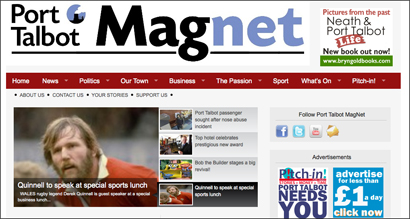
| Co-operatives like Port Talbot Magnet prove that alternative models of media ownership are viable. (Pic : blogs.journalism.co.uk) |
Most of the recommendations are positive. The Assembly is now taking the issues and problems affecting the Welsh media much more seriously than any of us probably expected them to. There's broad agreement that "something needs to be done" and many of the witnesses - in particular Golwg360 and the Port Talbot Magnet - have shown that alternative models of media ownership are completely viable.
What I hope though, is that the Assembly and Welsh Government don't consider this report as "job done".
A lot of it comes down to money. Huw Lewis said himself that Wales is likely to be "disproportionately" affected by cuts to BBC local services. If anything, that should be a motivator for the devolution of broadcasting in the medium term. But as I said, the committee seemed reluctant to come out and say it, preferring instead to "keep it under review".
We also have to remember that "creative industries" and the "media" encompasses much more than TV, radio and newspapers. It includes films, gaming (which I've blogged about before), music/music production, advertising, general web design and classics such as magazines and literature. Those areas probably should have been included in more detail within the scope of the report.
The Welsh are a relatively creative people, but sadly we've always looked eastwards for vehicles of delivery, or to seek justification or approval. That doesn't mean that there needs to be a drawbridge mentality when it comes to the Welsh media. I think what we want most of all is to be noticed. It's a pretty damning indictment that nobody from the "British" print press - by which most Welsh people get their news - seems to have been called, or responded, to the committee.
Until the realities of devolution are acknowledged at the UK level, I don't think we'll ever get the kind of coverage we need to hold the Assembly, or other civic institutions, to account. Therefore, like many other things, we're probably going to have to do this one ourselves. That's better than waiting forever and a day for validation from the London Bubble, but it brings its own set of problems and issues that need addressing before we can think about devolving broadcasting or separate Channel 3 licences.
This report could - in the medium to long term - form the foundations for a Welsh broadcasting and media policy, but as always it comes down to will, incentives and innovation – both political and economic.
Thursday, 23 June 2011
UK Government puts Charley to sleep
By OwenThursday, June 23, 2011BBC, Film, Fire, ITV, PUBH, Roads, Society, Whitehall, YPeopView Comments
![]() |
| Mwrarawrwrararww "Charley says his P45 is in the post" |
The Central Office of Information (COI) is to close next year, with the loss of up to 400 jobs.
In the grand scheme of things, I guess such a move can be expected as it's low-hanging fruit for spending cuts. But believe it or not, this brings to close a long relationship between government and the public. A relationship that most of us don't know is there but certainly remember.
What I'm referring to of course, are public information films.
"Nanny state" to some. Life savers to others.
How many lives have been saved by Charley the cat's "advice" down the years? Or the Green Cross Code man? Perhaps Donald Pleasance's most important career role was to warn children to stay away from stagnant bodies of water.
Modern public information films are a far more polished, expensive and audience-savvy exercise and I doubt they will disappear all together. However, in a climate where attacking the "big state" is a popular thing to do - and sometimes the right thing - we should remember that even though it's not very glamorous sounding, the COI might've helped us all at some point.
Whether it's taking extra care with chip pans, or making sure you don't accidentally on purpose get hit by a train. It was comforting to know that the state actually cared enough about you to warn you of these things - even if it came across as incessant nagging.
I don't think anyone will believe me when I say we owe the COI a debt of gratitude, but younger versions of ourselves probably do.
In the grand scheme of things, I guess such a move can be expected as it's low-hanging fruit for spending cuts. But believe it or not, this brings to close a long relationship between government and the public. A relationship that most of us don't know is there but certainly remember.
What I'm referring to of course, are public information films.
"Nanny state" to some. Life savers to others.
How many lives have been saved by Charley the cat's "advice" down the years? Or the Green Cross Code man? Perhaps Donald Pleasance's most important career role was to warn children to stay away from stagnant bodies of water.
Modern public information films are a far more polished, expensive and audience-savvy exercise and I doubt they will disappear all together. However, in a climate where attacking the "big state" is a popular thing to do - and sometimes the right thing - we should remember that even though it's not very glamorous sounding, the COI might've helped us all at some point.
Whether it's taking extra care with chip pans, or making sure you don't accidentally on purpose get hit by a train. It was comforting to know that the state actually cared enough about you to warn you of these things - even if it came across as incessant nagging.
I don't think anyone will believe me when I say we owe the COI a debt of gratitude, but younger versions of ourselves probably do.
Wednesday, 27 April 2011
Election 2011 : The ITV Leaders Debate
Firstly I'd like to praise ITV Wales's coverage of this election. It's been good overall, and it's pleasing that a commercial operation has put effort into it. I also think Jonathan Hill did a fine job as host last night, and was quick to point out if something was devolved or not as well as asking one or two awkward rebound questions.
Please don't take this as an endorsement of the Welsh media as a whole, they try their best but we should still look quite jealously at Scotland in this regard.
First and foremost, it was a very impressive performance by Ieuan Wyn Jones. He showed an aggression and passion that he isn't exactly known for. Someone's been at the Relentless! However, this isn't a "Clegg Moment" in the election campaign overall, for obvious reasons. Despite an annoying tendency to waffle off-topic, and almost being caught out once or twice, it was a very assured performance and one both he and Plaid can be pleased with. I just hope he realises he may have shown his cards too soon for next week's BBC debate. 8/10
A typically eye-catching Kirsty Williams did a good job for the Lib Dems. Is she trying a bit too hard to be on the audience's side though? It seemed a little contrived and cheesy. That doesn't mean she wasn't effective. She can dish out as good as she gets, and caused an awkward moment or two for both IWJ and Carwyn Jones. If she can ditch the prim and proper school girl manners; like raising her hand before speaking, pulling faces as though she's going to "scweem and scweem until I can scweem no more" and went on the offensive more often, she would give off an aura of gravitas and leadership. At the moment it's far too obvious she's in opposition. 7/10
Carwyn Jones was ever affable. However, I think he trod a lot of the same ground as IWJ in his answers - at times both gave near enough exactly the same answer! Sadly for Carwyn, IWJ was more effective. It's the same stuff from Labour about Tory-cuts, and once again I don't think we heard enough Labour policy. He defended Labour's record well, and gave decent enough answers, but what he lacks in these debates is a bit of passion. He's far too laid back. Labour may well walk the election, but their leader at least should appear as though there's something to fight for. 6.5/10
Poor Nick Bourne had the short straw. I don't think he (or Carwyn Jones) expected IWJ to be so aggressive - and it showed - at least initially, in Nick's body language. He seemed very apologetic for his UK colleagues, and spent far too long defending them than promoting the Welsh Conservatives' cause. He did come back into it towards the end and stood up to IWJ's more robust approach. Once again the Conservatives go on the "talk Wales down" road, I wish they would be positive about their own policies and Wales just once. I don't think they are (the much trotted out phrase) "anti-Welsh" but their dour commentary borders on self-loathing. 6/10
Please don't take this as an endorsement of the Welsh media as a whole, they try their best but we should still look quite jealously at Scotland in this regard.
First and foremost, it was a very impressive performance by Ieuan Wyn Jones. He showed an aggression and passion that he isn't exactly known for. Someone's been at the Relentless! However, this isn't a "Clegg Moment" in the election campaign overall, for obvious reasons. Despite an annoying tendency to waffle off-topic, and almost being caught out once or twice, it was a very assured performance and one both he and Plaid can be pleased with. I just hope he realises he may have shown his cards too soon for next week's BBC debate. 8/10
A typically eye-catching Kirsty Williams did a good job for the Lib Dems. Is she trying a bit too hard to be on the audience's side though? It seemed a little contrived and cheesy. That doesn't mean she wasn't effective. She can dish out as good as she gets, and caused an awkward moment or two for both IWJ and Carwyn Jones. If she can ditch the prim and proper school girl manners; like raising her hand before speaking, pulling faces as though she's going to "scweem and scweem until I can scweem no more" and went on the offensive more often, she would give off an aura of gravitas and leadership. At the moment it's far too obvious she's in opposition. 7/10
Carwyn Jones was ever affable. However, I think he trod a lot of the same ground as IWJ in his answers - at times both gave near enough exactly the same answer! Sadly for Carwyn, IWJ was more effective. It's the same stuff from Labour about Tory-cuts, and once again I don't think we heard enough Labour policy. He defended Labour's record well, and gave decent enough answers, but what he lacks in these debates is a bit of passion. He's far too laid back. Labour may well walk the election, but their leader at least should appear as though there's something to fight for. 6.5/10
Poor Nick Bourne had the short straw. I don't think he (or Carwyn Jones) expected IWJ to be so aggressive - and it showed - at least initially, in Nick's body language. He seemed very apologetic for his UK colleagues, and spent far too long defending them than promoting the Welsh Conservatives' cause. He did come back into it towards the end and stood up to IWJ's more robust approach. Once again the Conservatives go on the "talk Wales down" road, I wish they would be positive about their own policies and Wales just once. I don't think they are (the much trotted out phrase) "anti-Welsh" but their dour commentary borders on self-loathing. 6/10