This site is no longer updated

Please use the links in the sidebar to visit the new sites!

Showing posts with label Hungary. Show all posts

Thursday, 8 December 2016

Senedd busts a gut

(Pic : oeko-travel.org)

We're all living longer, but that doesn't necessarily mean we're any healthier. We also all know that obesity and lack of regular exercise are two of the most significant public health crises facing Wales.

There's no single root cause and no single solution. The one thing that can be said is that – like many public health issues – it comes down to changing behaviour.

There was a members debate in October on the benefits of walking and cycling (Senedd rallies to get Wales moving). This is a sequel, but with greater emphasis on the public health impacts of sedentary lifestyles.

The motion called for the Assembly to note that:
  • Obesity continue to rise and is more prevalent amongst poorer communities.
  • Changing eating habits is difficult and down to the availability and affordability of good food as well as general cooking skills.
  • The Active Travel Act 2013 is yet to make an impact on levels of walking and cycling.
  • Declines in smoking have come about through education and government action. A combination of education, legislation and public procurement changes are needed to address the growing public health problem.


Jenny Rathbone AM (Lab, Cardiff Central) started off with the stark statistic that one quarter of Welsh adults are obese and 60% overweight (clip). The consequences are serious, like diabetes, cardiovascular disease and cancers. Also, the difference in life expectancy between rich and poor is 9-to-11 years, most of which is "completely avoidable".

Less than a third of adults eat five or more portions of fruit and vegetables a day, while just 1% of food advertising promotes vegetables. Despite schemes like Appetite for Life, Wales has amongst the worst child obesity rates in the UK. Three measures Jenny highlighted that could bring about change include: restrictions on marketing (which is non-devolved), promoting healthy eating in schools and using taxes to change behaviour.

Jenny cited a scheme in Flintshire where children order school meals at registration. This eliminates waste by letting caterers know exactly how much to prepare, with seasonal products promoted – no other local authority has followed Flintshire's lead.

Around the world, France has introduced a tax on sugary drinks, Finland and Mexico have put taxes on sweets, sugary drinks and similar things like ice cream. In Hungary, they apply a public health tax to certain products, with consumers subsequently choosing cheaper or healthier alternatives and food manufactures reformulating their products to avoid taxation.

Plaid Cymru health spokesperson, Rhun ap Iorwerth AM (Plaid, Ynys Môn), said it was no overstatement that obesity is one of greatest health challenges of our age, but the tide isn't turning in the same way as smoking and alcohol where young people are now less likely to take them up (clip). Childhood obesity is worse now than it was a few years ago, and Rhun was saddened Anglesey has one of worst levels of childhood obesity, with a third of 5 year olds overweight or obese.

Tackling obesity needs the same commitment and resources as tackling smoking. Heavy taxation and advertising bans cut smoking rates, but tackling obesity makes that look easy. That's because the health impacts of obesity are not automatically understood as there's no single source, and foods only become harmful when over-consumed. There's no level of support to the obese similar to that provided for smokers, while governments still make decisions that contribute to unhealthy lifestyles like car-centric town and city planning.

Vikki Howells AM (Lab, Cynon Valley) highlighted issues in disadvantaged areas. 63% of adults in Rhondda Cynon Taf were either overweight or obese, and obesity is expected to cost the Welsh NHS £465million and the wider economy £2.4billion by 2050 (clip). Also, only 1 in 3 children meet physical activity guidelines (see also - Fat of the Land : More work needed on childhood obesity). Policies like free swimming promote exercise, while Change4Life promotes health eating in schools. Cwm Taf health board are also providing obese pregnant women with specialist ante-natal services to prevent weight gain during and after pregnancy.

Vikki was disappointed the UK Government watered down proposals on sugar and unhealthy food advertising, particularly as unhealthy food remains cheap and accessible. Welsh children also suffer from a "nature deficit disorder" where they have weaker attachment to the outdoors than children elsewhere in the UK; dealing with this can encourage them to take more exercise.

Dai Lloyd AM (Plaid, South Wales West) believed it was important not to just talk about this but get to grips with it (clip). As a doctor he's dealt with problems stemming from obesity, seeing the solution as combination of healthy eating, stricter portion sizes and increasing breast-feeding (see also: Life, Ethics & Independence XI : Breastfeeding) to give babies a good start in life - research shows it decreases obesity.

Nobody has to go to extremes on personal fitness, it's as simple as walking as much as possible; this "natural fitness" can't be replicated by prescription medicines. Dai talked up legislative measures, which have successfully reduced smoking and can change the way society thinks about an issue.

John Griffiths AM (Lab, Newport East) said it's also important to have strong local examples in what can be done to meet the challenges so good practice is spread out (clip). Newport holds "physical activity summits" with key partners. He also praised a local Park Run scheme, where hundreds of people take part every week, with agreement to hold a second meeting. John hoped physical literacy will be driven forward in schools to embed good habits in young people that stay with them for life (see also: Should PE be a compulsory subject?).

Gareth Bennett AM (UKIP, South Wales Central) said levels of walking and cycling haven't shown much improvement since the Active Travel Act, with an actual decline in walking to school (clip). He asked whether the Welsh Government could offer financial incentives to encourage walking to school and outdoor activities? They could also support leisure centres, who through outsourcing may increase prices and entrance fees. He criticised the lack of targets to boost active travel in the Future Generations Act, and questioned how cyclists and walking will be integrated into the South Wales Metro.

Long distance cycle paths -  welcome though they are - do little
to encourage "everyday" physical activity.
(Pic : Visit Wales)

Julie Morgan AM (Lab, Cardiff North) was proud of the Active Travel Act, but it has to be used at every opportunity (clip). A message needs to go out that people can help develop safe walking and cycling routes that are useful to them. However, health habits need to start young – whether breast-feeding or ante-natal support – and Sustrans are targeting young mothers and mothers-to-be, as there's evidence that if parents walk or cycle, their children will too.

Julie also focused on poverty. For both boys and girls aged 2-15, there's a greater prevalence of obesity in lower-income groups. Nutrient-dense foods are more expensive and lower-income consumers have lower protein, iron, oily fish and vitamin intake.


Lee Waters AM (Lab, Llanelli) endorsed John Griffith's praise for Park Run, being enthused by the support of volunteers – many of whom wouldn't do any exercise if the scheme didn't exist, making the £6,000 investment in getting Park Runs off the ground a "no-brainer" (clip).

The Active Travel Act "shouldn't be a tick-box exercise", but is a huge opportunity to get people who take little or no exercise to do some as part of their everyday routine; leisure centres and gyms are ineffective with such groups. Most car journeys are under 1 mile and these journeys need to be done by foot or by bike.

He said AMs had a cognitive dissonance in saying they want to do something on public health, but being inconsistent in how they apply it. He cited support for free parking in town centres as, despite AMs wanting to increase active travel, the policy encourages car travel. He also had guarded criticism for Carmarthenshire Council for focusing development of long-distance cycling/walking routes for tourists at the expense of utilitarian point-to-point urban routes in Llanelli.

Minister for Public Health & Social Services, Rebecca Evans (Lab, Gower), said that while the Welsh Government were doing more to create the circumstances for people to make healthy choices they can't do it alone (clip).

The Change4Life programme will be complemented by Public Health Wales training health staff to offer brief, helpful advice on lifestyle changes. At a UK level, we need restrictions on advertising of high fat, sugar and salt foods – particularly to children. She supports the UK's sugary drinks levy but would like to see progress, citing the voluntary salt reduction with food producers scheme, which has resulted in salt levels falling by 50% since 2012. Procurement criteria will factor in nutrition – something already being done in the NHS and set to expand across the public sector.

In terms of active travel, there's a commitment to work with schools to develop walk-to-school schemes and fund cycling and walking training. Local authorities are also currently working on their integrated active travel maps under the Act.

Over 80% of the adults are non-smokers for the first time since records began, and this has been achieved through preventing uptake amongst the young and helping people quit. The recently-introduced Public Health Bill includes "strong" measures on smoking, while there's a target to reduce the percentage of the population who smoke population to 16% by 2020.

In summing up, Conservative health spokesperson, Angela Burns AM (Con, Carms. W. & S. Pembs.), said the Minister could do one thing today without a grand strategy (clip): increase the amount of time dedicated to sport in schools (which has consistently declined over the decade) and be more creative in defining "physical activity" – girls may be more body conscious and dislike team sports, for example.

It was also all well and good taking part in Park Runs or going to a gym surrounded by "Lycra-clad bunnies" – but the large group of people who are overweight need to feel less embarrassed and out of place when attempts are made to "bring them in", as their body image may put them off exercise in the first place.

The motion was unanimously approved.

Guts up!

It was always going to be difficult to cover so many points in a limited amount
of time, but cooking lessons were broadly overlooked in the debate.
(Pic : Barry Comprehensive School)

I'm not going to spend too much time on commentary as I've written a lot about this in the past and I intend to look at junk food (with a view towards independence) in January, so I'll be coming back to some of the issues raised yesterday, particularly tax.

The only area in the motion that AMs didn't really address was cooking lessons. There's always a risk that, by trying to create a "literacy" for what are basic life skills, school timetables will be full to bursting - but I'd expect the argument for "food literacy" to rumble on ahead of the new curriculum.

Points made by Lee Waters and Angela Burns are worth picking up on. Firstly, there really is too much emphasis on long-distance walking and cycling routes aimed at tourists than those within and between urban areas (though hopefully the integrated travel maps will help there). Having a nice, scenic bike ride, walk or run along an old railway line is fine, but people need to walk from school, shops and work – not just in their leisure time - or the whole thing's pointless.

It's often the easiest option for local authorities because longer-distance routes are often much easier to engineer; for example, they won't interfere with road traffic as much and don't require large number of drop kerbs or other safety features. So you might end up with a high quality route between, for argument's sake, Pontypridd and Cardiff - but as soon as you get to Cardiff and stray too far from the Taff Trail things get more difficult to engineer and this in turn will put casual cyclists and walkers off, maintaining the cycle of car dependence.

Secondly, Angela Burns was right to say that as the majority of the adult population are now overweight or obese, the hectoring we've seen with smoking probably isn't going to work. The approach need to be subtle and needs to match what individuals want or would feel comfortable with. For example, women-only gyms staffed by women personal trainers, a wider variety of sports offered in schools (as said) and harder-nosed measures like banning secondary school pupils from leaving premises at lunchtime (whilst simultaneously offering nutritonally balanced options for them; ideally with their input).

Saturday, 27 April 2013

The rise of Europe's far-right

Has a shift on the fringes of politics to far-right and populist conservative parties
in Europe been a recent phenomenon? Or is it more complicated than that?
(Pic : The Guardian)

Back in January, Human Rights Watch warned that far-right politics in Europe were becoming more mainstream. No specific causes were outlined, however this has – in my opinion – inevitably come about as a result of the European economic crisis, as well as more localised problems which haven't been properly dealt with since the end of the Cold War.

Goose steps over Europe


It's worth pointing out that shifts to far-right, or populist hard right politics in Europe aren't recent. Since the threat of Islamic fundamentalism was brought to the fore post-9/11 attacks, countries in Europe with small, unintergrated minorities have seen a noticeable shift to the right, perhaps in a panicked attempt to "protect themselves" through limiting things like immigration.

The first major shift in modern times was probably the Austrian Freedom Party (Freiheitliche Partei Österreichs [FP
Ö]) under the leadership Jörg Haider, who was killed in a car accident in 2008. The Freedom Party won 27% of the vote in the Austrian federal elections in 1999, winning 52 seats, and eventually formed a governing coalition with the conservative Austrian People's Party.

Did the success of  the FPO in 1999 "legitimise"
the far-right in European politics?
(Pic : Der Standard)

Although the FPÖ at the time were more populist that outright fascist, Jörg Haider had expressed sympathy for select Nazi policies, was accused of anti-semitism as well as having links with Holocaust deniers. The election of the FPÖ shocked Europe so much, that 14 nations introduced temporary diplomatic sanctions against Austria via the European Union. Eventually, the EU was forced into a rather humilating climb-down, but the precedent has been set, and it more than likely played a role in Haider stepping down from his role as party leader.

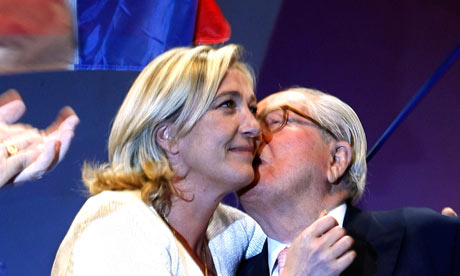
Despite an ongoing "professionalisation" of far-right parties like the French Front National and the BNP, this was probably the first time the far-right had been "legitimised" in Europe since the 1920s and 30s. This will, in my opinion, have had a knock on impact on other nations too.

Between 1998 and 2001, the populist anti-immigration Danish People's Party (Dansk Folkeparti) made a major breakthrough in the Folketing, winning 22 seats – a rise of 9. That's roughly the level of support they've remained at since, peaking at 25 seats following the Jyllands-Posten Mohammed cartoon controversy. They played ”kingmaker” in 2001, offering their support to enable a right-wing coalition government to be formed, in exchange for changes to Denmark's immigration rules – now amongst the strictest in Europe.

The right-wing Flemish nationalist Vlaams Blok (now Vlaams Belang) were effectively disbanded. They breached Belgian anti-racism laws, once proposing a form of segregation in parts of public life and expulsion of non-European immigrants. They peaked at 32 seats – near enough a quarter of all seats - in the Flemish Parliament in 2004.

The populist anti-immigration PVV played "kingmaker" following
the 2010 Dutch general election. A trend seen in other European countries.
(Pic : BBC)

Further north, in the Netherlands, the Party for Freedom (Partij voor de Vrijheid [PVV]) managed to win 24 seats in the lower house Dutch general election of 2010. Under the leadership of the charismatic Geert Wilders – something of a hard line spiritual successor to the assassinated right-libertarian Pim Fortuyn - they adopted a strong stance on Europe, Islam and immigration. Like the Danish People's Party, they were instrumental in government formation through something akin to a confidence and supply agreement.

The hilariously-named Liberal Democratic Party of Russia – whose policies, which are neither really democratic or liberal, hint that they would try to hunt down and eat our Lib Dems – somehow have 56 seats in the Duma. They want the Russian Empire back, and they wouldn't be afraid to use nuclear weapons to get it back either.

In the present, however, two of the more significant far-right movements are perhaps the most worrying.


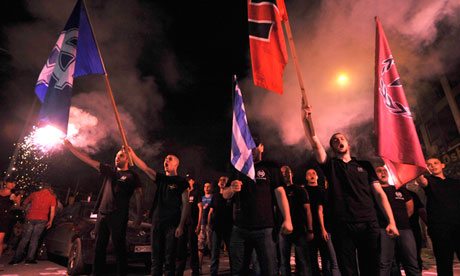
Golden Dawn - the first Nazis freely-elected in Europe since the 30s?
(Pic : The Guardian)

Between 2006 and 2010, Jobbik of Hungary came from nowhere to win 47 seats in the Hungarian Parliament. They once had a ”uniformed group” that probably fell short of an outward paramilitary organisation, though they were disbanded by the Hungarian courts. Although they strongly deny any racism against minority groups – including the Roma - in 2012, a Jobbik MP called for the creation of a list of dangerous Jews who ”pose a threat to Hungarian national security.”

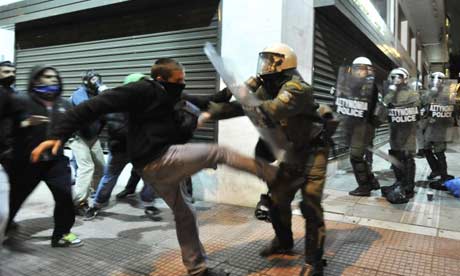
In Greece, since the torturous collapse of the country's economy, Golden Dawn won 18 seats in the Greek Parliament. They have links to hooliganism, and have been implicated in violent attacks against political opponents and ethnic minorities. Their election slogan in 2012 was, "Rid this land of filth." They're probably the closest Europe has come to freely-elected Nazi's since 1933.

It isn't all rosy

Despite all this, far-right parties and populist right-wing parties very rarely get into "power". They generally, at best, end up as small players in coalitions. Or – as in the Netherlands and Denmark – remain outside of government entirely, only popping up to get a few concessions to prevent centre-right governments collapsing. So, I think there is a natural "glass ceiling" when it comes to the far-right or populist conservatives.


Many of the parties I've mentioned have fallen back in recent elections. The PVV lost 9 seats in the last Dutch elections in 2012 for example. They were also responsible for that early election by withdrawing support for the ruling coalition, after a disagreement over austerity measures. Geert Wilders was blamed by the coalition partners and, ultimately it seems, the Dutch public for it.

Despite grabbing headlines, the overall performance of far-right
parties in many European nations states is poor.
(Pic : The Guardian)


Germany's National Democratic Party (Nationaldemokratische Partei Deutschlands [NPD]) have never performed well at all levels of government in Germany - perhaps understandably - with only a dozen or so elected representatives in state legislatures. In France, despite high-profile, highly-visible successes in Presidential and European elections, the Front National perform poorly at local, regional and national level, with only two Deputies. In Austria, the Freedom Party have never really attained the heights they did under Haider.

That's before mentioning the abject electoral performances of far-right parties closer to home.

I don't think there's anything more damning for liberal politicians than for the public to turn around and choose a far-right candidate over them. Barring legitimate concerns over some policy areas, it's the ultimate protest vote, boiling down to, "I'd rather vote for a Nazi(ish politician) than you." But I don't think many people voting for them really want a far-right (or in many cases far-left) politician to represent them, more give the "usual lot" a very big kick up the backside.

The far-right in Wales and the UK

Have the EDL been and gone?
(Pic : The Telegraph)
Naturally, I've got to position Wales in this somehow. Because we have a right-wing government in Westminster, the far-right in the UK, Wales included, is perhaps neutered. We've already seen a tightening of immigration rules - with negative effects on the Welsh NHS - and a level of right-euroscepticism from Tory backbenchers in Westminster.

Something both far-left and far-right parties and organisations share is a lack of ideological unity, or splits in support by people seeking an "ever purer" version of their politics.


Internal problems within the BNP have led to them suffering said splits in support. Some joined or forming new parties, with the National Front seeing a teeny-weeny resurgence, and the English Defence League probably stealing the BNP's thunder as the most vocal "far-right" organisation on the island of Great Britain. Even the EDL have probably come and gone, as attendances at their rallies - which once mobilised thousands - have been reduced to a hardcore.

The performance of far-right parties in Wales has been historically atrocious – though not quite as bad as Scotland – and I don't see that changing any time soon. There was a poorly-attended "White Pride" march in Swansea a few weeks ago, which is absolutely hilarious in context. Swansea is 94% white and that's one of the lowest percentages.

However, in terms of the "populist hard right", things might be changing and it would threaten the Welsh Conservatives more than any of the other parties.


With UKIP presenting a - you could almost say "secular" - non-racist way to express disapproval over policy areas like Europe and immigration, as well as a strident British Nationalism, I don't think the future of the far-right in Wales or the UK is rosy at all. Beyond Nigel Farage, UKIP don't really have much, though that could change. However, Nigel Farage could well be the BNP's executioner if he can convince enough people concerned over policy areas like immigration that he presents a creditable and socially-acceptable voice for them. That's probably the reason why there may be ex-BNP in UKIP.

The BNP's executioner? Do UKIP offer a "softer", "secular"
more socially-acceptable voice for those concerned about
immigration and Europe?
(Pic : BBC)
Those ex-BNP were probably sold a lemon "we're not racist" schtick when selected as paper candidates by the BNP, and some people's opinions will change over time. Some don't, and they'll probably embarrass UKIP. Opposing high levels of immigration or the EU - even if I don't agree with that - doesn't mean you're a racist as long as you present a reasonable argument. I do believe parties like UKIP have failed to do that, and they're far too reactionary.

But in my opinion, all that would be is a shift to a "populist hard right" similar to Denmark and the Netherlands. That would be much more preferable than a move to neo-fascist organisations seen in parts of eastern and southern Europe.

Again though, I don't think there's any chance of UKIP being in position to run anything larger than a rural English district council. Their aim will likely be to drag the Conservatives to the right, and the rest of us out of the EU.

The EU : A last defence against fascism?


This is the first major economic downturn parts of Europe
will have faced since the end of the Cold War....and they're struggling.
(Pic : Wall street Journal)
Many self-styled rebels in western Europe might wear Che Guevara t-shirts as a reaction to a free-market orthodoxy.
Many younger people in eastern Europe of voting age, will not have grown up under the iron jackboot of Soviet Communism, which was nothing more than fascism with a heart. They'll have probably been told stories of how brutal and repressive it was, and how its collapse left their newly-emerging nation states in a weak position.

Those in eastern, and perhaps southern Europe, look to relics of long-dead glorious empires and the social order that used to "exist" under ultra-nationalist dictatorships. Remember that the Axis in WWII consisted of more than Germany, Italy and Japan; it included plenty of puppet regimes in eastern Europe and the Balkans too.

This resurgence of the European far-right is not only the fault of the global financial sector, but the   mainstream, technocratic Christian and social democrats who dominate European politics.

In the west and south, they've failed to get a grip on issues like the high cost of living, they helped to prop up and create housing bubbles and in some circumstances they've mortgaged the future of their younger generations to pay off the mistakes of the present.

In the east, while the cost of living remains low compared to the west, they're just getting through the first major economic downturn since the fall of Communism. In some countries like Latvia, it's caused property bubbles to burst, while elsewhere they're experiencing double digit unemployment rates and high levels of poverty, used to exploit inter-ethnic tensions.

Meanwhile, EU institutions have become cumbersome and wasteful – perhaps in some circumstances causing more problems than they're supposed to solve.

The trouble is that as soon as mainstream politicians and parties are seen to be failing to address issues like those, at a time when things are tough and people are scared, charismatic individuals come to the fore offering simple soundbite solutions to complex issues. Sometimes they only offer a closed fist and a jackboot. When you've exhausted all avenues with "traditional" parties, what else have you got to turn to?

There's one firewall though. All those nations, by and large, still want to be "part of the club" when it comes to the EU, even if levels of scepticism and uncertainty about the EU itself are on the rise. If they shift towards fascism rather than a populist, UKIP-style "tough on crime and immigration" stance, it would generate enough disgust within the EU to trigger sanctions – be they economic or social – and that would play a role in bringing them back into line.

This is going to sound ridiculous, but for all its faults, we should start to position the EU in terms of it being the last line of defence for European liberal democracy.