This site is no longer updated

Please use the links in the sidebar to visit the new sites!

Showing posts with label Torfaen. Show all posts

Tuesday, 15 November 2016

FMQs : GPs, Chainsaws & Trump


There were a number of exchanges relating to the new President-Elect of the US this afternoon ( as you might expect) but the staple topic of health dominated discussion overall.

Tuesday, 11 October 2016

FMQs : Curious Tales, Cwmbran Hospital & Ireland


There was a varied FMQs today, with questions ranging from the M4, average earnings, the planning system and also a polite warning from the Llywydd.

Thursday, 7 January 2016

Making the Metro

(Pic : BBC Wales)
At the end of November the Welsh Government launched the first publicity campaign for the proposed South Wales Metro after the project was given a firm go ahead earlier in 2015 (Metro a Go Go).

Friday, 24 April 2015

The Abyss Staring Back at Wales

The National Assembly has voted in favour of a moratorium on opencast mining.
Whether there'll actually be a moratorium is a different issue.
(Pic : The Guardian)
As promised on Wednesday, I come back to another members debate, this time on opencast mining, which is a controversial issue in the South Wales Valleys in particular. There's a map of current and former sites available from the Assembly Members Research Service blog (here).

A cross-party motion called for the Welsh Government to :
  • Introduce a moratorium on opencast mining to allow for a strategic review into whether current measures are properly protecting communities.
  • Respond to research into opencast restoration failures, addressing concerns about MTAN2 (the official guidance) and the recommended 500 metre "buffer zone" between mines and homes.
  • Support local authorities that undertake legal action to force restoration.


Lynne Neagle AM (Lab, Torfaen) started by applauding the cross-party support for a moratorium on opencast mining during an election campaign (clip). A pause on opencast mining was needed to give space and time for the Welsh Government to undertake a strategic review on the impact of mining, with the cost of lengthy public inquiries leaving planners "stuck between rock and a hard place".

Lynne mentioned the Varteg proposals, where despite more than a decade of protest, mining companies propose to opencast 100m away from homes and a primary school. Although the original application was rejected, another application (near enough unchanged) has been submitted, so MTAN2 isn't meeting the needs of constituents. Alun Davies AM (Lab, Blaenau Gwent) made a point that the Assembly voted through the Wellbeing of Future Generations Act 2015, and opencast mining was contrary to the spirit of the law.

The Assembly are waiting for a Petitions Committee report into whether MTAN2 should be made law, and although there are disagreements, we can't afford the current confused situation to continue. She cited Garn Lakes near Blaenavon as an example of where restoration has worked, so she didn't want to tar all mining companies with the same brush. However, the "dodgy dealings" have "cast a shadow on the industry", and companies shouldn't be allowed to develop new sites to cover the cost of existing obligations.

William Graham AM (Con, South Wales East) reminded everyone that the motion called for a moratorium, not a ban on opencasting, and a pause will allow time to consider amendments to the Planning Bill (clip). He listed a number of sites in his region - including Ffos-y-fran in Merthyr and Varteg – as well as their controversial planning histories.

William said the 500m buffer zone was agreed by the Assembly, but Welsh Government draft policy proposed a 350m buffer zone; and although the government has said the buffer has to be given appropriate weight in planning applications, words were not enough. He suggested local authorities should be able to reject retrospective applications so developers are aware that the buffer is an absolute condition, not optional. William proposed that sub-standard restoration can be resolved through the use of restoration insurance bonds to prevent companies avoiding their liabilities towards restoration.

William Powell AM (Lib Dem, Mid & West Wales) started by paying tribute to the United Valleys Action Group (clip). It was vital to see a "consistency of approach" in planning, particularly technical advice notes, and proposals that breach planning conditions need to be properly justified. The market conditions for coal have changed, leaving "colossal" shortfalls in funding for restoration, meaning companies are "unable to finish projects they've started".

He called for greater public consultation with regard mine closures and their after-use, listing come of the common knock-on impacts nearby residents face such as poor air quality, noise, and declining property prices. He ended by saying the motion consistent with commitments to develop renewable energy.

Gwenda Thomas AM (Lab, Neath) said her constituency was built on coal, and it defines the area's past, but if carbon capture technology is proven viable, coal could have a future (clip). She doesn't oppose responsible mining but supports the motion anyway. Gwenda previously called for a presumption against new mining applications unless communities are properly protected, and subsequent events reinforced her views.

Gwenda described the legal actions between cash-strapped local authorities and mining companies - who can afford £250,000 for a single barrister's view - as a David vs Goliath battle. The people of Cwmllynfell, which borders East Pit, have been promised restoration for three generations, but now they're told "there's no money" and they must have a lake, which involves constructing a wall to hold back tens of thousands of cubic metres of water.

Celtic Energy and Oak Regeneration have made a string of promises relating to
restoration of former mines - like East Pit above - but they've all fallen flat.
(Pic : Wales Online)
David Rees AM (Lab, Aberavon) also acknowledged the historical and current importance of coal, though despite providing jobs, it contradicts carbon reduction policies (clip). He described how Parc Slip has been off limits since 1947 (technically incorrect as the eastern half has been restored), and how the ownership transferred from British Coal to Celtic Energy in 1997, who in turn transferred ownership to offshore company, Oak Regeneration, which has caused more problems in trying to recover costs. David also questioned what has happened to levies raised from coal privatisation?

Natural Resources Minister, Carl Sargeant (Lab, Alyn & Deeside), accepted that opencast was an "emotive issue", acknowledging the context of a moratorium (clip). Although he was sympathetic, he said it wouldn't resolve the situation or secure restoration. Opencast isn't a new industry, unlike fracking, and is "deeply embedded in communities" with live planning applications.

The Minister placed the blame on "market-driven" privatisation of the coal industry, which was rushed through with no consideration given to the effect it would have on communities. Companies retain the rights of a state-owned company but with none of the obligations. Peter Black AM (Lib Dem, South Wales West) said Scotland was pursuing the UK Government for restoration funds, and Carl agreed that the UK Government can't shirk its responsibilities.

He praised some aspects of MTAN2,  described as "wide-ranging" in a number of factors, including taking the track record of the company and future restoration plans into consideration with regard planning applications. David Rees intervened to say he believed there had to be upfront guarantees of restoration, as Parc Slip was more expensive to restore than was predicted.

Carl said the Welsh Government couldn't take action which "results in restoration solutions being taken off the table" simply because people live in close proximity to the mines. He did confirm that the Welsh Government will support councils taking legal action, and that he would host a summit with "stakeholders" on the future of opencast.

In reply, Bethan Jenkins AM (Plaid, South Wales West) called for a "fit for purpose system" that's made in Wales, rejecting comparisons with Scotland as Welsh communities generally live closer to pits (clip). The findings from Welsh Government research were imperfect but its call to strengthen MTAN should be enacted, even if the report "pities developers" and doesn't address communities.

In terms of policy proposals, Bethan suggested creating a mineral planning centre of excellence, ex-miner liason panels to provide technical assistance unavailable to planners and compel local authorities to retain minerals planning officers – despite having four mines, Neath Port Talbot has no expert planners. In the longer-term, workers should be retrained in renewables, saying Plaid Cymru would support creating a Green Skills College.

On specific cases, in particular Parc Slip, she said companies should own the land they mine as it's hard to hold an offshore company like Oak Regeneration to account, with Celtic Energy only acting as an operator and subsequently refusing to take responsibility. Bethan also said the exceptions in MTAN2 are too broad, like "economic development", which could mean anything to anyone.

Although welcoming the proposed summit, Bethan revealed that a FOI request (I presume it's this - pdf) showed there has been no correspondence between the UK and Welsh governments
on opencast mine restoration for five years.

The motion was agreed by 36 votes to none with 16 abstentions from the Labour frontbench and some backbenchers (recorded vote here).

Where next?

If you went to the Parc Slip nature reserve today, you wouldn't believe you were walking
on a former opencast mine. When you reach the other end of the reserve, you see this.

It's a non-binding vote. The Assembly agrees that a moratorium should happen, but the Welsh Government isn't obliged to follow through with that - just as there were premature celebrations over a fracking moratorium earlier this year. As William Graham said, it's right to remember that the motion called for a temporary pause on opencasting to allow for a review, not an outright ban, which would be a knee-jerk reaction.

Nevertheless there's a serious issue here that's failed to be addressed adequately by local authorities, Welsh and UK governments. The mining companies have them by the proverbial balls, and with so many tricks and loopholes, they've done them up like kippers.

It's highly likely Parc Slip will never be restored to how it was. The stark contrast between Parc Slip nature reserve and the void tens of metres away serves as a perfect historical artifact, marking the difference between state-ownership and regulation of the mining industry, and privatisation, where companies have figuratively "f**ked 'n' chucked" the land.

If the mining companies had a good track record of restoring sites, boundaries were properly enforced and the law was robust enough to ensure all that happened, opencasting would be less controversial. Now, it's not unreasonable to say opencast mining deserves to die out in Wales.

The remaining problem is that we still need coal. Wales and the UK retain coal-fired power stations and everyone except David Rees and Bethan Jenkins forgot that coal is a vital ingredient in steel-making (Assembly takes a ride on Heavy Metal) – Parc Slip supplied Port Talbot steelworks; Ffos-y-fran, Cwmgrwach and Tower supply Aberthaw power station and the steel industry.

As Bethan was also keen to point out on Twitter, only a fraction of the coal Port Talbot steelworks is obtained via opencast, the rest is imported (along with iron ore etc.)

The best hope for opponents is closure of Aberthaw power station and replacement with a renewable scheme (like a second tidal lagoon in Cardiff Bay) or something like gas or biomass. I'm also sure none of the AMs advocate closing steelworks, but if you want to "keep coal in the ground" permanently, that's what has to happen.

Digging coal up safely, locally and moving it by rail is better than importing it, which just shifts the problem elsewhere and increases the carbon footprint. Despite improvements to mining techniques and underground safety, I doubt anyone other than reactionary socialists want to see a return of shaft mining either.

This issue could turn out to be an important milestone in the decarbonisation of the Welsh
economy, but politicians should be honest about the hit Wales would take as a result.
(Pic : © Copyright Robin Drayton and licensed for reuse under this Creative Commons Licence)

So which way are we going to go? It would be a mistake to rely wholly on the green economy to replace jobs lost during the de-carbonisation of Wales.

Even though the numbers employed in opencast are a fraction of those employed in deep mining, very few forms of renewable energy are as labour intensive as fossil fuels or heavy industries like steel-making or chemicals. You put up a wind turbine, fit solar panels, insulate a home or build a tidal lagoon and apart from routine maintenance that's it – job done. The same goes for nuclear. The number of jobs required to run a station are a fraction of those needed to build it.

One of the reasons deep mining collapsed is because while demand for coal was holding up, the industry employed so many people it became uneconomical. Green technology has the opposite problem in that it employs too few people and often requires government subsidy.

Although its true to say opencast costs jobs too - in agriculture/land management (obviously), and more abstract cases like the Richards & Appleby cosmetics factory in the Rhymney valley - politicians should at least be honest and say that the main goal of renewables is clean energy production and energy efficiency, not long-term mass job creation or traditional economic growth. How they sell that is their problem.


Sunday, 4 January 2015

The Parc Slip Monster

Celtic Energy's inability to fill a hole they dug has left
a murky "lake" for local communities to deal with.
(Pic : BBC Wales)

Just before Christmas, the issue of open-cast mining in south west Wales reared it's head again after an intervention by a group of Assembly Members, worried about faltering restoration plans at two former mines.

Caerphilly-based Celtic Energy – listed on the recent Western Mail Top 300 as the 56th largest company by turnover in Wales - transferred ownership of four open-cast sites to British Virgin Islands registered subsidiary, Oak Regeneration. The two largest sites are Parc Slip near Kenfig Hill - which straddles the border between Neath Port Talbot (NPT) and Bridgend (BCBC) – and East Pit near Cwmllynfell in the Amman Valley.

Oak Regeneration are tasked with restoring the two sites following the expiration of mining licences. They propose to develop a garden village at Parc Slip and a resort at East Pit. In order to fund these works, Oak Regeneration were pressing for further extensions to mining licences.

There's a huge coal seem stretching from Margam to Pencoed. Most of it is under the Cefn Hirgoed Common and Sarn, so the only realistic extraction point is towards the Margam end, which has either been open-cast already or is farmland.

Extensions to mining licences are often highly-controversial and strongly opposed in local communities as it's a particularly dirty and noisy industry and renders previously open-access land useless for decades (more at the end of Digging deep into deals done dirt cheap).

Perhaps Oak Regeneration hoped the "ambitious" restoration proposals would swing licence decisions and public opinion in their favour, to the point that some local councillors were won over by the plans. Both NPT and BCBC dilly-dallied on issuing enforcement notices (as the respective planning authorities), which would legally-bind the company to immediately start work on restoring the sites back to normal. Mining even continued at East Pit after the licence expired.

The Serious Fraud Office (SFO) intervened and several Oak Regeneration directors found themselves in court accused of attempting to defraud Bridgend, NPT and Powys councils. In February 2014 the case was dismissed, and an attempt to restart the case failed late last year. By the looks of it the SFO tried altering the charges after the case went to court, but because no money changed hands there was little hard evidence to implicate the defendants.

The cost of restoring both mines is estimated to be £157million, but Oak Regeneration are reported to have only set aside a paltry £8million. Unless extensions to mining licences are granted, it's likely that the resulting enforcement notices would bankrupt Oak Regeneration, and the cost of restoring the mines will fall on NPT, BCBC and the Welsh Government.

Although she wasn't mentioned in relation to the intervention, Bethan Jenkins AM (Plaid, South Wales West) is one of the few AMs who has spoken out consistently on this and has campaigned on open-cast mining since she was first elected.

It's also right to say she's often given short shrift by Welsh Government ministers – usually Carl Sargeant (Lab, Alyn & Deeside) and previously John Griffiths AM (Lab, Newport East) – when pressing for answers in the Assembly.

Since it's become more obvious that the sites are unlikely to be restored, the rest of the AMs in South Wales West have caught up Keystone Cops style – up to and including Carwyn Jones himself (though he did know about this).


The AMs are calling for Celtic Energy - Oak Regeneration's parent company - to stump up the restoration money. Celtic Energy have sung from the same hymn sheet as Oak Regeneration : extend mining licences to raise restoration funds. In light of falling coal prices it's unlikely to raise enough.


It isn't limited to this part of Wales either. Although Bethan's the most prominent campaigner on this issue in the Assembly, others – like Lynne Neagle AM (Lab, Torfaen) - have expressed concerns about a proposed open-cast mine near Fart Egg in her constituency, while protests against the Ffos-y-fran mine on the outskirts of Merthyr have rumbled for the best part of 25 years.

This isn't a particularly popular industry, regardless of whether it provides jobs or not.


This is why Wales can't have nice things....

Is this what we're getting?
Nope, think again....
(Pic : bridgendbites.com)

There's been a clear lack of foresight by the local authorities, the mining companies and the Welsh Government which - unless a solution is found - could leave a scar on the landscape that will last generations.

Open-cast mines can be and are restored successfully, demonstrated (ironically) at Parc Slip.

The eastern half of Parc Slip open-cast, on the outskirts of Tondu, was fully restored in the 1980s-1990s and is now a popular nature reserve (pictured above). If you went there today you would barely know it used to be a mine. To the west, there's a poorly fenced-off moonscape and a massive hole filling with water. I don't know what East Pit is like, but I'm presuming it's similar.

There are obvious safety concerns.
Depending on the rocks around it, the water is likely to be either very acidic or very alkaline, so there's no way it can be treated to become a pleasant "lake". It'll either have to be back filled or pumped out and disposed of properly. The water's also so blue it looks like a tropical lagoon, but anyone tempted to take a dip during the summer would be swimming in bleach.

Back in 2013, Cllr. Luke Ellis (Lab, Pyle) warned people to stay away after reports of trespassing, but the water's even higher now. So greater efforts will need to be made to keep people away.

Then there's the flooding risk. It's taken about 5 years to fill 60-70 metres of mine workings. Judging by what I've seen there's only another two to three years left until there's a real threat the "lake" will be over-capacity.

If the "lake" breached, the River Kenfig (which is right next to the mine and the only obvious place for the water to go) is too small to cope, so it could cause flooding downstream in Pyle and North Cornelly. That's bad enough on it's own, but it would be an ecological disaster too, as polluted water will head for Kenfig Burrows - a Site of Special Scientific Interest.

Open-cast mining is safer than drift and deep mining at the expense of the environment. Having said that, as long as power stations like Aberthaw and key industries like the Port Talbot steelworks continue to need coal, it's better to source that coal locally and move it by rail than import it.

In the medium to long-term, Aberthaw power station (and other coal-fired power stations around the UK) will either be replaced or close due to poor emissions standards, while TATA are/were considering opening a drift mine in Margam. Therefore, it looks as though open-cast doesn't have much of a future.

Celtic Energy and Oak Regeneration have been underhand, having sold NPT, BCBC and the Welsh Government magic beans. The latter can't say they weren't warned either.

This has always been about extending mining licences. The regeneration projects are a pipe dream that companies are under no obligation to deliver.
Housing developments, which Celtic Energy have been plugging since the AMs' intervention, are moot. Nobody seriously thinks Oak Regeneration - a company without a pot to piss in - would be able to oversee a garden village (which would probably cost £450-500million) at Parc Slip, do they? We'll be lucky if they grow trees there again.

So you can see what's going to happen. It'll either be left as it is for the foreseeable future and become a potential serious environmental hazard. Or, there'll be no choice but to extend mining licences to prevent NPT and BCBC, probably the Welsh Government too, being left with a massive clean up bill as Oak Regeneration go bust. I wouldn't want to see that happen because costs will be be passed on to taxpayers.

A Machiavellian part of me does want that to happen though, because the Welsh Government have been complacent on open-cast mining for years (minerals policy is devolved - MTAN). A nice big bill to bail out a dodgy offshore company would be just the kick up the backside they desperately need.


This is why I get annoyed when politicians say "sustainable" because, as the Welsh Government often prove, they don't practice what they preach. There's absolutely nothing "sustainable" about what's happening at Kenfig Hill.
Maybe they won't see open-cast as such a neighbourly industry anymore and start to think about proper regulation, including absolute cast-iron guarantees (perhaps backed by legislation) of financing for restoration projects before mining licences are granted.

Ultimately, the reason why governments introduce so much of the "obstructive red tape" businesses complain about is because some companies continuously breach the trust of local communities this way.


Right, what are we going to call it?

"
Lake Sargeant"? "Llyn Carwyn"?

Monday, 21 July 2014

M4 Newport - The Committee Strikes Back

It's the committee report AMs couldn't wait to read, containing heavy
criticism of the Welsh Government's decision on the M4 around Newport.
(Pic : transportxtra.com)

The saga from the start :

It's led to rows, hypocrisy, (minor) backbench rebellions, and has turned out to be one of the more controversial committee inquiries in the Assembly's short history.

Towards the end of last week, the National Assembly's Environment and Sustainability Committee published their eagerly-anticipated report into the decision-making process which led to the announcement, on July 16th , that the £1billion M4 "Black Route" around Newport will be given the go-ahead.

The report itself (pdf) is short and to the point compared to other Assembly committee reports, and well worth a look regardless of your opinion on the M4 bypass scheme itself.

From the outset, the Committee say they were disappointed that neither the minister in charge, Edwina Hart (Lab, Gower), or the Confederation of British Industry (CBI) – one of the biggest cheerleaders for the bypass – appeared before them to give oral evidence.

The Committee have "grave concerns" about the consultation process which led to the Black Route being selected, but they stress that they make no observations on the "merits of any particular route". They believe that had the minister properly engaged with them, many of those concerns would've been addressed.

The Committee subsequently made a single recommendation; that Edwina Hart answers all of the questions and concerns raised in their letter to her on June 5th (pdf).

They go on to say that if the minister can't answer their questions to their satisfaction, then consideration should be given to restarting the public consultation process to ensure that all concerns (below) are taken into account and that all alternatives to the Black Route are considered.


The Committee's Concerns


The route selection process
– It's questioned whether the process of choosing a route met the EU's Strategic Environment Assessment (SEA) directive. In the first consultation (2011-12
M4CEM), a completely new motorway wasn't included as an option. Then, it was included as an option in the second consultation carried out in 2013-14. This suggests the SEA process hasn't been followed correctly, as the sudden change in heart on the need for a bypass would contradict the environmental reports issued alongside each consultation.

The choice between purple, red and black routes (2013 consultation) – The choices on offer with regard a route for an M4 bypass were too similar to each other to "allow a meaningful comparison as required by the SEA directive". It also hasn't been made clear whether the Blue Route has been fully assessed by the Welsh Government to SEA standards.

The environmental report – Natural Resources Wales (NRW) say some of the concerns they raised weren't included in the final environment report. NRW flatly disagree with many of the conclusions in said report, which underplayed the impact on biodiversity, and provided incomplete assessments of  greenhouse gas emissions, water quality, landscape and townscape impacts.

Consideration of public transport (or lack of) – Possible public transport options and the South Wales Metro scheme haven't been given full consideration. They should've been weighted directly alongside the M4 proposals as they could have a big impact on the underlying case for a bypass.

Validity of traffic forecasts – Traffic forecasts on the M4 are produced using the UK's Department for Transport (DfT) forecasting methodology. However, in the past this methodology has – according to leading academics – predicted big growths in traffic volumes and car ownership when levels have actually remained flat. There should've been a more flexible traffic prediction methodology based around varying scenarios, but it's not something the Welsh Government can do themselves as DfT are very protective of their forecasting models. If traffic growth doesn't match the DfT's unreliable forecasts then the M4 bypass will be a waste of money. So the case for a bypass is partly reliant on traffic increasing. That's very "unsustainable".

Costs – It's unclear if environmental mitigation measures, or the future of the A4810 Steelworks Road, have been factored in to the estimated costs of the Black Route. Also, the proposed capital borrowing limit as set out in the Wales Bill (£500million) is only half the estimated total cost of the scheme. Therefore, there's a lack of clarity on how future borrowing powers would be used, and the impact the bypass would have on finances available for transport projects like the Metro. The Committee say it's "difficult to conclude....that a convincing case for the long-term value for money of this investment has been made".

Executive Decisions demand Executive Answers

There's no obligation on ministers to follow through on any recommendations made by an Assembly committee - it's just a good idea to do so. If Edwina Hart wants to ignore this she can, though it would probably make it more difficult for the Welsh Government to win any legal challenge (if it goes that far), as it looks like the Welsh Government haven't gone about this in a professional way and are washing their hands with democratic scrutiny.

Without question, something has to be done to the roads in and around Newport. I'm not blinkered enough to think the solution lies in public transport and "active travel" alone.
 

But you get the impression the Welsh Government wanted a new M4 from the start, they just realised they couldn't afford it. As soon as borrowing powers came into the picture – fuelled by the enthusiasm from Whitehall to give Wales "fiscal responsibility" – the Welsh Government decided to press forward with this while they still had a window of opportunity.

So we ended up with a public consultation that was effectively based around three minor variations of a single option and what appear to be "sexed-up dossiers".

Edwina Hart has done the position of economy minister proud so far, so it would be a real shame if she ends up pushing through something she may later come to regret. Maybe a bypass really is the right option, but it has to be handled conscientiously. That clearly hasn't happened.

This is one of the single largest capital investments in Welsh history, standing at the equivalent of about 65% of the Welsh Government's total annual capital budget. It's serious stuff that deserves proper answers from the minister before anyone can think of getting the project underway.

Saturday, 5 October 2013

Newport's M4 coronary bypass

The public are now being consulted on options for
an M4 Newport bypass. Again.
(Pic : ITV Wales)

A public consultation on the proposed M4 relief road around Newport was launched by the Welsh Government in the last fortnight.

Woah!....Hang on a minute....I'm getting a strange....feeling....of
déjà vu.

Because of the M4's vital importance to the whole of south east Wales, the consultation appears to be open to everyone (not just Newport, Cardiff, Torfaen & Monmouthshire residents), and responses are due by 16th December 2013. You can find out more information, and the consultation documents, at this website.

A brief history

You all know why there's continued calls for a Newport bypass : accidents and congestion around the Brynglas tunnels and low speed limits due to the curvy nature of the M4 through Newport. Problems said to "clog the arteries of the south east Wales economy etc."

Initial plans for an M4 relief road were scrapped in 2009 due to concerns about costs. Some modifications and upgrades were made to roads around Newport instead, including a duel carriageway to the south of Llanwern steelworks which opened recently.

Then, the Welsh Government went back to the drawing board, and between 2011 and 2012 launched another consultation. This time, the emerging plan was for the current M4 to be widened, including the Brynglas tunnels themselves. However, Friends of the Earth Cymru described the process as "shambolic". Some aspects - in particular some data used to support the project - potentially left the Welsh Government open to a legal challenge. Those plans were quietly sidelined.

With borrowing powers on the table, and with Westminster keen to prove they're friends of Wales, we've finally come full circle to option one – an M4 Newport bypass. Costs don't seem to be concerning anyone this time, even though the question of how they're actually going to pay for it is, as yet, unanswered.

Will there be a toll? Will the toll gates move from the Severn bridges to the new M4 (more on that from Plaid Monmouth)? When will we know if the Welsh Government will even get borrowing powers?

Current cost estimates, AFAIK, are still around the £1billion range, with the South Wales Chamber of Commerce estimating a new M4 would boost the Welsh economy by £2.1billion.

The Options

The (latest) three options for the M4 Newport bypass
(taken from M4Newport website, click to enlarge)
The draft plans present three options (illustrated above) :
  • Black Route (the preferred option) – Leaves the M4 at Castleton, dips south of Duffryn and the Docks Way landfill site, crosses directly through Newport Docks/River Usk, south of Llanwern and Glan Llyn, rejoining the M4 at Magor.
  • Red Route – Leaves the M4 at Castleton, passes closest to Duffryn, north of the Docks Way landfill site, crosses Newport Docks/River Usk further north than the black route, then follows the same route to Magor.
  • Purple Route – As the red route, but crosses the River Usk further north and is a bit further away from Duffryn.

All three go through the Gwent Levels site(s) of special scientific interest.

There would also be several complimentary measures included alongside the bypass :
  • Improvements to traffic management on the current M4 (which would presumably become the M48 once any bypass is completed).
  • A new link road between the M48 and B4245 in Rogiet to serve a future Severn Tunnel Junction park & ride.
  • Unspecified improvements to cycling and pedestrian infrastructure.

What if the bypass isn't built?

This is described as a "do minimum" scenario. If the bypass is rejected, the Welsh Government believe it would result in; unspecified negative effects on the economy of south east Wales, longer journey times thus reducing the travel to work area, higher levels of noise and air pollution near to the existing M4 and a greater risk of accidents (mostly due to rear-end shunts in stop-start traffic).

It's worth pointing out that keeping things the way they are would have a negligible impact on current levels of greenhouse gas emissions, nor would it have any additional impact on either the wider Newport environment (except right next to the M4) or the Gwent Levels.

Why aren't alternatives included in the consultation?


If you have artery problems, a visit to the heart surgeon is to be avoided,
not put to the top of the list. You try the lifestyle changes first.
(Pic : livestrong.org)
I still maintain that a completely new M4 bypass is excessive (more for costs than the principle of a new road), so I'm inclined to oppose this. If I had to choose, I would've stuck with the "coronary stent option"  - the 2011-2012 plans to widen the existing M4 - or at very least remodel the M4 through Newport to discourage local traffic from using it (closing slip roads etc).

As Freshwater PR's Steve Howell pointed out in the Western Mail on Monday, you have the South Wales Metro and SEWTA's plans for the Gwent area, both of which have hardly got a look in within this consultation.

The report says 43% of journeys on the M4 around Newport are for less than 20 miles. If a public transport system was developed in and around Cardiff, Newport and Bristol that could beat the car in terms of journey times, then logically, enough traffic could be taken off the M4 during peak times to avoid needing an M4 bypass in the first place.

And you might be able to do that for a lot less than £1billion.

When you have a blocked coronary artery – as the Newport M4 is sometimes described as - you don't immediately rush to go under the knife for a operation that carries severe risks, you usually make an attempt at lifestyle changes first.

Even if you do go under the knife, if you don't change your lifestyle alongside it, a bypass doesn't last very long. Yes, lifestyle changes would be difficult but you would have to face up to it at some point.


Think of lorries and cars as lard pies; think of buses, trains, walking and bikes as salad.

Tuesday, 21 May 2013

Active Travel Bill - Learning lessons from elsewhere

"Build it and they won't come?"
Is the Active Travel Bill a missed opportunity to match education - and
incentives to push modal shift - with improved cycling facilities?
(Pic : roadswerenotbuiltforcars.com)
The Active Travel Bill was introduced earlier this year, and is currently making its way through the first committee stage, which is due to finish this week.

To recap, the Bill intends to place a duty on local authorities to map and plan "active travel routes" (English : Cycle and pedestrian lanes), allowing them to identify gaps, improve facilities and hopefully provide better quality routes to encourage walking and cycling.

Amongst the issues raised in committee is whether legislation is required, as opposed to a new strategy instead. There's also some confusion over departmental responsibilities – Culture Minister John Griffiths (Lab, Newport East) is the lead minister for the Bill, even though it's a transport responsibility - as well as the exact guidance local authorities will be issued with if the Bill is passed.

Another concern was that the legal requirement to carry out the mapping exercise might only apply to settlements with more than 2,000 residents – which would affect rural parts of the country, and bypass 23% of the Welsh population. That's not to mention the overarching issue of funding too.

I don't think you can deny that one of the main concerns about cycling (or walking) is safety. The main way nations, citing examples elsewhere in Europe, have tried to overcome that is by developing fully-segregated cycling facilities.

Sustrans recently announced plans for a segregated cycle route between Cardiff and Newport, which is estimated would cost just £500,000. That would buy you a few metres of motorway or half a railway station. So these things are relatively cheap, it's just a matter of finding the money and having the levels of use to justify spending it.

The Bill, as it stands, spells out that local authorities will need to "secure continuous improvement" to active travel networks. It's unclear if that means prioritising segregation over things like (cheaper) painted cycle lanes, we'll have to wait and see. Suzy Davies AM (Con, South Wales West) has a short debate in the Assembly on this issue on Wednesday.

However, there are warnings about going whole hog in developing cycling facilities without the underlying "nudge factors" to get people on their bikes in the first place.

There's one town in the UK which is, arguably, the ideal template for creating and sustaining a cycling culture. It has a fully segregated cycling and walking network, linking residential areas to major employers, the town centre core, as well as key transport infrastructure – the sort of thing the Active Travel Bill wants to encourage Welsh councils to develop.

Except, despite all that, it's been a massive failure. At its peak, it's reported only 14% of people used cycles as their main form of transport, and now the figure's just 3%.

Welcome to Stevenage

Does the fact things like this are seen as "radical" in the UK, highlight
the uphill struggle the Welsh Government and Sustrans have?
(Pic : The Telegraph)
Stevenage was developed as a new town in the 1960s and 70s, so we only have Cwmbran as a direct comparison in Wales. We can't apply the same criteria to most Welsh towns, which are older and have different geographies, but I think the underlying themes are still relevant.

Despite everything being designed from the outset with cyclists and pedestrians in mind - including traffic-free routes, underpasses and segregation between pedestrians and cyclists - it never caught on. People still opted to use their cars for short journeys, even if the facilities available were up to the standards of the Dutch.

So, even if you provide some of the best cycling facilities possible, if you don't get people to think "bike before car" – whether that's through discouraging car travel deliberately (i.e. low speed limits, speed humps, car park charges), or through education – it probably won't work.

Recent developments in London are another example of the uphill climb facing the Welsh Government and Sustrans. London has already developed a network of "cycle superhighways", and is now experimenting with Dutch-style cycle-friendly roundabouts (where cyclists have right of way when crossing the exits) and cycle traffic signals.

I think it highlights how backward the UK is when it comes to cycling when developments like these are flagged up as "radical innovations", so mind-blowing, that they need to be confined to the academic bubble for further study as if they were alien concepts. They've been used elsewhere in the world for decades.

I still think, broadly speaking, the draft law is a good one. It just falls short of what it could have been. Judging by some of the committee evidence, I think others feel the same way deep down.

One of the big let downs in the Active Travel Bill is that it's heavily focused on the practical mapping exercise, with little emphasis on the "softer/social" changes required to encourage people out of their cars – just like Stevenage.

It should've had provisions in there for things like cycle proficiency training, speed limits and minimum standards for cycling facilities. Of course, all that could be included in any official guidance drawn up by the Welsh Government.

We can do better than just monitoring cycle lanes, ticking a box for each new metre of tarmac put down. Tarmac that – without the right cultural shift – is unlikely to be used as intended.

Saturday, 3 November 2012

Schools without books? Learning 2.0

Welsh schools are beginning to introduce tablet computers into
the classroom. Where could this development lead?
(Pic : Welsh Government)
Information Technology is a compulsory subject until the age of 16, and a core part of the National Curriculum. However, beyond computing, technology also increasingly plays a role in teaching other subjects – for example : scientific models, computer aided design, presentations, notes and even core texts.

With concerns raised about the physical health of children as the result of heavy bags, could Wales blaze a trail for book less, technology-led, interactive learning. If we do, it could completely revolutionise how we teach, and would set us in good stead for the coming (technological) challenges ahead.

Current policy

One Wales piloted a "Laptop for every child" scheme,
but technological changes might have rendered it redundant.
(Pic : BBC Wales)
Plaid Cymru had a policy to give each pupil a laptop, and launched a pilot programme during the Third Assembly, but that was ditched by Labour last year. Recently, it's been revealed that laptops bought by Torfaen council under this scheme are still in storage. Full-blown laptops probably over-engineered the solution to the problem, but clearly the Welsh Government have thought along these lines for some time, and this line of thinking has had an impact - perhaps not in the way Plaid expected.

Education Minister, Leighton Andrews (Lab, Rhondda), is a technophile – and that's a progressive and exciting development in my opinion. He's actively encouraging the use of mobile phones and social networking as a teaching tool, instead of seeing them as a nuisance.

Labour's 2011 manifesto included commitments to build a "virtual learning environment", which would link teaching materials across institutions and classrooms – for example :YouTube, iTunes and Open University material.


Tablet computers are already being used in Welsh schools as a learning tool. Tonypandy Community College are piloting the use of Android tablets for things like internet access/research, word processing and presentations. They cost £65 and pupils contribute £10 towards the cost. Obviously the widespread introduction of tablet computers in the classroom would be expensive, but as technology changes, it might become affordable, practical and even desirable.

Cardiff Council are also spending £3million on introducing tablet computers across its schools.

A Task and Finish Group reported back at the beginning of the year, giving ten headline recommendations, the standout ones being:
  • The establishment of a national organisation to oversee digital resources in the classroom (Hwb)
  • Improving the skills of educators in use of technology
  • A national "digital collection" as a learning resource (in both languages)
  • The ability to access teaching resources anywhere, and the creation of a unique User ID to be used anywhere
  • Manage IP rights and create income through external licencing

The questions now are : What would all this look like? How might it work?

Pontydysgu and Taccle2

Interactive textbooks are already being
offered by the likes of Apple.
(Pic : Phonearena.com)
Pontydysgu is a pan-European research consultancy focusing on "personal learning" and use of technology in teaching, which has been dubbed "E-learning 2.0." There's a concerted effort by the European Commission to investigate, develop and research applications of technology in learning. Pontydysgu produced a paper on working and learning, and it overall message was that the "industrial model" of teaching (classrooms as structured learning "factories") was becoming increasingly outdated.

We've seen a shift towards that already in Wales, with the creation of more apprenticeships. But it also means that things once seen as outside the traditional definition of education, such as lifelong , informal and distant learning courses were "starting to converge." So instead of a structured : school – college – university model, you can pretty much learn wherever you are and at any time.

The paper says that "with the availability of multiple knowledge sources....the way young people are using computers for learning....looks dysfunctional." There's also a difference between primary and secondary schools. Primary schools have a focus on developing social skills, key skills and social adjustment, while secondary schools are a bridge between higher-technical training and fundamentals needed to become a productive citizen.

How can all these new technologies be applied to the classroom? Do we need a rethink of the structure and progression of pupils within the public education system? That's where Taccle2 comes in.

If Pontydysgu is about researching the ins and outs, the Taccle2 project is more about application – guiding teachers in introducing e-learning to classrooms. This includes providing resources such as : games, use of established tools like Google Earth, interactive e-books. They also provide guidelines for prospective e-textbook authors.


As these are pan-European projects, I think one area which could be focused on is – you guessed it – modern foreign languages and Welsh. With Plaid Cymru and the Conservatives both mulling over bringing a "third language" into primary schools (presumably French), I think e-learning tools would be a great way to introduce second and third languages at a steady pace.

Swansea University and Academi Hywel Teifi launched "Gemau Glew" last year as a Welsh-language learning aid (you can try it yourself at Syniadau). I don't see why this could be expanded to a whole load of languages, or even integrated properly into courses like those provided by the Open University or Learn Direct.

Teaching of tomorrow

Although, as said earlier, IT is a core part of the school curriculum, there have been complaints raised about how it's taught in schools. At the moment, it's more application based and showing you how to use them. But this neglects things like coding and binary – the "languages of computers" – which is usually left until GCSE or A-Level.

I'm not computer-minded at all, in fact I'm something of a technophobe. To me, the internets is a series of tubes. But neglecting coding is a bit like teaching kids a subject like history, but without them being able to write. IT will have to become something transferable across subjects and become as important as reading, writing and maths.

Tablets and computers shouldn't replace traditional teaching methods. In fact it could make teaching a bit easier, personalise student learning and through interactive programmes, make learning a lot more hands-on and fun.

The technological requirements

Simplified programming languages like "Scratch"
could gently introduce younger children and teens to coding.
(Pic : Lunduke.com)
First things first. We need to develop a robust, cheap tablet computer. This could be based off the Raspberry Pi computer – now manufactured in Pencoed – which uses a Linux operating system.

The open source bit is key. One of the recommendations in The Collective Entrepreneur was that public computer software should shift to open-source to reduce costs. These could be Linux-based, like Android, or a bespoke one developed for Welsh needs.

Now, if every school pupil, every university and every government department (local or national) issued tablets that ran the same software, you could create a "national grid for computing". Everyone in Wales would (eventually) have a working knowledge of the operating system, and would be free to develop improvements to applications and programmes because it's open-source. We'll probably be able to keep public IT contracts in-house.


So, for example, if someone working in an NHS IT department come up with improved accountancy software, it could be replicated across the Welsh public sector quite easily. There would no longer be that clash between computer systems. Yes, if it's good enough, they could probably sell them as well (I do watch The Thick of It).

Secondary schools, FE colleges and probably universities, would need to become free Wi-Fi zones – that's unlikely to come cheap. A nation-wide "cloud computer" could be established to move documents, files etc. quickly and easily between institutions. This could have a dramatic impact on things like freedom of information.

Open source software would likely be easier to update too. It shouldn't really affect personal gadgets. The "national tablet" would be very much designed for work, and people would still be able to use other computers for personal use, or gaming etc.

If students were given the freedom to code their own, then it might lead to boosts in computer literacy, creative expression and individualistic thinking.

School specific

The tablet mentioned earlier would be given away, or part-subsidised, in Year 7, and flexible enough to be used throughout a pupil's secondary and further/higher education. Primary schools should focus on traditional computers and things like handwriting, social skills and basic numeracy.

The tablets would presumably come pre-loaded with "essential software" – things like word processors, spreadsheets, presentation, calculators, dictionaries. It could also come with personalised timetables or homework assignments. These could, once again, be open-source (Open Office for example).

IT teaching in secondary schools would shift towards coding and modifying both these tablets and desktop computers. It could include software development – which, if good enough, could be shared/sold nationally – graphic design, games design, troubleshooting and hardware upkeep.

In other lessons, the tablets would be used instead of pen, textbooks, worksheets and paper. Obviously, this won't be suitable for every single school subject. Many subjects would still require hands-on practical sessions – sciences, PE and the arts for example.

How would this benefit pupils and teachers?

A "national tablet" could be used across the Welsh
public and private sector as a "work tool".
(Pic : Inventinginteractive.com)
Apps replacing textbooks – There's an obvious cost benefit. You could also convert existing textbooks to e-book versions, or interactive textbooks. These could be shaped entirely to meet the requirements of a Welsh curriculum. Universities and major employers could help in writing and developing these. It should also give teachers a wider choice in texts to choose from.

Individualised/customised learning – Teachers would have a much greater toolkit in developing class assignments and worksheets. They could include video, games, songs, animations etc. If the coding language were simple enough, teachers would be able to create individual lessons off a template to match each pupils respective needs.

Environmental benefits – Paperless working would have obvious benefits, and perhaps make school administration more efficient. For example, registration and signing in/out could be done electronically.

24/7 learning and nowhere to hide
- There would be no excuses for not doing homework/losing homework, other than laziness. Some applications could be created to enable teachers to give homework to absent pupils - as Twitter has been used to send work to Cwmcarn High School pupils recently. Pupils might even be able to follow lessons from home in some – but not all – cases. This could be useful in rural areas, and dramatically change the way we thing about "school" as a single building you leave your kids at.

Potential Drawbacks

Exams like this would probably have to stay. But would
pupils have the attention span to sit and write?
(Pic : BBC)
Charging – The tablets would need a long battery life, and the costs of recharging would need to be taken into consideration. Maybe wireless chargers could be installed in public buildings so they can recharge on the go, but the technology for that is likely to be some way away and quite expensive.

Exams – Traditional "pen and paper" exams would probably have to stay. That's not to say that if there were a switch to tablets that pupils would forget how to write, but they would need to keep in touch with handwriting somehow. I doubt the safeguards are there to enable exams to be taken on tablets, especially if enterprising young people found ways to "code their way to success."


Outdated technology – One of the reasons open source is key is that updates can be spread quickly and, nominally, for free. That's not the same case for the hardware. There's a good chance a "national tablet" might seem quite antiquated within 5-10 years of being developed.

Distractions and horseplay – There's the chance that children simply won't pay any attention and use their tablets to play games/wind up teachers during lessons. The learning material itself would have to be engaging to prevent this from happening, and that could lead to shorter attention spans amongst pupils in the long term. That's not a good thing. There's also the possibility of hacking.

Thursday, 17 May 2012

Leanne's Greenprint for the Valleys

The core message of Leanne Wood's greenprint is self-sufficiency
- something the Valleys desperately need.
(Pic : United Welsh)

I've been meaning to do this for some time, but my break finally allowed me to get around to it. Seeing as Leanne Wood is appearing on Question Time tonight, now's as good a time as any to post it.

Back in March 2011, Plaid Cymru launched a consultation document, authored by Leanne Wood, called "A Greenprint for the Valleys". It wasn't a detailed policy document and is actually pretty short, but it does give you a good idea of what Plaid's economic vision for this part of Wales is.

The Rationale

There are 4 key parts that underpin the Greenprint:

  • The co-operative history in the Valleys
  • Peak Oil & resource shortages – prompting a focus on "sustainable development"
  • Locally-sourced goods and energy (as a result of Peak Oil)
  • A new mutualism – in particular finance

It also points out that there are many examples of good projects already – food co-ops and time banks for instance. However due to a reliance on grant funding, these schemes are unlikely to be sustainable in the long-term due to general cut-backs, or resources being spread too thinly across a wide area like the Valleys.

Time and Money


There are three examples of alternative financial models given :

  • Mutual loans to businesses that "make positive contributions to the community"
  • Local currencies – backed by sterling – that can only be spent in the local economy
  • Time banks – people receive credits for every hour they spend volunteering, that can be spent in the local economy

My criticism would be that, however good these schemes sound, I don't see how it would generate any tangible wealth in GVA terms. It would, at least, increase economic activity and see reinvestment of time and money in areas that badly need it.

That might trump the need for traditional wealth generation in the short to medium term. As confidence in these communities builds, so would the enterprising spirit, combined with with a far more cooperative, team effort. A friendlier capitalism could start here.

What can government do?

The paper suggests several things the Welsh government could do to stimulate this "new economy." Obviously these powers, time-scales and abilities would be enhanced by independence - just thought I'd add that.

  • Tailor public sector contracts to small local businesses – incorporating clauses for apprenticeships, environmental criteria, and making contracts smaller to enable local cooperatives, social enterprises and small businesses to bid for work. A point made in The Collective Entrepreneur.
  • Set "carbon budgets" linked to council tax to provide incentives to local councils to meet green targets. Hopefully this would lead to things like power stations being more spread out and improved recycling rates.
  • A programme to bring heritage and disused buildings back into public use as community facilities (i.e churches, chapels, pubs, schools, abandoned businesses). Set a target for every community of 10,000 to have a "fully accessible community building" running services, courses etc.
  • A legally binding action plan to protect wildlife, countryside and ecosystems.
  • Pilot areas, where measurable environmental aims are set (i.e a percentage of homes to be 0% carbon emitting within an Assembly term) – starting off small, then gradually increasing over time.

Green Infrastructure

It's important that this new "green economy" has the right infrastructure in place to enable it to function.

Renewable energy cooperatives are cited, with the The Green Valleys project in the Brecon Beacons given as the main example. A community-owned hydroelectric scheme is expected to produce 82% of the community's energy needs, will reduce its carbon footprint by 137% and was constructed and maintained entirely by community volunteers - led by a steering group with a "wide range of expertise".

The potential for schemes like this in the Valleys is enormous due to its geography : plenty of publicly owned forestry land, upland areas and fast-flowing rivers.

During the leadership campaign, Leanne Wood also produced a policy paper on renewable and clean energy, which you can read at Syniadau (along with a link to an academic paper from Cardiff University's Dr Calvin Jones).

The Greenprint also proposes:

  • New models of finance, including pooling of borrowing powers, EU funding and credit unions to create an Investment Fund to provide low cost loans towards micro energy generation and energy efficiency.
  • Promotion and support for local currencies (mentioned earlier).
  • A "community land bank", where the Welsh Government can offer long-term leases for food co-ops or energy generation – with a clear assessment of suitable sites.
  • Integrated transport – partially coming to fruition with the recent support for a "South Wales Metro". The re-opening of disused railway tunnels is also mooted, but it's unclear if it's for new rail links or for pedestrians/cycling.
  • A shift in car parking towards town centres by discouraging free parking at out of town sites.

Skills and Participation

An expansion of apprenticeships is highlighted, preferably via the new cooperatives, with the aim of contributing to "long term self-sufficiency". Also the creation of a "Green Construction College" linked to the University for the Heads of the Valleys initiative.

Funding for valley-based universities should be partially dependent on their support and co-operation with the new green economy.

 The Communities First network should be reformed and help coordinate local volunteering teams, putting "like-minded people in touch with each other".

Several examples are given of successful food-related projects that meet these ideals, including :

  • A direct-to-consumer food company in Scotland
  • Todmorden – a town in West Yorkshire that "aims to be self-sufficient in food by 2018"
  • Riverside Community Market in Cardiff, which has established a weekly farmer's market, food co-op and expanded to include new land in Cowbridge.

The creation of a open-to-all "green social network" is seen as a way to maximise participation, with a democratically elected board to oversee and drive projects. The paper says that government would need to be less tribal, more "hands off", open-minded and supportive – acting as an "enabler" instead of a top-down "enforcer".


Is it time for the Welsh Government to "back off"?
(Pic : Click on Wales)

I think this has been the big flaw since devolution in Wales – a top-down, managerial government in Cardiff, that has very narrow goals, and is far too focused on its own pet-projects that it's blind to innovation and "big-picture" thinking. Reforming the civil service (or more its attitude) would help.

Is it viable?

Traditional supply-side economics has let the Valleys down, leaving them look like - in economic and social terms - the victim of an ugly assault. This "greenprint" isn't an economic panacea. I don't see it generating wealth in the traditional sense, but what it could give is priceless – hope and a sense of ownership.

Both things have been taken away by the economy, Cardiff Bay and Westminster over a period that stretches far beyond 1979. If you can increase activity, get people working (even if it's voluntary) and create a new sense of purpose in the Valleys, then it could at least lead to a social recovery, if not an economic one.

What could be both a positive development and a problem is the creation of a two-stream economy in Wales – an economy based on traditional economics in the M4 corridor and the north East and a cooperative one in rural parts of Wales and the Valleys. This could widen the prosperity gap between West Wales & The Valleys and East Wales - while increasing economic activity and giving communities their self-respect back. Is that a trade-off that's worth it? Maybe it's not as simple as that.

While it's important to support those producing new supplies of food, retrofitting homes and building new power schemes, you have to remember all those grey factories and offices that dot the Valleys. They need help and support too - and perhaps - should even be encouraged to join the greenprint.


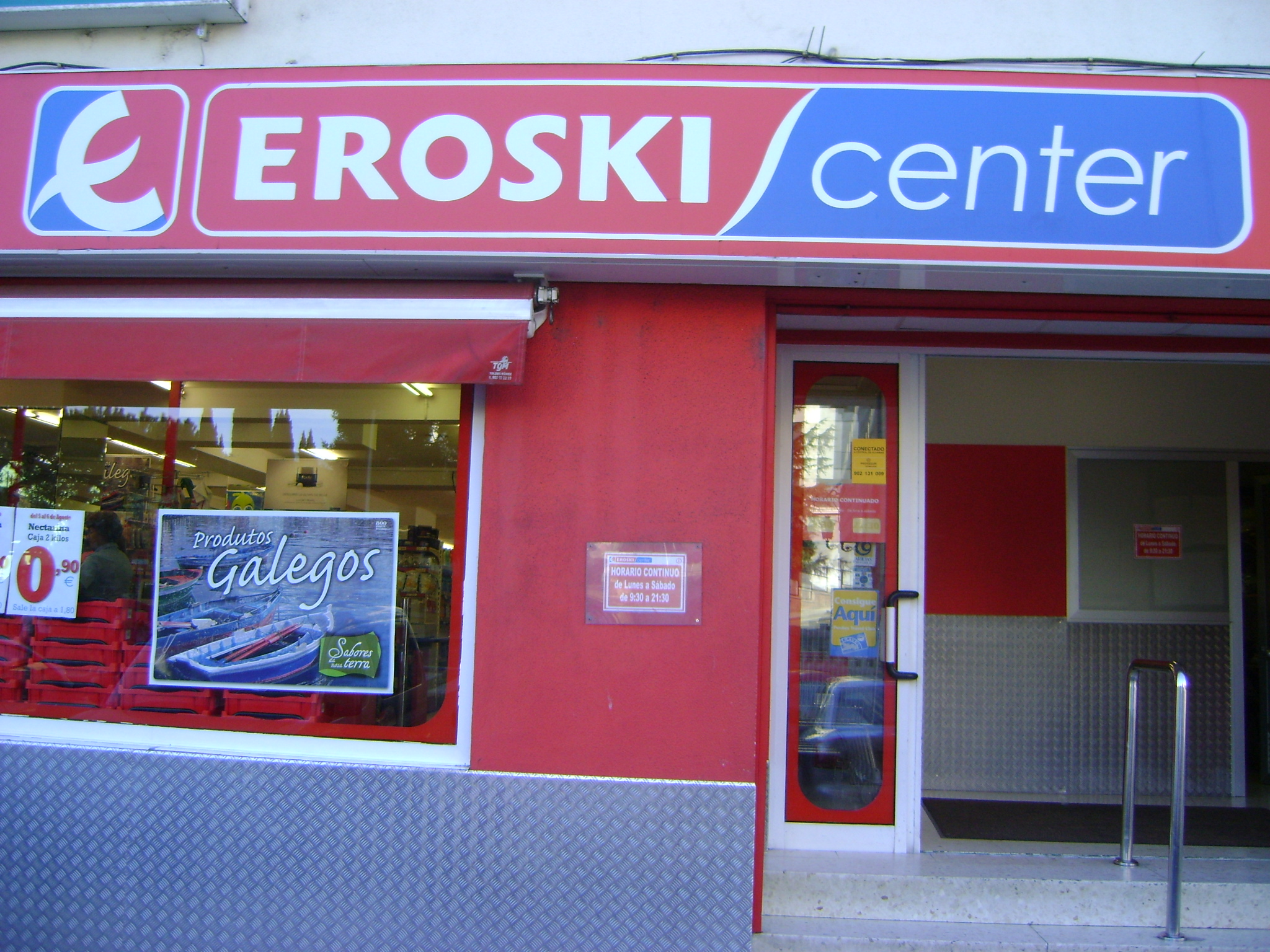
Eroski is a supermarket subsidiary of Mondragon - a Basque corporation
made up of hundreds of smaller, worker-owned co-operatives.
(Pic : Wikipedia)
It can work, and it can be serious business. It's been proven in the Basque Country. Mondragon Corporation – a federation of 200+ companies and co-operatives, employing some 84,000 people, had a €15billion turnover in 2010. It does everything from making consumer goods, banking, architecture, supermarkets and even has its own university.

That doesn't mean that this is some "utopian" solution to our own problems – Mondragon has enough problems of its own and is not free from criticism, usually from the left (see : Sharryn Kasmir's The Myth of Mondragon). Once a co-op reaches the size of Mondragon, does it "sell out"? Does it lose the sense of "ownership"?

Imagine if the Valleys had a Mondragon?

A banking arm based in Merthyr Tydfil, a manufacturing arm HQ'd at Ebbw Vale, an affiliated university, an energy company HQ'd at Hirwaun, a supermarket chain based in Caerphilly, a fashion chain in the Rhondda, an IT company in Cwmbran and a landmark headquarters north of the M4.

Now that would be something to see, wouldn't it.