This site is no longer updated

Please use the links in the sidebar to visit the new sites!

Showing posts with label France. Show all posts

Saturday, 26 October 2013

New law to rein in abandoned horses

A lovely horse, and some not so lovely horses.
The Welsh Government are cracking down on illegal fly-grazing via a new law

There've been instances across Wales of horses being left to fly graze on public land or farmland illegally, and for some time, the Welsh Government have wanted to clamp down on abandoned horses.

Bridgend and the Vale of Glamorgan are, in fact, picked out as "hot spots" for fly-grazing.


In 2011, more than 250 stray horses and ponies rampaged around Laleston and Coity, some managing to get onto the M4. In 2012, stray horses in the Bryntirion area of Bridgend took over playing fields and invaded both the local secondary school and people's gardens. Byron Davies AM (Con, South Wales West) has also raised concerns about ~200 abandoned horses in the Gower.

Horses can be temperamental, so can be dangerous to anyone who isn't used to handling them. It's usually the fire service and police who deal with the horses themselves, but local authorities have complained that the powers they currently have are "inadequate to enable them to tackle the issue."

In response, last week Natural Resources and Food Minister Alun Davies (Lab, Blaenau Gwent) introduced the Control of Horses Bill to the National Assembly.

A bit of controversy

Once again, the Welsh Government have sped up legislation, this time bypassing the first committee stage, which usually includes evidence from interested outside parties and experts. The Bill's fairly short and easy to understand so I don't think they're trying to pull a fast one, but you've got to wonder if the Welsh Government are starting to bypass legislative stages out of habit.

Ironically, Welsh Conservative leader - and farmer - Andrew Davies (Con, South Wales Central), might've provided the impetus by suggesting in previous debates that a fly-grazing law "could be required this winter" if it's harsh enough to put animals at risk. He believed the Welsh Government should "reach out to opposition parties to try to instigate a speedy passage of the Bill".

So they did, and the minister says he received concrete cross-party for it. That's the clear party political view, but - putting aside unrelated criticism of Alun Davies over the last 48 hours for a moment - it's not the view shared by the Assembly's committees.

Respective chairs of the Environment & Sustainability and Finance Committees - Dafydd Elis Thomas AM (Plaid, Dwyfor Meirionnydd) and Jocelyn Davies AM (Plaid, South Wales East) - criticised the decision at some length during the first debate on Tuesday.

Simon Thomas AM (Plaid, Mid & West Wales) - speaking on behalf of the Constitutional & Legislative Affairs Committee - said they didn't have a chance to scrutinise the legislation beforehand and that the committee "didn't like working this way."

A William Graham AM (Con, South Wales East) amendment to the debate motion "regretting" the decision to bypass the first committee stage failed to pass by just two votes.

What the law intends to do

The law covers "all equine animals".
(Pic : zoochat.com)
Bill here (pdf), explanatory memorandum here (pdf).

The Bill :
  • Gives local authorities the power to seize, impound and dispose of horses which are either :
    • On highways or in public places without lawful authority
    • On land without the consent of the landowner/occupier ("landowner" includes local authorities themselves)
  • Places statutory duties on local authorities to:
    • Give written notice at the point of seizure and to the police within 24 hours.
    • Take reasonable steps to find the horse(s) owner and inform them in writing within 7 days of seizure.
    • Keep a public register of all horse seizures.
  • Will mean horse owners are liable for the costs of any seizure of horses under this law, and the local authority won't be obliged to return a horse until payment has been received in full.
  • Will mean if the horse owner, or someone on their behalf, hasn't been found/come forward with 7 days, local authorities have the power to arrange for the "disposal" of the horse, including euthanasia.
  • Outlines that if money made from disposal falls short of the costs of seizure then the owner will be liable to make up the difference, but also if the disposal exceeds costs of seizure then the local authority will be required to pay the owner the difference.
  • Places a duty on Welsh Ministers to draft regulations for an appeals process.
  • Repeals/supersedes clauses relating to wild horses in previous local government legislation.
"Horse" for the purpose of the Bill is defined as a horse, donkey, pony, mule, hinny (whatever one of those is) and "any other equine animals". Zebras of Wales - not just the Treorchy kind - have been put on notice then, while somewhere there's a zoologist crying.

I know I'm talking theoretically here, but you can imagine what the public reaction might be if a zebra escaped from a travelling circus, zoo or sanctuary, wasn't recovered in time, and was (somehow) set to be put down under this law.

The Assembly's Finance Committee have asked for updated estimates of how many horses the Welsh Government would expect to be destroyed should the Bill become law. It's also said in the explanatory memorandum that the law will be reviewed two years, or sooner, after it becomes law.

What the law means

The explanatory memorandum says the Bill has been welcomed by animal welfare organisations and equine societies such as RSPCA, Redwings and Blue Cross,  who've seen sharp increases in the number of horses seeking re-homing or being abandoned.

The overriding goal of the law is clear cut, and it's obvious the Welsh Government are getting tough with fly-grazers.

Horse owners would have a week to reclaim their horse(s) if seized by a local authority. If not, the horse will either end up re-homed or in a knacker's yard, with the owner facing a hefty bill for their trouble.

7 days might seem harsh – previous limits were 14 days - and it was raised by Joyce Watson AM (Lab, Mid & West Wales) in the Environment & Sustainability Committee, while Julie Morgan AM (Lab, Cardiff North) had concerns about the potential impact on gypsies and travellers.

You've also got to wonder if disposal is the best solution, when compulsory microchipping of horses - in the same manner as dogs - might be better in the long-term.

Alun Davies told the committee he would expect "any responsible horse owners to check their horses on a daily basis". Negligent horse owners might have also seen the old limit as 14 days of free food for their horse(s) at the expense of someone else's land.

Some existing laws – like the Animals Act 1971 and Animal Welfare Act 2006 – place duties on owners to ensure the welfare of animals they own, and gives landowners the power to detain livestock that stray onto their land. Legislation specific to some old counties of Wales also granted local authorities the power to seize stray animals, however those provisions don't cover the whole of Wales, while the Control of Horses Bill will.

A similar, but significantly more extensive, law was passed in the Republic of Ireland in 1996. I think it perfectly highlights the difference between the sovereign powers an independent nation has and devolution.

The current cost of fly-grazing to the police, RSPCA, councils, equine societies and fire service is said to be a cumulative £1.2million a year.

The average cost – citing examples in Bridgend and Vale of Glamorgan – of a horse seizure is around £500 per horse, while other local authorities like Swansea say the costs are between £1,000 and £1,500 per horse.

The costs of the proposed law are mixed. Some local authorities operating under the local laws mentioned above will already carry out some of the functions outlined in this proposed Bill, so it won't cost them anything. For the rest, it might cost around £600 per horse.

To put things in perspective, Bridgend, Vale of Glamorgan and Swansea impounded 154 horses in 2012 alone – which is much higher than I had expected, working out at almost three horses a week.

At national level, a contract for secure accommodation for seized horses would cost around £450,000 to set up, and £300,000 per year afterwards. It'll cost the Welsh Government £11,000 to issue the appropriate statutory guidance.

I'd also propose another, less politically correct, solution to the problem:


I don't understand why people are squeamish about eating horse meat. It's eaten across Asia and mainland Europe – especially France, Italy, and northern Europe - we have loads of them, it's better for the environment as horses fart less methane than cows and they're all free range. It's also completely legal, just unfashionable.

It might encourage those thinking of abandoning their horses to sell them instead. You have to wonder if there would be a market for Welsh boucheries chevalines.
Saturday, 27 April 2013

The rise of Europe's far-right

Has a shift on the fringes of politics to far-right and populist conservative parties
in Europe been a recent phenomenon? Or is it more complicated than that?
(Pic : The Guardian)

Back in January, Human Rights Watch warned that far-right politics in Europe were becoming more mainstream. No specific causes were outlined, however this has – in my opinion – inevitably come about as a result of the European economic crisis, as well as more localised problems which haven't been properly dealt with since the end of the Cold War.

Goose steps over Europe


It's worth pointing out that shifts to far-right, or populist hard right politics in Europe aren't recent. Since the threat of Islamic fundamentalism was brought to the fore post-9/11 attacks, countries in Europe with small, unintergrated minorities have seen a noticeable shift to the right, perhaps in a panicked attempt to "protect themselves" through limiting things like immigration.

The first major shift in modern times was probably the Austrian Freedom Party (Freiheitliche Partei Österreichs [FP
Ö]) under the leadership Jörg Haider, who was killed in a car accident in 2008. The Freedom Party won 27% of the vote in the Austrian federal elections in 1999, winning 52 seats, and eventually formed a governing coalition with the conservative Austrian People's Party.

Did the success of  the FPO in 1999 "legitimise"
the far-right in European politics?
(Pic : Der Standard)

Although the FPÖ at the time were more populist that outright fascist, Jörg Haider had expressed sympathy for select Nazi policies, was accused of anti-semitism as well as having links with Holocaust deniers. The election of the FPÖ shocked Europe so much, that 14 nations introduced temporary diplomatic sanctions against Austria via the European Union. Eventually, the EU was forced into a rather humilating climb-down, but the precedent has been set, and it more than likely played a role in Haider stepping down from his role as party leader.

Despite an ongoing "professionalisation" of far-right parties like the French Front National and the BNP, this was probably the first time the far-right had been "legitimised" in Europe since the 1920s and 30s. This will, in my opinion, have had a knock on impact on other nations too.

Between 1998 and 2001, the populist anti-immigration Danish People's Party (Dansk Folkeparti) made a major breakthrough in the Folketing, winning 22 seats – a rise of 9. That's roughly the level of support they've remained at since, peaking at 25 seats following the Jyllands-Posten Mohammed cartoon controversy. They played ”kingmaker” in 2001, offering their support to enable a right-wing coalition government to be formed, in exchange for changes to Denmark's immigration rules – now amongst the strictest in Europe.

The right-wing Flemish nationalist Vlaams Blok (now Vlaams Belang) were effectively disbanded. They breached Belgian anti-racism laws, once proposing a form of segregation in parts of public life and expulsion of non-European immigrants. They peaked at 32 seats – near enough a quarter of all seats - in the Flemish Parliament in 2004.

The populist anti-immigration PVV played "kingmaker" following
the 2010 Dutch general election. A trend seen in other European countries.
(Pic : BBC)

Further north, in the Netherlands, the Party for Freedom (Partij voor de Vrijheid [PVV]) managed to win 24 seats in the lower house Dutch general election of 2010. Under the leadership of the charismatic Geert Wilders – something of a hard line spiritual successor to the assassinated right-libertarian Pim Fortuyn - they adopted a strong stance on Europe, Islam and immigration. Like the Danish People's Party, they were instrumental in government formation through something akin to a confidence and supply agreement.

The hilariously-named Liberal Democratic Party of Russia – whose policies, which are neither really democratic or liberal, hint that they would try to hunt down and eat our Lib Dems – somehow have 56 seats in the Duma. They want the Russian Empire back, and they wouldn't be afraid to use nuclear weapons to get it back either.

In the present, however, two of the more significant far-right movements are perhaps the most worrying.


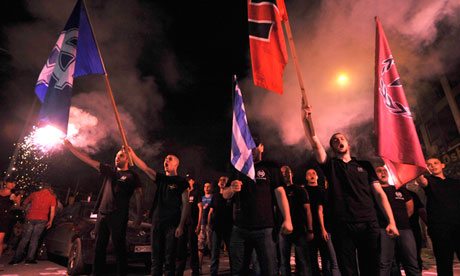
Golden Dawn - the first Nazis freely-elected in Europe since the 30s?
(Pic : The Guardian)

Between 2006 and 2010, Jobbik of Hungary came from nowhere to win 47 seats in the Hungarian Parliament. They once had a ”uniformed group” that probably fell short of an outward paramilitary organisation, though they were disbanded by the Hungarian courts. Although they strongly deny any racism against minority groups – including the Roma - in 2012, a Jobbik MP called for the creation of a list of dangerous Jews who ”pose a threat to Hungarian national security.”

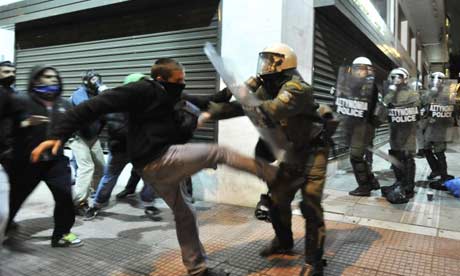
In Greece, since the torturous collapse of the country's economy, Golden Dawn won 18 seats in the Greek Parliament. They have links to hooliganism, and have been implicated in violent attacks against political opponents and ethnic minorities. Their election slogan in 2012 was, "Rid this land of filth." They're probably the closest Europe has come to freely-elected Nazi's since 1933.

It isn't all rosy

Despite all this, far-right parties and populist right-wing parties very rarely get into "power". They generally, at best, end up as small players in coalitions. Or – as in the Netherlands and Denmark – remain outside of government entirely, only popping up to get a few concessions to prevent centre-right governments collapsing. So, I think there is a natural "glass ceiling" when it comes to the far-right or populist conservatives.


Many of the parties I've mentioned have fallen back in recent elections. The PVV lost 9 seats in the last Dutch elections in 2012 for example. They were also responsible for that early election by withdrawing support for the ruling coalition, after a disagreement over austerity measures. Geert Wilders was blamed by the coalition partners and, ultimately it seems, the Dutch public for it.

Despite grabbing headlines, the overall performance of far-right
parties in many European nations states is poor.
(Pic : The Guardian)


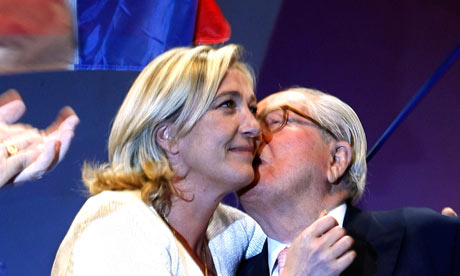
Germany's National Democratic Party (Nationaldemokratische Partei Deutschlands [NPD]) have never performed well at all levels of government in Germany - perhaps understandably - with only a dozen or so elected representatives in state legislatures. In France, despite high-profile, highly-visible successes in Presidential and European elections, the Front National perform poorly at local, regional and national level, with only two Deputies. In Austria, the Freedom Party have never really attained the heights they did under Haider.

That's before mentioning the abject electoral performances of far-right parties closer to home.

I don't think there's anything more damning for liberal politicians than for the public to turn around and choose a far-right candidate over them. Barring legitimate concerns over some policy areas, it's the ultimate protest vote, boiling down to, "I'd rather vote for a Nazi(ish politician) than you." But I don't think many people voting for them really want a far-right (or in many cases far-left) politician to represent them, more give the "usual lot" a very big kick up the backside.

The far-right in Wales and the UK

Have the EDL been and gone?
(Pic : The Telegraph)
Naturally, I've got to position Wales in this somehow. Because we have a right-wing government in Westminster, the far-right in the UK, Wales included, is perhaps neutered. We've already seen a tightening of immigration rules - with negative effects on the Welsh NHS - and a level of right-euroscepticism from Tory backbenchers in Westminster.

Something both far-left and far-right parties and organisations share is a lack of ideological unity, or splits in support by people seeking an "ever purer" version of their politics.


Internal problems within the BNP have led to them suffering said splits in support. Some joined or forming new parties, with the National Front seeing a teeny-weeny resurgence, and the English Defence League probably stealing the BNP's thunder as the most vocal "far-right" organisation on the island of Great Britain. Even the EDL have probably come and gone, as attendances at their rallies - which once mobilised thousands - have been reduced to a hardcore.

The performance of far-right parties in Wales has been historically atrocious – though not quite as bad as Scotland – and I don't see that changing any time soon. There was a poorly-attended "White Pride" march in Swansea a few weeks ago, which is absolutely hilarious in context. Swansea is 94% white and that's one of the lowest percentages.

However, in terms of the "populist hard right", things might be changing and it would threaten the Welsh Conservatives more than any of the other parties.


With UKIP presenting a - you could almost say "secular" - non-racist way to express disapproval over policy areas like Europe and immigration, as well as a strident British Nationalism, I don't think the future of the far-right in Wales or the UK is rosy at all. Beyond Nigel Farage, UKIP don't really have much, though that could change. However, Nigel Farage could well be the BNP's executioner if he can convince enough people concerned over policy areas like immigration that he presents a creditable and socially-acceptable voice for them. That's probably the reason why there may be ex-BNP in UKIP.

The BNP's executioner? Do UKIP offer a "softer", "secular"
more socially-acceptable voice for those concerned about
immigration and Europe?
(Pic : BBC)
Those ex-BNP were probably sold a lemon "we're not racist" schtick when selected as paper candidates by the BNP, and some people's opinions will change over time. Some don't, and they'll probably embarrass UKIP. Opposing high levels of immigration or the EU - even if I don't agree with that - doesn't mean you're a racist as long as you present a reasonable argument. I do believe parties like UKIP have failed to do that, and they're far too reactionary.

But in my opinion, all that would be is a shift to a "populist hard right" similar to Denmark and the Netherlands. That would be much more preferable than a move to neo-fascist organisations seen in parts of eastern and southern Europe.

Again though, I don't think there's any chance of UKIP being in position to run anything larger than a rural English district council. Their aim will likely be to drag the Conservatives to the right, and the rest of us out of the EU.

The EU : A last defence against fascism?


This is the first major economic downturn parts of Europe
will have faced since the end of the Cold War....and they're struggling.
(Pic : Wall street Journal)
Many self-styled rebels in western Europe might wear Che Guevara t-shirts as a reaction to a free-market orthodoxy.
Many younger people in eastern Europe of voting age, will not have grown up under the iron jackboot of Soviet Communism, which was nothing more than fascism with a heart. They'll have probably been told stories of how brutal and repressive it was, and how its collapse left their newly-emerging nation states in a weak position.

Those in eastern, and perhaps southern Europe, look to relics of long-dead glorious empires and the social order that used to "exist" under ultra-nationalist dictatorships. Remember that the Axis in WWII consisted of more than Germany, Italy and Japan; it included plenty of puppet regimes in eastern Europe and the Balkans too.

This resurgence of the European far-right is not only the fault of the global financial sector, but the   mainstream, technocratic Christian and social democrats who dominate European politics.

In the west and south, they've failed to get a grip on issues like the high cost of living, they helped to prop up and create housing bubbles and in some circumstances they've mortgaged the future of their younger generations to pay off the mistakes of the present.

In the east, while the cost of living remains low compared to the west, they're just getting through the first major economic downturn since the fall of Communism. In some countries like Latvia, it's caused property bubbles to burst, while elsewhere they're experiencing double digit unemployment rates and high levels of poverty, used to exploit inter-ethnic tensions.

Meanwhile, EU institutions have become cumbersome and wasteful – perhaps in some circumstances causing more problems than they're supposed to solve.

The trouble is that as soon as mainstream politicians and parties are seen to be failing to address issues like those, at a time when things are tough and people are scared, charismatic individuals come to the fore offering simple soundbite solutions to complex issues. Sometimes they only offer a closed fist and a jackboot. When you've exhausted all avenues with "traditional" parties, what else have you got to turn to?

There's one firewall though. All those nations, by and large, still want to be "part of the club" when it comes to the EU, even if levels of scepticism and uncertainty about the EU itself are on the rise. If they shift towards fascism rather than a populist, UKIP-style "tough on crime and immigration" stance, it would generate enough disgust within the EU to trigger sanctions – be they economic or social – and that would play a role in bringing them back into line.

This is going to sound ridiculous, but for all its faults, we should start to position the EU in terms of it being the last line of defence for European liberal democracy.

Thursday, 7 June 2012

Euro 2012 predictions


It's the biggest single-sport event of the Summer, co-hosted by Poland & Ukraine,  starting tomorrow afternoon.

There's no Welsh involvement obviously. The death of Gary Speed cast a shadow over a promising end to the qualification campaign. With the European Championships expanding to a 24-team tournament, Euro 2016 will be the best chance for Wales to qualify for a major tournament since 2004's disappointment. Wales should make the most of it, because I'm sure once all the complications of a 24-team tournament become obvious, it'll revert back to 16-teams.

However that's no reason to avoid looking at how our English and Irish friends will do.

Group A

Russia
Poland
---------
Czech Republic
Greece

Co-hosts Poland have an exciting generation of young players coming through. Wojciech Szczesny is one of the most talented young goalkeepers in the English Premier League, while Robert Lewandowski is one of the most prolific strikers in Europe. They are on the cusp of emulating the great sides of the 70s and 80s. It'll probably be inexperience of a few of the players that will let them down, offset by home advantage. I think they can get out of their group.

Russia have an immensely talented team, and an extremely effective forward line that includes the likes of Andrei Arshavin, Roman Pavlyuchenko and Pavel Pogrebnyak. I expect them to be fighting with the Czech Republic and Poland for the top two places and they'll probably get through in the end. They'll be serious challengers for a European or World Championship in the next decade, but I think this is too soon.

The Czech Republic will want to exorcise memories of Euro 2008, Petr Cech in particular. Milan Baros has a fearsome record at international level in goalscoring, but will influential player, and captain, Tomas Rosisky manage to stay fit the whole tournament? Russia will be too strong for them, I'm guessing, and they play Poland in their last game which will probably be the decider for second place, with home advantage being critical.

Greece will want to put smiles on faces back home. Can they repeat Euro 2004? Not a chance. They'll have to be incredibly disciplined, and incredibly lucky, to get out of a group with the hosts, Russia and the Czechs.

Group B

Netherlands
Germany
---------
Portugal
Denmark

The "Group of Death" in this tournament, but I actually think it's going to be fairly routine.

The Netherlands have one of the strongest squads at Euro 2012 and likely to be amongst the favourites. Only great rivals Germany are a real threat to them in this group. They are an incredibly attack-minded side, despite their anti-football at the 2010 World Cup Final. I fully expect them to get out of the group.

Germany are overdue a big tournament win, their last international trophy being Euro 96. If I were a betting man I'd put money on them. They are most people's favourites this time around, and probably mine as well. I think they'll be too strong for Portugal, and will probably flatten Denmark. It would be a huge shock if they didn't get out of this group.

Portugal look weaker than previous years, but on their day they can be a match for anyone. I just don't think they have enough to take on The Netherlands and Germany. They have no strikers of any note and will probably be reliant on Christiano Ronaldo and Nani to create chances.

Denmark will probably lose every game in a group like this. They performed incredibly well in qualifying, but I think even they'll accept this draw could've been kinder. Third place in the group at best. They have some of the best travelling fans in Europe though.

Group C

Spain
Italy
----------
Croatia
Republic of Ireland

I think Spain are going to be found out this time around, but they are still obvious contenders. Injuries to Puyol and Villa will be huge blows, and the core of the team are starting to show their age. I fully expect them to remain competitive, but I don't think they'll retain their title.

I think Italy are going to be the surprise package. They've had two very disappointing tournaments on the trot. With match-fixing scandals at home, they tend to perform when their backs are up against it. A few kind results here and there could see them go far, but I'd be surprised if they won it. They have a young side with a lot to prove, tempered with an experienced midfield at their peak ages, but they'll have to hope Mario Ballotelli doesn't go off on one, or destabilise the squad.

Croatia suffered heartache in 2008, exiting to Turkey on penalties. They have some very gifted players like Luka Modric, Niko Kranjcar, Eduardo and Vedran Corluka. However I think Spain and Italy will simply be too much for them.

What of the Republic of Ireland? Their first European Championships for 24 years. Russia aside, they had a pretty easy qualifying group in all honesty, and I think it'll show. It does have some sort of inevitability that they'll likely get something out of the Italy game, but it's incredibly optimistic to see them get out of their group.

Group D

France
England
----------
Sweden
Ukraine

France are a far cry from the shambles they were at the 2010 World Cup. On paper, they have one of the strongest squads, but it depends on which France will turn up. I fully expect them to qualify from the group quite comfortably, but after that, who knows? The tournament's dark horses, in my opinion, but they'll have to convincingly beat England in the first game.

What lies ahead for England (or should that be Liverpool-Everton XI) and Woy? The squad is mostly young, hungry, but in some areas woefully inadequate or inexperienced for this level – in particular "bench/squad" players. I think it's safe to say England are "in transition". However, I think they place too much emphasis on Wayne Rooney's contributions and are overestimating Sweden and Ukraine. They'll find it difficult, but I'd expect them to qualify from the group, which is probably the minimum the English would expect. For once though, I don't think there are many people predicting an England tournament win. Maybe with expectations at a low level though, they can produce results with the pressure off. We'll see.

Sweden's qualification performance betrays the straightforwardness of that qualifying group (Netherlands aside). They don't have a squad that screams that they'll do anything dramatic. Zlatan Ibrahimovic will probably be carrying the side, but they have a decent record at big tournaments for a country their size. Maybe they can cause an upset against England or France, but likely not.

Co-hosts Ukraine play in a European championships for the first time. Most of their players play in the, not brilliant but not great either, Ukrainian Premier League. I'm not expecting miracles from them here, but I wouldn't be surprised if they pulled off a brave performance or two in front of their own fans.

I also think the racism issue, however serious, has been massively overblown. Club and international football are very different and the Ukrainians won't allow anything to happen that projects them in a bad light. These "negative" stories are dug up before every major tournament. In 1994 it was that the Americans didn't like "sawkerball".  In 1998, 2000 and 2006 it was hooliganism (and it did come true to an extent). In 2002 it was the South Korean and Japanese perceived lack of atmosphere. In 2004 it was organisational difficulties in Portugal.  In 2010 it was South Africa's high crime rate. It's racism this time around, and it appears organisational difficulties are being expressed for 2014. The less said about the 2018 and 2022 World Cups the better.

Maybe it's justified this time, but it does have a patronising, sensationalist, perhaps even ignorant, undertone to it. Finger's crossed nothing happens to cast a shadow.

Knockout stages


Quarter-finals

Russia v Germany
Spain v England
Netherlands v Poland
France v Italy

Russia get a rubbish draw from their perspective. It should be against Germany, who should also win any duel between them. England, should they fail to win their group, will likely face Spain and I think there's only ever going to be one outcome there – England out at the quarter finals, but probably not involving penalties.

Netherlands v Poland should be a walkover for the Dutch (on paper), despite home advantage for the Poles. France v Italy would be an interesting one and hard to call. I'll go for France through on penalties. It's a coin toss.

Semi-finals

Germany v Spain
Netherlands v France

A step too far for Spain I believe. There's been a noticeable shift from "attractive" to "efficient/direct" football across Europe the last few years. If anyone can stomp out Spain's Barcelona-inspired "tiki-taka", it'll be the Germans.

There's one small problem with the Netherlands – they're perennial chokers. On paper they'll get into the final, but I wouldn't be surprised if France fluke it, sending the Dutch home on penalties or in extra time.

Final

Germany v France

The Germans are due a big tournament win, as I said earlier, I think they'll get it too – against France or the Netherlands.

Monday, 26 September 2011

Should a second language be compulsory at GCSE?

The Western Mail is reporting that CILT Cymru - the body for language teaching in Wales - believes that Welsh schoolchildren are falling behind their mainland European peers when it comes to learning a foreign language. They cite the number of pupils taking a full foreign language GCSE have fallen from 55% in 1995 to 29.6% in 2008.

As you might expect, some of the mouthbreathers that skulk around the Walesonline comments sections are pointing the finger at Welsh - probably because it's being taught at all rather than a compulsory subject at GCSE level.

For the record, I don't believe that Welsh should be compulsory post-14 in English-medium secondary schools
. I'll expand on my reasoning later in this post.

Mastering a Language

(For related and more in-depth look at the figures behind this, I seriously recommend this and other posts on Syniadau.)

It's said that it takes 10,000 hours to master a skill. There's no reason why this cannot include second languages. Also, some people will be naturally adept at picking up languages or linguistic skills in general, which may reduce the time. The reason people become fluent in a language is because they're immersed in it. All lessons in English-medium schools are as much English lessons as the subject being taught - and they certainly add up to 10,000 hours.

It's the same situation in Welsh-medium schools with regard Welsh, except these children (in many cases) are as likely to use English outside the classroom. That's true bilingualism.

At the moment, the Welsh GCSE short course - which the majority of GCSE students take to meet their "compulsory Welsh" requirement - consists of one or two hours of contact time A WEEK (not including homework). Welsh is compulsory in the same manner as Religious Education and PE are. It's something to fill a gap in the timetable, not a serious attempt at bilingualism.

Likewise, the full GCSE might be only be 3 or 4 hours of contact time a week.

This applies as much to modern foreign languages (MFL) as it does to Welsh. The way we teach children languages - except English - doesn't prepare them for fluency. Unless students take a MFL to A-Level or beyond, it's highly unlikely that they'll have anything other than a passing familiarity with the language.

My German GCSE would probably enable me to cope on a short trip, or even pick up a little bit extra from a phrase book or quick course, but it would never prepare me for business or to live there.

Bonjour, Guten Tag, Shwmae butt

Let's look at how languages are taught in outward looking internationalist countries mainland Europe.

France – A first and second foreign language are core compulsory parts of the French curriculum at all levels. A first foreign language (usually English or Spanish) is introduced in primary schools. Some schools still have Latin and Greek as optional subjects.

Germany – A foreign language is taught at every level in the German education system - usually English. Students choose from a wider variety of second languages at secondary level, and a second language is most times mandatory - sometimes even a third language - studied to the German equivalent of A-Level. Some German gymnasium (grammar schools) still teach Latin.

Netherlands – Schools teach English from between their equivalent of Years 3 and 6. Language education is a core - usually compulsory - part of the Dutch curriculum at all levels.

Finland
– Pupils are expected to learn two languages other than Finnish from age 7 right the way through the school system. There's a strong emphasis on reading (for pleasure) and communication skills from the outset.

The English Problem

There is no question, English is the international lingua franca (for now). Welsh students have an advantage of being able to speak it natively.

The - not necessarily arrogant - assumption that all you need is a good command of English to succeed internationally has helped create a blasé
attitude to foreign languages (including Welsh, which is a foreign language from a non-Welsh perspective). Why go through the hard graft learning a second language when you can take an "easier" GCSE instead?

In a way, the fact that many European nations choose English as the first foreign language to introduce to students has created this problem. This isn't because of the UK (with the exception of London), but the United States. How else would teenagers in Germany and France consume the latest Hollywood blockbuster or RnB hit without a decent grasp of English? Of course, they have dubbing and subtitle but it's not the same. English-language culture still has a big pull.

If foreign languages are ever going to take off in Wales - or indeed, the rest of the UK - these languages also need that pull. Welsh already has it to a certain extent, though you don't need to be a fluent Welsh speaker to enjoy the latest Welsh language music or watch S4C.

What can we do?
  • Introduce a third language at a much earlier age (around year 4), presumably a Romance language like French or Spanish due to the similarities with Welsh.
  • Teach Welsh, the "third language" and English along side each other in some lessons - especially those focusing on grammar and comprehension.
  • Introduce other foreign languages in Geography and History lessons in primary school. At least one of Arabic, Mandarin or Japanese should be explored.
  • Use sports stars, especially Premier League, La Liga footballers and French-based Welsh rugby internationals, to boost language uptake amongst boys in particular. Efforts to do this so far have been half-hearted.
  • A second (or third in the case of Welsh Medium schools) language should be a compulsory full GCSE choice - but this shouldn't have to be Welsh in English medium schools. English Literature, Religious Education (except faith schools), IT and PE should be dropped as a compulsory GCSE's to compensate.
  • Widen the choice of languages available at GCSE (i.e Mandarin, Portuguese, Japanese, Russian, Arabic, Hindi).

Proposed GCSE subject structure


Compulsory:

Mathematics
Double Award Science (or Separate Sciences)
English Language
Welsh First Language (WM Schools only)
Religious Studies (Faith Schools only)
Personal & Social Education (Not Examined)

Electives (Depending on facilities available to schools)

  • One Language other than Native Language(s)
Welsh, French, German, Spanish, Mandarin, Arabic, Hindi

  • One Technical, Scientific or Numerate Subject
Information Technology, Separate Sciences, Design & Technology, Textiles, Engineering, Business Studies, Accountancy, Economics, Electronics, Automotive Engineering & Design, Construction, Plumbing, Carpentry, Food Science

  • One Humanities Subject
Geography, History, Business Studies, Psychology, Sociology, Law, Politics, Philosophy, Economics, Classical Studies, Media Studies, Religious Studies, Physical Education, Care & Health, Tourism & Hospitality, Food Science

  • One Creative Arts Subject
English Literature, Welsh Literature (WM Schools), Art, Graphic Design, Music, Drama, Physical Education, Design & Technology, Media Studies, Food Science

  • First Free Choice

  • Second Free Choice (English Medium non-faith Schools Only)

Thursday, 8 September 2011

Rugby World Cup 2011 Predictions

Dere 'mlaen Cymru!..............
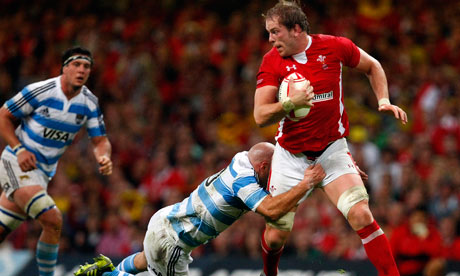
........until the quarter finals at least (Pic : Guardian)


The Rugby World Cup kicks off tomorrow, with all the home nations involved of course. I'm not much of a rugby fan to be frank - I'm more into football - but I believe I know just enough about the sport to make a prediction on the outcome.

The kick off times might be a bit inconvenient for the large European and African audiences, but the Antipodeans have had to deal with that every time the tournament has been hosted in the north - fair's fair.

Only five nations are realistic contenders for the trophy : New Zealand, Australia, South Africa, England and France. Many believe this World Cup is New Zealand's to lose. Call me lazy if you want, but I can go along with that.

A best case scenario for Wales and Ireland are kind draws in the quarter finals (depending on their results in their respective pools) that might open the door to the semi's or even the final itself but that's a long shot. Whether Scotland can get that far depends on their result against Argentina.

This Welsh side appear to be the best prepared ever for a World Cup. I think they can and will exorcise some Oceanian demons this time around....touch wood.

Pool A

New Zealand
France

==========
Tonga
-----------------
Japan
Canada

Pool B

England
Argentina

==========
Scotland
------------------
Georgia
Romania

Pool C

Australia
Ireland

===========
Italy
------------------
United States
Russia

Pool D

South Africa
Wales

===========
Fiji
----------------
Samoa
Namibia

Quarter Finals (winners in bold)

Australia v Wales
England v France
South Africa v Ireland
New Zealand v Argentina

Semi Finals

Australia v England
South Africa v New Zealand

Third Place Game

England v South Africa

Final

New Zealand v Australia