This site is no longer updated
Please use the links in the sidebar to visit the new sites!
Showing posts with label Monetary Policy. Show all posts
Tuesday, 28 June 2016
Monday, 22 February 2016
EU Referendum : The Deal
By OwenMonday, February 22, 2016Banks, Borders, Business, Cons, EU, EUCOM, Foreign Affairs, FreeMove, InOutRef, Monetary Policy, PM, Regs, Trade, WelfareView Comments
![]() |
| (Pic : Reuters via BBC) |
As you're probably all more than aware, last Saturday the Prime Minister, EU Commission and heads of government of other EU member states (EU Council) reached agreement on a renegotiated UK membership of the EU – you can read the text of the agreement here (pdf).
Saturday, 27 April 2013
The rise of Europe's far-right
By OwenSaturday, April 27, 2013BNP, Borders, Civil Liberties, Communists, Cons, EmpSk, EU Parl, Flanders, Foreign Affairs, France, Greece, Housing, Hungary, Monetary Policy, Nationalism, Netherlands, Racism, Russia, UKIP14 comments
| Has a shift on the fringes of politics to far-right and populist conservative parties in Europe been a recent phenomenon? Or is it more complicated than that? (Pic : The Guardian) |
Back in January, Human Rights Watch warned that far-right politics in Europe were becoming more mainstream. No specific causes were outlined, however this has – in my opinion – inevitably come about as a result of the European economic crisis, as well as more localised problems which haven't been properly dealt with since the end of the Cold War.
Goose steps over Europe
It's worth pointing out that shifts to far-right, or populist hard right politics in Europe aren't recent. Since the threat of Islamic fundamentalism was brought to the fore post-9/11 attacks, countries in Europe with small, unintergrated minorities have seen a noticeable shift to the right, perhaps in a panicked attempt to "protect themselves" through limiting things like immigration.
The first major shift in modern times was probably the Austrian Freedom Party (Freiheitliche Partei Österreichs [FPÖ]) under the leadership Jörg Haider, who was killed in a car accident in 2008. The Freedom Party won 27% of the vote in the Austrian federal elections in 1999, winning 52 seats, and eventually formed a governing coalition with the conservative Austrian People's Party.
| Did the success of the FPO in 1999 "legitimise" the far-right in European politics? (Pic : Der Standard) |
Although the FPÖ at the time were more populist that outright fascist, Jörg Haider had expressed sympathy for select Nazi policies, was accused of anti-semitism as well as having links with Holocaust deniers. The election of the FPÖ shocked Europe so much, that 14 nations introduced temporary diplomatic sanctions against Austria via the European Union. Eventually, the EU was forced into a rather humilating climb-down, but the precedent has been set, and it more than likely played a role in Haider stepping down from his role as party leader.
Despite an ongoing "professionalisation" of far-right parties like the French Front National and the BNP, this was probably the first time the far-right had been "legitimised" in Europe since the 1920s and 30s. This will, in my opinion, have had a knock on impact on other nations too.
Between 1998 and 2001, the populist anti-immigration Danish People's Party (Dansk Folkeparti) made a major breakthrough in the Folketing, winning 22 seats – a rise of 9. That's roughly the level of support they've remained at since, peaking at 25 seats following the Jyllands-Posten Mohammed cartoon controversy. They played ”kingmaker” in 2001, offering their support to enable a right-wing coalition government to be formed, in exchange for changes to Denmark's immigration rules – now amongst the strictest in Europe.
The right-wing Flemish nationalist Vlaams Blok (now Vlaams Belang) were effectively disbanded. They breached Belgian anti-racism laws, once proposing a form of segregation in parts of public life and expulsion of non-European immigrants. They peaked at 32 seats – near enough a quarter of all seats - in the Flemish Parliament in 2004.
| The populist anti-immigration PVV played "kingmaker" following the 2010 Dutch general election. A trend seen in other European countries. (Pic : BBC) |
Further north, in the Netherlands, the Party for Freedom (Partij voor de Vrijheid [PVV]) managed to win 24 seats in the lower house Dutch general election of 2010. Under the leadership of the charismatic Geert Wilders – something of a hard line spiritual successor to the assassinated right-libertarian Pim Fortuyn - they adopted a strong stance on Europe, Islam and immigration. Like the Danish People's Party, they were instrumental in government formation through something akin to a confidence and supply agreement.
The hilariously-named Liberal Democratic Party of Russia – whose policies, which are neither really democratic or liberal, hint that they would try to hunt down and eat our Lib Dems – somehow have 56 seats in the Duma. They want the Russian Empire back, and they wouldn't be afraid to use nuclear weapons to get it back either.
In the present, however, two of the more significant far-right movements are perhaps the most worrying.
| Golden Dawn - the first Nazis freely-elected in Europe since the 30s? (Pic : The Guardian) |
Between 2006 and 2010, Jobbik of Hungary came from nowhere to win 47 seats in the Hungarian Parliament. They once had a ”uniformed group” that probably fell short of an outward paramilitary organisation, though they were disbanded by the Hungarian courts. Although they strongly deny any racism against minority groups – including the Roma - in 2012, a Jobbik MP called for the creation of a ”list of dangerous Jews” who ”pose a threat to Hungarian national security.”
In Greece, since the torturous collapse of the country's economy, Golden Dawn won 18 seats in the Greek Parliament. They have links to hooliganism, and have been implicated in violent attacks against political opponents and ethnic minorities. Their election slogan in 2012 was, "Rid this land of filth." They're probably the closest Europe has come to freely-elected Nazi's since 1933.
It isn't all rosy
Despite all this, far-right parties and populist right-wing parties very rarely get into "power". They generally, at best, end up as small players in coalitions. Or – as in the Netherlands and Denmark – remain outside of government entirely, only popping up to get a few concessions to prevent centre-right governments collapsing. So, I think there is a natural "glass ceiling" when it comes to the far-right or populist conservatives.
Many of the parties I've mentioned have fallen back in recent elections. The PVV lost 9 seats in the last Dutch elections in 2012 for example. They were also responsible for that early election by withdrawing support for the ruling coalition, after a disagreement over austerity measures. Geert Wilders was blamed by the coalition partners and, ultimately it seems, the Dutch public for it.
| Despite grabbing headlines, the overall performance of far-right parties in many European nations states is poor. (Pic : The Guardian) |
Germany's National Democratic Party (Nationaldemokratische Partei Deutschlands [NPD]) have never performed well at all levels of government in Germany - perhaps understandably - with only a dozen or so elected representatives in state legislatures. In France, despite high-profile, highly-visible successes in Presidential and European elections, the Front National perform poorly at local, regional and national level, with only two Deputies. In Austria, the Freedom Party have never really attained the heights they did under Haider.
That's before mentioning the abject electoral performances of far-right parties closer to home.
I don't think there's anything more damning for liberal politicians than for the public to turn around and choose a far-right candidate over them. Barring legitimate concerns over some policy areas, it's the ultimate protest vote, boiling down to, "I'd rather vote for a Nazi(ish politician) than you." But I don't think many people voting for them really want a far-right (or in many cases far-left) politician to represent them, more give the "usual lot" a very big kick up the backside.
The far-right in Wales and the UK
| Have the EDL been and gone? (Pic : The Telegraph) |
Something both far-left and far-right parties and organisations share is a lack of ideological unity, or splits in support by people seeking an "ever purer" version of their politics.
Internal problems within the BNP have led to them suffering said splits in support. Some joined or forming new parties, with the National Front seeing a teeny-weeny resurgence, and the English Defence League probably stealing the BNP's thunder as the most vocal "far-right" organisation on the island of Great Britain. Even the EDL have probably come and gone, as attendances at their rallies - which once mobilised thousands - have been reduced to a hardcore.
The performance of far-right parties in Wales has been historically atrocious – though not quite as bad as Scotland – and I don't see that changing any time soon. There was a poorly-attended "White Pride" march in Swansea a few weeks ago, which is absolutely hilarious in context. Swansea is 94% white and that's one of the lowest percentages.
However, in terms of the "populist hard right", things might be changing and it would threaten the Welsh Conservatives more than any of the other parties.
With UKIP presenting a - you could almost say "secular" - non-racist way to express disapproval over policy areas like Europe and immigration, as well as a strident British Nationalism, I don't think the future of the far-right in Wales or the UK is rosy at all. Beyond Nigel Farage, UKIP don't really have much, though that could change. However, Nigel Farage could well be the BNP's executioner if he can convince enough people concerned over policy areas like immigration that he presents a creditable and socially-acceptable voice for them. That's probably the reason why there may be ex-BNP in UKIP.
| The BNP's executioner? Do UKIP offer a "softer", "secular" more socially-acceptable voice for those concerned about immigration and Europe? (Pic : BBC) |
But in my opinion, all that would be is a shift to a "populist hard right" similar to Denmark and the Netherlands. That would be much more preferable than a move to neo-fascist organisations seen in parts of eastern and southern Europe.
Again though, I don't think there's any chance of UKIP being in position to run anything larger than a rural English district council. Their aim will likely be to drag the Conservatives to the right, and the rest of us out of the EU.
The EU : A last defence against fascism?
| This is the first major economic downturn parts of Europe will have faced since the end of the Cold War....and they're struggling. (Pic : Wall street Journal) |
Many younger people in eastern Europe of voting age, will not have grown up under the iron jackboot of Soviet Communism, which was nothing more than fascism with a heart. They'll have probably been told stories of how brutal and repressive it was, and how its collapse left their newly-emerging nation states in a weak position.
Those in eastern, and perhaps southern Europe, look to relics of long-dead glorious empires and the social order that used to "exist" under ultra-nationalist dictatorships. Remember that the Axis in WWII consisted of more than Germany, Italy and Japan; it included plenty of puppet regimes in eastern Europe and the Balkans too.
This resurgence of the European far-right is not only the fault of the global financial sector, but the mainstream, technocratic Christian and social democrats who dominate European politics.
In the west and south, they've failed to get a grip on issues like the high cost of living, they helped to prop up and create housing bubbles and in some circumstances they've mortgaged the future of their younger generations to pay off the mistakes of the present.
In the east, while the cost of living remains low compared to the west, they're just getting through the first major economic downturn since the fall of Communism. In some countries like Latvia, it's caused property bubbles to burst, while elsewhere they're experiencing double digit unemployment rates and high levels of poverty, used to exploit inter-ethnic tensions.
Meanwhile, EU institutions have become cumbersome and wasteful – perhaps in some circumstances causing more problems than they're supposed to solve.
The trouble is that as soon as mainstream politicians and parties are seen to be failing to address issues like those, at a time when things are tough and people are scared, charismatic individuals come to the fore offering simple soundbite solutions to complex issues. Sometimes they only offer a closed fist and a jackboot. When you've exhausted all avenues with "traditional" parties, what else have you got to turn to?
There's one firewall though. All those nations, by and large, still want to be "part of the club" when it comes to the EU, even if levels of scepticism and uncertainty about the EU itself are on the rise. If they shift towards fascism rather than a populist, UKIP-style "tough on crime and immigration" stance, it would generate enough disgust within the EU to trigger sanctions – be they economic or social – and that would play a role in bringing them back into line.
This is going to sound ridiculous, but for all its faults, we should start to position the EU in terms of it being the last line of defence for European liberal democracy.
Monday, 8 April 2013
Margaret Thatcher 1925-2013
By OwenMonday, April 08, 2013Business, Cons, Energy, Fiscal Policy, Housing, Industry, LGBT, Monetary Policy, PM, Poverty, UK Parliament, Unionism, Unions6 comments
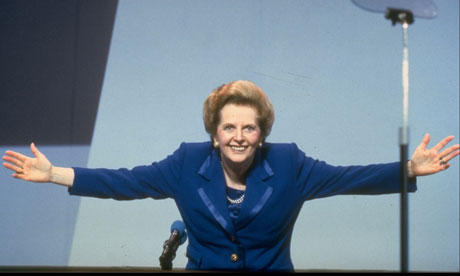
| It probably would've been wiser for me to keep quiet. However, Margaret Thatcher is going to be one of those people who will divide opinion for generations. (Pic : The Guardian) |
Well, "that day"
has finally come. Margaret Thatcher has died. Although she was in ill
health, and it was obvious she was – I'm not trying to be crass –
in her final years, this news came out of the blue.
I'm not a ghoul, but I'd often wondered what I would end up writing when this happened. Would I even write anything at all? Should I write anything?
I'm just about old enough to remember the tail end of her premiership through to her resignation, but it's unquestionable that she left her impact on my adulthood, and the lives of everyone who's come after me.
There's so much I could focus on, but I think it'll be her economic policies that she'll be most heavily associated with in Wales.
Absolutely everything today – from housing, who we buy our energy from, where we work, even the way we get around on things like the railways and buses - was touched or influenced by her one way or another.
When she came to office, the UK was, as often described, a basketcase ripped apart by union self-interest, woeful economic policies (not helped by various energy disputes and crises) and manifest incompetence by people at the top of government.
She radically repositioned and restructured the British economy - fuelled by North Sea oil - overheating the south east of England in the process and purpetuating a slow, ongoing decline in the industrial parts of the island, which has only been reversed in a few cases like Manchester.
You could twist that into a positive too. People now work in comfortable offices, earning more money, buying more "things" and "stuff". They no longer have to worry about their own safety by having no choice but to take up some of the most unpleasant jobs imaginable. The lucky ones anyway.
That devastating legacy to Welsh heavy industry through the 70s and 80s eventually led to the destruction of individual lives - those who missed out on the "new economy" - as a job vacuum was filled with welfare dependency and drugs.
At the time, everything was reduced in worth to a simply tallying of how valuable it was. These losers in her redefined game of life, and Wales in general, became worthless. We've borne that label from the defeat of the miner's strike right through to the present.
So, when she left office, it was a different kind of basketcase she left behind – a nation-state slave to living in other people's pockets and a fostered individualist culture where everyone was now out to ask - "What's in it for me?"
I think it's safe to say that, as of 2008, that ideology has crumbled, despite outlasting Soviet Communism and completely destroying the old English left (Wales still retains it – just about). It's also allowed politicians in Wales for decades - especially Labour - to point to her legacy as cover or to provide excuses for their own inaction.
However, people my age – deemed "Thatcher's children" - have grown up with it, and most of us actively embrace "me, me, me" regardless of our politics. As much as it embodies big banks, it also embodies stuff like reality television, things like Facebook/social media, mobile phone jingles, trendy city-centre apartments, hybrid turbo cars with big spoilers and it's the reason jobs like recruitment consultants exist.
Was she a good Prime Minister? Objectively, she was an excellent one. She was an ideologue and yes, a revolutionary, who knew precisely where she wanted to take the UK. She's going to be remembered as one of those great (as in important) historical figures that will divide opinion for as long as people have opinions.
Was she a good politician? The key difference between the two is that a leader of a nation has to maintain a detached objectivity from public feelings to be able to lead effectively – like a military officer. Politicians still have to care though, and have empathy. I think the fact so many of us fell off her coat tails as she enforced her revolution means she was a terrible politician. I don't think that's because she was incapable of caring, she probably just couldn't afford to care as there was too much at stake for her to reverse course.
Neither of that means she was a terrible person though, and I think it's wrong to think of her as evil, when all she was was a woman resolutely and pig-headedly committed to a set of core ideals and actions, believing with all her heart she was right even if those ideals were poisonous to some, yet the only answer to others.
Like it or not, she was in the right place at the right time. Like it or not, people voted for her again and again because they liked what she was doing - putting money in people's pockets and giving them "freedom of choice" over their "things" and "stuff".
Her legacy, in my eyes, will come down to those two words - "things" and "stuff." That's what we've all been reduced to since, and what we will continue to pander to.
She's endured ill health during a rather frail old age, so she's been released from that now. I would've hoped she would've been given the dignity of a funeral in private so her body doesn't become a focal point for the inevitable ideological thrashing over how she's either Gloriana II, or an evil witch "milk snatcher."
Let her rest. Let her outdated ideals rest alongside her too.
I'm not a ghoul, but I'd often wondered what I would end up writing when this happened. Would I even write anything at all? Should I write anything?
I'm just about old enough to remember the tail end of her premiership through to her resignation, but it's unquestionable that she left her impact on my adulthood, and the lives of everyone who's come after me.
There's so much I could focus on, but I think it'll be her economic policies that she'll be most heavily associated with in Wales.
Absolutely everything today – from housing, who we buy our energy from, where we work, even the way we get around on things like the railways and buses - was touched or influenced by her one way or another.
When she came to office, the UK was, as often described, a basketcase ripped apart by union self-interest, woeful economic policies (not helped by various energy disputes and crises) and manifest incompetence by people at the top of government.
She radically repositioned and restructured the British economy - fuelled by North Sea oil - overheating the south east of England in the process and purpetuating a slow, ongoing decline in the industrial parts of the island, which has only been reversed in a few cases like Manchester.
You could twist that into a positive too. People now work in comfortable offices, earning more money, buying more "things" and "stuff". They no longer have to worry about their own safety by having no choice but to take up some of the most unpleasant jobs imaginable. The lucky ones anyway.
That devastating legacy to Welsh heavy industry through the 70s and 80s eventually led to the destruction of individual lives - those who missed out on the "new economy" - as a job vacuum was filled with welfare dependency and drugs.
At the time, everything was reduced in worth to a simply tallying of how valuable it was. These losers in her redefined game of life, and Wales in general, became worthless. We've borne that label from the defeat of the miner's strike right through to the present.
So, when she left office, it was a different kind of basketcase she left behind – a nation-state slave to living in other people's pockets and a fostered individualist culture where everyone was now out to ask - "What's in it for me?"
I think it's safe to say that, as of 2008, that ideology has crumbled, despite outlasting Soviet Communism and completely destroying the old English left (Wales still retains it – just about). It's also allowed politicians in Wales for decades - especially Labour - to point to her legacy as cover or to provide excuses for their own inaction.
However, people my age – deemed "Thatcher's children" - have grown up with it, and most of us actively embrace "me, me, me" regardless of our politics. As much as it embodies big banks, it also embodies stuff like reality television, things like Facebook/social media, mobile phone jingles, trendy city-centre apartments, hybrid turbo cars with big spoilers and it's the reason jobs like recruitment consultants exist.
Was she a good Prime Minister? Objectively, she was an excellent one. She was an ideologue and yes, a revolutionary, who knew precisely where she wanted to take the UK. She's going to be remembered as one of those great (as in important) historical figures that will divide opinion for as long as people have opinions.
Was she a good politician? The key difference between the two is that a leader of a nation has to maintain a detached objectivity from public feelings to be able to lead effectively – like a military officer. Politicians still have to care though, and have empathy. I think the fact so many of us fell off her coat tails as she enforced her revolution means she was a terrible politician. I don't think that's because she was incapable of caring, she probably just couldn't afford to care as there was too much at stake for her to reverse course.
Neither of that means she was a terrible person though, and I think it's wrong to think of her as evil, when all she was was a woman resolutely and pig-headedly committed to a set of core ideals and actions, believing with all her heart she was right even if those ideals were poisonous to some, yet the only answer to others.
Like it or not, she was in the right place at the right time. Like it or not, people voted for her again and again because they liked what she was doing - putting money in people's pockets and giving them "freedom of choice" over their "things" and "stuff".
Her legacy, in my eyes, will come down to those two words - "things" and "stuff." That's what we've all been reduced to since, and what we will continue to pander to.
She's endured ill health during a rather frail old age, so she's been released from that now. I would've hoped she would've been given the dignity of a funeral in private so her body doesn't become a focal point for the inevitable ideological thrashing over how she's either Gloriana II, or an evil witch "milk snatcher."
Let her rest. Let her outdated ideals rest alongside her too.
Saturday, 8 December 2012
What Wales gets from the European Union
By OwenSaturday, December 08, 20124FirstMin, 4WGNatR, BudgetWG, Business, EU, EU Parl, EUCOM, Farming, Industry, InOutRef, Monetary Policy, Regeneration, Third Sector, Trade, UKIP, Universities4 comments
| It's bloated. It's bureaucratic. Its budget is yet to be (formally) decided. What does Wales actually get from EU membership? (Pic : capreform.eu) |
I don't think issues
surrounding the European Union are, really, at the forefront of most
people's minds. It does look as though an agreement on the EU budget for 2013 is imminent after an EU Commission climbdown, but the agreement for the budget between member states for 2014-2020 remains at an impass. These matters
impact Wales whether we like it or not.
The EU budget
A few weeks ago, Conservative backbenchers and Labour MPs voted against a rise in the EU's budget, and passed an amendment calling for a real-terms cut. You can argue this is a reasonable stand – if national governments have to make sacrifices, shouldn't Brussels?
The relationship between Wales and the EU is slightly different than many other parts of the UK. Although the EU failed to agree a budget at their last summit, any cuts or freeze will be noticeable here. A failure to agree to a budget would put long-term projects at risk.
Plaid Cymru MEP, Jill Evans, spelt out some benefits of Wales within the EU, working out that every Welsh person is getting back £40 more than is put in. That roughly works out at Wales being £120million better off as a whole.
That doesn't sound like much, but I think the benefits are much wider. It's also fair to say that some of this money may well have been (perceivably) mismanaged. I said this a few months ago:
The EU budget
A few weeks ago, Conservative backbenchers and Labour MPs voted against a rise in the EU's budget, and passed an amendment calling for a real-terms cut. You can argue this is a reasonable stand – if national governments have to make sacrifices, shouldn't Brussels?
The relationship between Wales and the EU is slightly different than many other parts of the UK. Although the EU failed to agree a budget at their last summit, any cuts or freeze will be noticeable here. A failure to agree to a budget would put long-term projects at risk.
Plaid Cymru MEP, Jill Evans, spelt out some benefits of Wales within the EU, working out that every Welsh person is getting back £40 more than is put in. That roughly works out at Wales being £120million better off as a whole.
That doesn't sound like much, but I think the benefits are much wider. It's also fair to say that some of this money may well have been (perceivably) mismanaged. I said this a few months ago:
"EU-funds appear to be used for things like public realm improvements, or incredibly niche schemes, spreading funds far too thinly. In the period 2007-2013, £1.5billion has been spent on the public sector (mainly universities), £99million on the third sector (including ~£6.1million to the likes of AWEMA), and just £23million in the private sector."
It's also worth pointing out that the EU's own strict guidelines, regulations and rules mean that an awful lot of effort needs to go into getting the funds in the first place. That doesn't mean that some of the people bidding for these funds are always suitable. Note Jac o' the North's account on that.
It's also right to point out that seeing grants as the be all and end all solution in Wales, or a natural "Welsh way of doing things", is perhaps creating an incredibly damaging, short-term, dependant mindset.
A Jocelyn Davies AM (Plaid, South Wales East) motion passed the Senedd – including support from Welsh Labour AMs – that pressed the Welsh Government to "make representations" to the UK Government, opposing the budget cut.
| Are (UK) Labour equally concerned about the "threat" posed by UKIP as the Tories seemingly are? (Pic : The Times) |
Now, I don't know why Westminster Labour have decided to lurch towards euroscepticism-lite. Maybe they're just hardening their stance to appear "tougher on Europe" than they were in government to stave of a UKIP threat amongst the working class.
I don't have any truck with UKIP's views, but in terms of public debate, they've opened a window – even if it only lets in muck spreading wafts. They're eccentric - with a Colonel Blimp jingoism and a twee view of the UK's place in the world – but deserve to, and will, be taken seriously in 2014 and 2015. However, I think it's too soon to be building them up as an electoral force. Due to FPTP, the chances of them gaining MPs will be slim.
Welsh Labour are, seemingly, more pro-Europe that the Westminster party. They might be disciplined on the surface, but there's a history of differences causing "tensions". The first chinks in Tony Blair's armour came from Wales in the shape of Rhodri Morgan.
If Carwyn Jones were taken seriously as a head of government by his own party, instead of being seen as a loyal provincial governor, I'd put £10 on him verses Ed within two rounds.
It's also heartening that Welsh politicians can debate these matters of importance in a reasoned and mature manner, while British politicians try to out-clown each other in the Westminster lobby on News 24 trying to prove who wants to cut the most.
How does Wales benefit from EU membership?
Broader benefits
Jobs – The First Minister acknowledges that at least 150,000 jobs were based wholly or entirely on EU membership, and 50,000 were employed directly by companies from other EU member states. You could also suggest EU membership imperils Welsh jobs – especially if operations move to more attractive places in eastern Europe. It's also fair to say these jobs wouldn't disappear overnight if the UK left.
Free trade & membership of the world's largest economy – As I highlighted back in September, Wales is less reliant on the EU for our exports than the UK as a whole. But having free and open access to a market of half a billion people in one of the wealthiest parts of the planet (in spite of what's going on) is a no-brainer.
| Carwyn Jones recently said that 50,000 people in Wales were employed by companies based elsewhere in the EU - including ~500 at (German-owned) Siemens Diagnostics in Llanberis. (Pic : Daily Post) |
Free movement – Although the UK isn't part of the Schengen agreement, being able to move visa-free between large economies like England, Germany and France - as well as faster-growing economies like Poland - should be considered a huge benefit. It's a shame we tend to focus on those coming in instead of thinking about going out – in business terms especially. It also has spin offs like guaranteeing free health care in EU nations.
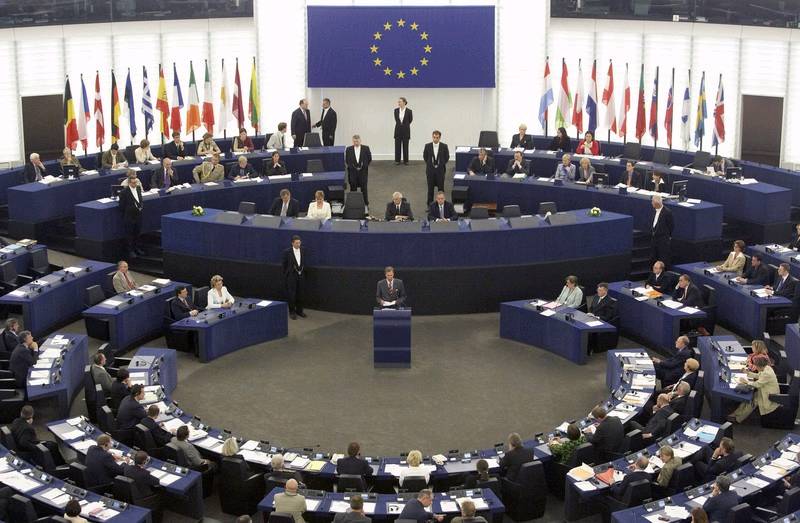
Peace & political stability – The timing of the EU being awarded the Nobel Peace Prize was...."amusing". The EU has developed a strength in its diversity - when it was once a weakness. Instead of Europe's great powers using smaller nations as chess pieces in their quest to dominate the continent (or further afield), disagreements are now thrashed out around negotiating tables in Brussels and Strasbourg. There's also a strong commitment to liberal democracy in all member states – though that's starting to slip in places like Hungary. It's just a shame the European institutions are so cumbersome, but maybe they need to be.
Harmonised pan-European regulations – Whenever we hear about EU laws, they are usually BS about straight bananas and weights and measures. What about mobile phone roaming? Environmental regulations? Standards on chemical safety and water quality? Car and air safety standards? Veterinary and agricultural standards? Cross-border crime fighting? It's also important to point out that the much-maligned European Court of Human Rights isn't part of the European Union.
Specifically important benefits for Wales
Agricultural Programmes – Includes the European Fisheries Fund, European Agricultural Rural Development Fund (worth about £195million to Wales between 2007-2013) and Common Agricultural Policy (CAP). The CAP alone is said to be worth £350million to Welsh farmers every year.
| The Common Agricultural Policy is due for reform, but without it, would Wales have much of a farming industry left? (Pic : BBC Wales) |
You can argue that farms shouldn't need subsidy, and should be encouraged to become more commercially viable – that's supposed to be amongst these funds main aims. These funds are in desperate need of reform – especially since EU enlargement - and make up a sizable chunk (€270billion) of the EU's total budget. I think attempts at reform have probably been blocked by the French and Spanish, who benefit disproportionately from the current arrangements. The UK does too, it has to be said.
Convergence Funds – Commonly referred to under the umbrella of "Objective One", or the more grand European Regional Development Fund (ERDF). These funds are worth up to £1billion over a 6 year period. It looks like West Wales & The Valleys might qualify again in 2013. That's not really good news, as convergence funds have to be match-funded by the Welsh Government and are a sign of a weak economy.
These funds have had a big impact on the university sector in particular. Jill Evans mentioned using EU funding to electrify the north Wales mainline recently, and that's the sort of project you would expect this money to be spent on. However, as noted earlier, I believe many of the projects over the last few decades have been well-meant, but haven't delivered anywhere near the outcomes – especially in terms of economic development and infrastructure – that West Wales & The Valleys desperately need.
| "Objective One" is probably the most visible sign of the EU in Wales. But is the money being invested wisely? (Pic : Ceredigion Council) |
European Social Fund – Another branch of "Objective One". This is worth around £690million over six years. These funds are used on the "social schemes". For example : reducing economic inactivity, "social justice", up-skilling. But it also makes its way to the third sector, who haven't covered themselves in glory of late. The rules are incredibly specific and so full of hoops, that I doubt much money makes it to the front lines.
Specific Investment Funds – This includes the JESSICA framework (funds aimed at developing urban areas). It could be considered a branch of the main convergence funding. The Welsh Government have set up and Urban Development Fund and the Regeneration Investment Fund under this EU framework. It's supposed to be used on regeneration projects. In fact, a chunk of RIFW's cash is going to be spent on Neath town centre over the next few years. Again, the outcomes and management should be questioned. The JEREMIE initiative also helps/helped the Welsh Government's finance arm (Finance Wales) support small and medium businesses. It was/is worth £150million.
Erasmus– A pan-European exchange programme. Although it's said only 630 students (and 112 staff) from Wales have participated in the programme last year, compared to the all-UK figure (~12,000 participants) that's roughly what you would expect – perhaps slightly more than our population share. Cardiff University also hosted one of the largest overseas Erasmus contingents in the UK. Even brief periods living and studying in another EU state would obvious help cross-cultural understanding and – hopefully – international relations should they grow up to become business or political leaders.
What we also get, and what we'll get in the future
| London Mayor, Boris Johnson, recently mooted a "pared down" relationship with the EU - citing Switzerland and Norway. That might suit London, but would it suit Wales, or the UK as a whole? (Pic : BBC) |
Bone-crushing levels of bureaucracy. No (Welsh) voice at the top tables. The pointless spectacle of moving between Strasbourg and Brussels. The ongoing "will they, won't they" fiscal union debacle. Nigel Farage. Uninspiring leaders at European level. And a voice for lunatics on the far-left and far-right in the European Parliament.
And it's fair to point out that there's significantly more subvention/subsidy from the UK that there is from the EU. We might be £40 better off in Europe, but thanks to leaky submarines, West Ham's new stadium and RBS – and other, more important things like social security – we're estimated to be about £4000 "better off" in the UK. Even if most of that is borrowed via the Treasury's credit card.
So although I clearly believe there are benefits to Welsh membership of the EU – via the UK at the moment – there's a need for reform.
The Lisbon Treaty went a long way towards doing that. It merged several institutions and created, in effect, a European constitution. But I think things are coming to a head due to the eurozone's fiscal problems.
My hunch is that the worst of the Euro fiscal crisis is behind us, but there's nothing ahead but a decade of stagnation. I think a new treaty is inevitable – probably creating a full fiscal union between eurozone members – and, ultimately, a "two-speed Europe".
Guess who'll be trundling along in the outside lane, indicating to take the next exit - with Wales in tow. Would that be in Wales' interests? It's a big question, and one that's perhaps too difficult to answer at the moment.
But, at the end of the day - whether you're Welsh, Slovene, German or French - we're all Europeans aren't we? If you even consider the British Isles a part of Europe. It appears the Leader of the Opposition in the Assembly doesn't.
Stronger together....
Saturday, 15 September 2012
Wales : An Economic Profile VI - Strengths & Weaknesses
By OwenSaturday, September 15, 20124WGEcon, Air, Business, Cardiff, EmpSk, Energy, Flint, Foreign Affairs, Independence, Industry, Monetary Policy, Poverty, Scotland, Trade, Universities, Welfare, WEP10 comments
- Part I - Primary Industries & Energy
- Part II - Manufacturing & Technology
- Part III - Services
- Part IV - Public Sector & Universities
- Part V - Wales in the global economy
Strengths
"Secure" resources
Industry requires copious amounts of both energy and water. Wales will have both long into the future - as long as the existing resources are not squandered or poorly managed.
I've put "secure" in quotation marks, because fuels like gas (Part I) will need to be supplanted at some point. To paraphrase what MH has said recently on the subject, we need to "use gas more cleverly".
"Secure" also means "safe". Wales is unlikely (but not completely so) to be a target for an act of terrorism, has relatively low crime rates and is in one of the strategically safest places in Europe - if not globally. That could attract some contentious employment – defence research for example, or yes, even nuclear weapons.
An office-based business can base itself anywhere, but this is one of the few trump cards Wales holds over London & SE England. For product development and manufacturing, Wales should be towards the top of many lists, seeing as we have the fundamentals in place. The question now is, what are the other reasons for us not being so?
Relatively high levels of graduates
As I pointed out in Part IV, Wales has a high (by EU standards) percentage of the working age population who have higher education qualifications (though this is still behind the UK average). It's quite likely that many of these are going to be public sector workers, in particular those working in health service professions that require degree-level qualifications (nurses, physiotherapists, radiologists etc.).
| Numbers of graduates are likely to have been boosted by healthcare professions like nursing becoming degree-level jobs. How can we turn more graduates towards business? (Pic : BBC Wales) |
What this suggests, is that a chunk of Welsh population have a love of learning. What the Welsh Government need to do, is ensure that people are encouraged to aim higher academically for our future economy.
That doesn't mean pushing everybody into the sciences. It also means : better qualified lawyers to scrutinise devolved legislation, better business managers, professionalising the "third sector" (Masters of Social Business Administration), qualified coaches for sport, teachers with higher-level qualifications (Welsh Labour wanted to make teaching a "Master's Level" profession in their 2011 manifesto) and improving skills in the civil service.
I believe that people should learn for its own sake. Although some courses might be "questionable", and going to university shouldn't be seen as a "must", we need to see graduates as a resource. They need to be used effectively in the private sector and not expect the vast bulk of them to go into the public sector.
Cardiff & Deeside
In Cardiff and Deeside, Wales has two significant urban areas which continue to attract significant investment, perhaps for differing reasons. That's not a suggestion that we "put all our eggs in two baskets". We shouldn't ignore the fact that amongst all the doom and gloom, Wales has two well-performing areas economically, even compared to the rest of the UK.
Swansea could easily catch up with the right investment in its city centre, in addition to the university development mentioned in Part IV. There's a strong hub of IT-related companies developing in the Newport/Cwmbran area while Bridgend & Neath Port Talbot have always been major manufacturing centres. Providing better links between the likes of Aberystwyth and Bangor universities and their environs will no doubt boost economies too. There's hope yet.
Good business survival rates
One of the big myths I hoped to bust with this series is the belief that the Welsh are "not entrepreneurial" or "not business-minded". I think we are in a "be your own boss" sense, but Wales doesn't have a big money, individualist, "corporate culture". That can be a good thing, or a bad thing.
Although enterprise birth rates in Wales were amongst the lowest in the UK in 2010, enterprise deaths, five-year survival rates and one-year survival rates were either at the UK average or exceeded it. Recently, it's been revealed that young Welsh adults were the most entrepreneurial in the UK.
Maybe this is just because of the plethora of grant and business support schemes offered by the Welsh Government. However, if you start a business in Wales, compared to the vast bulk of the UK, you're more likely to see it last longer and more likely to have your peers starting them too. Add this to the successes in university spin outs (Part IV) and it's safe to say that "failed in Wales" no longer applies.
Strong export record (in goods)
I hate treading old ground, but as I said in Part V if this is a strength of the Welsh economy, then we grasp every opportunity to guide and shape it with both hands.
The only downsides are that many up-and-coming Welsh SME's seem reluctant to look for opportunities beyond the UK, while goods exports are conglomerating in larger groups, becoming less diverse (a point raised in Offa's Gap). These are serious problems that needs addressing, but it's still overall good news.
It's important to note that this is in goods only – physical "things", not services. Wales will need to develop more balance between goods and services if the economy, as a whole, is to function better.
Weaknesses
Financial services "blind spot"
Bankers aren't the flavour of the month, but high-end financial services do provide high levels of GVA growth and, more crucially in the independence debate, high levels of tax income (when they pay them). First things first, I'm not advocating a "Welsh RBS". But is it so ridiculous a suggestion to have Welsh banks – based in Wales, investing both here (perhaps in energy projects) and around the world and providing highly paid jobs in Wales?
Wales does have a big success story in Admiral Group, but was it a fluke? Wales needs five or six "Admirals" to close the gap with the rest of the UK. The easy option would be to "bribe" one of the London companies to move to Cardiff. That would be a stop gap. Wales has to play the game (developing new financial service companies) instead of carrying the refreshments (branch functions).
I think insurance is one area Wales could look to build a critical mass in. It's less controversial than banking, we have success stories already, there's guaranteed markets (car insurance is compulsory) and in some cases it's fairly lucrative. Recruitment and training services, as well as niche consumer services like price-comparison websites, are other areas of potential.
Poor infrastructure, poor priorities
This has been done to death, but it needs attention drawing to it again. Wales is probably 20 years away from losing our only major airport if passenger figures continue to slide the way they are. We only have around 75 miles of motorway (though much more is "motorway standard"). We've had to wait God knows how long to have rail electrification put on the agenda. If you can't get goods, people and ideas to major markets quickly and efficiently, you end up being neither heard nor seen. That can even happen within the UK market itself.
| The Welsh Government do invest in things like roads and railways, but are they prioritising things correctly? (Pic : Abayoflife) |
I'm not convinced the UK or Welsh Governments take Welsh infrastructure anywhere near as seriously as they have to. I'm not restricting that to the "obvious things" like roads and railways. It includes all the hidden stuff, like a north-south inter-connector for electricity, 3G/4G coverage (now being addressed by the Welsh Government and the private sector - thumbs up) and even things like the structure and functioning of the civil service.
The Welsh Government's Infrastructure Investment Plan was a damp squib that prioritised waste management ahead of new transport links and energy. Using borrowing powers to fill pot holes/cover revenue spending is also rather silly. Their task in the face of swingeing capital spending cuts isn't easy, I'll acknowledge that, but there's no need to make things worse through their own lack of ideas.
Demographic shift to the economically inactive
This isn't just a case of pensionable-age "incomers" moving to rural Wales. It's also a case of younger people moving out of Wales because that's the only way to provide financial security for themselves. Lose the young, keep the old and immobile, top them up with migrant retirees. Pensioners, "good-lifers" etc. might well bring their savings with them - and they should have the right to move anywhere they choose - but they also have an ongoing cost that wouldn't be there otherwise. Wales can't afford to become a care home colony.
I'm willing to bet, per person in employment, productivity in Wales will be near enough the same as most parts of the UK (outside London and SE England).
If the Welsh Government really wants to improve Welsh economic output, they're going to have to come up with ways to retain talented people under 30 to balance things out a little – especially in rural areas. More people producing, production figures improve – simple.
Wales needs to become "noisier", and subtly discourage people from moving to Wales to seek a "quiet life." One way to do that is ensure there are enough well-paid jobs , social opportunities and affordable housing. And yes, we also have to target the levels of chronic long-term limiting illnesses in some Welsh local authorities – but that's more a health and social justice matter.
Over-reliance on "big branch employers" & lack of innovation
Business demographics statistics (2011), show that while 98% of all enterprises in Wales were in the micro and small band (employ under 50 people), 72% of national business turnover (£68.04billion) came from medium and large companies, with £56.1billion of that coming from just 1,580 large (250+ employees) businesses.
I'm guessing that many of those will be a remnant of the WDA glory days. Well, they're not going to be here forever. With every closure of a big grey box on a valleys industrial estate, a large chunk of GVA and national turnover is going to go with it.
Are these jobs worth it? We don't do very much research and development here. We don't do enough to protect and patent innovations here. I think politicians concentrate on reducing unemployment figures, see someone promising to bring 1,000 jobs - while not considering what those jobs entail or what they are paid – and roll out the carpet. Then they leave a few years later for the next
Wales needs to come up with the products, patent them/licence them, manufacture them and do all the marketing and back-office/HQ functions. That's the recipe for good GVA growth. In terms of independence, it means loyal Welsh "brands" paying healthy amounts of business and corporation taxes into the national coffers. Saying this is easy, doing it is much harder.
Skills shortages
It's another "old chestnut" – "Employees lacking the prerequisite skills necessary for the modern workplace blah blah blah." I don't think the situation is as bad as it has been – the numbers of school leavers leaving with no qualifications are falling, the numbers of apprenticeships are rising and as mentioned above Wales has a relatively high proportion of people with advanced qualifications. The issue, is whether all these bits of paper are actually worth anything.
It applies just as much to employers. How many Welsh business people have the requisite skills to expand their companies? Do they have the ambition to do so? How many Welsh business people speak a foreign language? Do they have good management skills?
If the business community are stuck thinking in a dull, "numbers on the balance sheet", conservative way, then the whole of the Welsh economy lacks "spark". I think this can improve - and the Welsh Government are taking steps towards that - but it might be too little, too late. It should've been done in the 1980s and 1990s - the moment Conservative and Labour UK Governments decided heavy industries (coal, then steel) had no future. That's the lasting legacy Maggie, John and Tony left us. Gordon left us the bill and Dave moves everything back to square one, ready to repeat itself.
Opportunities
Universities playing a greater economic role
Universities shouldn't become castles for academia in small towns, they should play an active role in developing the economy of those places in more ways than bringing in student money. The Republic of Ireland managed to build its economy based off a steady stream of graduates coming out of a large number of higher education institutions with technical qualifications.
Does Wales need to bring back the polytechnics? Do we need a "Welsh MIT"? Could industrial estates in university towns be used as enterprise zones for spin-outs?
That leads me nicely into....
Harnessing and developing niche specialisms
The Welsh Government, universities and the Welsh business community need to try and identify areas where Wales can develop a European, or world-leading, specialism based on what we have currently. I don't think this is about backing certain businesses or certain sectors. As highlighted on many occasions, successful individual companies can come from anywhere.
| What technologies and innovations will Wales be helping to develop in the future? (Pic : Autoevolution.com) |
I think this is about taking a long-term view about what products Wales can develop over the next thirty years, and whether we can get there before other parts of the world do, or try to stake a claim with other nations – for example pan-EU initiatives.
What could those specialisms be? Wales already plays a leading role in aerospace and automotives that could be expanded (and enhanced at the likes of the new Swansea University campus). There's materials sciences – looking for environmentally friendly building materials and "smart materials". Energy research is another obvious one. Whoever finds a way to store and produce hydrogen safely as a fuel, without as much energy intensity, is going to become very rich too, I'd imagine.
There are still plenty of options on the table
There are plenty of things the Welsh Government could do, within months even, and without requiring the devolution of further powers.
They could turn Finance Wales into an investment bank or a sovereign wealth fund (though they wouldn't be able to regulate it). They could create a regional exchange to help pump capital into SMEs as a stepping stone to the FTSE.
They could turn
Communities First clusters into social enterprises,
while professionalising them and (hopefully) reducing corruption due
to increased financial scrutiny as a result. There are other things
mentioned further down.
Admittedly, none of that would provide a solution by itself. It's still going to have to come down to ambition within the private sector and classic entrepreneurship. But, as we all know, the Welsh Government and civil service like to do things a "certain way".
The co-operative sector providing public services
How do you provide key public services - in particular things like health and social care - in sparsely populated areas with dwindling public funds? One solution might be to enact some of the recommendations in The Collective Entrepreneur report and have some services ran by co-operatives and not-for-profits.
I mentioned above that Communities First projects could become community social enterprises. It's a mooted model for the Welsh railways. You could even go as far as spin the NHS out on the Glas Cymru model.
There would be clear advantages and disadvantages. It might bring a business-minded approach to providing services (in terms of competition and waste), with those services remaining free/subsidised at the point of access – but it would still be a privatisation. It could lead to smaller hospitals and care homes being being kept open – but there's always the risk that they could close if they don't cover their costs. It would almost certainly lead to the creation of large companies that can compete on a European level to provide services, but is that what you want public services companies to do?
This would probably be too controversial to consider in the short term. However, if public spending is going to be squeezed, maybe it should be kept on the back burner until more detailed studies are carried out.
Fiscal sovereignty
You'd expect me to list this, wouldn't you? Can you can improve the economy within the current arrangements? The evidence over the last twenty years suggests this is going to be an uphill struggle, and Wales is going to need a significant change of tact. Or, do you need all the tools to create the conditions necessary to improve the economy? There's no guarantee that would work, but at least you'll be able to work to strengths and react quicker to shocks.
These two pieces by Russell Lawson over at the Walesbusiness blog (Wales' way out of the economic mire & Small is beautiful), list : accommodative monetary policy, fiscal policy focused on medium-term consolidation, tight grip on public debt, capital buffers, prudential bank lending policies, regulatory quality, enhanced liquidity in Europe and easing personal debt.
Hardly any of which Wales would be able to do without fiscal sovereignty or Independence – perhaps a separate currency too.
Threats
A continuing spiral of peripheral neglect
It's too risky for the UK Government to spend public money when there are no guaranteed of "returns". So instead of investing to provide jobs in Wales, they provide job replacements in the form of JSA and incapacity benefit – then some have the cheek to remind us that we're not pulling our weight.
The Welsh Government in turn acts like a palliative care nurse – focusing on quality of life – accepting that things are never going to improve dramatically economy wise.
Preventing Wales falling into destitution is seen as "better for us" than having a fully functioning economy that can stand on its own legs - even within the UK. It's about stopping things from becoming worse, rather than taking risks (or responsibility) needed to create something better
Despite spending more per head on economic development than other parts of the UK, Wales shows no sign of rising off the bottom of varying "league tables". The likelihood is that it's being spent badly, on the wrong things, for the wrong reasons. I'm no longer convinced it's a money issue anymore, but down to a case of poor economic policy - and that goes for all parties, not just Welsh Labour.
It's always "someone else's problem", and we don't want to take the harder path because we don't know if it'll work or not. That's toxic.
Inward investment drying up
In 2011-12, only 23 inward investment projects, out of 1,406 in the UK, took place in Wales – just over 1.6%. Although these projects seem to be pretty big, protecting/creating some 2,800 jobs (remember what I just said about big employers).
We need a desperate change of tact here. We're so used to "someone else doing it", that we've become timid about going out to other markets, or obsessed with the internal market within the UK. Welsh businesses are probably going to have to do more outward investment, or target new export markets, than expect inward investment to travel very far down the M4 from Heathrow.
Our competitor isn't England, but all those small nations who can take extra steps to attract investment. In the future, we'll need to measure success by looking to Welsh companies taking over English/wherever companies - not the other way round. The question is, are Welsh businesses up to the scale of that challenge? I don't know.
"Mad" economic policy
Economic policy in Wales can be boiled down to a few simple tenets:
Admittedly, none of that would provide a solution by itself. It's still going to have to come down to ambition within the private sector and classic entrepreneurship. But, as we all know, the Welsh Government and civil service like to do things a "certain way".
The co-operative sector providing public services
How do you provide key public services - in particular things like health and social care - in sparsely populated areas with dwindling public funds? One solution might be to enact some of the recommendations in The Collective Entrepreneur report and have some services ran by co-operatives and not-for-profits.
I mentioned above that Communities First projects could become community social enterprises. It's a mooted model for the Welsh railways. You could even go as far as spin the NHS out on the Glas Cymru model.
| There have been calls for a "not for profit" company to run Welsh railways, but does this Glas Cymru model need to stop at transport and utilities? (Pic : BBC Wales) |
There would be clear advantages and disadvantages. It might bring a business-minded approach to providing services (in terms of competition and waste), with those services remaining free/subsidised at the point of access – but it would still be a privatisation. It could lead to smaller hospitals and care homes being being kept open – but there's always the risk that they could close if they don't cover their costs. It would almost certainly lead to the creation of large companies that can compete on a European level to provide services, but is that what you want public services companies to do?
This would probably be too controversial to consider in the short term. However, if public spending is going to be squeezed, maybe it should be kept on the back burner until more detailed studies are carried out.
Fiscal sovereignty
You'd expect me to list this, wouldn't you? Can you can improve the economy within the current arrangements? The evidence over the last twenty years suggests this is going to be an uphill struggle, and Wales is going to need a significant change of tact. Or, do you need all the tools to create the conditions necessary to improve the economy? There's no guarantee that would work, but at least you'll be able to work to strengths and react quicker to shocks.
These two pieces by Russell Lawson over at the Walesbusiness blog (Wales' way out of the economic mire & Small is beautiful), list : accommodative monetary policy, fiscal policy focused on medium-term consolidation, tight grip on public debt, capital buffers, prudential bank lending policies, regulatory quality, enhanced liquidity in Europe and easing personal debt.
Hardly any of which Wales would be able to do without fiscal sovereignty or Independence – perhaps a separate currency too.
Threats
A continuing spiral of peripheral neglect
It's too risky for the UK Government to spend public money when there are no guaranteed of "returns". So instead of investing to provide jobs in Wales, they provide job replacements in the form of JSA and incapacity benefit – then some have the cheek to remind us that we're not pulling our weight.
The Welsh Government in turn acts like a palliative care nurse – focusing on quality of life – accepting that things are never going to improve dramatically economy wise.
| Wales needs it, London gets it. It's a familiar story, but you can't blame the UK Government for wanting returns on big investments. (Pic : The Guardian) |
Preventing Wales falling into destitution is seen as "better for us" than having a fully functioning economy that can stand on its own legs - even within the UK. It's about stopping things from becoming worse, rather than taking risks (or responsibility) needed to create something better
Despite spending more per head on economic development than other parts of the UK, Wales shows no sign of rising off the bottom of varying "league tables". The likelihood is that it's being spent badly, on the wrong things, for the wrong reasons. I'm no longer convinced it's a money issue anymore, but down to a case of poor economic policy - and that goes for all parties, not just Welsh Labour.
It's always "someone else's problem", and we don't want to take the harder path because we don't know if it'll work or not. That's toxic.
Inward investment drying up
In 2011-12, only 23 inward investment projects, out of 1,406 in the UK, took place in Wales – just over 1.6%. Although these projects seem to be pretty big, protecting/creating some 2,800 jobs (remember what I just said about big employers).
We need a desperate change of tact here. We're so used to "someone else doing it", that we've become timid about going out to other markets, or obsessed with the internal market within the UK. Welsh businesses are probably going to have to do more outward investment, or target new export markets, than expect inward investment to travel very far down the M4 from Heathrow.
Our competitor isn't England, but all those small nations who can take extra steps to attract investment. In the future, we'll need to measure success by looking to Welsh companies taking over English/wherever companies - not the other way round. The question is, are Welsh businesses up to the scale of that challenge? I don't know.
"Mad" economic policy
Economic policy in Wales can be boiled down to a few simple tenets:
- More jobs, regardless of how well they are paid, highly-skilled or what the job entails, is better than no jobs.
- It's better to play a bit-part (making components) instead of coming up with new products and IP-protecting them.
- Everything has to be led by the government because the private sector is too small/can't be trusted.
- See what England is doing. Ignore what the rest of Europe or the world is doing. Try to copy what England is doing because you have no ideas of your own/it's obviously the "right way". Hilarity ensues.
- Come up with fantastic new strategies and plans, then when they don't work, rearrange the words slightly.
- "Insert sector of the economy here" is the future! Then don't look at qualifications, case studies, necessary infrastructure, long-term projections, competition at home and abroad, fast growth businesses within Wales in the sector, constitutional powers, fiscal powers....it'll "just happen"! (Yes, I've probably just done that too.)
- Trying the same thing over and over again and expecting a different result.
Desperation, short-termism and pessimism
Let's say you were the CEO of a foreign business looking to invest in two areas.
The first has good
international links, a fairly decent ratio of public spending to GVA
and a reasonable level of public sector workers. They have major
centres of renown and an ambitious government that presents
themselves with confidence. They assure you that you can find
everything you need (if you want it). They have established companies
is high-value added sectors and have a good track record in economic
theory and promoting themselves abroad.
The other has no solid international links, has as much spent on it by the government as it produces each year and has low numbers of jobs created overall. They have a government either practically begging you to set up there - almost suffocating you with the amount of support or grants – or they hardly make any effort. You're not entirely convinced the government are serious, as they seem just as keen to promote links with other places, than concentrate on their own unique selling points.
One looks like an up and coming, business-friendly destination. The other looks as it it doesn't have any economic mojo at all. Now call them "Scotland" and "Wales".
I'm going to contradict myself, but equally damaging is the belief that we can't do anything right, and that there's something inherently wrong about the Welsh. Anecdotally, that's an incredibly depressing and commonly held belief within Wales – even if the evidence says differently. Talk about a colonial mindset.
Fiscal sovereignty
Having full economic powers is a double-edged sword. I mentioned earlier there would be opportunities, there would also be significant, potentially disastrous, risks too.
Fiscal sovereignty doesn't mean independence. But, with public spending as such cripplingly high levels, any measures that could see a reduction in the amount of pork heading our way would be opposed (see Mike Hedges recent comments on tax devolution). Quality of life could well sharply fall (i.e. harsh reductions in public spending). Though we wouldn't fall into the abyss - as the economy as a whole would likely remain exactly where it is. Public spending isn't the same thing as production.
The risk is this. Wales will have all these wonderful new powers, but then wouldn't use them "correctly". We might create more barriers to business, increase the amount of red tape, screw up business rates reforms or general business taxes (or even shy away from using them) and carries on micromanaging little schemes that they can't bear to put down because they don't want to be seen to be "wrong".
The gap between east and west Wales doesn't narrow, businesses lose confidence in economic prospects as well as the Welsh government, Welsh public policy and our civil service remain stuck in a nepotistic and innovation less-time warp and our economic figures fall through the floor.
It might even go the opposite way and become embroiled in a neo-liberal race to the bottom. It's not too ridiculous a suggestion - considering some of the things that go on here already - that we could end up with a Welsh Charles Haughey or Bertie Ahern.
Theoretically speaking, if that happened post-independence, people like me swing from lampposts or get put up against walls and shot.
Now read that dystopian economic commentary again.
If we wouldn't tolerate it post-independence or under devo-max, why have we tolerated it for the last thirty years?
------------------------------------------------------------------------------------------------------------------------------------------------
I hope you've enjoyed this series of blogs. What I wanted to show was that the Welsh economy certainly has weaknesses, but they are not all attributable to the Welsh as a people. We also have many success stories, but we really need to get a grip on these wider issues if Wales is to succeed economically.
That might mean taking more fiscal responsibility for ourselves, it might come down to one person having a brilliant business idea and having the assistance to take it forward.
At some point early in 2013, I'll look at local government and independence, which I was originally going to do so this time around.
| Scotland has managed to become successful within the UK, and not entirely down to oil. Perhaps we should be asking questions as to why Wales hasn't? (Behance.net) |
The other has no solid international links, has as much spent on it by the government as it produces each year and has low numbers of jobs created overall. They have a government either practically begging you to set up there - almost suffocating you with the amount of support or grants – or they hardly make any effort. You're not entirely convinced the government are serious, as they seem just as keen to promote links with other places, than concentrate on their own unique selling points.
One looks like an up and coming, business-friendly destination. The other looks as it it doesn't have any economic mojo at all. Now call them "Scotland" and "Wales".
I'm going to contradict myself, but equally damaging is the belief that we can't do anything right, and that there's something inherently wrong about the Welsh. Anecdotally, that's an incredibly depressing and commonly held belief within Wales – even if the evidence says differently. Talk about a colonial mindset.
Fiscal sovereignty
Having full economic powers is a double-edged sword. I mentioned earlier there would be opportunities, there would also be significant, potentially disastrous, risks too.
Fiscal sovereignty doesn't mean independence. But, with public spending as such cripplingly high levels, any measures that could see a reduction in the amount of pork heading our way would be opposed (see Mike Hedges recent comments on tax devolution). Quality of life could well sharply fall (i.e. harsh reductions in public spending). Though we wouldn't fall into the abyss - as the economy as a whole would likely remain exactly where it is. Public spending isn't the same thing as production.
The risk is this. Wales will have all these wonderful new powers, but then wouldn't use them "correctly". We might create more barriers to business, increase the amount of red tape, screw up business rates reforms or general business taxes (or even shy away from using them) and carries on micromanaging little schemes that they can't bear to put down because they don't want to be seen to be "wrong".
The gap between east and west Wales doesn't narrow, businesses lose confidence in economic prospects as well as the Welsh government, Welsh public policy and our civil service remain stuck in a nepotistic and innovation less-time warp and our economic figures fall through the floor.
It might even go the opposite way and become embroiled in a neo-liberal race to the bottom. It's not too ridiculous a suggestion - considering some of the things that go on here already - that we could end up with a Welsh Charles Haughey or Bertie Ahern.
Theoretically speaking, if that happened post-independence, people like me swing from lampposts or get put up against walls and shot.
Now read that dystopian economic commentary again.
If we wouldn't tolerate it post-independence or under devo-max, why have we tolerated it for the last thirty years?
------------------------------------------------------------------------------------------------------------------------------------------------
I hope you've enjoyed this series of blogs. What I wanted to show was that the Welsh economy certainly has weaknesses, but they are not all attributable to the Welsh as a people. We also have many success stories, but we really need to get a grip on these wider issues if Wales is to succeed economically.
That might mean taking more fiscal responsibility for ourselves, it might come down to one person having a brilliant business idea and having the assistance to take it forward.
At some point early in 2013, I'll look at local government and independence, which I was originally going to do so this time around.
Thursday, 2 August 2012
Offa's Gap - What? When? Where? & Why?
By OwenThursday, August 02, 2012BIS, Business, England, EU, Fiscal Policy, Foreign Affairs, HMT, Independence, Industry, Labour, Monetary Policy, Nationalism, Northern Ireland, Plaid, Scotland, Trade, Whitehall10 comments
| Offa's Dyke might be nothing more than a ditch, but Offa's Gap is looking distinctively deeper and wider - and Wales is quickly sinking into the sea on one side of it. (Pic : Britannica) |
Despite devolution, European structural funds and the economic boom in the early noughties, Offa's Gap – the gap in productivity between Wales and the rest of the UK – has widened over the years, and now Welsh GVA per capita stands at just 74% of the UK average. The report is a forensic analysis of this relative decline of the Welsh economy, and it makes for rather depressing reading - regardless of your political persuasion.
What are the paper's key findings?
The Welsh Growth Crisis
- For a period of around 20 years (1971-1988), the Welsh economy remained at around 85-90% of the UK average, but in the early 1990s (1992-93), fell dramatically compared to the rest of he UK.
- GVA per capita growth has been "significantly below the UK average apart from two years between 1990 and 2009", with a pronounced deterioration between 1996 and 1999.
- While the UK as a whole experienced resurgences following declines in economic output, Wales has been on a "continuous relative decline" since 1996.
- The average annual growth rate between 1971 and 1990 was almost exactly the same as the UK (1.96%), but since then, a gap of 0.6% opened between Wales and the rest of the UK opened.
- Welsh income growth was just 27% between 1991-2010 compared to 42% for the UK as a whole.
- Although Welsh GVA per capita fell compared to London between 1989 and 2009, possibly as a result of the financial services boom, it also fell relative to the rest of the UK. Most of the decline "is explained by Wales failing to keep pace with the UK as a whole."
- Welsh GDP relative to the EU27 has fallen from 92% in 1994, to 80% in 2009. The EU trend has been for poorer-than-average regions to outperform richer regions. However, this hasn't been the case in Wales. There's a strong argument for Wales "being the worst performing economic region in the entire EU."
The Welsh Growth Collapse (1995-2010)
- It's "only in the last 15 years that Offa's Gap has opened up." Wales hasn't always been as poorly performing as it is now. For most of the 20th century, Wales kept pace with most of the industrialised world.
- Extrapolated figures for Welsh growth, in terms of purchasing power per capita, show that by 2050, Wales might fall behind Russia, Mexico, Turkey, Argentina and possibly South Africa and China.
- The relative decline in this period is explained by problems in the Welsh business sector. Welsh household consumption declined relative to the rest of the UK, and there was less potential for equity release (which drove the consumption boom) due to lower Welsh house prices.
- When measured by gross output per employee, Welsh productivity was higher than the UK average between 1987 and 1996. When measured by GVA per employee, productivity was lower, but still remained above the UK average.
- There was a "precipitous decline" between 1994 and 1998, according to study by Richard Harris on behalf of the Welsh Government. There was an 18.5% decline in manufacturing GVA, and productivity went from 40% above the UK average to 20% below.
- Gross Operating Surplus (a measure of profitability in business) fell away sharply from the UK average between 1994 and 2001.
- Wales is more vulnerable to export effects on economic growth than the UK as a whole. The Welsh economy is more "open" (share of imports and exports are larger than the UK), and the domestic economy is less important.
- Welsh Government had "access to none of the policy levers available to national governments – currency depreciation, fiscal/monetary stimulus – to respond to an external shock."
- The pound was over-valued in this period, due to exports of financial services from London, leading to a deterioration in the balance of payments at a UK level, and a "hemorrhaging of jobs in the manufacturing sector" – which was still a major part of the Welsh economy (and still is compared to the rest of the UK).
The "Good" News
- Wales' total share of UK exports in goods rose from 4.09% in 1996 to 5.52% in 2011 - bigger than Wales' population share. Wales has significantly outperformed the UK and Scotland in this regard compared to 1996.
- The composition of Welsh exports is less positive. In 1996 17 sectors had an export share of 5% or more, by 2010 that was reduced to just three : petroleum products, power generating equipment and electrical machinery.
The Welsh Growth Enigma
There are two "puzzles" emerging:
- Why hasn't the economic decline resulted in a collapse in incomes?
- Why hasn't the robust trading in Welsh goods resulted in improved economic growth?
The answer to the first question, is that income falls have been "cushioned by transfer payments" – pensions, social security benefits & tax credits – which acts as a "dampening mechanism", but cannot last as the welfare state comes under more sustained fiscal pressure. (I touched on this a few weeks ago : Cameron on Welfare - Right analysis, Wrong sentiments).
The second question is more complicated to answer. Trade surplus' in exports of goods are likely to be offset by a deficit in trade in services (a shorthand example, would be Welsh people using financial services based in London). Wales' trade deficit with the rest of the UK was estimated to be around £4billion.
The national deficit in taxes, and deficit in imports of goods and services, are said to be "interrelated".
It means the bigger the current account deficit in Wales, the bigger the need for more central government intervention (to offset the economic decline). Levels of economic inactivity and ageing demographics "haven't changed sharply over the last 20 years." Only educated guesses can be made as to "why" this decline has happened, in spite of strong export performance.
Why did Offa's Gap widen?
Black Wednesday "freeing" Sterling from EMU – The report says that "blaming the City of London for Wales' woes is misplaced." However, the report does say that over-valuation of the pound, fuelled by the export of financial services by London, caused the gap between the UK and Wales to widen.
This could've been fuelled by Black Wednesday in 1992, which resulted in the value of the pound plunging suddenly. Over subsequent years, Sterling's value was able to rise dramatically, improving the economic performance of The City, which became the UK's "Golden Goose", right through to Labour winning the 1997 General Election and beyond. This dragged the UK average GVA upwards too fast for Wales to keep up. Wales didn't have the financial service industry to match Northern Ireland, Scotland and some other parts of England, which could've been able to take full advantage of this.
Lack of agglomeration & "too many eggs" – The consolidation of exports down the years into fewer sectors exemplifies this. Wales still hasn't seemed to have learned the lesson that being over-reliant on too few sectors can lead to disaster. The lack of major centres also means that there is very little to fall back on. Manchester, Birmingham, Leeds et al. had far more "back up" industries (mainly high-end services) to respond to post-industrialisation that Wales ever did, and probably ever will.
Decline of Steel - The late 1990s/early 00s was to the steel industry in Wales, what the 1980s were to the coal industry - and I think people forget that. The numbers employed in steel fell from around 63,000 in 1996 to around 8,000 in 2010. Steel is still one on Wales' big export categories, and the closure of the likes of the Ebbw Vale plant, and mothballing furnaces, not only impacts jobs, but seriously impacts Welsh GVA and exports. The decline of steel-making jobs in fact, roughly falls in line with the "precipitous decline" in manufacturing outputs in the late 1990s and early 00s. Look up the Mittel Affair too while you're at it - another Adam Price production.
LG Newport shaking faith in "big bang" inward investment – This was an infamous "white elephant", and the swan-song of the big "metal bashing", "branch factory", foreign direct investment (FDI) schemes in Wales. In 1996, it was announced up to 6,000 jobs would be created, off the back of around £150million of public subsidy via the WDA and government, and hardly any of that materialised.
This probably played a big role in the eventual winding up of the WDA, even if I think there was a rose-tinted view of their role and performance. Are we paying the price now for that decision? Should the WDA have been reformed, or given a new function, instead of scrapped?
- Better skilled, cheaper workforces (a remnant of a command economy)
- Full economic tools being used to promote the free market
- Commercial opportunities provided by "reconstruction efforts" (i.e. East Germany)
- A desire within these nations to become part of the European mainstream.
- A desire on the part of NATO powers to integrate "New Europe" into "The Western Sphere"
Wales suddenly had many more competitors than we were used to. Foreign investors could pick and choose where to plonk their factories. Wales couldn't offer anything compelling anymore.
Instead of competing with NE England, Northern Ireland and the West Midlands, Wales was now up against Poland, Slovenia, Slovakia, Czech Republic - and even the likes of China and India. How could a "region" (with - at the time - no devolution) compete with fully sovereign nations?
Misapplication of European structural funds – It would be unfair to say that no infrastructure/economic development funding has been used in West Wales & The Valleys. However, the vast bulk seems to be directed towards "social schemes" which provide something in the way of personal development, but little in the way of economic development.
EU-funds appear to be used for things like public realm improvements, or incredibly niche schemes, spreading funds far too thinly. In the period 2007-2013, £1.5billion has been spent on the public sector (mainly universities), £99million on the third sector (including ~£6.1million to the likes of AWEMA), and just £23million in the private sector.
Devolution didn't cause the decline, but may have contributed to prolonging it – The start of the decline was before devolution was even re-considered as UK policy – around the 1992 mark – and the severe dip happened around 1995 or 1996, before devolution even came into being. However, related to the EU funds issue, subsequent policies taken by Welsh Governments may well have prolonged the decline, rather than actively turning it around.
For example : scrapping (instead of reforming) the WDA as mentioned further up, spreading public infrastructure investment too thinly, responding too late to shocks (exceptions like ProAct and ReAct), the culture in the civil service (managerialism, fatalism, process over purpose, being "used to being poor") and the old chestnut of relying too much on the public sector to provide economic stimulus in our poorer performing areas.
What can be done?
| Wales is a net-exporter of goods. Should any economic growth strategy be focused on this underlying Welsh economic strength? (Pic : Commodity Online) |
A growth strategy focused on exports. "Expanding and diversifying the Welsh export base is critical to increasing Welsh economic growth and reducing dependence on budgetary transfers." It goes on to suggest the creation of a business-friendly arms-length agency that would aim to "attract export-oriented investment and support and encourage indigenous-based exporters."
That would be different to the old WDA, which focused on inward investment from foreign companies, rather than this proposal for effectively "outward investment from Welsh companies."
Maximising economic opportunities in England. England is called a "high-value market" with "45million people within 2 hours travelling time of Wales." Welsh businesses are described as failing to take advantage of the changing opportunities within the UK economy – for example, Welsh firms providing English health and education services as the UK Government increasingly privatises them, and publicly-owned Welsh companies bidding for these sorts of contracts. Statkraft (Norway) and Vattenfall (Sweden) are given as examples.
Significant investment in Welsh infrastructure. Transport costs affect regional economic performance, and the low level of investment in transport is "reflected in an completely unelectrified rail system, an ailing national airport, a Severn tunnel that is prone to flooding and a vulnerable two-lane pinch point at Brynglas tunnels." Most of Wales' large bulk exports (chemicals etc.) are transported by sea, but land-based transport could "seriously be affecting the performance of Welsh SME's." This shouldn't be seen as a be-all and end-all. More on that at Borthlas.
School of Hard Knocks, School of Athens and Lazy Big Brothers
| So, do you point "sky-wards" to more powers and independence? Or "earth-wards" to boosting the economy as a pre-requisite, within the current model? (Pic: Wikipedia) |
It hits home the near-quixotic task it is to get Wales into a position to move towards independence. That isn't "good news" for unionists though. In fact, it reflects incredibly badly on the UK.
Westminster is the burly big brother that saw their slightly dim, slightly smelly, unpopular little brother kicked in over and over again in the playground, and didn't do anything about it - perhaps even joined in a little bit. Behind all the smiles, denials and promises of action on Wales - past, present and future – we've been betrayed. That goes for you whether you're a nat, Labour, Welsh Tory or even the most ardent of ardent unionists.
This "growth collapse" happened on their watch, and almost entirely their brief. One thing we can say, is Wales can't rely on Westminster at all to dig us out of this. The solution will have to come from within Wales, and unpalatable decisions will need to be taken.
Welsh Labour's (or even the Assembly in general) approach to the economy is the equivalent of the big sister offering a shoulder to cry on. It'll make you feel better, it might even offer a distraction, but it's not going to stop the subsequent beatings the following day, and the day after that, and the day after that, and the day after that....
If this had been produced by an independent think-tank, or another political party, it would've been painful - shutting down this blog levels of painful - but the fact it's Plaid leading this has dulled pain a little bit. It (along with Gerry Holtham's recent musings, albeit with question marks on the numbers) brought us back down to Earth, and I think we (Nationalists) needed that. We've gotten a little carried away with events in Scotland.
I've always realised that Welsh independence isn't on the horizon the same way it is for Scotland. It looks likely I'm going to be another nat who goes to the grave or the crematorium oven never seeing independence - and I'm not even thirty yet. However, "fought the good fight, finished the course" and all that.... This report isn't telling us stuff we didn't already know - but it's not all doom and gloom. Even the most desperate cases can be turned around.
The problem now is the politics and philosophy on the way forward.
We have the slightly more pessimistic, hard-headed, empiricist, "worldly" views of the likes of Gerry Holtham. A conclusion that Wales can only be what it is at present, and the cold hard light of day says a failing nation (economically). This far, no further. But does that, ultimately, also mean "more of the same, please"? And an acceptance of the current failed models?
Meanwhile, nationalists are excessively idealistic, faith-based, "sky-ward" people. A belief that Wales should aspire to be something greater than the sum of its parts, and that it can only be done with full freedom of thought and action. It's more imaginative, significantly more creative, gives you more options, but is in no way grounded in conventional rationality, or more importantly - conventional economics.
The frustrating thing is we all want the same thing – a successful Welsh economy, and a prosperous Wales. We just can't agree on a single way forward without dragging in the "chicken or the egg" re. independence/more powers. We need something to break us out of that thinking.
The question for all of us lay people, the politicians (of all colours), the business supremos, the trade unionists, is what do we do next?
I'm currently working on a "six part special" related to this - on the current status of the Welsh economy - which will be published either later this month, or next month. I'll have some possible answers to that question then, and maybe a slightly more positive outlook.