This site is no longer updated
Please use the links in the sidebar to visit the new sites!
Showing posts with label Racism. Show all posts
Monday, 13 March 2017
Tuesday, 6 December 2016
FMQs: PISA, Article 50 & Bank Closures
By OwenTuesday, December 06, 2016Ambulance, Banks, Brexit, Buses, Cons, Farming, FMQs, Labour, Plaid, PrimaryC, Racism, Schools, SupCo, UKIP, WGEcon, WGHealth, WrexhamView Comments
Obviously the big story today is the OECD's PISA 2015 results – I'm pushing to get something done for tomorrow but I'm currently unwell 😰. In the meantime, there's the penultimate FMQs of 2016 with PISA featuring heavily as you might expect.
Thursday, 17 November 2016
Who are "The Establishment"?
By OwenThursday, November 17, 2016Borders, Brexit, Business, EmpSk, EU, Foreign Affairs, Industry, Pirate, Poverty, Racism, SNP, UK Press, UKIP, USA, WIssView Comments
![]() |
| Is the idea of a single monolithic Establishment a myth? (Pic : The Spectator) |
2016 will be marked by a revolt against the status quo in liberal democracies. In Wales we've seen the election of UKIP AMs for the first time, followed by Brexit. Earlier this year there was an inconclusive Irish general election. There's also the re-election of Jeremy Corbyn in the face of opposition from Labour's aristocracy and finally Donald Trump's victory last week.
Saturday, 27 April 2013
The rise of Europe's far-right
By OwenSaturday, April 27, 2013BNP, Borders, Civil Liberties, Communists, Cons, EmpSk, EU Parl, Flanders, Foreign Affairs, France, Greece, Housing, Hungary, Monetary Policy, Nationalism, Netherlands, Racism, Russia, UKIP14 comments
| Has a shift on the fringes of politics to far-right and populist conservative parties in Europe been a recent phenomenon? Or is it more complicated than that? (Pic : The Guardian) |
Back in January, Human Rights Watch warned that far-right politics in Europe were becoming more mainstream. No specific causes were outlined, however this has – in my opinion – inevitably come about as a result of the European economic crisis, as well as more localised problems which haven't been properly dealt with since the end of the Cold War.
Goose steps over Europe
It's worth pointing out that shifts to far-right, or populist hard right politics in Europe aren't recent. Since the threat of Islamic fundamentalism was brought to the fore post-9/11 attacks, countries in Europe with small, unintergrated minorities have seen a noticeable shift to the right, perhaps in a panicked attempt to "protect themselves" through limiting things like immigration.
The first major shift in modern times was probably the Austrian Freedom Party (Freiheitliche Partei Österreichs [FPÖ]) under the leadership Jörg Haider, who was killed in a car accident in 2008. The Freedom Party won 27% of the vote in the Austrian federal elections in 1999, winning 52 seats, and eventually formed a governing coalition with the conservative Austrian People's Party.
| Did the success of the FPO in 1999 "legitimise" the far-right in European politics? (Pic : Der Standard) |
Although the FPÖ at the time were more populist that outright fascist, Jörg Haider had expressed sympathy for select Nazi policies, was accused of anti-semitism as well as having links with Holocaust deniers. The election of the FPÖ shocked Europe so much, that 14 nations introduced temporary diplomatic sanctions against Austria via the European Union. Eventually, the EU was forced into a rather humilating climb-down, but the precedent has been set, and it more than likely played a role in Haider stepping down from his role as party leader.
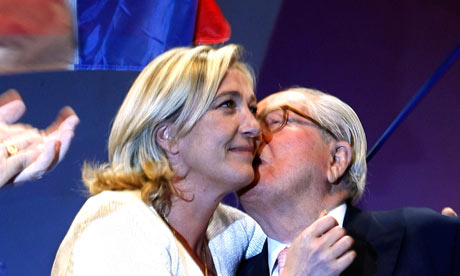
Despite an ongoing "professionalisation" of far-right parties like the French Front National and the BNP, this was probably the first time the far-right had been "legitimised" in Europe since the 1920s and 30s. This will, in my opinion, have had a knock on impact on other nations too.
Between 1998 and 2001, the populist anti-immigration Danish People's Party (Dansk Folkeparti) made a major breakthrough in the Folketing, winning 22 seats – a rise of 9. That's roughly the level of support they've remained at since, peaking at 25 seats following the Jyllands-Posten Mohammed cartoon controversy. They played ”kingmaker” in 2001, offering their support to enable a right-wing coalition government to be formed, in exchange for changes to Denmark's immigration rules – now amongst the strictest in Europe.
The right-wing Flemish nationalist Vlaams Blok (now Vlaams Belang) were effectively disbanded. They breached Belgian anti-racism laws, once proposing a form of segregation in parts of public life and expulsion of non-European immigrants. They peaked at 32 seats – near enough a quarter of all seats - in the Flemish Parliament in 2004.
| The populist anti-immigration PVV played "kingmaker" following the 2010 Dutch general election. A trend seen in other European countries. (Pic : BBC) |
Further north, in the Netherlands, the Party for Freedom (Partij voor de Vrijheid [PVV]) managed to win 24 seats in the lower house Dutch general election of 2010. Under the leadership of the charismatic Geert Wilders – something of a hard line spiritual successor to the assassinated right-libertarian Pim Fortuyn - they adopted a strong stance on Europe, Islam and immigration. Like the Danish People's Party, they were instrumental in government formation through something akin to a confidence and supply agreement.
The hilariously-named Liberal Democratic Party of Russia – whose policies, which are neither really democratic or liberal, hint that they would try to hunt down and eat our Lib Dems – somehow have 56 seats in the Duma. They want the Russian Empire back, and they wouldn't be afraid to use nuclear weapons to get it back either.
In the present, however, two of the more significant far-right movements are perhaps the most worrying.
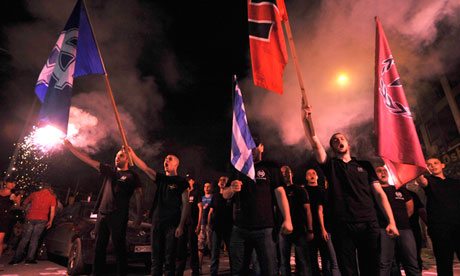
| Golden Dawn - the first Nazis freely-elected in Europe since the 30s? (Pic : The Guardian) |
Between 2006 and 2010, Jobbik of Hungary came from nowhere to win 47 seats in the Hungarian Parliament. They once had a ”uniformed group” that probably fell short of an outward paramilitary organisation, though they were disbanded by the Hungarian courts. Although they strongly deny any racism against minority groups – including the Roma - in 2012, a Jobbik MP called for the creation of a ”list of dangerous Jews” who ”pose a threat to Hungarian national security.”
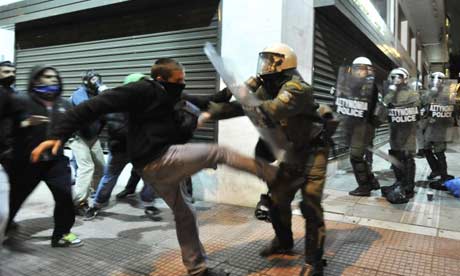
In Greece, since the torturous collapse of the country's economy, Golden Dawn won 18 seats in the Greek Parliament. They have links to hooliganism, and have been implicated in violent attacks against political opponents and ethnic minorities. Their election slogan in 2012 was, "Rid this land of filth." They're probably the closest Europe has come to freely-elected Nazi's since 1933.
It isn't all rosy
Despite all this, far-right parties and populist right-wing parties very rarely get into "power". They generally, at best, end up as small players in coalitions. Or – as in the Netherlands and Denmark – remain outside of government entirely, only popping up to get a few concessions to prevent centre-right governments collapsing. So, I think there is a natural "glass ceiling" when it comes to the far-right or populist conservatives.
Many of the parties I've mentioned have fallen back in recent elections. The PVV lost 9 seats in the last Dutch elections in 2012 for example. They were also responsible for that early election by withdrawing support for the ruling coalition, after a disagreement over austerity measures. Geert Wilders was blamed by the coalition partners and, ultimately it seems, the Dutch public for it.
| Despite grabbing headlines, the overall performance of far-right parties in many European nations states is poor. (Pic : The Guardian) |
Germany's National Democratic Party (Nationaldemokratische Partei Deutschlands [NPD]) have never performed well at all levels of government in Germany - perhaps understandably - with only a dozen or so elected representatives in state legislatures. In France, despite high-profile, highly-visible successes in Presidential and European elections, the Front National perform poorly at local, regional and national level, with only two Deputies. In Austria, the Freedom Party have never really attained the heights they did under Haider.
That's before mentioning the abject electoral performances of far-right parties closer to home.
I don't think there's anything more damning for liberal politicians than for the public to turn around and choose a far-right candidate over them. Barring legitimate concerns over some policy areas, it's the ultimate protest vote, boiling down to, "I'd rather vote for a Nazi(ish politician) than you." But I don't think many people voting for them really want a far-right (or in many cases far-left) politician to represent them, more give the "usual lot" a very big kick up the backside.
The far-right in Wales and the UK
| Have the EDL been and gone? (Pic : The Telegraph) |
Something both far-left and far-right parties and organisations share is a lack of ideological unity, or splits in support by people seeking an "ever purer" version of their politics.
Internal problems within the BNP have led to them suffering said splits in support. Some joined or forming new parties, with the National Front seeing a teeny-weeny resurgence, and the English Defence League probably stealing the BNP's thunder as the most vocal "far-right" organisation on the island of Great Britain. Even the EDL have probably come and gone, as attendances at their rallies - which once mobilised thousands - have been reduced to a hardcore.
The performance of far-right parties in Wales has been historically atrocious – though not quite as bad as Scotland – and I don't see that changing any time soon. There was a poorly-attended "White Pride" march in Swansea a few weeks ago, which is absolutely hilarious in context. Swansea is 94% white and that's one of the lowest percentages.
However, in terms of the "populist hard right", things might be changing and it would threaten the Welsh Conservatives more than any of the other parties.
With UKIP presenting a - you could almost say "secular" - non-racist way to express disapproval over policy areas like Europe and immigration, as well as a strident British Nationalism, I don't think the future of the far-right in Wales or the UK is rosy at all. Beyond Nigel Farage, UKIP don't really have much, though that could change. However, Nigel Farage could well be the BNP's executioner if he can convince enough people concerned over policy areas like immigration that he presents a creditable and socially-acceptable voice for them. That's probably the reason why there may be ex-BNP in UKIP.
| The BNP's executioner? Do UKIP offer a "softer", "secular" more socially-acceptable voice for those concerned about immigration and Europe? (Pic : BBC) |
But in my opinion, all that would be is a shift to a "populist hard right" similar to Denmark and the Netherlands. That would be much more preferable than a move to neo-fascist organisations seen in parts of eastern and southern Europe.
Again though, I don't think there's any chance of UKIP being in position to run anything larger than a rural English district council. Their aim will likely be to drag the Conservatives to the right, and the rest of us out of the EU.
The EU : A last defence against fascism?
| This is the first major economic downturn parts of Europe will have faced since the end of the Cold War....and they're struggling. (Pic : Wall street Journal) |
Many younger people in eastern Europe of voting age, will not have grown up under the iron jackboot of Soviet Communism, which was nothing more than fascism with a heart. They'll have probably been told stories of how brutal and repressive it was, and how its collapse left their newly-emerging nation states in a weak position.
Those in eastern, and perhaps southern Europe, look to relics of long-dead glorious empires and the social order that used to "exist" under ultra-nationalist dictatorships. Remember that the Axis in WWII consisted of more than Germany, Italy and Japan; it included plenty of puppet regimes in eastern Europe and the Balkans too.
This resurgence of the European far-right is not only the fault of the global financial sector, but the mainstream, technocratic Christian and social democrats who dominate European politics.
In the west and south, they've failed to get a grip on issues like the high cost of living, they helped to prop up and create housing bubbles and in some circumstances they've mortgaged the future of their younger generations to pay off the mistakes of the present.
In the east, while the cost of living remains low compared to the west, they're just getting through the first major economic downturn since the fall of Communism. In some countries like Latvia, it's caused property bubbles to burst, while elsewhere they're experiencing double digit unemployment rates and high levels of poverty, used to exploit inter-ethnic tensions.
Meanwhile, EU institutions have become cumbersome and wasteful – perhaps in some circumstances causing more problems than they're supposed to solve.
The trouble is that as soon as mainstream politicians and parties are seen to be failing to address issues like those, at a time when things are tough and people are scared, charismatic individuals come to the fore offering simple soundbite solutions to complex issues. Sometimes they only offer a closed fist and a jackboot. When you've exhausted all avenues with "traditional" parties, what else have you got to turn to?
There's one firewall though. All those nations, by and large, still want to be "part of the club" when it comes to the EU, even if levels of scepticism and uncertainty about the EU itself are on the rise. If they shift towards fascism rather than a populist, UKIP-style "tough on crime and immigration" stance, it would generate enough disgust within the EU to trigger sanctions – be they economic or social – and that would play a role in bringing them back into line.
This is going to sound ridiculous, but for all its faults, we should start to position the EU in terms of it being the last line of defence for European liberal democracy.
Thursday, 21 February 2013
Census 2011 : National Identity & Ethnicity
By OwenThursday, February 21, 2013Borders, Cardiff, Census 2011, China, Conwy, England, EnglishM, EU, Flint, Gwynedd, Iaith Gymraeg, Merthyr, Monmouth, Nationality, Newport, Pakistan, Poland, Racism, Universities9 comments
![]() |
| Is Wales significantly less "British" than commonly believed? It looks like it. (Pic : Clive Morgan via theimagefile.co.uk) |
How "Welsh" is Wales?
This has been covered before by both Syniadau and Welsh not British. All the data I've used to compile this is available here. I couldn't link to them directly.
2011 was the first census year you were able to officially record yourself as Welsh, English, Scottish etc. so there are no previous figures from 2001 to judge any changes.
![]() |
| % of population giving some form of Welsh identity in the 2011 census (Click to enlarge) |
So, how "Welsh" is Wales? For this exercise I'm counting "Welsh only", "Welsh and British" and "Welsh and another identity" as "describing themselves as Welsh".
Only two local authorities – Flintshire and Conwy – had less than 50% of the population giving no Welsh identity. Flintshire probably due to close interconnections and cross-border commuting to/from the Wirral, Merseyside and Cheshire. Conwy probably because of retirees and, yes, people moving from the large conurbations of NW England to live by the sea. Denbighshire also came close to having 50% or less. Powys, Ceredigion and Monmouthshire also have what could be considered "weak" Welsh identity.
The strongest Welsh identity is in the south, in particular the former coalfields. RCT and Merthyr have joint highest levels of Welsh identity at 82.2%, with all valleys local authorities (including Swansea and Carmarthenshire) having Welsh identifying populations of 70%+.
Cardiff - as you might expect - falls just short of a 60% Welsh identifying population. I imagine all national capitals are more "international" than their respective nations with the exception of Pyongyang. Newport and Vale of Glamorgan have similar figures, presumable as they are "overspill".
![]() |
| % of the population giving NO British identity (Click to enlarge) |
Nationally, 65.8% of the resident Welsh population gave some sort of Welsh identity, and the clear majority of them (87.3%) considered themselves exclusively Welsh.
But what about "British" identity? It's probably best to highlight how many people gave NO British national identity in the census – that would include people describing themselves as English, Scottish etc. It's actually quite startling.
A clear majority in every single Welsh local authority didn't consider themselves "British" at all. Again this sentiment is stronger in the south Wales valleys, but even in supposedly Anglicised areas it's the same trend, just less pronounced.
It ranges from 81.4% in Merthyr Tydfil to 65.9% in Monmouthshire – and Monmouthshire is the lowest. You're looking at an average 26% of people per local authority considering themselves British or (Something) and British. That's outstripped by Welsh identity and, in come cases, English identity.
The English in Wales
Although the numbers of Scots, Northern Irish and Irish are recorded, they don't make up any significant percentage of the Welsh population. What's clear, and what you probably already knew, is that the English are the largest "minority" in Wales.
![]() |
| % of the resident population giving some form of English identity (Click to enlarge) |
"Minority" is key. Nationally, just 13.8% of the resident Welsh population identified themselves as wholly or partially English.
English identity ranges from 31.7% in Flintshire, to just 4.5% in Merthyr Tydfil. There's no English majority in any local authority, and doesn't appear to be on the cusp of happening any time soon. The average percentage of people identifying themselves as English (one way or another) per local authority is a paltry 14.9%.
If anyone still thinks Monmouthshire's "a part of England" – 21.8% of the population considered themselves wholly or partially English. Judging by the numbers in the Gwent Valleys – also part of the former county of Monmouthshire – it's probably best the English Democrats stay away from canvassing there. They would be better off trying Connah's Quay and Mold instead. However, I suspect Flintshire isn't "nice" enough to be annexed.
In terms of people born in England, the pattern's varied. 20.8% of the resident Welsh population were born in England in 2011. However, it's heavily skewed towards Powys and Flintshire, with large English-born populations in Ceredigion, Conwy and Denbighshire.
![]() |
| % of the resident population born in England (Click to enlarge) |
Elsewhere in Wales, especially the south, the numbers of English-born are low, barely rising above 10% in Valleys areas. Only 14.1% of Swansea's population were born in England and just 12.2% in Bridgend. Even Cardiff doesn't break the 20% barrier. It's only Monnmouthshire in the south that stands out.
The numbers of Welsh-born living in England amounts to 1% (or 561,000 people, perhaps more) of the English population. The number of English-born in Wales (20.8%) amounts to 637,200 people. So there's clearly been net "English" in migration, but it's a difference of just 76,000 people compared to those leaving. And not all of them will be "English".
Place of birth
In 2001, there was a local authority average of 26.9% of the population born outside Wales. In 2011, that's risen to 29.2% - which is slightly higher than the Welsh national figure (27.4%). This is because the actual figures across Wales vary wildly on a county-to-county level.
![]() |
| % of resident population not born in Wales (click to enlarge) |
Only two local authorities – Conwy and Denbighshire – saw a fall in the numbers born outside Wales.
However, in Powys and Flintshire, half of the resident population were born outside Wales, with the likes of Conwy (45.5%) and Ceredigion (44.5%) close behind. In fact, the numbers born outside Wales are heavily skewed towards rural parts of the country with the exception of Carmarthenshire.
Now, most of the people reading this are going to immediately point to English in migration. But....
The numbers of people in Wales born in England – outlined further up - have remained relatively stable. There's no evidence of a "mass influx", and in the south the numbers born in England have flatlined or even fallen slightly. Nationally, the English-born population of Wales has only risen by 0.5% compared to 2001, and the bulk of that can be accounted to Powys, Carmarthenshire and Neath Port Talbot. Even Cardiff has only seen a 0.6% rise.
![]() |
| Change in the % of residents born in England 2001-2011 (click to enlarge) |
The evidence points to the increase in people being born outside Wales being driven by migrants from the European Union (post 2004 enlargement) or elsewhere, perhaps mainly international students. This was a point I made in the Welsh language post.
Wrexham (+2.6%), Ceredigion (+1.4%), Cardiff (+1.8) and Carmarthenshire (+1.3%) have all seen a rise in EU-born residents that completely outstrips English-born once non-EU born are added to that. It's a similar pattern in every local authority.
At local authority level, there's an average 2.2% increase in the numbers born outside Wales. Up to 1.95% (88%) of that is down to EU and "other" immigrants. It's almost identical to the average fall in the number of Welsh-born residents.
So if you're determined to want a migratory reason as to why the percentage of Welsh-speakers have fallen, you'll have to look much, much further east than Offa's Dyke.
![]() |
| Change in the % of residents not born in Wales 2001-2011 (Click to enlarge) |
It's also fair to point out that being "born in England" doesn't mean you're not Welsh, or vice versa.Quite a fair number of Welsh babies in border counties like Powys will have been born in English hospitals I'd imagine – the Royal Shrewsbury is closer than Bronglais. 20.8% of the Welsh population may have been born in England, but only 13.8% of the population consider themselves wholly or partially "English."
Oh, and under those definitions I'm not Welsh either. I count in the census as someone "not born in Wales." If you're going to judge nationality by birthplace alone, I guess I'm going to have to "bugger off home" with a Cantonese dictionary tucked under my arm and leave Wales for the "proper Welsh."
Race in Wales
| Outside the cities and university towns, it's safe to say that Wales remains (relatively) mono-ethnic. (Pic : BBC Asian Network) |
There's little point analysing Caucasians. The average "white" ethnic population per local authority was 96.6%. Bears in woods. Compare that to the 86% total for EnglandandWales.
That means in terms of people from mixed, black, Asian or other (i.e Arab) backgrounds, the all-Wales average is just 3.4% - and that's been dragged upwards by a handful of local authorities.
The only local authorities that can point to having anything close to a multi-ethnic population are Cardiff and Newport. In Cardiff, 15.3% of people are from a mixed or minority ethnic backgrounds, while it's 10% in Newport. Swansea comes in fairly close behind them, but even there 94% of the population are from white ethnic groups.
The largest minority ethnic group across Wales are Indian, Pakistani and Bangladeshi Asians. This broadly corroborates my last census post on religion, where Islam and Hinduism are the two largest faiths outside Christianity.
![]() |
| % of the resident population from a mixed, black, Asian or other minority ethnic background in 2011 (Click to enlarge) |
The largest Chinese communities are in Cardiff (1.2%), Swansea (0.9%) and Gwynedd (0.7%).
The Black-Welsh population though, barely registers outside Cardiff (2.4%) and Newport (1.7%). There's an average black population of 0.38% per local authority. In Merthyr Tydfil there were, in 2011, no black residents (or so few they barely reached .1 of a percent). Several local authorities - in particular across north Wales, the Gwent Valleys and Pembrokeshire - recorded just 0.1%.
Outside Cardiff (2%), Swansea (1%) and Newport (1%); Ceredigion (0.5%) and Gwynedd (0.7%) recorded the largest populations of "other" resident ethnic groups.
What could this mean?
British identity in Wales is soft – It's unclear what impact last summer's successful London Olympics will have had, but it's worth pointing out that the census was taken around the same time as last year's other "Big British Bash" – Billy Whizcopter and Kaff getting married. It doesn't appear to have made any impact. I'm not sure what this means for nationalism. It could be a good thing - for obvious reasons. Or, it could equally mean the Welsh are comfortable with multiple nationalities to spend too much time thinking about it. But when they do think about it, they'll perhaps be more likely to lean towards "Welsh" (or English) than "British." Everything points to there being polarisation between a majority Welsh identity and a large minority English identity.
| Reinforcing the common bonds of "British identity"? Or excuse for a piss up? You got to say - based on the evidence - excuse for a piss up. (Pic : BBC) |
The English are not "swamping" Wales (as a whole) – Aside from Flintshire, Powys and the Costa Geriatrica, there's no real sign of any mass influx. Judging by the figures, quite a few English people in Wales may now consider themselves Welsh. Good. Why shouldn't they? What matters is how old they are, and I'll be looking at demography another time.
Wales is becoming more "European" – With 88% of the change in people born outside Wales driven by non-British immigration – especially EU enlargement nations - Wales has become ever so slightly more cosmopolitan. It's unclear if this is a good thing or a bad thing. Hopefully it could lead, in the long-term, to more trade opportunities or university co-operation.
Link between universities and minority ethnic residents – It's fairly probable that having a university in your local authority boosts the numbers of people from minority ethnic backgrounds by attracting international students. That would explain why Ceredigion, Rhondda Cynon Taf and Gwynedd have proportionally larger minority ethnic populations than somewhere like Bridgend or Blaenau Gwent.
| Are a large chunk of minority ethnic residents in Wales international students? (Pic : The Guardian) |
The Assembly accurately reflects Wales' ethnic make up – There's one AM for approximately 1.7% of the population. Having two AMs from minority backgrounds – Mohammad Ashgar (Con, South Wales East) and Vaughan Gething (Lab, Cardiff South & Penarth) – is pretty much representative, so well done us. So that's a far cry from the hand-wringing that the devolved administrations aren't doing enough here. Maybe positive discrimination here should concentrate instead on gender balance and, in Wales' case, disabilities – my next stop.
Monday, 22 October 2012
AWEMA - No Taffioso deals, but some questions unanswered
By OwenMonday, October 22, 20124Assembly, 4Cabinet, 4WGFin, BSC, CivServ, EU, Fiscal Policy, Labour, Lib Dems, Plaid, Racism, Swansea, Third Sector, WGS4 comments
Last Thursday, the
Wales Audit Office published their long-awaited report into AWEMA,
following the charity's liquidation. More on this
at : National Left, Jac o' the North, Peter Black AM, A Change of Personnel, Inside Out, Betsan Powys and Gareth Hughes.
Firstly, we need to get the Labour issue out of the way. The report found no evidence of outright political interference, saying that although "the full basis of some of the Welsh Government's funding decisions were unclear" there was little evidence of "inappropriate ministerial involvement." (p31)
By that, they mean there were no deals in smoky rooms, or ministers going out of their way – on record - to accommodate Naz Malik. In fact, AWEMA didn't always get what they asked for.
The report highlights who was responsible for what over the period (Appendix 5). Three names feature prominently throughout - Jane Hutt, Carl Sargeant & Edwina Hart – with a few others, such as Carwyn Jones, Sue Essex, Brian Gibbons and Andrew Davies playing minor roles. Also, between 2007-2011, Ieuan Wyn Jones played a significant role as minister responsible for the European funding , but his name doesn't feature as often.
So, this was a primarily Labour-led systemic failure, but neither Plaid, nor the Lib Dems (Mike German's brief involvement circa 2000-2001 & Lib Dem AWEMA trustees), come out of this completely smelling of roses (heh).
Welsh Labour conspiracy theories are entertaining – no doubt harbouring truths - but a scandal would have to be really big and bad to make an impact. It also distracts from the key issue – poor governance. The way to dent a party's credibility, is that when they're crap at the job they're elected to do, it gets reported as widely as possible.
On that, the findings were more damning. You could sum up the rest of the report in one sentence : In handling AWEMA, the Welsh Government, parts of the European Funding Office and civil service have been vain, disorganised and shown poor leadership.
Vain - The report says that the Welsh Government's equalities unit issued advice to Jane Hutt and Rhodri Morgan that they were worried about the "impact on the Welsh Government's reputation among....minority ethnic groups, were it to cease funding AWEMA." (p40)
When the wider scandal broke in 2011, and the organisation's existence was threatened, AWEMA did play the race card. So civil service warnings were, perhaps, vindicated. So what? Fearing the reactions to "controversial" decisions is no way to run a government or civil service. It's vanity. To quote The Thick of It from the weekend, "This is the result of a political class that's given up on morality and simply pursues popularity at all costs."
Disorganised – The report highlights major errors in grant funding, citing lack of stability in the equalities unit, and brushing aside the findings of a specially commissioned report. Edwina Hart wasn't even sent a submission about new funding arrangements, despite commissioning the review in the first place and being responsible for funding (p41).
The equalities unit "did not rigorously follow up concerns about AWEMA's governance arrangements" for a period of five years (2005-2010) and didn't take allegations, by the chair and acting chair in 2007, into consideration. The European Funding Office had no concerns about AWEMA's EU projects, but "didn't apply sufficient rigour in monitoring these projects."
Poor leaders – The Welsh Government were warned no fewer than eight times between 2000-2011 about AWEMA (Appendix 3), including former Plaid AM, Dai Lloyd and Peter Black AM (Lib Dem, South Wales West) as recently as 2010.
The Welsh Government were satisfied with many of AWEMA's projects, but too lazy in monitoring them – a recurring theme. They didn't respond to specific allegations, had poor communication between departments, failed to follow-up concerns or "get to the heart of issues" when concerns were raised. (p71-72)
The report says that "management of....funding to AWEMA by the Welsh Government....has often been poor." There's praise, however, for how the Welsh Government reacted in 2011 .Shame it couldn't have been said earlier.
It's also unclear how much this has cost. Direct payments from the Welsh Government totalled £7.15million between 2000-2011. The Welsh Government claimed a debt owed to them of around £900,000. AWEMA disputed this, and the figure was reduced to around £545,000. Naz Malik denied there were any missing funds on ITVWales' Sharp End. It's unlikely AWEMA's creditors - including the Welsh Government - will see any of that money again.
Some important questions remain partially, or wholly, unanswered. So this hasn't been flushed yet.
Bethan Jenkins pressed Finance Minister, Jane Hutt (Lab, Vale of Glamorgan) to release documents from the equalities unit, to little avail. The change of Permanent Secretary might be a legitimate excuse for that, and might delay backbench AMs getting answers too.
We partially know why funding kept going to AWEMA – the Welsh Government/civil service didn't want to be accused of racism – but it's worth hearing the reasons from the ministers themselves. We now, also, have a good idea about who was involved. Will we get any apologies?
Other issues and questions I don't think have been satisfactorily cleared up include:
Firstly, we need to get the Labour issue out of the way. The report found no evidence of outright political interference, saying that although "the full basis of some of the Welsh Government's funding decisions were unclear" there was little evidence of "inappropriate ministerial involvement." (p31)
By that, they mean there were no deals in smoky rooms, or ministers going out of their way – on record - to accommodate Naz Malik. In fact, AWEMA didn't always get what they asked for.
The report highlights who was responsible for what over the period (Appendix 5). Three names feature prominently throughout - Jane Hutt, Carl Sargeant & Edwina Hart – with a few others, such as Carwyn Jones, Sue Essex, Brian Gibbons and Andrew Davies playing minor roles. Also, between 2007-2011, Ieuan Wyn Jones played a significant role as minister responsible for the European funding , but his name doesn't feature as often.
So, this was a primarily Labour-led systemic failure, but neither Plaid, nor the Lib Dems (Mike German's brief involvement circa 2000-2001 & Lib Dem AWEMA trustees), come out of this completely smelling of roses (heh).
Welsh Labour conspiracy theories are entertaining – no doubt harbouring truths - but a scandal would have to be really big and bad to make an impact. It also distracts from the key issue – poor governance. The way to dent a party's credibility, is that when they're crap at the job they're elected to do, it gets reported as widely as possible.
On that, the findings were more damning. You could sum up the rest of the report in one sentence : In handling AWEMA, the Welsh Government, parts of the European Funding Office and civil service have been vain, disorganised and shown poor leadership.
Vain - The report says that the Welsh Government's equalities unit issued advice to Jane Hutt and Rhodri Morgan that they were worried about the "impact on the Welsh Government's reputation among....minority ethnic groups, were it to cease funding AWEMA." (p40)
When the wider scandal broke in 2011, and the organisation's existence was threatened, AWEMA did play the race card. So civil service warnings were, perhaps, vindicated. So what? Fearing the reactions to "controversial" decisions is no way to run a government or civil service. It's vanity. To quote The Thick of It from the weekend, "This is the result of a political class that's given up on morality and simply pursues popularity at all costs."
Disorganised – The report highlights major errors in grant funding, citing lack of stability in the equalities unit, and brushing aside the findings of a specially commissioned report. Edwina Hart wasn't even sent a submission about new funding arrangements, despite commissioning the review in the first place and being responsible for funding (p41).
The equalities unit "did not rigorously follow up concerns about AWEMA's governance arrangements" for a period of five years (2005-2010) and didn't take allegations, by the chair and acting chair in 2007, into consideration. The European Funding Office had no concerns about AWEMA's EU projects, but "didn't apply sufficient rigour in monitoring these projects."
Poor leaders – The Welsh Government were warned no fewer than eight times between 2000-2011 about AWEMA (Appendix 3), including former Plaid AM, Dai Lloyd and Peter Black AM (Lib Dem, South Wales West) as recently as 2010.
The Welsh Government were satisfied with many of AWEMA's projects, but too lazy in monitoring them – a recurring theme. They didn't respond to specific allegations, had poor communication between departments, failed to follow-up concerns or "get to the heart of issues" when concerns were raised. (p71-72)
The report says that "management of....funding to AWEMA by the Welsh Government....has often been poor." There's praise, however, for how the Welsh Government reacted in 2011 .Shame it couldn't have been said earlier.
It's also unclear how much this has cost. Direct payments from the Welsh Government totalled £7.15million between 2000-2011. The Welsh Government claimed a debt owed to them of around £900,000. AWEMA disputed this, and the figure was reduced to around £545,000. Naz Malik denied there were any missing funds on ITVWales' Sharp End. It's unlikely AWEMA's creditors - including the Welsh Government - will see any of that money again.
Some important questions remain partially, or wholly, unanswered. So this hasn't been flushed yet.
Bethan Jenkins pressed Finance Minister, Jane Hutt (Lab, Vale of Glamorgan) to release documents from the equalities unit, to little avail. The change of Permanent Secretary might be a legitimate excuse for that, and might delay backbench AMs getting answers too.
We partially know why funding kept going to AWEMA – the Welsh Government/civil service didn't want to be accused of racism – but it's worth hearing the reasons from the ministers themselves. We now, also, have a good idea about who was involved. Will we get any apologies?
Other issues and questions I don't think have been satisfactorily cleared up include:
- What were the precise failings which resulted in the answer to the (2006) written question by Dai Lloyd and Peter Black AM being "incomplete and inaccurate"?
- Why, despite concerns raised in the 2004-05 report, was funding to AWEMA increased in subsequent years?
- Why did the Welsh Government "fail to act" in response to the 2007 accusations from the acting chair and vice-chair of AWEMA?
- What, precisely, did the Charities Commission do in relation to the 2007 allegations?
- Where are the Home Office records relating to their £346,000 grants to AWEMA?
- What was particular about the 2011 disclosures that convinced the Welsh Government to act compared to prior warnings?
- What actions are the Welsh Government and civil service taking to prevent this from happening again?
It's been reported that several urgent questions have been submitted for tomorrow, and today, the Assembly's Public Accounts Committee heard that the Welsh Government had "no way of highlighting that AWEMA was high risk." I think it's time ministers were upfront, or lines will never be drawn under this.
Monday, 18 June 2012
Politics of pride : The evils of nationalism
By OwenMonday, June 18, 2012Borders, Foreign Affairs, Independence, Nationalism, Nationality, Plaid, Racism, SNP, UKIP, Unionism6 comments
200-up. Thank you for
your continued support.
No political ideology is perfect, and nationalism (in all its manifestations) is no exception. I expect this post is going to go down like a lead balloon, but it's a subject worth considering.
It's often been said that socialism, for example, is the "politics of envy". If we're going to use the Seven Deadly Sins in this exercise, you can disregard gluttony and sloth as they don't really fit in anywhere. Social conservatism could be described as the "politics of wrath" - trying to keep things a certain way through pressure or compulsion. Economic liberalism, the "politics of greed". Social liberalism, the "politics of lust". Green politics probably combines lust for the planet with socialist envy.
But what about nationalism? You could say nationalism is the "politics of pride".
1. It can be co-opted into something much worse
"Balkanisation" is often thrown around, as a pejorative, to describe the rise of nationalism amongst the British nations. The cause of the Yugoslav Wars in particular are immensely complicated, covering various religious, ethic, historical grievances and economic/socio-political manoeuvring. The power-keg - created by years of inter-ethnic tensions - and a constitution complicated by varying degrees of autonomy in addition to trying to fit the Yugoslavian socialist system into it, set the ball in motion. A violent break-up however, could have been avoided.
The strident Serb nationalism (or you could argue Serb unionism/irredentism) adopted by the League of Communists in Serbia could be considered the key catalyst, or turning point, in the violent break up of Yugoslavia. The Serbs had gradually seen their influence wane within the Yugoslav federation, and their historic claims on Kosovo undermined. It created a nationalist narrative, pitting the exploited Serbs against their neighbours. By seizing control of the Yugoslav (federal) agenda, and taking steps to undermine the sovereignty of the other nationalities to "protect themselves", the Serbs became the popular villain of the piece - but that would be wrong. No side is blameless, though the Slovenes and Macedonians probably come out of it better than the others.
If this were the 13th century, you could argue that the British Isles had a similar situation, but those days are long gone now. There's no chance of a violent break-up akin to Yugoslavia for a multitude of reasons. Even the former Yugoslavia is slowly moving towards an era of slightly more peaceful coexistence. They'll probably all be better off for it in the long-term.
However, if the nations of the former Yugoslavia had taken a more conciliatory tone, instead of using nationalism to blockade themselves in, or to lay claims to each others territories, or to ferment mistrust, maybe history would've been different and far less bloody.
Mix the pride of nationalism, with the wrath of social conservatism and you end up with fascism. Mix it with envy and you end up with sort of Stalinist Communism. Mix it with greed and you have imperialism.
Nationalism is an incredibly potent tool. It's not something that should be wielded by amateurs, or tied to messages or political purposes that are contradictory. It draws on a primal territorialism that every human on the planet possesses – "this is mine/ours, that is yours/theirs".
When used correctly, it can unite, instill hope, boost morale and drag struggling nations over the finishing line. When used incorrectly, or when taken to extreme limits, it can divide, lead to a monocultural cul-de-sac, exceptionalism and xenophobia.
That leads us nicely into the next section.
2. It can be used as a "dog whistle"
It's said "patriotism is the last refuge of the scoundrel", but perhaps it's "the last tool of scoundrels".
Your government is struggling. It's running out of ideas. You need a plan. The quickest and easiest way to dig your way out of a hole is to wrap yourself in the flag. We've seen it in Wales so many times now, it's moved from being something nationalists would arguably welcome (the "Welshification" of politics) to something obstructive to the political process and debate. If I'm honest it's even increasingly annoying, not because of "treading on Plaid's turf", but because it's a convenient distraction from the issues.
One of my least-favourite pejoratives is the term "anti-Welsh". For example, anything the Coalition Government does is "anti-Welsh" because they don't spend every waking moment worrying about what the Welsh Government thinks on welfare reform, or macroeconomics. Until those levers are in the hands of politicians based in Wales, Westminster is perfectly within their rights to tell Welsh politicians to shut up - none of your business.
Obviously I wish there were only one national flag flying above public buildings in Wales. But while there are two flags, we have to accept, in this devolution age, that there are some things our politicians shouldn't be focusing too much time and energy on. There are plenty of problems here that need sorting out, within the scope of our devolved Assembly – that's the true patriotic duty, isn't it?
It happens quite often at the British level too. The British equivalent being mentions of "Our Boys", World War II footage dubbed over with a Churchill speech (or an air-raid siren), slow-motion montages of athletes crossing finishing lines or pumping fists.
The royal family are the ultimate dog whistle – for both unionists and a fair chunk of nationalists – for differing reasons.
I don't know what it's supposed to instill. Pride perhaps?
I'd be prouder if, oh I don't know, Cardiff managed to attract a Green Investment Bank, we had a mile of electrified railway, or if there wasn't a excessive charge on getting into the country in the first place.
It's become a card played on so many occasions, at the wrong times, that when there's a genuine slight against Wales, the reactions can be brushed aside as a chippy nat rant.
3. "Exclusivity" and replacing one elite with another
Can you ever have a Welsh nationality while it's subsumed under a British nationality? Can you be Welsh, while not being ethnically Welsh? Is nationalism "exclusive"?
I don't buy that argument, but I can see why many would get that impression. Civic nationalism is inclusive to a wide degree. I don't think there's any danger of Welsh or Scottish nationalism doing this really. It's what comes after that bothers me.
Now it also cuts both ways - persecution and prejudice against minority languages and ethnicities for example. Like it or not, it has happened in Britain, even today continuing in a more sneering and condescending fashion - and one of the reasons there's a nationalist element in the first place.
I touched on this a few days ago in relation to the UK. I don't think there's anything wrong with having a single Welsh national identity, alongside a cultural/social British, European or Commonwealth one. I doubt non-nationalists are ever going to understand the difference, and nationalists will never be comfortable with duel-nationality. Perhaps though, we're allowing identity politics to get in the way of the practicalities. It's more fun, and it stimulates more passionate debate, but it doesn't matter really, does it?
Yes, there are differences between ethnic "Welshness", civic Welshness and Britishness (civic, social and ethnic). The civic Welshness is the most important one to most nationalists. That means if you live in Wales, you are equal to a Welsh "born and bred" individual. That's a guiding principle across Europe and is unlikely to ever change.
However, I'd argue that Wales should be primarily run for the benefit of the civic Welsh alone. Wales should have the apparatus in place to enable it to run itself effectively. We should be promoting Welsh talent and primarily concerned about the needs of Welsh businesses, a Welsh environment and a Welsh economy like every other nation on the planet is with theirs, on the basis of equal standing internationally.
That also means there's going to be a Welsh social stratification, cases of Welsh exploiting other Welsh people and a Welsh culture of excess. Racism, sexism and other forms of discrimination won't go away overnight post-independence. Maybe Wales would be better placed to deal with these problems, but it'll be the same old faces, same old stories, just with a Welsh accent.
For Oxbridge, see Aberystwyth and Cardiff. For Eton see Haberdashers, Llandovery College and Ruthin School. Our future politicians and leaders of industry will likely be treading a very familiar path.
When nationalist, and in some cases socialist, debate in Wales is often reduced to a case of the working-class "oppressed" Welsh fighting against the exploitation of the British establishment, post-independence we'll be confronted with a deeply uncomfortable fact:
We're as bad a bunch as the rest of them.
In small nations (or more accurately, nations with a very small/elitist civic society - and that includes the UK), where everyone knows one another, a "pally" culture can develop. This happens in all nations to a certain extent, but in smaller ones, it can become more pronounced, leading to cronyism, and opening doors to corruption. It also means that when a minister or a public figure needs to be held to account, it doesn't happen for risk of causing offence, hitting morale within a party/ institution or creating political enmity (i.e. Storing up a potential leadership challenge at a later date).
These elites serve a vital role though. They generally drive forward the creation of a civic culture, serve as patrons of national institutions and form the ties that bind the politics to the civic – linking state to citizen. In (south) Wales they're called the "crachach" or the "Taffia". Sometimes they're divided into Welsh-speaking and non-Welsh speaking categories. The irony is that most of the people who've used these terms, or heard of them, probably are part of the crachach – including politicians elected to "stand up for the working man (or woman)."
There's the danger of swapping one elite for another elite, or serving the interests of one against the other. I wouldn't be happy with a recreation of Westminster in Cardiff Bay post-independence, but that's one likely outcome. Of course if there were a "new politics" : direct democracy, complete transparency in government and a continuation of the Assembly's (generally) more casual procedures and atmosphere, then there's a chance this could be avoided – but not entirely. It isn't even avoided today, look at AWEMA.
4. Nationalism vs Cosmopolitanism vs Internationalism
This is tied to "exclusivity". What's the best outlook for a nation?
Many small European nations could be considered monocultural or monoethic. Wales is no exception to this, really. Is that a "good" or a "bad" thing? Multiculturalism is a force for good, as long as it's bound by an overarching, inclusive, civic state identity that's separate from the ethnic one – obviously I believe that to be Welsh.
However, nationalism is often accused of being "backward" or "introspective". There's nothing wrong with that at all. You don't know where you're going unless you know where you've come from, but you don't always have to look behind you. I certainly prefer looking forward, and what I see in the future is red, white and green. If a nation doesn't look after itself, or its own wider interests first, how can it ever be expected to look out for others?
There's a suburban smugness about cosmopolitanism. It results in the infusement of different cultures, cuisines and worldviews – and that's positive. But it also results in nauseating examples of middle-class "safe multiculturalism". The sort of people who'll go to a Mela, who'll travel around off beaten Africa or Asia, but would balk at a minority couple moving in next door and who might come to the conclusion that their own culture is backward. It's all surface deep. It also results in walking on eggshells to avoid offending people.
But there's also a rather smug "monoculturalism" as well. You won't find the best examples of Welsh folk music and poetry playing in front of a few people in a pub, or in a rain-sodden tent in mid-Powys . You'll find them at football and rugby grounds. But, not just in Wales it has to be said, that sort of thing is sneered at because it's not diverse enough, it's "too popular", or it doesn't have a greater message behind it - other than believing, en-masse, that the referee occasionally masturbates.
The likes of North Korea aside, no nation stands alone. It's a globalised world and Europe has led the way in international cooperation, culminating in one of the great political achievements of the 20th Century – the European Union. This can easily accommodate nationalism. In fact, you could argue that nationalism is enhancing it by ensuring every nation (as a member state) is an equal, breaking down traditional expansionistic and exceptionalist powers, and ceding sovereignty consistently across all of the peoples of Europe. Unity through diversity, not in spite of it. An entire continent, not just a collection of islands off the coast.
5. Nationalism is a means to an end, not a means in itself.
It could be argued that this is also one of the big plus points for nationalism – it's 100% achievable. A nationalist politician can walk away at some point saying "job done." It isn't as abstract - in terms of delivery - as "social justice" or "personal liberty".
Is nationalism even a ideology? At heart, it's very narrow and functional - more about system of government than how a government should be run. It's more a facilitator than deliverance.
Civic nationalism has an end-game – independence or a significant degree of self-determination. Once that's achieved, where does it go? Ultimately, it'll be other ideologies and parties that will deliver the means. In Wales and Scotland, nationalism has been adopted by social democratic parties, or you could say social democratic policies have been adopted by nationalist parties.
I dabbled in traditional left-wing politics, before concluding that an independent Wales is probably the best vehicle see any movement towards equality, social liberalism and social justice – based on examples elsewhere in Europe.
That's compared to the dramatically unequal United Kingdom, that hasn't changed enough after decades and centuries of Labour, Conservative and Liberal rule. Having said that, Welsh independence alone probably won't deliver it either – and that's the point I'm making - but at least it gives us a chance to deal with it our own way – and yes, it probably is significantly different to how the English or Scottish would, so much so we'll have to go it alone.
This is going to sound odd, but I don't really feel any "loyalty" towards Wales. I'm not a flag waver or a chest-beater. I'm not really interested in the emotional and romantic arguments for independence, aside from the Welsh right to self-determination. I'm more concerned about pragmatism.
At the risk of repeating myself, I believe independence would allow Wales to operate to its fullest potential as compared to being part of the UK - or more specifically, the possible reforms independence could bring would enable such.
That's incredibly boring, isn't it? Therefore it makes sense to have an emotional pull alongside it, even if you don't really believe it. It's almost like seeing "the national cause" as a religious act of faith. I've even said before that independence would be a "leap of faith". Though it's wrong to suggest that nationalists alone are culpable of this.
But once a nation has achieved sovereignty (not necessarily in a Westphalian sense) what would be the purpose of nationalism? Some of the answers are above - and they're not something to look forward to.
No political ideology is perfect, and nationalism (in all its manifestations) is no exception. I expect this post is going to go down like a lead balloon, but it's a subject worth considering.
It's often been said that socialism, for example, is the "politics of envy". If we're going to use the Seven Deadly Sins in this exercise, you can disregard gluttony and sloth as they don't really fit in anywhere. Social conservatism could be described as the "politics of wrath" - trying to keep things a certain way through pressure or compulsion. Economic liberalism, the "politics of greed". Social liberalism, the "politics of lust". Green politics probably combines lust for the planet with socialist envy.
But what about nationalism? You could say nationalism is the "politics of pride".
1. It can be co-opted into something much worse
"Balkanisation" is often thrown around, as a pejorative, to describe the rise of nationalism amongst the British nations. The cause of the Yugoslav Wars in particular are immensely complicated, covering various religious, ethic, historical grievances and economic/socio-political manoeuvring. The power-keg - created by years of inter-ethnic tensions - and a constitution complicated by varying degrees of autonomy in addition to trying to fit the Yugoslavian socialist system into it, set the ball in motion. A violent break-up however, could have been avoided.
The strident Serb nationalism (or you could argue Serb unionism/irredentism) adopted by the League of Communists in Serbia could be considered the key catalyst, or turning point, in the violent break up of Yugoslavia. The Serbs had gradually seen their influence wane within the Yugoslav federation, and their historic claims on Kosovo undermined. It created a nationalist narrative, pitting the exploited Serbs against their neighbours. By seizing control of the Yugoslav (federal) agenda, and taking steps to undermine the sovereignty of the other nationalities to "protect themselves", the Serbs became the popular villain of the piece - but that would be wrong. No side is blameless, though the Slovenes and Macedonians probably come out of it better than the others.
If this were the 13th century, you could argue that the British Isles had a similar situation, but those days are long gone now. There's no chance of a violent break-up akin to Yugoslavia for a multitude of reasons. Even the former Yugoslavia is slowly moving towards an era of slightly more peaceful coexistence. They'll probably all be better off for it in the long-term.
However, if the nations of the former Yugoslavia had taken a more conciliatory tone, instead of using nationalism to blockade themselves in, or to lay claims to each others territories, or to ferment mistrust, maybe history would've been different and far less bloody.
Mix the pride of nationalism, with the wrath of social conservatism and you end up with fascism. Mix it with envy and you end up with sort of Stalinist Communism. Mix it with greed and you have imperialism.
Nationalism is an incredibly potent tool. It's not something that should be wielded by amateurs, or tied to messages or political purposes that are contradictory. It draws on a primal territorialism that every human on the planet possesses – "this is mine/ours, that is yours/theirs".
When used correctly, it can unite, instill hope, boost morale and drag struggling nations over the finishing line. When used incorrectly, or when taken to extreme limits, it can divide, lead to a monocultural cul-de-sac, exceptionalism and xenophobia.
That leads us nicely into the next section.
2. It can be used as a "dog whistle"
It's said "patriotism is the last refuge of the scoundrel", but perhaps it's "the last tool of scoundrels".
Your government is struggling. It's running out of ideas. You need a plan. The quickest and easiest way to dig your way out of a hole is to wrap yourself in the flag. We've seen it in Wales so many times now, it's moved from being something nationalists would arguably welcome (the "Welshification" of politics) to something obstructive to the political process and debate. If I'm honest it's even increasingly annoying, not because of "treading on Plaid's turf", but because it's a convenient distraction from the issues.
One of my least-favourite pejoratives is the term "anti-Welsh". For example, anything the Coalition Government does is "anti-Welsh" because they don't spend every waking moment worrying about what the Welsh Government thinks on welfare reform, or macroeconomics. Until those levers are in the hands of politicians based in Wales, Westminster is perfectly within their rights to tell Welsh politicians to shut up - none of your business.
Obviously I wish there were only one national flag flying above public buildings in Wales. But while there are two flags, we have to accept, in this devolution age, that there are some things our politicians shouldn't be focusing too much time and energy on. There are plenty of problems here that need sorting out, within the scope of our devolved Assembly – that's the true patriotic duty, isn't it?
It happens quite often at the British level too. The British equivalent being mentions of "Our Boys", World War II footage dubbed over with a Churchill speech (or an air-raid siren), slow-motion montages of athletes crossing finishing lines or pumping fists.
The royal family are the ultimate dog whistle – for both unionists and a fair chunk of nationalists – for differing reasons.
I don't know what it's supposed to instill. Pride perhaps?
I'd be prouder if, oh I don't know, Cardiff managed to attract a Green Investment Bank, we had a mile of electrified railway, or if there wasn't a excessive charge on getting into the country in the first place.
It's become a card played on so many occasions, at the wrong times, that when there's a genuine slight against Wales, the reactions can be brushed aside as a chippy nat rant.
3. "Exclusivity" and replacing one elite with another
Can you ever have a Welsh nationality while it's subsumed under a British nationality? Can you be Welsh, while not being ethnically Welsh? Is nationalism "exclusive"?
I don't buy that argument, but I can see why many would get that impression. Civic nationalism is inclusive to a wide degree. I don't think there's any danger of Welsh or Scottish nationalism doing this really. It's what comes after that bothers me.
Now it also cuts both ways - persecution and prejudice against minority languages and ethnicities for example. Like it or not, it has happened in Britain, even today continuing in a more sneering and condescending fashion - and one of the reasons there's a nationalist element in the first place.
I touched on this a few days ago in relation to the UK. I don't think there's anything wrong with having a single Welsh national identity, alongside a cultural/social British, European or Commonwealth one. I doubt non-nationalists are ever going to understand the difference, and nationalists will never be comfortable with duel-nationality. Perhaps though, we're allowing identity politics to get in the way of the practicalities. It's more fun, and it stimulates more passionate debate, but it doesn't matter really, does it?
Yes, there are differences between ethnic "Welshness", civic Welshness and Britishness (civic, social and ethnic). The civic Welshness is the most important one to most nationalists. That means if you live in Wales, you are equal to a Welsh "born and bred" individual. That's a guiding principle across Europe and is unlikely to ever change.
However, I'd argue that Wales should be primarily run for the benefit of the civic Welsh alone. Wales should have the apparatus in place to enable it to run itself effectively. We should be promoting Welsh talent and primarily concerned about the needs of Welsh businesses, a Welsh environment and a Welsh economy like every other nation on the planet is with theirs, on the basis of equal standing internationally.
That also means there's going to be a Welsh social stratification, cases of Welsh exploiting other Welsh people and a Welsh culture of excess. Racism, sexism and other forms of discrimination won't go away overnight post-independence. Maybe Wales would be better placed to deal with these problems, but it'll be the same old faces, same old stories, just with a Welsh accent.
For Oxbridge, see Aberystwyth and Cardiff. For Eton see Haberdashers, Llandovery College and Ruthin School. Our future politicians and leaders of industry will likely be treading a very familiar path.
When nationalist, and in some cases socialist, debate in Wales is often reduced to a case of the working-class "oppressed" Welsh fighting against the exploitation of the British establishment, post-independence we'll be confronted with a deeply uncomfortable fact:
We're as bad a bunch as the rest of them.
In small nations (or more accurately, nations with a very small/elitist civic society - and that includes the UK), where everyone knows one another, a "pally" culture can develop. This happens in all nations to a certain extent, but in smaller ones, it can become more pronounced, leading to cronyism, and opening doors to corruption. It also means that when a minister or a public figure needs to be held to account, it doesn't happen for risk of causing offence, hitting morale within a party/ institution or creating political enmity (i.e. Storing up a potential leadership challenge at a later date).
These elites serve a vital role though. They generally drive forward the creation of a civic culture, serve as patrons of national institutions and form the ties that bind the politics to the civic – linking state to citizen. In (south) Wales they're called the "crachach" or the "Taffia". Sometimes they're divided into Welsh-speaking and non-Welsh speaking categories. The irony is that most of the people who've used these terms, or heard of them, probably are part of the crachach – including politicians elected to "stand up for the working man (or woman)."
There's the danger of swapping one elite for another elite, or serving the interests of one against the other. I wouldn't be happy with a recreation of Westminster in Cardiff Bay post-independence, but that's one likely outcome. Of course if there were a "new politics" : direct democracy, complete transparency in government and a continuation of the Assembly's (generally) more casual procedures and atmosphere, then there's a chance this could be avoided – but not entirely. It isn't even avoided today, look at AWEMA.
4. Nationalism vs Cosmopolitanism vs Internationalism
This is tied to "exclusivity". What's the best outlook for a nation?
Many small European nations could be considered monocultural or monoethic. Wales is no exception to this, really. Is that a "good" or a "bad" thing? Multiculturalism is a force for good, as long as it's bound by an overarching, inclusive, civic state identity that's separate from the ethnic one – obviously I believe that to be Welsh.
However, nationalism is often accused of being "backward" or "introspective". There's nothing wrong with that at all. You don't know where you're going unless you know where you've come from, but you don't always have to look behind you. I certainly prefer looking forward, and what I see in the future is red, white and green. If a nation doesn't look after itself, or its own wider interests first, how can it ever be expected to look out for others?
There's a suburban smugness about cosmopolitanism. It results in the infusement of different cultures, cuisines and worldviews – and that's positive. But it also results in nauseating examples of middle-class "safe multiculturalism". The sort of people who'll go to a Mela, who'll travel around off beaten Africa or Asia, but would balk at a minority couple moving in next door and who might come to the conclusion that their own culture is backward. It's all surface deep. It also results in walking on eggshells to avoid offending people.
But there's also a rather smug "monoculturalism" as well. You won't find the best examples of Welsh folk music and poetry playing in front of a few people in a pub, or in a rain-sodden tent in mid-Powys . You'll find them at football and rugby grounds. But, not just in Wales it has to be said, that sort of thing is sneered at because it's not diverse enough, it's "too popular", or it doesn't have a greater message behind it - other than believing, en-masse, that the referee occasionally masturbates.
The likes of North Korea aside, no nation stands alone. It's a globalised world and Europe has led the way in international cooperation, culminating in one of the great political achievements of the 20th Century – the European Union. This can easily accommodate nationalism. In fact, you could argue that nationalism is enhancing it by ensuring every nation (as a member state) is an equal, breaking down traditional expansionistic and exceptionalist powers, and ceding sovereignty consistently across all of the peoples of Europe. Unity through diversity, not in spite of it. An entire continent, not just a collection of islands off the coast.
5. Nationalism is a means to an end, not a means in itself.
It could be argued that this is also one of the big plus points for nationalism – it's 100% achievable. A nationalist politician can walk away at some point saying "job done." It isn't as abstract - in terms of delivery - as "social justice" or "personal liberty".
Is nationalism even a ideology? At heart, it's very narrow and functional - more about system of government than how a government should be run. It's more a facilitator than deliverance.
Civic nationalism has an end-game – independence or a significant degree of self-determination. Once that's achieved, where does it go? Ultimately, it'll be other ideologies and parties that will deliver the means. In Wales and Scotland, nationalism has been adopted by social democratic parties, or you could say social democratic policies have been adopted by nationalist parties.
I dabbled in traditional left-wing politics, before concluding that an independent Wales is probably the best vehicle see any movement towards equality, social liberalism and social justice – based on examples elsewhere in Europe.
That's compared to the dramatically unequal United Kingdom, that hasn't changed enough after decades and centuries of Labour, Conservative and Liberal rule. Having said that, Welsh independence alone probably won't deliver it either – and that's the point I'm making - but at least it gives us a chance to deal with it our own way – and yes, it probably is significantly different to how the English or Scottish would, so much so we'll have to go it alone.
This is going to sound odd, but I don't really feel any "loyalty" towards Wales. I'm not a flag waver or a chest-beater. I'm not really interested in the emotional and romantic arguments for independence, aside from the Welsh right to self-determination. I'm more concerned about pragmatism.
At the risk of repeating myself, I believe independence would allow Wales to operate to its fullest potential as compared to being part of the UK - or more specifically, the possible reforms independence could bring would enable such.
That's incredibly boring, isn't it? Therefore it makes sense to have an emotional pull alongside it, even if you don't really believe it. It's almost like seeing "the national cause" as a religious act of faith. I've even said before that independence would be a "leap of faith". Though it's wrong to suggest that nationalists alone are culpable of this.
But once a nation has achieved sovereignty (not necessarily in a Westphalian sense) what would be the purpose of nationalism? Some of the answers are above - and they're not something to look forward to.
Monday, 13 February 2012
AWEMA - someone in Cardiff needs to own up
By OwenMonday, February 13, 20124Assembly, 4Cabinet, Blogosphere, BSC, CivServ, Crime, Fiscal Policy, Labour, Poverty, Racism, Swansea, Third Sector, WGSView Comments
More on this at Jac OThe North, Inside Out, National Left, The Western Mail, Betsan Powys, Gareth Hughes and Wales Home.
It's been a point made elsewhere but Martin Shipton and his team at The Western Mail (as well as BBC Wales and the South Wales Evening Post) need to be congratulated for this excellent piece of investigative journalism. It's shows the true value a solid national press has for Wales and the vital role it plays in holding TPTB to account.
The latest report from the Welsh Government and Big Lottery Fund was published last week into the goings-on at All Wales Ethnic Minority Association (AWEMA). We've had things called "scandals" in the past (Nick Bourne's Ipod, The Lib Dem 2, second homes in Penarth and Rosie Butler's table), but I'd agree with Daran Hill that this is "perhaps the biggest scandal around the use of public money since devolution began". However, we have to put this in perspective. It's still small fry compared to some of Westminster's shenanigans.
You probably already know about what happened but here's a summary of the allegations from the latest report:
It's been a point made elsewhere but Martin Shipton and his team at The Western Mail (as well as BBC Wales and the South Wales Evening Post) need to be congratulated for this excellent piece of investigative journalism. It's shows the true value a solid national press has for Wales and the vital role it plays in holding TPTB to account.
The latest report from the Welsh Government and Big Lottery Fund was published last week into the goings-on at All Wales Ethnic Minority Association (AWEMA). We've had things called "scandals" in the past (Nick Bourne's Ipod, The Lib Dem 2, second homes in Penarth and Rosie Butler's table), but I'd agree with Daran Hill that this is "perhaps the biggest scandal around the use of public money since devolution began". However, we have to put this in perspective. It's still small fry compared to some of Westminster's shenanigans.
You probably already know about what happened but here's a summary of the allegations from the latest report:
- AWEMA didn't submit any accounts to Companies House or the Charity Commission for the year 2010-11 and no management accounts exist having "not been produced for some time".
- There's an "absence of key policies and procedures within AWEMA", for example an expenses policy, conflict of interests register or register of hospitality's given/taken – this was taken advantage of (mobile phone bills paid, greetings cards, parking charges) although the sums were small and backed with receipts.
- Creditor information was not available - said to be vital to give assurance of solvency.
- Naz Malik (the CEO) hadn't been subject to a performance appraisal since 2006.
- ABOMA (the board of management) held no regular meetings or were done so on an "ad hoc" basis with big gaps between them – sometimes as long as 11 months.
- Naz Malik's decisions were only given retrospective approval by ABOMA.
- Expenditure from AWEMA's funds included £2,100 on gym membership, £800 on rugby and cricket tickets and one of Naz Malik's parking tickets worth £110. None of these were disclosed to HMRC and it's unclear if these were funded from public money.
- Naz Malik relied on the Financial Director for details of financial processes, when as CEO he should have "a key duty in overseeing these processes".
- The AWEMA payroll system was "seriously inadequate". The three directors salaries were "high in comparison to other members of AWEMA" though action has now been taken by ABOMA.
- Naz Malik's daughter reported to him as a director, a "clear conflict of interest" and her salary increased from £20,498 in 2008 to £50,052 in 2012 with Naz Malik present at meetings of ABOMA (when approving salary increases) both as CEO and an ABOMA member.
The most damning statement of all is that there can be "no assurances" that there were "appropriate arrangements in place to safeguard and make proper use of Welsh Government (£105k), Wales European Funding Office (£5m) or Big Lottery Funds (£523k) entrusted to AWEMA". That's a potential (and I have to stress potential) misuse of some £6million in public funds.
But it gets worse.
As you probably know, the Welsh Government were warned about AWEMA in a 2004 report (found by a Lib Dem researcher – more on that at Gareth Hughes's blog) that suggested all public funding was stopped there and then.
So it's taken the Welsh Government 8 years to act, after they commissioned their own report into AWEMA, after the resignation of their acting chairman in 2007 and after that report rung whacking great big alarm bells that AWEMA had issues.
We needn't dwell on the fact that the Malik family are prominent Labour members and supporters. I don't buy that this was a conspiracy - just a toxic mix of negligence, arrogance and old fashioned cronyism. In fairness Labour were quick to suspend them and appear content to stall things for now while distancing themselves from the Malik's and AWEMA. No doubt they'll want to "move on to the important issues that matter to the people of Wales blah blah blah" - and they'd have a point.
However this going to be hard for them to shake off for the following reason.
Somebody, somewhere, signed off public money to AWEMA back in 2004 (probably with the best of intentions) while ignoring independent advice wilfully or accidentally. Presumably a social justice, European affairs or equalities minister, a deputy minister or a senior civil servant.
Only the anoraks who follow Welsh politics closely are really interested in this and we're comfortably out-numbered by those who aren't. However I think we'll all be more forgiving if that person (or persons) owned up instead of hunkering down hoping this will blow over. If it turns out public money they signed off has been abused in any significant way, a dent in their pride by taking ownership of their mistake should be the least of their concerns.
At the very least that person(s) has to come out with an apology, explain the reasons why they ignored the original report and cooperate with any new investigations. The sooner the better. We don't know what any possible criminal investigation could reveal though I suspect the worst of it is already public knowledge.
I'm not going to speculate on who that could be.
Of course that's small comfort to those losing their jobs or having their schemes/funding/programme under threat by AWEMA's demise. I hope that all those who had nothing to do with this can move on to better things.
I also hope someone in Cardiff Bay or Cathays Park is having their conscience tugged before someone else tugs it for them.