Wales doesn't have the
longest coastline in the world – and the Welsh perhaps aren't
considered "seafaring" in the same way as the Cornish or
English. Nonetheless it's a spectacular addition to the
natural beauty of the country and could also provide a significant
economic boost, which was the focus of the latest backbench debate in
the Senedd.
Were the Welsh Government diddled when they nationalised Cardiff Airport in 2013?
(Pic : Wales Online)
As others have said, the Welsh Government's reputation when it
comes to spending public money has taken a big hit over the last
few days, and brings what I said in Wales reacts to steel job cuts
all the more into focus:
With the latest section of the A465 dualling project set to fully open soon,
it's worth reflecting on the short-term and long-term impact.
(Pic : a465brynmawr2tredegar.co.uk)
The latest section in
the long-running project to dual the Heads of the Valleys road (A465) between Abergavenny and
Hirwaun is due to fully open imminently (it's been partially open for
a few weeks now). Section 3, which runs between Tredegar and
Brynmawr, has cost £158million, with £80million of that coming from
the EU.
Implementing the
Williams Commission local government reforms will be one of the
stories dominating the rest of the Fourth Assembly, and will play a
big role in determining if the Welsh Government have truly delivered
this term.
Back in June, the former Local Government Minister,
Lesley Griffiths (Lab, Wrexham), said that the proposed reforms "had
to deliver profound change". The First Minister himself has
spoken quite strongly in favour of mergers (down to between 10 and 12
councils from the current 22) as soon as practically possible.
It's
clear though that with a few exceptions – like Denbighsire and Conwy, which are actively exploring a voluntary merger – the
proposals have received a frosty reception from the Welsh local
government sector. Clearly one of the major concerns are the proposed
upfront costs of the reforms; the Williams Commission put the figure
at £100million (saving £60-80million per year afterwards), local
government put it at £200million with a potential 15,000 job losses.
The Welsh Local Government Association (WLGA) – the body
that represents local authorities – recently upped the ante by
producing their own discussion paper (pdf) and alternative plan.
What are the WLGA's concerns?
Firstly, that there's no
political consensus on the way forward in the Assembly, and with up
to £877million in savings needing to be found in total by 2018, an
£80million per year saving is described as being "academic".
Secondly,
they're worried there'll be a disconnect between the local and the
regional. Some of the proposed new local authorities may be too large
to provide smaller communities with a "connection" but too
small to provide scale.
The Williams Commission weren't
convinced by collaboration between local authorities. However, WLGA
present evidence submitted by former adviser to Rhodri Morgan, Paul
Griffiths, suggesting that it works for some local services (social
care, school improvement), and that the threat of "collaborate
or merge" has created a presumption in local government that
mergers are inevitable, so collaboration was never properly
explored.
The English Example
The WLGA cite the example
of the Greater Manchester Authority (GMCA). It's a collaborative
regional authority made up of ten metropolitan borough councils. Each
member authority sends one member to the GMCA, contributes towards
its running costs and the GMCA takes responsibility and control of
the Greater Manchester Integrated Transport Authority, as well as
specific powers over things like economic development.
In
Wales, we're attempting something similar through city regions.
However, our city regions are essentially grand committees with no
real teeth.
In England, the UK Government have proposed
devolving "serious powers" over economic development,
strategic planning, business rates collection, housing and training
to the major cities and groups of counties. Both UK Labour and
Conservatives are talking this up as a model of English
devolution.
What do the WLGA propose for Wales?
A presumptive map of what the WLGA propose.
(Click to enlarge)
The
WLGA propose the creation of four collaborative regional bodies
:
North Wales
Mid & Central Wales (sic)
South West
Wales
South East Wales
The map is presumptive and the WLGA
don't specifically state which local authorities would be placed
where. It's based off the collaborative boards the WLGA proposed back
in 2005 and also pretty much falls in line with the regional
transport consortia.
The WLGA propose that the regional bodies
take responsibility for :
Transport planning and
delivery
Strategic land use planning
Economic
development
Regional tourism promotion
School
improvement
Commissioning of health and social care services
Waste
processing and management
IT services, payroll, pensions and
back office/HR functions
They also propose that - supported by
comments made by Prof. Gerald Holtham - taxes like stamp duty and
landfill tax be "devolved" to these regional bodies.
They
believe this would offer greater financial security for these
services, a more strategic approach to service delivery and greater
scale. The WLGA do, however, accept that redundancies would be
inevitable but no figures are given. No figures for the set up costs
are given either.
New primary legislation might be required
from the National Assembly to make this happen. Or, the appropriate
Welsh Minister might be able to make use of current executive powers
to push the proposal through. In both cases it would likely require
full Assembly approval.
When you get to the bits about how
these regional would be governed, things begin to fall apart.
Based
on the examples they give from England, the membership won't be
elected, but appointed by the constituent local authorities. Some
regional bodies in England include non-elected members, some have a
"rotation" of appointed members, some have a membership
that reflects the political make-up of the respective local
authorities. So it'll be another board and committee for our wonderful local councillors to join.
A real alternative?
They say a good compromise is one that dissatisfies everyone equally.
Are the Welsh Government going to listen to this, though?
(Pic : Click on Wales)
With the appointment of Leighton Andrews as the new minister with responsibility for local
government, I don't see the Welsh Government changing tact. The
mergers are going to be pushed through whether the WLGA like it or
not.
I've said it previously, but I wouldn't be surprised if
we ended up with a further compromise that leads to some local
authorities remaining as-is - I don't think the 10-12 number is set
in stone. Some mergers will clearly be easier to do than others,
while some local authorities might have a different preferred merger
partner than those outlined by the Williams Commission (Bridgend and
Vale of Glamorgan; Swansea & Neath Port Talbot etc.).
Also,
*AWOOGA* THIS SOUNDS OH SO FAMILIAR! *AWOOGA* I'm only 18 months ahead of the curve
here, but I'm just a blogger after all.
Of course, it's not
identical to what I (and Lyn Thomas previously) have said. I
envisaged regional government being a tier of government in itself –
an unashamed return to two-tier local government.
This
proposal is half-way there, makes a moderate amount of sense, and
deserves to be considered and listened to. It might be too late though.
The goodwill shown towards the proposed Circuit of Wales
is quietly turning into suspicions and doubts.
(Pic : Click on Wales)
After numerous delays and bubbling
controversies, it's worth returning to the Circuit of
Wales saga.
I briefly outlined what the project involves in Formula One, Motorsports and Wales. Jac o' the North also covered it in
Vroom, Vroom – The Next Gravy Train? In short, the project proposes
a motor sports track, a karting track, various related facilities (hotels etc.) and an industrial
park at Rassau to the north of Ebbw Vale in Blaenau Gwent.
The
total cost of the project is currently estimated to be in the region
of £280million, and is being led by Heads of the Valley Development
Company (HVDC). Concerns about some claims made by the
developers prompted a BBC Wales Week In, Week Outinvestigation last
month (though it's no longer available on iPlayer), and also an angry
response from established motor circuits like Silverstone, Brands Hatch and
Donington Park, who fear the project could receive illegal
state aid.
As I was preparing this post, news broke yesterday that the EnglandandWales Planning Inspectorate are going to hold a four-day public inquiry in June to determine whether the project will go ahead.
The Jobs Issue
Job creation figures have been criticised by industry experts as wide of the mark - although,
of course, any job creation is going to be welcomed in the Heads of the Valleys.
(Pic : frequency.com)
Last
summer, estimates regarding the number of jobs created from the project's backers and developers were in the region os 4,000 construction jobs and 6,000 operational jobs - a total of around 12,000.
Following Week In, Week Out, HVDC said the figures
are 2,300 construction jobs and between 4,000-6,000 operational jobs.
Yeah, the figures are suspect. But the proposed
business park could make an excellent base for the automotive
industry (Ebbw Vale is an automotive enterprise zone). It's
historically been one of Wales' economic and manufacturing sector
success stories and would provide highly-skilled, relatively
well-paid engineering jobs.
Prof. Garyl Rees of the Wales
Automotive Forum, told Week In, Week Out estimates that
the project would create 6,000 operations jobs requires "incredible
multipliers" and "doesn't do any good to anybody". He
hints the real figure is closer to 1,000 jobs – which is still
significant in the Heads of the Valleys, don't get me wrong -
meaning the original estimates are only 600% out.
If estimates
on jobs are that far out, I doubt it's the only area where there are "issues".
Promising jobs in an economically
depressed area is always going to win hearts and minds – rightly or
wrongly. Just be sure the numbers add up, because I suspect Prof.
Rees is right based on historical precedents. The Money Issue
There's no deal in place to secure a major event (MotoGP), while the apparent
request for state assistance has been angrily criticised by established circuits.
(Pic : aqueduct.co.uk)
Last August, when
discussing the project's finances, I said this :
"There's....the
question of how events will be attracted to this new circuit in the
face of competition from established circuits - and how much that
might cost. It would almost certainly require some sort of capital
funding from the Welsh Government at some point."
Although
the developers claimed they had the money to build the track itself,
the begging bowl has promptly come out, hinting towards a £30million
investment from the Welsh Government and possibly up to £20million
from the UK Government – a total of £50million in public funds
(~18% of the total cost). I don't think it's beyond the realms of
possibility that the next round of EU funding will be eyed up
too.
The project has already been awarded a £2million loan
from the Welsh Government, prompting Antoinette Sandbach AM (Con,
North Wales) to call for a Wales Audit Office investigation before
any more public funds are put into it.
All this is wasted
money if we end up with a track with no events. As of yet, the developers have
no deal in place to host the British leg of the MotoGP championship
from 2015 – which would move from Silverstone. It's also unclear what
other events the Circuit of Wales aims to attract.
It's
claimed the Circuit of Wales could generate 750,000 visits a year.
MotoGP would probably attract ~250,000 people over a three-day race
weekend - a third of the visitor estimates in just three/four days.
What about the rest of the year? The only other motorsport event that
comes close to those figures is Formula One, and there's no chance of
that moving to Wales. Are the visitor figures another very optimistic over-estimate?
You can
argue the business park is more economically important than the
race track, as at least it would be used all-year round and provide
more than temporary hospitality and race-day jobs. So surely the
business park should be the priority development, with the race track
a nice add-on, not the other way around.
There's feudal remnant at play too. As the Western Mail and Daily Wales recently
reported, the Duke of Beaufort (a distant cousin of Bet Windsor –
net worth circa £135million) stands to make several million pounds
out of this development, as he's the landowner via a claim to the
title of Earl of Glamorgan dating back to Chuckles II. The Earldom of Glamorgan is a
courtesy tital only used to address the direct relatives of a peer, so AFAIK shouldn't have any value in itself.
Also, as Jac o'
the North said, only one person on the HVDC board of directors has any
experience in motor sport – and that's as a motorcycle racing
manager.
What started as slightly tangy whiffs in the air
that make you check your shoes, is turning into a full-blown farmer's
field pong.
Here comes the muck spreader....
The
Environment & Planning Issue
A Natural Resources Wales u-turn on their objections to
the project has been called into question.
(Pic : Chris Hatch via Gwent Wildlife Trust)
The development is on common
land, which means any land lost has to be replaced like-for-like on
adjacent upland moors. It's a process the EnglandandWales Planning
Inspectorate says could take up to a year, leading to significant
delays in planning and – subsequently – construction.
When
the plans were first submitted, Natural Resources Wales (the joint environment body established in April 2013) registered an objection, which should've/could've led to the scheme being "called-in"
by the Welsh Government and possible further delays.
Correspondence between Welsh Government officials,
agents working on behalf of HVDC, and Natural Resources Wales (NRW), were
released via a Freedom of Information request last September. The
important documents are Nos. 18-18c, which is NRW's response to a
request for further advice.
NRW say in 18a (pdf) that,
"....from the outset, we have had serious concerns over the
scale, location and nature of the scheme as submitted and the likely
resultant environmental impacts."
They go on to say that
they wanted to work with the developers and Blaenau Gwent Council to
ensure the environmental impacts would be mitigated, adding that a lot of work
went towards that goal – though all the relevant information
should've been provided from the start. They then conclude that the
project no longerneeded to be called-in by the Welsh Government. A near
complete u-turn.
Since then, it's been revealed by BBC's
The Wales Report that internal NRW e-mails suggest they've been put
under pressure not to object to major developments. Morgan Parry –
a well-respected NRW board member who died in January – is quoted
as saying :
"I don't know who wrote our submission or how
high up the hierarchy it was escalated, but I know that staff are
finding it difficult to do anything other than give the same answer
as we would have done before....
"The only way our
advice on issues such as Circuit of Wales is going to change is if we
are directed by (Welsh) government to have regard for other factors
over and above the environmental ones. And that, I believe, would be
a very sad day."
That day came.
Coincidentally, the minister in charge of the
environment, Alun Davies (Lab, Blaenau Gwent), is also the local AM.
Quasi-judicial decisions and all that. He is, however, quoted as
dismissing criticism of the Circuit of Wales u-turn as possibly the work of
"one disgruntled employee".
Personally-speaking, I have no objection to these
flagship "big projects". They should be judged on their
individual merits and strength of their business/economic case –
weighed against the environmental impacts (which should be offset).
I don't see the point of protecting every single scrap of moorland, which is about as unnatural as it comes as it
should, ideally, be covered in forest (sheep farming aside).
So in principle, I support the
Circuit of Wales. It's just the execution of the project and sheer
number of unanswered questions that risks bringing the whole thing
down. That's not something limited to this project either, it's almost becoming standard practice in Wales.
For "big projects",
the whole process – from planning to construction – has to be
transparent. Figures shouldn't be plucked out of the
sky, and key decisions shouldn't be made behind closed doors in a
manner that could compromise the independence of major public bodies.
An example of good practice here would be the proposed
tidal lagoon in Swansea Bay.
If developers think they'll need public money, they should be
up-front about that from Day 1, not drop politicians in it just as
the public momentum builds behind a project. It's an underhand
tactic, and bounds politicians and other decision-makers to support
them in order to avoid becoming public enemy number one. It puts them in a difficult position, so it's not fair on them or fair on us.
We've
seen it with RIFW (which has yet to reach a conclusion). Lest we forget Valleywood?
We've also seen it with some of the schemes proposed for restoration
of open-cast mining sites (like the Teletubby Village at Margam), and
Carmarthenshire's dealings with Llanelli Scarlets (also something related from Y Cneifiwr). On a smaller
scale, we've seen it in the case of the suspected fraud in the
Milford Haven regeneration scheme.
Wales can't afford to
become a nation of - what the Irish would call – gombeens; which
roughly translates as shady wheeler-dealers with political
connections. Labour would be wise not to perpetuate their position as
a gombeen-enabler, shoring up their strong claim to be a Welsh
version of Fianna Fáil.
Cornish nationalist party, Mebyon Kernow, recently launched a
consultation on the format of Cornish devolution.
(Pic : Western Morning News)
While most of the constitutional focus
in Wales has been on Silk II, and constitutional focus across the UK
on the Scottish independence referendum, the fifth nation of the UK
has thrown its own hat into the ring.
Cornish nationalist
party, Mebyon Kernow (MK), launched a consultation document on proposals for a devolved
Cornish Assembly on March 5th – St Piran's Day. It's
available here (pdf).
Fifty thousand Cornishmen will know the
reason why
As I've covered before (The Case for Cornwall),
Cornwall meets most of the standard requirements and historical precedents to be considered a
nation rather than an English region or county. Back in 2001, more
than 50,000 signed a declaration calling for Cornish devolution.
It was Liberal Democrat policy, with the closest Cornwall coming to devolution being a backbench Government of Cornwall Bill (pdf) introduced by Dan Rogerson MP (Lib Dem, North Cornwall) in 2009.
Many of the problems facing Cornwall are very similar to those facing
us in Wales - especially in terms of economic development
and demographic change.
(Pic : BBC)
With the UK constitution now in flux, MK
believes "there
needs to be a mature, respectful and wide-ranging debate about the
future of the whole of the UK and how it is governed." A
constitutional convention then - something our First Minister and
others in the National Assembly would no doubt agree with.
If
it's agreed that Cornwall should see devolution, and a detailed
proposal fleshed out, MK supports holding a referendum.
Many
of the challenges facing Cornwall are all to familiar to us in Wales
: an ageing population caused, in part, by in-migration of retirees;
high house prices in rural areas, a relatively weak economy (Cornish
GDP per capita was 61.2% of the UK average in 2012, compared to 72.3%
for Wales) and "peripheral neglect" by being so far from
Westminster.
Except, of course, Wales, Northern Ireland and
Scotland have their own devolved legislatures to deal with some of
these issues to varying degrees of success (or failure).
MK
believe a Cornish Assembly would "be in a strong position to
built a more prosperous economy....support Cornwall's traditional and
emerging industries, build on Cornwall's sense of place, it's unique
brand, and maritime potential".
Chuckles' "Prince of Wales" title is exactly that - a title and nothing more.
His role in Cornwall, however, is significantly more hands on
- perhaps to Cornwall's detriment.
(Pic : The Telegraph)
The party also believe
that Cornwall suffers from a "democratic deficit" as they
only have 123 councillors serving a population of 534,000 in a single
unitary authority. Devon has two and a half times the population but
four times the councillors, while Somerset has 1.7 times the
population and 3.5 times the number of councillors.
A National
Assembly would also reinforce Cornwall's national status, with
73,200 people describing themselves as Cornish in the 2011 census,
despite it not being on the official census form, working out at
around 14% of the population. Also, 46% of children in the 2013 school
census described themselves as Cornish (more from Cornish Republican).There's a very specific bone of contention too involving the Windsor clan. Chuck Windsor (and
presumably in the short to medium term, Billy Windsor) enjoys near-feudal rights as Duke of Cornwall. MK believe devolution will make it easier to hold a full inquiry into "Cornwall's
ambiguous constitutional relationship with the Crown and contradictions
between this....and administrative arrangements".
What would a National Assembly
of Cornwall look like?
Mebyon Kernow propose something for Cornwall near enough identical
to what we have in Wales, with some key differences - in particular the voting system.
(Pic : cornwallvsf.org)
Devolved powers – Effectively the
same powers as the Welsh Assembly (agriculture, tourism, health,
education, culture, housing, local government etc.) - including
primary law-making powers from the start. They also want the power to
vary income tax, perhaps in light of what's on the table for Wales
and Scotland.
The Cornish Assembly – 40 Assembly Members
(AMs) elected in multi-member constituencies by Single Transferable
Vote (STV). This works out as roughly 1 AM per 13,350 people. The
exact arrangements and constituencies will be decided by a special
commission. Cornish AMs would sit in committees and work in a similar way to our AMs. Although there's nothing in the proposal about where a Cornish Assembly would be based, you would presume it would be at the existing Cornwall Council buildings in Truro without the need for a new
building.
Cornish Government – Made up of between 4 and 6
ministers with "a small number of junior ministers". It
would be headed by a First Minister along the same lines as the Welsh
Government and supported by a civil service.
Finance –
Cornwall would be funded via a Welsh-style block grant via a
needs-based settlement, which MK estimate at being in the region of
£4billion. They also want control of EU Structural Funding
(Objective One), which Cornwall receives in the same way as West
Wales & The Valleys, except it's administered from London and
Bristol.
Local Government Reorganisation – The single local
authority covering Cornwall would be rescinded and replaced with four
new councils, each with 35-45 councillors, set out by legislation.
These councillors would also be elected by STV. Some decisions could
be devolved further down to community and parish councils.
External
Relations – Cornwall should have representation on the
British-Irish Council, and should have its own MEP, with offices in
Brussels. Cornwall should also have its own Commonwealth Games team
and the Cornish should be protected via the Convention for National Minorities in the same way as the Welsh and Scottish.
Devolution : Go for it, but don't repeat our
mistakes
If a Cornish Assembly were formed, these signs might have
more than a little bit a truth in them for once.
(Pic : libdemvoice.org)
Wales stands testament to the fact that while
devolution does bring a means to make sometimes significant policy changes, it doesn't
guarantee success, and is far from a
"magic bullet" in itself. Believe it or not,
Mebyon Kernow have been "inspired" by some of the
achievements of our National Assembly over the past 15 years (and the
Scottish Parliament), picking out :
Scrapping prescription
charges and hospital car parking charges.
Protection from the
"creeping privatisation of the NHS in England".
Statutory
waste and recycling targets with an aim of "zero
waste".
Allowing suspension of "right to buy" in
areas facing housing pressures.
So there are plenty of things
the Cornish can learn from devolution elsewhere in the UK, but there
are also plenty of mistakes they would do well not to repeat. I would pick out mismanagement of EU
funds as the biggest lesson Cornwall could learn from Wales, as
well as timidity in policy making and having too small a legislature
to allow effective criticism of the executive.
Politically-speaking,
a Cornish Assembly could throw up some interesting things.
If you want to compare it to
Wales, it's likely the Lib Dems and Labour would swap positions, with
Cornwall becoming a Lib Dem hegemony and Labour being a minor party
that would struggle to get more than 3/4 seats in a 40-seat
legislature. It would make the machinations of an STV system
interesting for psephologists I suppose – and it's sensible that Mebyon
Kernow have proposed that system from the start.
As to
how to get in the position of being able to hold a referendum, MK
would have to secure their "Gwynfor moment". By that I mean winning, or
seriously challenging for, a Westminster seat. Then the party would
probably have to become a major force on Cornwall Council, being in a
position to form a government or some sort of coalition with the
Lib Dems in order to get Cornish devolution on the Westminster
agenda.
A special task & finish group recently
reported back (pdf) to Education Minister Huw Lewis (Lab, Merthyr Tydfil &
Rhymney) on how, and precisely what, history is taught in the
National Curriculum – in particular Welsh history.
The
National Curriculum and Cwricwlwm Cymreig
The National Curriculum, established in 1988, sets out the specifics of what
schoolchildren should learn, what subjects are compulsory in Welsh
schools by age group and the sorts of outcomes you would expect based
on pupil performance in each subject.
Even before devolution
came into being there was a need for specific "opt outs"
for Wales; not just obvious things like the Welsh language, but less
obvious things like local history and geography. This developed over
the years to become the "Cwricwlwm Cymreig" (CC) - an initiative
to include a "Welsh element" in National Curriculum
subjects so pupils understand the "political, social and
cultural aspects of Wales as part of the world as a
whole."
Obviously this is easier to do in certain subjects
(like English literature, history, social sciences and geography) and
much harder in others (like sciences and IT).
The Cwricwlwm Cymreig initiative is supposed to put a "Welsh element" at the heart of subjects, but there's a mixed approach to it.
(Pic : Cadw)
This history
inquiry is a small part of a wider review of the National Curriculum
which is due to be completed by September 2014.
The task and finish group believed the CC
shouldn't be delivered through history alone, because it would be
damaging to the very concept of the CC by focusing on "the past"
instead of enabling future Welsh citizens to understand their place in the world in the present. They recommend that the CC be delivered across
all subjects "where relevant and meaningful."
There
were concerns that delivering the CC primarily through history could
lead to the subject becoming "parochial", or being
interpreted as "nationalist propaganda". They were also
concerned that schools were taking different approaches to the CC;
some give a "Welsh dimension to every subject" while others
either restrict it to the arts and history alone, or bolt it on as an
afterthought.
Primary schools believe that "themes"
are a better way to deliver it, but this has often focused too much
on Wales and the local area and not enough on Welsh links to the rest
of the world. Meanwhile, it's suggested some secondary schools are reducing history
lessons or combining them into a single "humanities"
subject block.
The panel considered a change of name from "Cwricwlwm
Cymreig" to "Wales & The World"
because many people don't know the difference between Cymreig (relating to Welsh culture & nationhood) and Cymraeg (Welsh language). As we all know, a vocal minority get a bit jumpy about such things. However, they concluded
that a name change "would not resolve the issue".
History
in the curriculum
Prior to the creation of the National
Curriculum, it's said teachers had greater freedom in the
historical topics they taught, including adding "a strong element
of local history in their schemes of work". But it also allowed
them to completely ignore it too, leading to England-dominated
"British history" being taught instead.
The "Age of the Princes" is one key part of Welsh history
said to be missing from the programme of study.
(Pic : British Library)
They suggest lessons could be learnt from
Scotland (a syllabus for Scottish Standard [GCSE] History is available here pdf p14), where Scottish history is at the heart of the curriculum,
but placed in a wider context with international influences
recognised. The panel don't believe there needs to be a whole scale
change, just Wales placed more centrally.
One of the main
problems pointed out by the panel though, were a lack of resources
(Welsh language resources, textbooks etc.). However, the popularity
of BBC Wales' The Story of Wales and the book The New History of
Wales prove there's demand for "Welsh history." The
group believes two
key periods in Welsh history aren't includedon the programme of
study:
The period 400AD-1000AD - the era of the Christian
saints and when Wales consisted of independent principalities
(underpins Welsh nationhood).
The Methodist Revival/Nonconformism
of the 18th
Century (underpins 20th Century Welsh politics).
I'd add the 1960s and 70s too; including Welsh language
activism, the peak and decline of trade unionism as a political force,
second-wave feminism etc. (underpins modern Welsh
society).
The panel believes a new programme of study should
be developed from the existing one, retaining important parts of
British, European and World history, whilst allowing key aspects of
local and Welsh history to make their way in. You could contrast Welsh language activism with civil rights movements in Northern Ireland and the United States, for example.
The history
of England is said to be the "official history of
Britain" as a nation-state. The panel believe this attitude still
prevails - though without completely sidelining Welsh history in the curriculum - and pupils learn more about the history of England than the
history of Wales. Welsh history is usually only included from a
perspective of how it affects England (or if we want to be more accurate, the Norman aristocracy).
"History is written by the victors", and it seems Welsh schoolchildren
and Welsh society still has to live with that centuries on.
(Pic : BBC Wales)
We saw an example of
that only last week via – where else – but Wales Online (c/o Blog Menai). Oystermouth Castle in the Mumbles:
"It was twice burnt down by Welsh
rebels but later became a kind of "Camelot"
for the Lords of Gower who used it as a site for meetings and
festivals."
That's like describing the Falkland
Islanders as "rebels" in 1982, or Channel Islanders as
"rebels" against the Germans
between 1940-1945.
It would be completely wrong to portray the Welsh during this period as noble freedom-fighters - the actual history is like something out of Game of Thrones (more on that from A Medievalist Errant) - but the "official history" does us a disservice too. The Welsh in Wales - until the Laws in Wales Acts when we became "English" and easily ignored - are often portrayed as pirates, bandits and a general nuisance.
The panel believe Welsh history should be
at the heart of history courses at any level in Wales, saying –
rather poetically – that "a map of their (Welsh children's)
past should be as familiar to them as the way home from
school."
Let's hope that in the chase for more Welsh history on the school curriculum
we don't lose sight of the bigger stories Wales played a role in.
(Pic : mametzwood.com)
One of history's great strengths
as a subject – and why it's in the curriculum in the first place –
is that it compliments subjects like English (or Welsh) and the
social sciences by teaching pupils about interpretation and
comprehension of events, evidence and bias.
So how history is
taught, and its themes, shouldn't be determined by politicians. I was
tickled by claims that changes in Wales could be interpreted as
"nationalist propaganda" when nobody bats an eyelid at
what's happening in the English curriculum, where there's been a regression to rote-learning facts about Britain's "glorious
past".
There's
quite a lot of Welsh and local history taught and I have first-hand
experience of it. We were taught the Norman conquest, Llywelyn ap Gruffydd &
Owain Glyndwr's rebellions, the origin of the Tudors, the Welsh role in the
English Civil War and the Industrial Revolution.
Though I never took the subject beyond 14, in my
opinion perhaps too much time was spent on that and not enough on
world history (with obvious exceptions like the world wars).
It's right to expect a healthy amount of Welsh history in the
curriculum. You can still teach broad stroke subjects like the Second
World War without neglecting our "Blitzs" in Swansea and
Cardiff, or the role the Bridgend Arsenal and Bevin Boys played, for
example.
Having said that, it would be a crying shame if the
subject becomes parochial just to tick a box. It has to have meaning
and context, and it has to be done sensitively enough so wider issues
and events aren't glossed over.
A coherent vision for Cardiff city centre and how
it links with the Cardiff Bay regeneration area has been a cause
célèbre for so many people, for so long, that it sounds
like a broken record each and every time it's brought up in the media.
In the last few weeks, we've seen
further development of two visions. One from Cardiff City Council,
the other from a group of citizens and thinkerscalled
Imagine Cardiff.
Due to Cardiff's clout, and with the imminent launch of a strategic city region in south east Wales (I've outlined my own ideas for regional government before too), everywhere from Bridgend to the English border is counting on Cardiff city centre to be "the jewel in the crown".
Cardiff Council
Cardiff city centre should be the "jewel in the crown" of any
future city region, but - to date - on-off plans for a dramatic transformation have
been dealt with in a manner that borders on incompetence or laziness.
(Pic : Wales Online)
The plans for the city centre, from a
political viewpoint, boil down to two key schemes :
The enterprise zone– In collaboration with the Welsh Government, and aimed at
financial and professional services, the enterprise zone covers the
area around the Millennium Stadium and Cardiff Central station (known
as "Central Square"), Callaghan Square, the JR Smart
Capital Quarter and Dumballs Road. Incentives include targeted
business support and business rate relief schemes.
Rebuilding Momentum – Tied to the enterprise zone, this (latest) 30-year
masterplan focuses on key developments within the enterprise zone
area; including high-density housing (6,400 units), a convention
centre, more than 500,000 sqm of office space and a bus or tram-based
light rapid transit system linking the city centre to Cardiff
Bay.
Now, that's all fine and dandy.
As for the problems, the previous Cardiff Council
administration (Lib Dem-Plaid coalition) outlined their own vision
for the city centre between 2008 and 2011. The incoming Labour
administration scrapped it, and have since come up with....almost
exactly the same plan. So that's several years work wasted for no
reason.
Also, to date, the only major developments taking
place within the area are a new campus for Cardiff & Vale College
at Dumballs Road (due to open in 2015) and modest redevelopments of
Cardiff Central and Queen Street stations.
Cardiff Council
have since been buying up land in and around the city centre despite
there being no firm plans in place. There doesn't appear to be any
chance of a replacement for the central bus station any time soon
(which was at least included in previous plans), and the whole
thing seems to be rather disorganised, though there are legitimate
concerns around the state of the economy.
Someone senior needs
to have a quiet word as they're making a pig's ear of what should be
one of the most exciting economic developments in Wales for the past
50 years.
It seems no one has a clue what's going on, or the
timetables, apart from Russell Goodway himself (maybe Edwina Hart, but
I suspect she's out of the loop too) and perhaps Cardiff Council's
cabinet.
The previous administration – for all its faults,
and there were plenty of them – at least gave us all some idea of
what they wanted to do with the city centre. Come back Rodney
"International" Berman. All is forgiven!
Imagine
Cardiff
With the difficulties in closing or rebuilding railways, the likelyhood
is that this is what would pull into the shiny new
transport hub in Cardiff Bay - not a tram.
(Pic : Urban 75)
A concept report commissioned on behalf of the Imagine
Cardiff group, sponsored by Vaughan Gething AM (Lab, Cardiff S &
Penarth) and Jenny Rathbone AM (Lab, Cardiff Central) was unveiled to
much fanfare last week. The report itself is rather large, but
available here.
It's full of the sort of buzzwords you would
expect – "progressive", "partnership",
"stakeholders", "engage",
"sustainable/sustainability" etc.
I don't care
about that, only the meat. The vision includes:
Wetland
reserves at Bute Park and Parc Trelai.
A 2km blue flag beach in
Cardiff Bay based round the eastern edge of the barrage.
A new
urban village at Porth Teigr dubbed "Baltimore Village"
(developed by B&B Enterprises by any chance?).
A floating
stage/outdoor performance area in Cardiff Bay.
A 21st
Century transport interchange in Cardiff Bay, along with circular
tram system around the edge of Cardiff Bay, Penarth and Butetown,
linking to a wider public transport network, including a Cardiff city
centre circle line and branch lines to the rest of the city and the
airport.
The cost estimates for their "core scheme"
– wetlands, beach, Baltimore village – is a rather "modest"
£175million. The cost of all of the vision is a rather more
substantial £972.1million (which I believe is an under-estimate),
and that doesn't include funds towards other developments like Porth
Teigr itself and Cardiff's Local Development Plan housing
requirements (alone estimated to be £6billion).
The intention
would be for a "co-operative consultancy" made up of
professionals to advise and work for an Imagine Cardiff community
interest company. That's rather novel and I'm not sure if something like that has been done on this scale in Wales before, or the rest of the UK for that matter.
You can't fault the vision. All of the ideas
put forward are brilliant and the artist's impressions are
seductive (you can see a selection from architectural designer Alex Whitcroft here). The beach, the wetlands...great stuff!
I love the idea of
a floating stage (though it would need a roof) and an artificial
beach. The latter is very much achievable, depending on the
questionable bathing quality of Cardiff Bay itself (overall water quality is surprisingly good).
But it is
what it is....artificial. Fake. The whole of Cardiff Bay gives the
impression of being a fairground for the middle classes with some
shiny buildings dotted around it, turning its back on Butetown as if
it were a bad smell.
It still needs some ironing out, however
large chunks of this vision read like a bog-standard gentrified
housing development with a few extras added that will probably never
see the light of day.
For example, they'll have to drop all
hope of a tram network as they outlined it. A tram going around the
outer circle of Cardiff Bay would never be self-sustaining.You can
walk it in an hour. Then there's the negative connotations of putting
"affordable" housing right next to a working port.
A great beach, coherent waterfront development, potential
for a tram network and renewable energy....Swansea says "hello".
(Pic : guide2swansea.com)
The Cardiff
Bay branch line would need to be replaced, and it's incredibly
difficult – legally – to close a railway. There are plenty of
other things that need clearing up across Wales as well, unless the
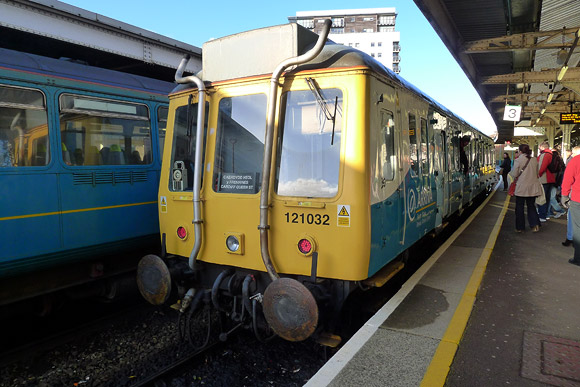
"vision" is of a slam-door single car unit trundling into
shiny Roald Dahl station after the epic journey from a Cardiff Queen
Street bay platform, bellowing black diesel fumes at 6mph.
For the moment, that's all Network Rail have planned for it.
Cardiff
isn't some sprawling metropolis, it's a compact city by European
standards, and I doubt Cardiff really needs a high-density tram
network. Instead, it needs to make better use of existing transport
corridors - in particular railways - like filling in gaps in Roath,
Ely, Rumney and St Mellons; and ideally at some point in the future
completing a "circle line" from Coryton to Radyr.
Any
rapid-transit system should probably be bus-based too. So not
everything Cardiff Council are planning is bad. I know that's not
very "glamorous", but Swansea has more claim to a tram
system than Cardiff, especially as the corridor's in place via the
bendy bus between Morriston and Singleton.
Yesterday, the First
Minister published the second annual progress report (available here in pdf), updating the Assembly and the
rest of us on progress made in delivering Welsh Labour's Programme for Government.
The report itself, and its annexes, have both been slimmed down significantly and the report itself is surprisingly
readable.
The "excitement"
pretty much ends there, as this is a post for the anoraks (and lazy
Assembly staffers). Don't worry about me though, posts like this
don't take as long as they might seem as it's basically just listing
stuff.
As I said last year, the commitment to transparency is
commendable, and I don't really question the First Minister's
commitment to "delivery" either. Progress reports like
these are, broadly speaking, a good idea. It's just the means of
delivery that's the issue. More from me on that next
week.
Reaction
As you can imagine, the First Minister
was keen to emphasise his government's record at "standing up
for Wales during difficult times", whilst acknowledging that
other challenges lie ahead – most notably in the health service,
some aspects of education and local government (once the cuts start
to bite properly).
Opposition politicians were quick to
point that the report is a "fig leaf", "self-congratulatory"
and giving the mistaken impression that "all is well".
Both sides have a point. If Labour really want their record in goverment to be judged on things like water resource zone targets or new PCSOs, they're within their rights to do so I suppose. Just don't expect anyone to get too excited about that. People do notice things like class sizes, waiting lists and the general health of the economy though. There are also hardly any
targets indicated whatsoever.
Like last year, it's up to you if
things have gotten better or not. However, many areas have improved,
albeit by small amounts in general. The indicators themselves though are fairly unambitious on the whole. Many have barely anything to do with the Welsh Government at all.
"Flat lining" is the
general impression given by the report, with one or two exceptions in
both directions.
Methodology
In a change from last
year - and in order to slim down the length of the post - I'm only
counting indicators that have "changed significantly" one
way or another. The definition of "changed significantly"
is subjective (in general +/- 1% change or its equivalent). So I suggest if you're really, really interested in
this, you go through the report, annexes or indicators and decide for
yourselves.
Unless stated otherwise, I'm comparing figures to
the previous year (2011-12).
Once again, some indicators
continue to only have one column of statistics to base delivery off (like this),
or don't have any figures at all.
Some figures are exactly the same as those provided last
year. Compare this post with last year's post and you'll see it for
yourselves (if you can be bothered).
It appears many indicators have been subtly changed, I don't think that results in fair
comparisons as it's effectively "changing the goal posts".
For example, renewable energy production was counted in terms of kWh in 2012,
this year it's as a percentage of total energy produced. I don't think it's
that much of a problem in the grand scheme of things, but it's a concern.
Now, on to the main event....
Getting
Better
Culture & Heritage
Visits to the National
Museum rose by 34,000 on 2011.
The number of educational visits to
CADW sites rose by ~13,300 on 2011.
The number of free swims taken
up by the over 60s rose by ~60,000 on 2011.
60.6% of conservation
and maintenance work was completed on scheduled monuments by Q4 2012,
compared to 52.2% in 2011.
An extra 8 libraries were refurbished
between 2011 and 2012, bringing the total number to 87.
Economy
& Transport
The percentage of the adult workforce
qualified to the equivalent of 2 A-levels rose by 2% to 54% between
2012 and 2011.
The percentage of the adult workforce with a
degree-level qualification rose by 1% to 33% over the same
period.
The percentage of 19-24 y.o. NEETS fell from 22.9% in 2010
to 22.1% in 2011.
The number of visits to CADW sites, local and
national museums rose by 800,000 between 2010 and 2011.
The number
of rail journeys in Wales rose by 1.3million between 2009 and 2010 to
over 27.2million.
The percentage of households with access to next
generation broadband rose by 6% to 37% in 2012, however this remains
the lowest rate of the Home Nations.
Jobs Growth Wales exceeded
its target of 4,000 job opportunities - creating 6,000 - and are "on
course" to meet targets of Skills Growth Wales II.
The number
of apprenticeships offered via Young Recruits rose by 165 between
2011 and 2012.
Apprenticeship success rates rose by 3% between
2011 and 2010.
2G mobile coverage now covers 99.2% of Wales in
2011, compared to 84% in 2010.
Education & Schools
The
percentage of pupils attaining 5 A*-C GCSEs rose by 1.1% on 2011 (to
51.1%) - a sharper rise than England (0.4%), but still lagging behind
overall (59.4%).
The gap in attainment for those in receipt of
free school meals as KS4 (GCSE) closed by 1.6% between 2010 and 2011
to stand at a 33.2% points difference.
Post-16 "staying on"
rates rose by 1.2% between 2010 and 2011 to 80.1%, but lag behind
England overall.
The number of further education courses
successfully completed rate rose by 1% to 82% in 2011 compared to
2010.
Environment
The percentage of electricity
generated from renewables rose from 5% in 2010 to 7.9% in 2011.
The
amount of gas used by Welsh households fell by more than 1,000 kWh
between 2010 and 2011, while the amount of electricity fell by 70 hWh
(could be a bad thing when you factor in fuel poverty).
The
percentage of municipal waste recycled rose by 4.9% to 48.5% of all
waste – the highest recycling rate of the Home Nations.
The
percentage of water resource zones meeting target headroom
requirements rose to 96% from 88% between 2010 and 2011.
The
percentage of rivers, lakes and coastlines achieving a "good"
ecological status rose by 2.7% between 2011 and 2012.
The area of
woodland to be managed to UK Forest Standard rose by 23,000 hectares
between 2012 and 2011, with significant rises since 2009.
28 more
Community Flood Plans were created between 2011 and 2012.
The
percentage of journeys to work under 5 miles made by foot or by cycle
rose by 6% on 2007 to 26% in 2010.
Equality, Housing,
Communities & Poverty
KS2 and KS4 attainment rates for
special needs pupils both improved between 2010 and 2011.
The
percentage of ethnic minority households accepted as homeless fell
from 8.8% in 2010 to 6.6% in 2011 (hinting at falling
homelessness).
There were 285 fewer incidents of "hate
crimes" in 2011 compared to 2010.
There were 7 more
authorised gypsy & traveller sites in 2012 compared to 2011.
The
percentage of assessed dwellings containing at least one "Category
1" hazard fell by 7% between 2010 and 2011.
The percentage of
homeless families that include dependant children fell from 43% in
2010 to 41% in 2011.
21,000 households had received help or advice
about reducing energy bills as part of the NEST scheme.
Credit
union memberships rose by ~5,500 between 2011 and 2012 to just under
60,000 members.
The number of statutory plans produced by local
authorities has fallen from 88 in Q4 2011 to 31 in Q4 2012, reducing
bureaucracy.
The net benefit of efficiency savings in local
authorities from joint e-procurement (xchangewales) rose from £14.8m
in 2011 to £18.5m in 2012.
The number of adults receiving direct
payments rose to 3,200 in 2011 from 2,730 in 2010.
The percentage
of children seen alone by social workers rose from 29.5% in 2010 to
33% in 2011.
The percentage of looked-after children experiencing
more than once change of school in a year fell by 2% between 2010 and
2011 to 12.2%.
Health
The mortality rate for
circulatory diseases (under 75s) fell to 68 per 100,000 from 71 per
100,000 people in 2011.
The number of hospital acquired infections
remains generally lower in 2012 and 2013 than previous years, and
significantly lower than pre-2009.
The number of emergency
admissions for chronic conditions is around 800-1,000 per month lower
in 2012 compared to 2011.
The percentage of GP practices reviewing
their palliative care arrangements increased by 5% between 2010 and
2011 to 90.9% of practices.
The percentage of surgeries offering
online repeat prescriptions rose from 18% in 2012 to 43% in
2013.
Teenage conceptions per 1,000 people fell from 36.9 in 2010
to 34.2 in 2011.
The percentage of children immunised against MMR
rose by 2% between 2010 and 2011 to 93% overall, compared to 80% in
2003.
Seasonal uptake of flu vaccines for the over 65s rose
between 2010 and 2011 but remain significantly lower than the rest of
the UK.
The percentage of delayed transfers of care (for social
care reasons) is generally lower in 2012 than in 2011.
Rural
Affairs
Household incomes in rural areas remain marginally
higher at 100.9% of the Welsh average.
The percentage of people
employed in rural areas remains higher than the combined rural-urban
average at 69.7% in 2012 – a rise of 1% on 2011.
The percentage
of direct payments made to farmers by the end of December each year
rose from 88% in 2011 to 97% in 2012 – compared to 75% in 2007.
The
number of passengers using the BwcaBus community transport service
rose by at least 10,500 between 2011 and 2012 to 23,800 passengers in
total.
Safety
Drug-related deaths fell by 15 between
2010 and 2011 to 137 deaths.
Alcohol-related deaths fell by 35
over the same period to 459 deaths.
The overall crime rate fell to
63 per 1,000 people in 2011 compared to 68 in 2010 and 102 in
2003.
The percentage of people aged 16-59 taking Class A drugs
fell to 2% in 2011, from 2.3% in 2010 and 2.9% in 2009.
The number
of first-time entrants into the youth justice system in Wales fell by
over 600 between 2010 and 2011.
The percentage of successful
prosecutions for violence against women rose from 71.8% in 2010 to
74.8% in 2011.
The number of fires attended per 10,000 population
fell from 67.8 in 2010 to 53.6 in 2011.
Road casualties fell by
213 between 2011 and 2012, with a 185 fall in serious casualties and
a 28 fall in the number of fatalities.
The number of people
supported by the All Wales Domestic Abuse and Sexual Violence
Helpline rose to more than 3,100 in 2012, compared to just over 1,000
in 2011.
In 2012, 433 of the pledged extra 500 PCSOs had been
recruited, compared to 47 in 2011.
The number of people with
substance misuse problems benefiting from the European Social Fund
peer-mentoring rose by 331 between 2011 and 2012.
Access to
suitable custodial accommodation for young people rose by 2.9% between
2011 and 2012.
Getting Worse
Culture
& Heritage
The number of children participating in arts
activities fell by 1% on 2011 to 79%.
The number of visits to CADW
monuments fell by 68,000 on 2011.
The number of free swims taken
up by under 16s fell by ~61,000 on 2011.
Economy &
Transport
The percentage of 16.-18 y.o NEETS in Wales rose
from 11.5% in 2011 to 12.1% in 2012.
The value of tourism spend at
CADW sites fell by ~£260,000 between 2011 and 2012.
The value of
contract opportunities offered through Sell2Wales fell by ~£600,000
between 2011 and 2012 (could be seen as a positive if contracts are
more attainable for smaller companies).
The number of
beneficiaries of ReAct fell by more than 1,000 between 2012 and 2011
(possibly due to economic improvement).
The number of employees
benefiting from the Wales Union Learning Fund fell by ~1,800 between
2012 and 2011.
The number of dangerous trunk road defects rose by
161 in Q4 2012 compared to Q4 2011.
Education &
Schools
The number of further education institutions fell to 14
in 2011 (due to mergers) and is likely to be even less now. It's up
to you if this is a failure or not, but it's a "negative".
The
percentage of higher education institutions with incomes higher than
the UK mean fell from 45% to 40% in 2010.
Environment
Levels
of greenhouse gas emissions rose by ~3.5million tonnes between 2009
and 2010.
The number of properties benefiting from enhanced flood
or coastal protection fell by ~500 between 2011 and 2012.
Equality,
Housing, Communities & Poverty
The gap in attainment
between girls and boys widened at KS4 between 2010 and
2011.
Incidents of sexual crimes rose by 70 between 2011 and
2010.
Men continue to have significantly higher employment rates
(71.4%) than women (63.3%).
The number of homeless families with
children living in bed and breakfast accommodation rose from 10 in
2010 to 30 in 2011.
The percentage of children living in combined
material deprivation rose from 16% to 20% in 2009.
The percentage
of households living in fuel poverty rose to 30% in 2012, from 26% in
2010.
The percentage of people attending arts schemes from
under-represented groups fell by 0.4% between 2011-2012 and 1.5%
since 2010.
The percentage of 19 year olds in education or
training when leaving care fell from 48.1% in 2010 to 47.3% in
2011.
Health
There were 3,000 extra emergency
admissions to hospital in 2011 compared to 2010.
The gap in life
expectancy between the most and least deprived hasn't improved
between 2008 and 2009.
The percentage of patients waiting less
than 4 hours in accident and emergency departments was 85.9% in April
2013, compared to 88.6% in April 2012 and 92.1% in April 2007.
56.1%
of ambulances met the 8 minute category A response target in December
2012, compared to 64.8% in December 2011.
The number of cancelled
operations was generally higher in 2012 compared to 2011, but much
lower than 2002-2003.
The percentage adults who are overweight or
obese rose by 1.2% to 58.5% of the population in 2012.
97.4% of
non-urgent cancer patients started treatment within 31 days in Q1
2013, compared to 99% in 2011.
83.6% of urgent cancer patients
started treatment within 62 days in Q1 2013 compared to 90.3% in Q4
2011.
The number of deceased organ donors fell from 67 to 52
between 2011 and 2012.
91.4% of patients waited less than 26 weeks
for referral to treatment in March 2013, compared to 94% in March
2012.
Rural Affairs
Only 6% of rural households had
access to next generation broadband in 2012.
The number of herds
losing their bovine TB free status increased on 2011 in
2012.
Safety
Recorded crime at railway stations rose
from 1,054 incidents in 2011 to 1,114 incidents in 2012.
Access to
suitable community sentence accommodation for young people fell by
0.5% in 2012.
The percentage change in average hours young
offenders spent in suitable education, training or work-based
activity once in a custodial or community sentence fell from 17.6% in
2011 to 11.7% in 2012.
Life for sale, or to use for your
amusement. One less than careful owner. Requires extensive
refurbishment due to blogging.