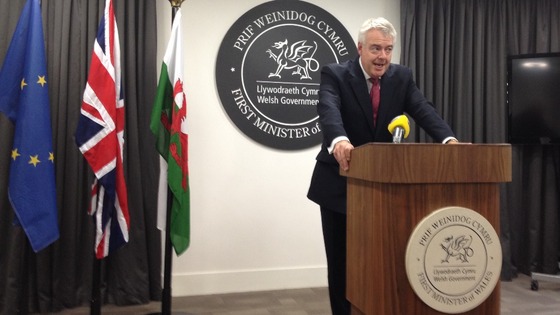
The news that the Welsh Government will refuse to bail out four health boards dominated proceedings today, but the activation of Article 50 tomorrow also focused attentions.
This site is no longer updated
Please use the links in the sidebar to visit the new sites!
Showing posts with label Welsh Press. Show all posts
Tuesday, 28 March 2017
FMQs: Article 50, NHS Deficits & Grass fires
By OwenTuesday, March 28, 2017Brexit, BudgetWG, Buses, Cardiff, Cons, Fire, FirstMin, FMQs, Hospitals, Labour, Newport, Plaid, RCT, Roads, UKIP, Welsh Press, WGCom, WGHealth, WhitehallView Comments
The news that the Welsh Government will refuse to bail out four health boards dominated proceedings today, but the activation of Article 50 tomorrow also focused attentions.
Tuesday, 6 September 2016
Boring, Boring Senedd
By OwenTuesday, September 06, 2016Assembly, Commission, Labour, Lib Dems, Plaid, Society, Welsh PressView Comments
![]() |
| (Pic : topnews.in) |
He hasn't been in there long, but one of the new intake of AMs – Steffan Lewis AM (Plaid, South Wales East) – caused (a bit of) a ruckus a few weeks ago after claiming Assembly proceedings were "dull to watch".
Tuesday, 12 January 2016
EU Referendum : The IWA Debate
By OwenTuesday, January 12, 20164FirstMin, Borders, EU, Farming, Foreign Affairs, InOutRef, ITV, IWA, Labour, Nationalism, Northern Ireland, Norway, Regs, SteelSOS, Switzerland, Trade, UKIP, Unionism, Universities, Welsh PressView Comments
We still don't know when the referendum will be held on the UK's membership of the European Union but, to much fanfare, the first Welsh debate was hosted last night in Cardiff by the Institute of Welsh Affairs (IWA) and Cardiff University, with the First Minister lining up against UKIP leader, Nigel Farage MEP.
Monday, 16 November 2015
Groundhog Day : Auditing the Welsh Media
By OwenMonday, November 16, 20154WGCulTor, 4White Papers, BBC, Blogosphere, BT, BudgetUK, DCMS, Film, Gaming, Iaith Gymraeg, Internet, ITV, IWA, Radio, S4C, UK Press, Welsh PressView Comments
![]() |
(Pic : BBC Wales) |
The IWA's online organ, Click on Wales, released drafts of the report's sections throughout October, but the full and final report is now available at around 150 pages long (pdf). It's an incredibly useful analysis, but not anything we haven't heard before.
The state, and decline, of the Welsh media has been discussed on and off for the best part of a decade – such discussions being even more important this year in the context of negotiations on the BBC's Charter renewal. This site's no exception :
- Saving the Welsh press (29.11.11)
- Future of the Welsh media report (15.5.12)
- More questions on the future of the Welsh press (4.2.13)
- Broadcasting Wales Parts I-VIII (September 2013)
- The Assembly & The Democratic Deficit (12.11.13)
- How Local is "Local TV"? (18.1.14)
- Senedd on the Box (2.10.14)
- Strapped 4 Cash? (27.6.15)
- Downloading (22% - 2 years left)....(8.7.15)
- You Won't Believe What Happens Next....(14.9.15)
Television & Public Service Broadcasting (PSB)
![]() |
- Digital terrestrial television reach in Wales (97.8%) is marginally below the UK average (98.5%). Virgin Media's cable services only reach 23% of Wales and hasn't changed since 2004, this is well below the UK average of 44%.
- Wales has the highest proportion of HD-ready televisions and take-up of HD services of the Home Nations (Wales = 76%; UK average = 73%).
- Made in Cardiff – currently Wales' only local TV station – has a weekly reach of 196,000 viewers.
- Overall viewing minutes have fallen consistently across the UK – particularly amongst children and the under-35s - but Welsh viewers spend longer watching PSB than any other part of the UK.
- Over a third of viewers in Wales used "catch-up" services in 2014. BBC iPlayer, Sky, ITV Player and 4OD are the most popular services. Netflix has grown significantly in popularity since 2012. A majority of catch-up services are viewed on television, but increasingly on tablet computers too, while there's a decline in PC/desktop views.
- BBC Wales, ITV Wales and S4C spent a combined £215.35million on PSB services in 2014-15, a decline of £19.25million (8.2%) on 2008.
- Since 2008, there've been 545 fewer TV hours produced (all BBC and ITV; S4C saw an increase) and 1,187 fewer hours of radio programming since 2008.
- BBC and ITV produced 17.5 hours of English language output per week in 2015, compared to 24.5 hours in 1990 – a 48% reduction. ITV Wales now only produces 5.5 hours, compared to 15.5 in 1990.
- 63% of BBC's English language output was current affairs, news or politics. Just 2.8% was comedy, drama and the arts.
- S4C's funding fell from £104.4million a year in 2010 to £85.7million in 2014-15 – a reduction of 18.4%. They spend, on average, about £31,000 per hour, though drama productions can cost up to £140,000 per hour.
- In 2014, 3.2% of PSB network production spend was in Wales, compared to a population share of 4.9%. 65.4% was spent in London and Southern England.
- BBC Wales and independent producers provided £60.3million worth of UK network shows in 2014-15, primarily dramas.
- Average listening hours per week in Wales fell from 24.4 hours in 2007 to 22.4 hours in 2014 – however weekly listening hours are the highest of the Home Nations. Radio also had a bigger reach at 94.5% of the adult population, compared to 89.4% across the UK.
- Wales has the highest share of BBC Network listeners in the Home Nations at 49% of listeners.
- Reach figures for BBC Radio Wales and Radio Cymru have shown steady declines, from 435k and 155k respectively in 2008-09 to 418k and 119k respectively in 2014-15.
- Ownership of digital radios (DAB) is also highest in Wales amongst the Home Nations at 47% (UK = 43%). This brings Wales very close to the 50% threshold set by the UK Government whereby they would consider a digital radio switchover.
- BBC Radio Wales and Radio Cymru spent a combined £20.6million on programming in 2014/15 and cost per hour was near enough the same for each (£1.5k-1.6k).
- Commercial radio has the lowest listening share in Wales amongst the Home Nations at 39%, compared to the UK average of 43%. Wales also generated the lowest commercial radio revenues of the Home Nations at £14.9million.
- Only three companies control commercial stations in Wales – Global Radio, UTV and Town & Country Broadcasting. Digital switchover may mean commercial stations are "released entirely" from their local obligations.
- 78% of premises in Wales have taken up broadband services, compared to 42% in 2006.
- 79% of Welsh households have access to super fast broadband – more than Scotland (73%) and Northern Ireland (77%).
- 3G mobile broadband outdoor services reach 97.9% of Welsh households. However, outdoor 4G services currently only reach 62.8%, compared to the UK average of 89.5%.
- Welsh newspapers have seen massive declines in daily circulations since 2008, ranging from falls of more than 50% for the Western Mail, South Wales Argus and South Wales Echo to just a 6.3% fall for the south Wales version of Metro.
- These numbers are, generally, in line with declines in newspaper sales elsewhere, with some UK papers suffering even steeper declines.
- Online there's said to be a "more level playing field" between Trinity Mirror and BBC, with Wales Online and Daily Post websites being competitive with BBC Wales Online services in terms of unique browsers. Use of Wales Online has grown by 586% since 2006.
- 59% of adults access BBC online services, and online services are significantly more popular amongst those aged 16-24.
- 27% of people said Facebook was now their main source of local news.
- BBC Wales spent a total of £2.541million on their online services (£399,000 was spent on Welsh language services/BBC Cymru Fyw).
- S4C Clic viewing sessions had increased by 232% since 2013-14, with an additional 500,000 downloads of S4C mobile apps.
- With Trinity Mirror agreeing a takeover of Local World, most of the major national, regional and local newspapers in Wales are owned by just two companies - Trinity Mirror and Newsquest.
- The number of journalists in south Wales has fallen from over 700 in 1999 to 108 in 2013.
- There are said to be 46 "hyperlocal" websites active in Wales, and research has suggested around half of hyperlocal site owners in the UK have had some form of journalistic training – though most were self-funded and only 13% generated more than £500 a month income.
- £1.85million in grants were made available to Welsh language publications in 2013-14, compared to £748,000 for English language publications. 50 papurau bro receive grants of up to £1,900 a year from the Welsh Government.
- S4C launched a £1million digital fund in 2012 to create interactive media and other apps.
- The Welsh Government should establish an independent media panel to monitor media trends and commission studies, working with relevant academic departments.
- Investment in BBC Wales' English language services should increase by £30million a year, ideally via an increase in the licence fee. This must include programming other than news and current affairs.
- S4C's funding and editorial independence must be maintained to avoid slipping into a "cycle of decline". Collaboration between BBC and S4C should be maintained, however.
- BBC 2 Wales and S4C should be broadcast in high-definition.
- The effectiveness of DAB coverage should be assessed before any decision is taken on a digital radio switchover.
- Radio regulation should be devolved to the Welsh Ofcom advisory commission.
- The abandonment of local radio obligations should be reconsidered.
- BBC Radio 1 and 2 should provide an opt-out news service for Wales.
- The UK Government should support BBC establishing an interactive online service for Wales.
- Responsibility for broadcasting should be shared between the UK Government and devolved administrations.
- BBC Audience Councils should be replaced with National Broadcasting Trusts, which would help shape the delivery of a national service licence.
- All PSB broadcasters should lay their annual reports in front of the National Assembly.
- The Welsh Government and Ofcom should commission a joint study into the future of local media in Wales, embracing community radio, papurau bro, hyper-local news websites and local newspapers.
- The Welsh Government should create a "challenge fund" administered by the Arts Council for Wales and Wales Books Council to help develop new local news services.
What the audit missed
![]() |
Magazines - Including (ironically), the IWA's own Agenda, Planet as well as others like Cambria, Barn, Golwg and New Welsh Review. It does mention "publications", particularly with regard papurau bro, but there was little evidence provided on the impact of grant funding cuts on English language magazines or their long-term prospects.
Films & Music - The Welsh film production industry only gets passing mentions, along with music. You would've expected music to have been in there considering recent rows between Radio Cymru and Welsh language musicians. Although this certainly crosses into "the arts", it seems the definition of "media" has been set rather narrowly.
"Citizen Journalism"/The Blogosphere – It's admittedly a grey area, reportedly written off by Culture Minister Ken Skates (Lab, Clwyd South) as "opinion-driven" during the suit-and-sandwich conference because, as we all know, there's little political bias in the mainstream media.
There was a throwaway line about the number of blogs increasing but being "about lifestyle rather than news" - thanks a bunch. I can only speak for myself, and I might get 2% of the South Wales Evening Post's unique browsers on a good day; but I don't know whether being left out is an insult or compliment (sites like Carmarthenshire Planning certainly do count as hyperlocals).
It doesn't really matter because in the absence of public funding, political backing, advertising or publicity it's clear the blogosphere is (relatively) successful and performs a unique function. The Welsh blogosphere's still languishing in the shadows of Scotland's fifth estate; it would take me 20-30 years to match what Wings Over Scotland gets in site metrics in a single year. There's also a high turnover;
Gaming – The Welsh games industry has grown over the last few years from being practically non-existent to including some breakout companies. It's also one of the most popular mediums around, and as big as, if not bigger, than the film and television industries at present. I'm surprised the IWA and politicians haven't cottoned on to that yet. What do they think people, particularly those under the age of 35, are doing if they're not watching television, listening to the radio or reading newspapers? (See also : More than just a game).
A Warning on Funding
![]() |
Time for some mathematical gymnastics to serve as a warning on how to interpret the funding figures in the report and how that fits from a "value for money" perspective. The easiest way to do that is to compare the ratio of amount of money spent versus the audience.
Based on the figures provided for BBC's English language web services, for every £1 they spend, they get 85.5 unique browsers. BBC Cymru Fyw gets 11.5 unique browsers for every £1 spent.
For every £1 I spend directly on Oggy Bloggy Ogwr - without a publicly-funded newsroom, television and radio network to back me up and whilst only posting a few times a week - I get 5,272 unique browsers.
Oggy Bloggy Ogwr is, therefore, 62 times greater value for money than BBC Wales Online and 458 times greater value for money than BBC Cymru Fyw. *Jazz hands*
Not bad for opinion-driven non-media.
Technically speaking, if I put more money into this site its "value for money" would mathematically decrease because the audience is naturally limited and no amount of extra money would change that. Hence that's why complicated political and investigative stories tend to cost a lot of money and get poor returns for broadcasters and publishers, which leads to a downward spiral in coverage.
It also, theoretically, means the "true value" of non-current affairs, non-mainstream television (i.e children's), radio programmes as well as blogs and hyperlocals is likely to be significant in terms of what they bring to the table - perhaps more so than was reflected in the report and in general discussions on the Welsh media.
It's therefore not entirely a funding issue because it doesn't buy you viewers or readers. It's an audience issue and comes down to the quality of the product and how efficiently it's produced.
When you compare what Wales gets from our broadcasters and publishers compared to what the Republic of Ireland gets – utilising similar sums of money and with a similar set up - we're clearly doing something wrong here.
Conclusions
![]() |
It's an incredibly useful analysis, but not anything we haven't heard before.
Individual AMs have made their own concerns known down the years, but it'll take the closure of one of the major Welsh newspapers – probably The Western Mail – or the subsuming of S4C into BBC Wales to actually force the Welsh Government into action. Calls for challenge funds and independent panels (yet another bloody committee) will fall on deaf ears as ministers can, justifiably, say it's not their problem as broadcasting is a non-devolved issue.
We can never, realistically, expect the UK Government to do anything constructive either; as long as UK-wide network shows continue to be watched or made in Wales, as far as they'll be concerned that's job done. A market failure – and that's essentially what this report implies very strongly – is just something that happens.
So it's worth saying again that it's an incredibly useful analysis, but not anything we haven't heard before.
Television and newspapers will remain important for the time being. However, the only rays of hope for the future, it seems, are online – even though Wales Online is close to becoming a parody of itself, and doesn't generate anything close to the same revenues as Media Wales' print productions – and community radio, which is holding up particularly well and isn't getting the attention it deserves in this debate.
I'm concerned there's too much hand-wringing over Wales being seen at the UK level in network shows when major broadcasters and newspaper publishers can't even harness a captive audience at a Welsh level. The success of Y Gwyll/Hinterland has happened by accident because melodramas about troubled detectives with names like Smegmä Smegmässon are in vogue at the moment (to saturation point). That won't last forever, neither will network shows like Casualty and Doctor Who.
Nobody has really explained what they want either. Do they really expect a Welsh political story affecting less than 5% of the UK's population to be given equal treatment to an English one affecting 85% on network news? News bulletins would end up three or four hours long.
There are only two reasons you'll see Wales on the front pages or in the main news bulletins: human tragedy and sport. The murders of April Jones and Tracey Woodford, as well as the Welsh national rugby and football teams, have probably got more coverage and column inches in the UK media than the Welsh Government and Assembly have in 10 years. A BBC network radio news opt-out - recommended in the report - or "Welsh Six" on TV might go some way towards addressing that.
As cynical as it sounds, maybe we just have to come to terms with the fact very little of interest happens in Wales. That's reflected in our politics, our economy and the small-c conservatism that forms the fabric of Welsh society. That's very well represented in our media – including this blog.
So to conclude, the report is an incredibly useful analysis, but not anything we haven't heard before.
Wednesday, 5 February 2014
The reason why there's no grown up drugs debate
By OwenWednesday, February 05, 20144WGHealth, Cons, Crime, Drugs, England, Labour, PUBH, Science, UK Press, Welsh PressView Comments
| The Wedinos scheme - backed by more than £100,000 in Welsh Government funding - has prompted criticism from the Welsh Conservatives. They're probably wrong. (Pic : BBC) |
Last week, it was revealed the Welsh Government had signed off £102,000 towards a joint project with Public Health Wales where people can anonymously send in suspected legal highs, and other drugs, for laboratory analysis. Here's more from BBC Newsbeat.
Called Wedinos (English : "After Dark"), the initiative aims to log and track emerging legal highs and act as an "early warning/intelligence system", so authorities can identify trends and help clampdown on them (where applicable).
It's said to be aimed at health workers and the police, but members of the public can use it as well. All the results appear on the website, displaying the packaging, listed effects and active ingredients.
If someone was given a drug laced with, for argument's sake, rat poison, it would show up in the test and if acted upon quickly could be life-saving.
It's an absolutely brilliant idea, and for £102,000 per year is a snip. The Welsh Government have come under deserved criticism for their management of the health service, but today I tip my hat. Brownie points the Health Minister, Mark Drakeford (Lab, Cardiff West). This is the sort of evidence-based policy I like to see.
Then the Welsh Conservatives barge into view. Andrew Davies might well be "19 stones of pure Welsh beef", but here's 19 tonnes of bovine faeces.
I'm sure the Welsh Conservatives think the The Western Mail are doing them a favour by releasing any and all thoughts, getting everyone hot under the collar and demanding "something be done" as they grumble about profligate Carwyn and chums.
What The Western Mail and Daily Di have done, however, is display to readers some the shaky logic the Welsh Conservatives use sometimes. Hopefully the party can learn something from it and become a truly effective opposition – something they've rarely threatened to do in the Fourth Assembly - but I won't hold my breath. I don't know what's got into them over the last few weeks.
The key claims the Shadow Health Minister, Darren Millar (Con, Clwyd West), made were that :
- Drug dealers are being given access to a "free analytical service to test the quality of their substances".
- The service is diverting cash away from other NHS services, with the obligatory references to cancer patients being denied life-saving drugs.
- By funding the service, the Welsh Government are "confusing the message that drugs are harmful and potentially promoting their use".
Let's deal with the first once. I'm sure most drug dealers don't give a toss about the quality of the stuff they peddle, as shown on this DrugScope page - just as long as someone buys it. Checking for purity implies they're trying to comply with some sort of trading standards for the black market. I realise Conservatives are supposed to support the corner-cutting entrepreneur, but this is taking it to new levels.
Next, the issue of cash diversion. £102,000 is ~0.0017% of the Welsh health and social services budget, just to point that out. There's debate over how much the Welsh Government and LHBs actually spend on, for argument's sake, cancer patients. In 2012, the Conservatives quoted the Rare Cancer Foundation, which said a cancer drug fund – similar to the one that operates in England – could be set up for £3.3million.
Whether Wales needs a drugs fund for rare and costly medicines is open to debate, but putting the £102,000 into that would be just over 3% of the way there. I'm also sure plenty of terminal cancer patients are charged for extra bedrooms so their grandchildren can visit in their final days too, or even evicted.
Last, it's the issue of "promoting drug use", which I just find bizarre.
Wedinos doesn't condone the use of drugs, just tests them and helps identify them. Far from giving up "the fight against drugs", it's a pretty powerful tool in keeping them off the streets, especially if police and other authorities can spot the harmful drugs more easily. Many legal highs look like super sour sweets.
On the one hand, the Welsh Government and Public Health Wales are treating drugs as much as a health issue as one of criminal justice. It's their job to reduce harm and exposure, and a project like Wedinos might do it.
On the other hand, the Welsh Conservatives are out of touch moralists with Ronald Reagan still ringing in their ears, who don't seem to grasp that a scheme like this can aid the fight against drugs on the street and, you know, prevent people becoming seriously ill or dying. That's something the National Health Service is supposed to do, isn't it? Preserve health?
Would they really be happy for children (won't someone think of them!?) to come into contact with unidentified substances just to prove some point about moral decline and make people think the Welsh Government are "soft on drugs"?
The Welsh Government are many things, but their policy on substance misuse could be considered one of their few successes down the years.
I consider this sort of knee-jerk stuff incredibly depressing and think less of AMs and their parties whenever they engage in it.
I am working on a – you guessed it – six-parter on drugs policy where I'll explore things related to this in a bit more detail. I'm about a third of the way through it and hope to finish it for March. I'm considering binning it because if some of our betters aren't mature enough to have these sorts of discussions, the rest of us probably aren't either.
Thursday, 21 November 2013
Housing Bill introduced to the National Assembly
By OwenThursday, November 21, 20134Assembly, 4Bills, 4WGCom, Business, Crime, EnglishM, Housing, Labour, Local Gov, Plaid, Planning, Poverty, Welfare, Welsh Law, Welsh PressView Comments
Continuing the housing theme, the Welsh
Government's Housing Bill was introduced to the National Assembly on Tuesday by Housing and Regeneration Minister, Carl Sargeant (Lab,
Alyn & Deeside).
It's fair to describe it as "flagship" legislation, and it's also a whopper, coming in at 85 pages.The Bill's available here (pdf) and the explanatory memorandum here (pdf).
It's been recently said elsewhere....apparently....that the Welsh blogosphere often "lacks thought and detail", is too safe and sanitised and has failed to "facilitate democratic engagement and scrutiny".
I'll admit it. I've let you, the Assembly, our AMs and the whole of Welsh society down.
It's a burden I carry every night, as I lie awake, wondering whether to cover gosspy, banal stories like the ongoing collapse of local democracy in Carmarthenshire, the impact of High Speed 2 on the Welsh economy or getting my chompers around the annual report of the Chief Dental Officer.
The blogosphere continuously fails to demand answers to the big questions. What does the Taxpayers' Alliance think about politicians eating and breathing at public expense? What does some chippy anonymous source think about press officers writing press releases at their place of work?
The blogosphere was supposed to open a window, casting light and transparency on Welsh democracy and those who claim to uphold it. Clearly, all opening that window ever did was let in a field's worth of beefy cow farts. It's a dereliction of duty. We need to return to fighting for what is right and cover the controversial.
I'll spend more time hanging around the Senedd, Eli Jenkins pub and Tŷ Hywel looking for receipts in bins. I'll use my extensive network of Assembly spies and media connections - because everyone outside the Bay Bubble establishment has them - more effectively; telling you if Assembly staff are using all those flatscreen TVs to watch Bargain Hunt, or what AMs really think of Peter Black's ties. The people have a right to know.
Instead of my typically concise, pithy blogs, I'm going to do something different today and go into a bit more detail than usual. There's nothing more worthy of democratic engagement and scrutiny than a new law; which could directly and indirectly affect tens of millions in public and private spending as well as thousands of households. The sort of thing I'd usually just gloss over.
Few of you are masochistic enough to delve through it yourselves, so I guess I'm going to have to try to cram more than 250 pages of text to as close to 2,000 words as possible. In my own time. By myself. For free.
What people think of that and whether people take time to acknowledge it is another matter.
Why does Wales need a Housing Bill?
It's claimed 14,000 new homes are required in Wales each year – up to 9,200 private new builds, and 5,100 from other providers like private landlords, housing associations and local authorities. They're all going to be of varying quality and owned/operated by many different companies and individuals.
One of the key aims is to create a mandatory licensing system for landlords and letting agents, as until now such schemes have been voluntary, with some landlords being bad news for both tenants and communities.
The Welsh Government say there are 22,000 empty properties, many of which can be brought up to a decent standard. Existing homes, especially older housing, also need upgrades. That's being carried out to social housing via the Wales Quality Housing Standard (WHQS), but not enough is being done in the private rented sector.
Homelessness is on an upward trend – some 5,800 households were accepted as homeless in 2012-13 - as housebuilding slows, social houses aren't built at a fast enough rate to keep up with demand, and welfare reforms impact households, like the infamous "bedroom tax".
In addition to that there's the perennial local campaign favourite of new gypsy and traveller sites, while the Bill could also lead to reforms in social housing standards and charges, and make an expansion of co-operative home ownership easier and more attractive to prospective tenants.
What does the Housing Bill propose?
The Bill itself is divided into 8 parts and 3 schedules. I'm clumping them together into broad themes instead.
Regulation of the Private Renting Sector
The Bill:
It's fair to describe it as "flagship" legislation, and it's also a whopper, coming in at 85 pages.The Bill's available here (pdf) and the explanatory memorandum here (pdf).
It's been recently said elsewhere....apparently....that the Welsh blogosphere often "lacks thought and detail", is too safe and sanitised and has failed to "facilitate democratic engagement and scrutiny".
I'll admit it. I've let you, the Assembly, our AMs and the whole of Welsh society down.
It's a burden I carry every night, as I lie awake, wondering whether to cover gosspy, banal stories like the ongoing collapse of local democracy in Carmarthenshire, the impact of High Speed 2 on the Welsh economy or getting my chompers around the annual report of the Chief Dental Officer.
The blogosphere continuously fails to demand answers to the big questions. What does the Taxpayers' Alliance think about politicians eating and breathing at public expense? What does some chippy anonymous source think about press officers writing press releases at their place of work?
The blogosphere was supposed to open a window, casting light and transparency on Welsh democracy and those who claim to uphold it. Clearly, all opening that window ever did was let in a field's worth of beefy cow farts. It's a dereliction of duty. We need to return to fighting for what is right and cover the controversial.
I'll spend more time hanging around the Senedd, Eli Jenkins pub and Tŷ Hywel looking for receipts in bins. I'll use my extensive network of Assembly spies and media connections - because everyone outside the Bay Bubble establishment has them - more effectively; telling you if Assembly staff are using all those flatscreen TVs to watch Bargain Hunt, or what AMs really think of Peter Black's ties. The people have a right to know.
Instead of my typically concise, pithy blogs, I'm going to do something different today and go into a bit more detail than usual. There's nothing more worthy of democratic engagement and scrutiny than a new law; which could directly and indirectly affect tens of millions in public and private spending as well as thousands of households. The sort of thing I'd usually just gloss over.
Few of you are masochistic enough to delve through it yourselves, so I guess I'm going to have to try to cram more than 250 pages of text to as close to 2,000 words as possible. In my own time. By myself. For free.
What people think of that and whether people take time to acknowledge it is another matter.
Why does Wales need a Housing Bill?
It's claimed 14,000 new homes are required in Wales each year – up to 9,200 private new builds, and 5,100 from other providers like private landlords, housing associations and local authorities. They're all going to be of varying quality and owned/operated by many different companies and individuals.
One of the key aims is to create a mandatory licensing system for landlords and letting agents, as until now such schemes have been voluntary, with some landlords being bad news for both tenants and communities.
The Welsh Government say there are 22,000 empty properties, many of which can be brought up to a decent standard. Existing homes, especially older housing, also need upgrades. That's being carried out to social housing via the Wales Quality Housing Standard (WHQS), but not enough is being done in the private rented sector.
Homelessness is on an upward trend – some 5,800 households were accepted as homeless in 2012-13 - as housebuilding slows, social houses aren't built at a fast enough rate to keep up with demand, and welfare reforms impact households, like the infamous "bedroom tax".
In addition to that there's the perennial local campaign favourite of new gypsy and traveller sites, while the Bill could also lead to reforms in social housing standards and charges, and make an expansion of co-operative home ownership easier and more attractive to prospective tenants.
What does the Housing Bill propose?
The Bill itself is divided into 8 parts and 3 schedules. I'm clumping them together into broad themes instead.
Regulation of the Private Renting Sector
The Bill:
- Makes it a legal requirement for private landlords and/or letting agents to register and be licenced with any local authority in which they let property.
- Places statutory duties on local authorities to maintain a publicly accessible register of licenced landlords and agents.
- Places a duty on licenced landlords or agents to notify local authorities of any change of circumstances within 28 days of the change occurring.
- Disqualifies people from receiving a licence if they :
- fail a "fit and proper persons test" – including committing fraud, acts of discrimination or harassment, firearms offences, sexual offences or failing to comply with other housing/landlord laws.
- haven't been trained in managing rental properties to the local authority's satisfaction.
- don't agree to abide by a Welsh Government Code of Practice.
- Mandates that licences will be valid for 5 years from the date of issue and will allow licences to be renewed 3 months before they expire.
- Grants local authorities the power to :
- revoke licences if a landlord or agent breaches any rules (with a right to appeal).
- issue "rent stopping orders" - where no rent is payable – if a landlord fails to comply with licencing requirements.
- turn down a licence renewal (with a right to appeal).
- Creates new offences, like :
- failing to produce/display a licence - up to £1,000 fine.
- advertising, letting or managing a rental property without a licence - up to £1,000 fine, barring a "reasonable excuse".
- failing to provide documents to local authorities when required - up to £2,500 fine.
- providing false information to the local authority - up to £2,500 fine.
Homelessness
| The Housing Bill aims to prevent people becoming homeless in the first place by placing duties on housing authorities to intervene early. (Pic :BBC) |
- Places a statutory duty on local authorities to carry out a homelessness review and publish a homelessness strategy every four years starting in 2018, which includes monitoring current and expected levels of homelessness, homelessness prevention activities and resources available to combat homelessness.
- Defines a "homeless person" as someone who :
- has no accommodation they can occupy legally.
- cannot occupy a home in the UK they would otherwise be entitled to occupy.
- cannot secure entry into a home they otherwise live in.
- lives in a movable home with no permitted place to put it.
- Defines someone as "threatened with homelessness" if they would become homeless (as defined above) within 56 days.
- Outlines that when dealing with homelessness applications, local authorities must :
- determine whether emergency accommodation is "suitable" for a person.
- provide information and advice to someone who's homeless or threatened with homelessness.
- prevent homelessness applicants from becoming homeless in the first place.
- guarantee accommodation for "priority need applicants".
- try and find accommodation within their area whenever they can. Though the Bill sets out the arrangements whereby they notify, in writing, any other local authority they intend house someone in.
- Sets out guidelines for appeals, reviews, and protection of a homeless applicant's property (where applicable).
- Makes it an offence to provide false, or knowingly withhold, information when making a homelessness application, punishable by a fine of up to £2,500.
- Gives local authorities the power to refer homeless applicants to another local authority in Wales or England if they don't have a local connection - unless they're at risk of domestic abuse.
- Defines "local connection" as a person who :
- was normally resident in the local authority they've made a homelessness application in.
- is employed in the local authority.
- has family associations in the local authority.
Eligibility for Homelessness Assistance
- "Priority need applicants" include :
- pregnant women (and a person they would normally reside with).
- people with dependant children, with disabilities, are elderly, have a serious illness or are subject to domestic abuse.
- people affected by a natural or man-made disaster.
- 16-21 year olds who've left care, fostering or are at risk of sexual or financial exploitation.
- former military personnel who are homeless upon leaving the Armed Forces.
- "vulnerable" released prisoners (or someone who's been held on remand) but only those with a "local connection" (as defined above).
- People ineligible for help under this law are :
- persons from abroad who are otherwise ineligible, including non-EU nationals.
- subject to immigration controls or are excluded from benefit entitlements under the Asylum & Immigration Acts 1996 & 1999
- Statutory homelessness duties on local authorities will end for people who:
- turn down emergency accommodation that the local authority has deemed suitable.
- become "intentionally homeless" (i.e. evicted due to anti-social behaviour) – though the Welsh Government will have the power to draw up who counts as "intentionally homeless".
- accepts either an offer of a private sector tenancy that lasts at least 6 months or a social housing tenancy.
Gypsies & Travellers
| The Housing Bill could lead to an increase in the number of legal traveller sites in Wales. (Pic : BBC Wales) |
- Defines a "gypsy or traveller" as
- a person of a "nomadic lifestyle" regardless of race.
- people who used to live a nomadic lifestyle but no longer do (i.e. health reasons).
- travelling circuses and show people.
- anyone who lives in a mobile home for cultural reasons.
- Places a statutory duty on local authorities to :
- carry out an assessment of, and publish a report into, gypsy and traveller site requirements every five years from the publication of their first report.
- use their powers under the Mobile Homes Act 2013 to provide sites for travellers where there's an assessed need.
- Gives Welsh Ministers the power to :
- approve, amend or reject any gypsy and traveller needs assessment, and issue guidance to local authorities.
- force local authorities to meet certain duties with regard gypsy and traveller sites as stipulated in the Mobile Homes Act 2013.
Social Housing Standards
The Bill :
- Gives Welsh Ministers the power to set and revise standards for social housing, including :
- rent levels and service charges (which will be charged separately).
- rules relating to rent levels and service charges.
- the quality of social housing itself.
- Gives Welsh Ministers (or someone working on their behalf) the power to issue warnings, intervene, and the power of entry, if they believe housing authorities aren't complying with standards.
- Removes a requirement in the Housing Act 1985 for housing authorities - when setting "reasonable rents" - to keep social rents broadly in line with private sector rents. Instead, they'll need to comply with any new guidance/limits Welsh Ministers introduce.
Finance, Tenancies and Council Tax on Empty Properties
| Long-term empty and abandoned homes will be liable to a 150% council tax rate. (Pic : BBC Wales) |
- Abolishes the Housing Revenue Accounts Subsidy (HRAS), and gives Welsh Ministers the power to set a "settlement payment" for the eleven Welsh local authorities forced to leave the scheme as a result.
- Amends the Housing Act 1988 to enable mutuals and co-operatives to provide assured tenancies, enabling co-operative/mutual tenants to benefit from the same legal protections as assured tenancies offered elsewhere.
- Via amendments to the Local Government Finance Act 1992, gives local authorities the option to set an additional 50% rate of council tax (150%) on "long-term empty properties" (unoccupied and unfurnished for at least a year). It also gives Welsh Ministers the power to decided what properties this would apply to.
Costs
Now things start to get complicated.
Creating a mandatory landlord and agent register will cost £500,000, but would be self-financing because of fee income. Start-up costs for local authorities are estimated to be £250,000. Most of the burden falls on landlords and agents - upwards of £8million (between 2015-2017) - with costs falling to £265,000 per year once landlords/agents are registered and properly accredited as outlined in the Bill.
With regard the homelessness measures, the explanatory memorandum estimates ~32,100 applications for homelessness assistance will be made in 2015-16. The total cost, under existing laws, is estimated to be ~£21.3million. Under the preferred option in the new law, additional costs are estimated to be £5.9million, based on increases in homelessness assistance applications - an extra 3,200 - as a result of the Bill's provisions (for example, increasing the limit of "threatened with homelessness" from 28 to 56 days).
The total cost of the homelessness provisions is estimated to be in the region of £27.2-32.4million, based on expected homelessness figures, which themselves are dependant on multiple factors, including welfare reform and the state of the economy.
The gypsy and traveller measures will cost ~£1.6million per year until 2019-20, with most of that being the existing £1.5million grant to fund new traveller sites.
The preferred option for social housing standards sees a £15,000 per year cost fall on the Welsh Government, and £7,000 per year falling on social housing providers to collect and submit data. The preferred option for rent and service charge changes would initially cost £1.7million to set up – the vast bulk falling on local authorities – and £397,000 per year afterwards.
Abolishing HRAS has apparently been agreed with the Treasury, estimated to cost ~£990,000. However, an estimated £33million of rent income from Welsh local authority housing would then remain in Wales instead of being paid to Westminster.
The costs of the co-operative housing tenancy provisions will be around £130-140,000, mostly taking the form of continued funding to the Wales Co-operative Centre.
Additional council tax rate on empty homes would initially cost £359,000 to local authorities and Welsh Government to set up. From 2016-17, when the provisions come into force, it'll cost £527,000 per year in increased enforcement and tribunal costs. However, it's estimated a 150% council tax rate would raise somewhere between £11-14.4million for local authorities from the just over 24,200 homes left empty for more than a year.
What does this Bill mean?
There
are many significant provisions in this Bill, notably the creation of
a mandatory licensing system for private landlords, which should
professionalise the industry further, helping to drive "slumlords"
out – I'm thinking along the north Wales coast in
particular.
Alongside that, other provisions – like those relating to mutual and co-operative housing and a fairer system of rents and charges for social housing tenants – seem sensible, even populist in some circumstances. It's for AMs to decide if that's truly the case though.
The extra council tax rate on empty properties might cause problems, especially if many are old holiday homes that haven't been used in a long time, though it's unrelated to the proposed general 200% rate on second homes. It would also encourage owners either to sell, renovate or rent their properties, increasing housing supply.
The abolition of HRAS – one of the few ways Wales has subsidised England to the tune of hundreds of millions of pounds, perhaps more, for decades – will lead to rent being retained in Wales, and money that could be reinvested in social housing by housing authorities. If the Bill passes and HRAS is abolished, then the Bevan Foundation and Plaid Cymru can probably chalk up its abolition as a success for them as much as the Welsh Government.
The gypsy and traveller provisions could cause problems as many people have an "issue" with traveller sites. The prospect of more of them being required by law could lead to difficulties in some communities, and perhaps for individual AMs too. No AM will be able to campaign against extra traveller sites honestly if they back the provisions in the Bill as outlined.
Entrenched opposition to sites might be less if local residents knew travellers living on legal sites were paying their way (they pay council tax when living on local authority and private sites, and most - if not all - work), had a strict code of conduct, and had full access to local authority services like rubbish collection.
There needs to be a bit of common sense when deciding where they should go. They shouldn't be sited out in the sticks on busy main roads, but there's no point in siting them in built up areas either. I'm not sure if that's best left to any Welsh Government guidance/regulations to come from the Bill, or if it should be included as clauses within the Bill itself.
The homelessness provisions are extensive – perhaps to the point it should've been a stand alone Homelessness Bill. They could cause controversy, mainly due to the impact on recently-released prisoners and (as I understand it) the powers for Welsh local authorities to transfer any homeless applicants who don't have a local connection elsewhere - including back over the border where applicable. The only exceptions, it seems, would be those fleeing domestic violence.
The Bill maintains released prisoners as a priority homelessness group if they have a proven local connection. However, homelessness is often cited as a cause of re-offending. Like gypsies and travellers, sheltered accommodation for homeless and vulnerable young adults is often sited in unsuitable places and attracts local opposition.
It's a reasonable compromise, as is the general requirement for a "local connection" when receiving homelessness assistance. It's best people receive help where they have strong connections and are perhaps known to the authorities, instead of becoming vagrants. The same requirements should apply to social homes too.
Now things start to get complicated.
Creating a mandatory landlord and agent register will cost £500,000, but would be self-financing because of fee income. Start-up costs for local authorities are estimated to be £250,000. Most of the burden falls on landlords and agents - upwards of £8million (between 2015-2017) - with costs falling to £265,000 per year once landlords/agents are registered and properly accredited as outlined in the Bill.
With regard the homelessness measures, the explanatory memorandum estimates ~32,100 applications for homelessness assistance will be made in 2015-16. The total cost, under existing laws, is estimated to be ~£21.3million. Under the preferred option in the new law, additional costs are estimated to be £5.9million, based on increases in homelessness assistance applications - an extra 3,200 - as a result of the Bill's provisions (for example, increasing the limit of "threatened with homelessness" from 28 to 56 days).
The total cost of the homelessness provisions is estimated to be in the region of £27.2-32.4million, based on expected homelessness figures, which themselves are dependant on multiple factors, including welfare reform and the state of the economy.
The gypsy and traveller measures will cost ~£1.6million per year until 2019-20, with most of that being the existing £1.5million grant to fund new traveller sites.
The preferred option for social housing standards sees a £15,000 per year cost fall on the Welsh Government, and £7,000 per year falling on social housing providers to collect and submit data. The preferred option for rent and service charge changes would initially cost £1.7million to set up – the vast bulk falling on local authorities – and £397,000 per year afterwards.
Abolishing HRAS has apparently been agreed with the Treasury, estimated to cost ~£990,000. However, an estimated £33million of rent income from Welsh local authority housing would then remain in Wales instead of being paid to Westminster.
The costs of the co-operative housing tenancy provisions will be around £130-140,000, mostly taking the form of continued funding to the Wales Co-operative Centre.
Additional council tax rate on empty homes would initially cost £359,000 to local authorities and Welsh Government to set up. From 2016-17, when the provisions come into force, it'll cost £527,000 per year in increased enforcement and tribunal costs. However, it's estimated a 150% council tax rate would raise somewhere between £11-14.4million for local authorities from the just over 24,200 homes left empty for more than a year.
What does this Bill mean?
| Expect to see more of this. This Bill is....wait for it....potentially quite controversial, and there are more talking points than the media have let on. (Pic : Wales Online) |
Alongside that, other provisions – like those relating to mutual and co-operative housing and a fairer system of rents and charges for social housing tenants – seem sensible, even populist in some circumstances. It's for AMs to decide if that's truly the case though.
The extra council tax rate on empty properties might cause problems, especially if many are old holiday homes that haven't been used in a long time, though it's unrelated to the proposed general 200% rate on second homes. It would also encourage owners either to sell, renovate or rent their properties, increasing housing supply.
The abolition of HRAS – one of the few ways Wales has subsidised England to the tune of hundreds of millions of pounds, perhaps more, for decades – will lead to rent being retained in Wales, and money that could be reinvested in social housing by housing authorities. If the Bill passes and HRAS is abolished, then the Bevan Foundation and Plaid Cymru can probably chalk up its abolition as a success for them as much as the Welsh Government.
The gypsy and traveller provisions could cause problems as many people have an "issue" with traveller sites. The prospect of more of them being required by law could lead to difficulties in some communities, and perhaps for individual AMs too. No AM will be able to campaign against extra traveller sites honestly if they back the provisions in the Bill as outlined.
Entrenched opposition to sites might be less if local residents knew travellers living on legal sites were paying their way (they pay council tax when living on local authority and private sites, and most - if not all - work), had a strict code of conduct, and had full access to local authority services like rubbish collection.
There needs to be a bit of common sense when deciding where they should go. They shouldn't be sited out in the sticks on busy main roads, but there's no point in siting them in built up areas either. I'm not sure if that's best left to any Welsh Government guidance/regulations to come from the Bill, or if it should be included as clauses within the Bill itself.
The homelessness provisions are extensive – perhaps to the point it should've been a stand alone Homelessness Bill. They could cause controversy, mainly due to the impact on recently-released prisoners and (as I understand it) the powers for Welsh local authorities to transfer any homeless applicants who don't have a local connection elsewhere - including back over the border where applicable. The only exceptions, it seems, would be those fleeing domestic violence.
The Bill maintains released prisoners as a priority homelessness group if they have a proven local connection. However, homelessness is often cited as a cause of re-offending. Like gypsies and travellers, sheltered accommodation for homeless and vulnerable young adults is often sited in unsuitable places and attracts local opposition.
It's a reasonable compromise, as is the general requirement for a "local connection" when receiving homelessness assistance. It's best people receive help where they have strong connections and are perhaps known to the authorities, instead of becoming vagrants. The same requirements should apply to social homes too.
Tuesday, 12 November 2013
The Assembly & The Democratic Deficit
By OwenTuesday, November 12, 20134Assembly, 4Cabinet, 4Commission, ASC, BBC, Blogosphere, BroadW, Iaith Gymraeg, Internet, UK Press, Welsh Press, WGSView Comments
Over the last year, Llywydd Rosemary
Butler (Lab, Newport West) hosted a series of debates – with
contributions from journalists, various experts and hyperlocals - on
how the National Assembly is covered by both Welsh and UK medias.
Termed "The Democratic Deficit", it's believed Welsh politics isn't given fair coverage at UK level, while improvements could be made closer to home. This harms democracy because the public aren't as well-informed about decisions taken in Cardiff Bay as AMs would like them to be.
When I covered broadcasting and media in September, I said this would be an "unofficial Part IX". I addressed some concerns in more detail in parts I, II (the press), V (devolution of broadcasting) and VIII (the internet).
As this process draws to a conclusion, a final "up yours" to the Welsh political class came from News International's Guto Harri at the Royal Television Society's lecture last Thursday. There are suggestions Guto's lecture wasn't exactly the response the Llywydd and AMs were hoping for.
What the Assembly proposes
I presume there'll be further details
provided, but last week the Llywydd briefly outlined what the
Assembly Commission plans to do to address the "democratic deficit"
:
Termed "The Democratic Deficit", it's believed Welsh politics isn't given fair coverage at UK level, while improvements could be made closer to home. This harms democracy because the public aren't as well-informed about decisions taken in Cardiff Bay as AMs would like them to be.
When I covered broadcasting and media in September, I said this would be an "unofficial Part IX". I addressed some concerns in more detail in parts I, II (the press), V (devolution of broadcasting) and VIII (the internet).
As this process draws to a conclusion, a final "up yours" to the Welsh political class came from News International's Guto Harri at the Royal Television Society's lecture last Thursday. There are suggestions Guto's lecture wasn't exactly the response the Llywydd and AMs were hoping for.
What the Assembly proposes
| Improvements to press communications facilities and more open Assembly information are amongst the measures put forward. (Pic : ITV Wales) |
- Improve Assembly reporting by creating a "journalism hub" for national, local and hyperlocal media at the Senedd; provide better communication facilities for journalists, and offer induction sessions for journalism trainees so they understand the Assembly's work.
- Make Assembly data more open and accessible.
- Inform AMs about digital communication tools and how to use them to greater effect.
- "Take the Assembly out into communities they represent" by hosting regional media days.
The first measures are the
most important ones. Though considering the Senedd is a modern
building, you would've expected half-decent media facilities anyway.
Offering more induction sessions is an obvious one, but – again –
you would've expected things like that to already be in place.
On open data, I don't think it's a problem at Assembly level. All information is there if someone wants to find it. I've said it many times, but the Assembly itself is transparent. The real issue is at Welsh and local government level. If an institution gets too many FOI requests, they're probably not very open.
On digital communications, most, if not all, AMs give the impression of knowing the importance of social media. Twitter and Facebook pages seem to be a popular way for AMs to keep constituents updated with their work, though some AMs use social media more effectively than others. There's no harm in updating AMs, but I suspect it would only tell them what they already know.
Local papers and hyperlocals do a reasonable job of giving AMs column space and opportunities for statements, promote campaigns etc. The Glamorgan Gazette, for example, has a rotating column for local AMs, MPs and senior councillors, though it's not as prominent as it should be, tucked away with the news from neighbourhood correspondents. I don't quite understand the concept of "regional media days" to be honest.
I think it's worth giving you an idea of what I believe my part is in the grand scheme of things, and my views on why there's a democratic deficit in the first place.
I realise the following will be typically wordy, but after the effort Rose Butler and David Melding have put into addressing the news deficit on our behalf, the subject deserves a thorough evaluation.
How outlets cover the Assembly
Coverage of Welsh politics by the UK media is
awful and hard to defend (with exceptions, notably The Guardian). In
that respect, Guto Harri was talking out of his backside, but his
reasoning for lack of coverage – "not knowing what the big
stories (in Wales) are" and political differences "not being interesting in itself" - is correct.
The BBC have improved, but I don't think there's any chance of UK newspapers following suit (more detailed explanation here). Welsh politics only gets prominent coverage at UK level when a devolved issue either potentially affects the UK as a whole or England directly - like the Human Transplantation Act. The solutions will have to come from within Wales, and it's a huge challenge.
Coverage by "national" media (including BBC Wales and ITV Wales) is as good as can be expected based on available resources, but it's second fiddle to UK stories which are Anglocentric by default. As I said, many local and hyper-local outlets give reasonable coverage to the Assembly and Welsh Government initiatives. The issues are at a national, not local level.
Online coverage is OK for a country of Wales' size, though nothing compared to Scotland. It's also dependant on people actively seeking it out. The Welsh political blogosphere isn't as big as it used to be - mostly due to the rise of social media - with peaks and troughs around a core of established bloggers who've done it for a while.
The blogosphere's biggest single weakness is a lack of women (with obvious exceptions like Caebrwyn). Though I'd estimate, based on various measures, that around 30-40% (sometimes up to half) of my audience is female, whenever I've covered what could be termed "women's issues" - like rape, abortion, FGM and female representation in the Assembly - I've felt like a fraud, as though I'm not doing it justice or getting the perspective right.
My other concern is that there's a lot of knee-jerk and self-parodying stuff online. If the internet commentariat isn't already seen as consisting of tin foil hat wearing cranks, it'll happen soon enough. As a result, independent internet commentary is perhaps seen as a fringe source of political news/commentary instead of a serious source.
The Assembly itself
I don't have any strong opinion on using computers during
debates etc. and it's a weak criticism. I appreciate AMs have a heavy workload and I'm glad they can multi-task. I have no issues with
"standards of debate" either. The written record proves AMs
know what they're talking about. My issue would be ministers dodging
giving direct answers to questions.
My pet hate though, is "jargon". You get the impression AMs say certain things to reassure themselves they're "doing the right thing" – but whenever they use such terms, they're talking to "The Bay Bubble" not the public.
Also, many Assembly and committee discussion topics - however important - are incredibly dry, bordering on impossible to make interesting to a wider audience. You can't say I haven't tried! You can understand why newspapers and broadcasters gloss over the details and go for headline-grabbing facts, which are often thin on the ground.
I find it amusing when AMs attempt Churchillian speeches on subjects like free car parking, trees and badgers. I understand part of their job is to be riled-up on behalf of those for whom such things really are important, so I'd never criticise them for it.
I wouldn't mind more forthright opinions from AMs to create talking points, but I'd be concerned about how such remarks would be interpreted by the press, as we've seen outspokenness slapped down before.
Instead, there either need to be more individual member debates, and/or a more prominent role for short debates. They tend to be topical (like the Page 3 debate) and possibly more interesting to the public. AMs seem to get more passionate about issues they take to heart, or issues directly brought to them by constituents, charities and other organisations.
The Assembly website is excellent, though the Welsh Government website is cluttered. I'm pleasantly surprised how quickly proceedings are transcribed, while outreach initiatives and things like the Member's Research Service are second to none (though I prefer to do research myself). There's also the opportunity for more direct influence, like creating and signing petitions.
It's down to us - the public - to make good use of those things, but you can only lead a horse to water.
How I source Assembly stories
My main sources are online (the Assembly itself, other blogs, BBC, Wales Online etc.). I don't watch/listen to
political programmes often (because I likely already know the details
what's being discussed) and the only print newspaper I read is the
Glamorgan Gazette. I think I'm the exception there , so offline sources are still important.
I usually get the headline and an overall picture of the story, then look into the details under my own steam.
I rarely watch Assembly proceedings (live or recorded) because I don't have time to. Instead, I use Y Cofnod to look for relevant quotes, see what arguments/issues are being put forward by AMs and ministers, and because it's quicker. I can scroll through a one hour debate in 5-10 minutes and still get the jist of what's been said.
I don't have any "Assembly sources", so I only use what's on public record. I've never been "told" to write something – politely asked a few times, though never by AMs or their staff - and what I choose to cover's up to me. The only time I've been approached to write something by anyone associated with the Assembly was the photography competition in 2012.
Choosing what to cover
I
weigh up : how much interest it would generate, whether others have covered the story in detail already (so I don't need to cover it), how long it would take
me to write, and how easy it would be to cover all of the relevant
points and source evidence.
Coverage of technical Assembly matters like committee reports and legislation is probably seen as my "niche". In terms of legislative and committee work - not including casework, evidence, consultations etc. - if AMs produce it, most of the time I have to read it. I'm not paid £50k+ to do that though, so if I believe it'll take too much time, I usually don't cover it unless I believe I'll get a return in terms of views/shares.
The economy, health and education tend to attract more views, but it depends on the specifics. My South Wales Programme post generated more interest and was more "sharable" than my post on the NHS Finance Bill, for example. One directly affects people (and myself) and had been in the mainstream press a lot; the other's a bit anoraky, but still an important part of what AMs do.
Areas I don't cover as often – because they never generate as much interest as I hope – are : the environment, rural affairs, social justice matters and things like culture. Whenever I've covered the Welsh language, for example, it's not "serious" posts like this and this that draw wider audiences, but....this and this. The only exception were posts relating to census data.
If I'm asking a question, or covering something controversial, I'll get more views than for more mundane topics. However, if I frame a "dull topic" in a certain way - the M4 bypass, for example - then it makes a difference. So how something's presented is as important as the information itself, and it changes levels of interest in the story.
That's something the Assembly and AMs need to take on board too if they didn't already know. Statements full of buzzwords or ideological grandstanding will go over most people's heads.
Meanwhile, reducing things to an overly hyperbolic rump just makes them look silly - comparing TVs to the fall of Rome for example, or saying satirical photos relating to controversial public service reforms were puerile and offensive.
Whenever statements like that are made, I don't think "This will not stand! I can't wait to vote for that person and/or party in 2016!" Instead, I hope the AMs/sources in question have taken their blood pressure medication. Basil Fawlty, Nora Batty, and Homer Simpson often spring to mind.
I don't think AMs realise how fortunate they are Wales doesn't have any prominent satirists. Such people would be merciless as the jokes often write themselves.
Audiences and reach
I can only speak for myself, but I suspect most of my audience are "seriously interested in politics" anyway, not "the public at large". Some well-known figures know of the blog's existence, but I doubt politicians, their staff or Assembly staff read it to any extent.
Most of my hits are search specific or from other blogs. Social media is important but only when I get shares from those with lots of followers, or multiple shares.
Shares from politicians and media personalities are very rare, but definitely broadens a post's reach and audience, often making the difference between three-figure views and four-figures.
I presume I don't get many shares because : I don't use social media much anyway, AMs/staff are careful not to spread "news" from an unsolicited source (which is eminently sensible), I'm only covering what they already know/already said, they're too busy, my posts get lost in news feeds, they simply don't agree with what's been written or I'm not on the radar.
PR problems and bad news stories
In Westminster politics, there are more opportunities for headline-grabbing stories about things like criminal justice, foreign affairs, major constitutional issues like membership of the EU and daily life matters like energy prices and macroeconomics.
Health is probably the closest we have to a "headline generating topic" in Wales that's completely under the Assembly's influence. While, as I've said, many other Assembly matters are dry or technical. So a big chunk of prominent Welsh political stories fall under the categories "scandal" or "waste of money" or in terms of public services a combination of the two.
I believe it's because journalists are looking for the few opportunities to provoke a public reaction, and those types of stories are the easiest way to do it in the absence of eye-catching policies from the Assembly itself.
Public service failures are worthy of coverage - no issues there. When it comes to the Assembly or AMs, I approach "scandals" and "questions of propriety" objectively, trying not to jump to conclusions. I make it a point of principle not to delve into personal affairs unless it directly affects public roles, and I won't let mainstream headlines or other blogs guide that. I'm more likely to ignore the story, or criticise an over-reaction by the press.
In terms of "waste of money stories", I weigh up : the circumstances surrounding the use of money itself, the relative size of departmental budgets (a £50,000 misspend has a bigger impact at local level, for example, than at the Assembly) and whether it was spent in good faith/no hints of irregularities before deciding whether or not to cover it. Stories relating to the Assembly which involve poor judgement but no clear wrongdoing are often hysterically blown out of proportion (like recent office furniture spending at Ty Hywel). Meanwhile, more serious but dull stories don't get the coverage they warrant - Y Cneifiwr's look at the failure of the COASTAL project, for example, which involves tens of millions in public funds.
Taxpayers Alliance-style press releases, "propriety investigations" and anonymous source smears are often spiteful and childish. There's a real danger such stories will create a "cry wolf" effect too, where people just switch off because genuine scandals are conflated with tittle-tattle about spending too much on stationary, toilet paper etc.
Having said that, "going for the jugular" often - sadly - guarantees publicity and comment. Therefore, a bit of self-awareness from AMs and public bodies wouldn't go amiss.
Decisions should probably pass a test - let's call it a "Shipton Test" - before being undertaken. If you can picture a negative Western Mail front-page splash as a result of what you/your party/your department are about to do, either re-think it or thoroughly explain the reasoning. Don't do a Carmarthenshire and hide behind process to avoid being transparent, and don't expect ordinary people to simply defer to your authority and follow your logic.
Even if such investigations are done - genuinely - in the public interest to hold decision-makers to account, largely unrelated criticism of AMs and long-standing failing policies (perhaps going back generations) is often used as an avenue to attack the Assembly as an institution. That's damaged Welsh politics, and public perceptions of Welsh politics, in terms of media coverage more than anything else.
On open data, I don't think it's a problem at Assembly level. All information is there if someone wants to find it. I've said it many times, but the Assembly itself is transparent. The real issue is at Welsh and local government level. If an institution gets too many FOI requests, they're probably not very open.
On digital communications, most, if not all, AMs give the impression of knowing the importance of social media. Twitter and Facebook pages seem to be a popular way for AMs to keep constituents updated with their work, though some AMs use social media more effectively than others. There's no harm in updating AMs, but I suspect it would only tell them what they already know.
Local papers and hyperlocals do a reasonable job of giving AMs column space and opportunities for statements, promote campaigns etc. The Glamorgan Gazette, for example, has a rotating column for local AMs, MPs and senior councillors, though it's not as prominent as it should be, tucked away with the news from neighbourhood correspondents. I don't quite understand the concept of "regional media days" to be honest.
I think it's worth giving you an idea of what I believe my part is in the grand scheme of things, and my views on why there's a democratic deficit in the first place.
I realise the following will be typically wordy, but after the effort Rose Butler and David Melding have put into addressing the news deficit on our behalf, the subject deserves a thorough evaluation.
How outlets cover the Assembly
| Due to low circulation figures in Wales, it's unlikely the UK print press will ever cover Welsh politics to a great extent. (Pic : BBC Wales) |
The BBC have improved, but I don't think there's any chance of UK newspapers following suit (more detailed explanation here). Welsh politics only gets prominent coverage at UK level when a devolved issue either potentially affects the UK as a whole or England directly - like the Human Transplantation Act. The solutions will have to come from within Wales, and it's a huge challenge.
Coverage by "national" media (including BBC Wales and ITV Wales) is as good as can be expected based on available resources, but it's second fiddle to UK stories which are Anglocentric by default. As I said, many local and hyper-local outlets give reasonable coverage to the Assembly and Welsh Government initiatives. The issues are at a national, not local level.
Online coverage is OK for a country of Wales' size, though nothing compared to Scotland. It's also dependant on people actively seeking it out. The Welsh political blogosphere isn't as big as it used to be - mostly due to the rise of social media - with peaks and troughs around a core of established bloggers who've done it for a while.
The blogosphere's biggest single weakness is a lack of women (with obvious exceptions like Caebrwyn). Though I'd estimate, based on various measures, that around 30-40% (sometimes up to half) of my audience is female, whenever I've covered what could be termed "women's issues" - like rape, abortion, FGM and female representation in the Assembly - I've felt like a fraud, as though I'm not doing it justice or getting the perspective right.
My other concern is that there's a lot of knee-jerk and self-parodying stuff online. If the internet commentariat isn't already seen as consisting of tin foil hat wearing cranks, it'll happen soon enough. As a result, independent internet commentary is perhaps seen as a fringe source of political news/commentary instead of a serious source.
The Assembly itself
| Once hailed as a sign of a 21st century parliament, the use of computers in the Siambr is now seen as a distraction during debates - one of many unfair criticisms IMO. (Pic : Wales Online) |
My pet hate though, is "jargon". You get the impression AMs say certain things to reassure themselves they're "doing the right thing" – but whenever they use such terms, they're talking to "The Bay Bubble" not the public.
Also, many Assembly and committee discussion topics - however important - are incredibly dry, bordering on impossible to make interesting to a wider audience. You can't say I haven't tried! You can understand why newspapers and broadcasters gloss over the details and go for headline-grabbing facts, which are often thin on the ground.
I find it amusing when AMs attempt Churchillian speeches on subjects like free car parking, trees and badgers. I understand part of their job is to be riled-up on behalf of those for whom such things really are important, so I'd never criticise them for it.
I wouldn't mind more forthright opinions from AMs to create talking points, but I'd be concerned about how such remarks would be interpreted by the press, as we've seen outspokenness slapped down before.
Instead, there either need to be more individual member debates, and/or a more prominent role for short debates. They tend to be topical (like the Page 3 debate) and possibly more interesting to the public. AMs seem to get more passionate about issues they take to heart, or issues directly brought to them by constituents, charities and other organisations.
The Assembly website is excellent, though the Welsh Government website is cluttered. I'm pleasantly surprised how quickly proceedings are transcribed, while outreach initiatives and things like the Member's Research Service are second to none (though I prefer to do research myself). There's also the opportunity for more direct influence, like creating and signing petitions.
It's down to us - the public - to make good use of those things, but you can only lead a horse to water.
How I source Assembly stories
| The written record of proceedings is usually more important to me than live/recorded feeds. Though I make full use of most of the Assembly's online resources. (Pic : BBC) |
I usually get the headline and an overall picture of the story, then look into the details under my own steam.
I rarely watch Assembly proceedings (live or recorded) because I don't have time to. Instead, I use Y Cofnod to look for relevant quotes, see what arguments/issues are being put forward by AMs and ministers, and because it's quicker. I can scroll through a one hour debate in 5-10 minutes and still get the jist of what's been said.
I don't have any "Assembly sources", so I only use what's on public record. I've never been "told" to write something – politely asked a few times, though never by AMs or their staff - and what I choose to cover's up to me. The only time I've been approached to write something by anyone associated with the Assembly was the photography competition in 2012.
Choosing what to cover
| Some topics - especially health and the economy - attract more views and shares than other, equally important, devolved areas like the environment. (Pic : BBC Wales) |
Coverage of technical Assembly matters like committee reports and legislation is probably seen as my "niche". In terms of legislative and committee work - not including casework, evidence, consultations etc. - if AMs produce it, most of the time I have to read it. I'm not paid £50k+ to do that though, so if I believe it'll take too much time, I usually don't cover it unless I believe I'll get a return in terms of views/shares.
The economy, health and education tend to attract more views, but it depends on the specifics. My South Wales Programme post generated more interest and was more "sharable" than my post on the NHS Finance Bill, for example. One directly affects people (and myself) and had been in the mainstream press a lot; the other's a bit anoraky, but still an important part of what AMs do.
Areas I don't cover as often – because they never generate as much interest as I hope – are : the environment, rural affairs, social justice matters and things like culture. Whenever I've covered the Welsh language, for example, it's not "serious" posts like this and this that draw wider audiences, but....this and this. The only exception were posts relating to census data.
If I'm asking a question, or covering something controversial, I'll get more views than for more mundane topics. However, if I frame a "dull topic" in a certain way - the M4 bypass, for example - then it makes a difference. So how something's presented is as important as the information itself, and it changes levels of interest in the story.
That's something the Assembly and AMs need to take on board too if they didn't already know. Statements full of buzzwords or ideological grandstanding will go over most people's heads.
Meanwhile, reducing things to an overly hyperbolic rump just makes them look silly - comparing TVs to the fall of Rome for example, or saying satirical photos relating to controversial public service reforms were puerile and offensive.
Whenever statements like that are made, I don't think "This will not stand! I can't wait to vote for that person and/or party in 2016!" Instead, I hope the AMs/sources in question have taken their blood pressure medication. Basil Fawlty, Nora Batty, and Homer Simpson often spring to mind.
I don't think AMs realise how fortunate they are Wales doesn't have any prominent satirists. Such people would be merciless as the jokes often write themselves.
Audiences and reach
I can only speak for myself, but I suspect most of my audience are "seriously interested in politics" anyway, not "the public at large". Some well-known figures know of the blog's existence, but I doubt politicians, their staff or Assembly staff read it to any extent.
Most of my hits are search specific or from other blogs. Social media is important but only when I get shares from those with lots of followers, or multiple shares.
Shares from politicians and media personalities are very rare, but definitely broadens a post's reach and audience, often making the difference between three-figure views and four-figures.
I presume I don't get many shares because : I don't use social media much anyway, AMs/staff are careful not to spread "news" from an unsolicited source (which is eminently sensible), I'm only covering what they already know/already said, they're too busy, my posts get lost in news feeds, they simply don't agree with what's been written or I'm not on the radar.
PR problems and bad news stories
| Two types of high-profile stories tend to dominate domestic coverage of Welsh politics - "scandals" and "wasting money". (Pic : Wales Online) |
Health is probably the closest we have to a "headline generating topic" in Wales that's completely under the Assembly's influence. While, as I've said, many other Assembly matters are dry or technical. So a big chunk of prominent Welsh political stories fall under the categories "scandal" or "waste of money" or in terms of public services a combination of the two.
I believe it's because journalists are looking for the few opportunities to provoke a public reaction, and those types of stories are the easiest way to do it in the absence of eye-catching policies from the Assembly itself.
Public service failures are worthy of coverage - no issues there. When it comes to the Assembly or AMs, I approach "scandals" and "questions of propriety" objectively, trying not to jump to conclusions. I make it a point of principle not to delve into personal affairs unless it directly affects public roles, and I won't let mainstream headlines or other blogs guide that. I'm more likely to ignore the story, or criticise an over-reaction by the press.
In terms of "waste of money stories", I weigh up : the circumstances surrounding the use of money itself, the relative size of departmental budgets (a £50,000 misspend has a bigger impact at local level, for example, than at the Assembly) and whether it was spent in good faith/no hints of irregularities before deciding whether or not to cover it. Stories relating to the Assembly which involve poor judgement but no clear wrongdoing are often hysterically blown out of proportion (like recent office furniture spending at Ty Hywel). Meanwhile, more serious but dull stories don't get the coverage they warrant - Y Cneifiwr's look at the failure of the COASTAL project, for example, which involves tens of millions in public funds.
Taxpayers Alliance-style press releases, "propriety investigations" and anonymous source smears are often spiteful and childish. There's a real danger such stories will create a "cry wolf" effect too, where people just switch off because genuine scandals are conflated with tittle-tattle about spending too much on stationary, toilet paper etc.
Having said that, "going for the jugular" often - sadly - guarantees publicity and comment. Therefore, a bit of self-awareness from AMs and public bodies wouldn't go amiss.
Decisions should probably pass a test - let's call it a "Shipton Test" - before being undertaken. If you can picture a negative Western Mail front-page splash as a result of what you/your party/your department are about to do, either re-think it or thoroughly explain the reasoning. Don't do a Carmarthenshire and hide behind process to avoid being transparent, and don't expect ordinary people to simply defer to your authority and follow your logic.
Even if such investigations are done - genuinely - in the public interest to hold decision-makers to account, largely unrelated criticism of AMs and long-standing failing policies (perhaps going back generations) is often used as an avenue to attack the Assembly as an institution. That's damaged Welsh politics, and public perceptions of Welsh politics, in terms of media coverage more than anything else.
Thursday, 3 October 2013
The Story of Wales in the Welsh Curriculum
By OwenThursday, October 03, 20134WGEd, BBC, Curriculum, England, History, Iaith Gymraeg, Newport, Northern Ireland, Schools, Scotland, Swansea, Tourism, Tradition, Universities, Welsh PressView Comments
A special task & finish group recently reported back (pdf) to Education Minister Huw Lewis (Lab, Merthyr Tydfil & Rhymney) on how, and precisely what, history is taught in the National Curriculum – in particular Welsh history.
The National Curriculum and Cwricwlwm Cymreig
The National Curriculum, established in 1988, sets out the specifics of what schoolchildren should learn, what subjects are compulsory in Welsh schools by age group and the sorts of outcomes you would expect based on pupil performance in each subject.
Even before devolution came into being there was a need for specific "opt outs" for Wales; not just obvious things like the Welsh language, but less obvious things like local history and geography. This developed over the years to become the "Cwricwlwm Cymreig" (CC) - an initiative to include a "Welsh element" in National Curriculum subjects so pupils understand the "political, social and cultural aspects of Wales as part of the world as a whole."
Obviously this is easier to do in certain subjects (like English literature, history, social sciences and geography) and much harder in others (like sciences and IT).
| The Cwricwlwm Cymreig initiative is supposed to put a "Welsh element" at the heart of subjects, but there's a mixed approach to it. (Pic : Cadw) |
This history inquiry is a small part of a wider review of the National Curriculum which is due to be completed by September 2014.
The task and finish group believed the CC shouldn't be delivered through history alone, because it would be damaging to the very concept of the CC by focusing on "the past" instead of enabling future Welsh citizens to understand their place in the world in the present. They recommend that the CC be delivered across all subjects "where relevant and meaningful."
There were concerns that delivering the CC primarily through history could lead to the subject becoming "parochial", or being interpreted as "nationalist propaganda". They were also concerned that schools were taking different approaches to the CC; some give a "Welsh dimension to every subject" while others either restrict it to the arts and history alone, or bolt it on as an afterthought.
Primary schools believe that "themes" are a better way to deliver it, but this has often focused too much on Wales and the local area and not enough on Welsh links to the rest of the world. Meanwhile, it's suggested some secondary schools are reducing history lessons or combining them into a single "humanities" subject block.
The panel considered a change of name from "Cwricwlwm Cymreig" to "Wales & The World" because many people don't know the difference between Cymreig (relating to Welsh culture & nationhood) and Cymraeg (Welsh language). As we all know, a vocal minority get a bit jumpy about such things. However, they concluded that a name change "would not resolve the issue".
History in the curriculum
Prior to the creation of the National Curriculum, it's said teachers had greater freedom in the historical topics they taught, including adding "a strong element of local history in their schemes of work". But it also allowed them to completely ignore it too, leading to England-dominated "British history" being taught instead.
| The "Age of the Princes" is one key part of Welsh history said to be missing from the programme of study. (Pic : British Library) |
They suggest lessons could be learnt from
Scotland (a syllabus for Scottish Standard [GCSE] History is available here pdf p14), where Scottish history is at the heart of the curriculum,
but placed in a wider context with international influences
recognised. The panel don't believe there needs to be a whole scale
change, just Wales placed more centrally.
One of the main problems pointed out by the panel though, were a lack of resources (Welsh language resources, textbooks etc.). However, the popularity of BBC Wales' The Story of Wales and the book The New History of Wales prove there's demand for "Welsh history."
The group believes two key periods in Welsh history aren't included on the programme of study:
One of the main problems pointed out by the panel though, were a lack of resources (Welsh language resources, textbooks etc.). However, the popularity of BBC Wales' The Story of Wales and the book The New History of Wales prove there's demand for "Welsh history."
The group believes two key periods in Welsh history aren't included on the programme of study:
- The period 400AD-1000AD - the era of the Christian saints and when Wales consisted of independent principalities (underpins Welsh nationhood).
- The Methodist Revival/Nonconformism of the 18th Century (underpins 20th Century Welsh politics).
I'd add the 1960s and 70s too; including Welsh language
activism, the peak and decline of trade unionism as a political force,
second-wave feminism etc. (underpins modern Welsh
society).
The panel believes a new programme of study should be developed from the existing one, retaining important parts of British, European and World history, whilst allowing key aspects of local and Welsh history to make their way in. You could contrast Welsh language activism with civil rights movements in Northern Ireland and the United States, for example.
The history of England is said to be the "official history of Britain" as a nation-state. The panel believe this attitude still prevails - though without completely sidelining Welsh history in the curriculum - and pupils learn more about the history of England than the history of Wales. Welsh history is usually only included from a perspective of how it affects England (or if we want to be more accurate, the Norman aristocracy).
We saw an example of
that only last week via – where else – but Wales Online (c/o Blog Menai).
Oystermouth Castle in the Mumbles:
It would be completely wrong to portray the Welsh during this period as noble freedom-fighters - the actual history is like something out of Game of Thrones (more on that from A Medievalist Errant) - but the "official history" does us a disservice too. The Welsh in Wales - until the Laws in Wales Acts when we became "English" and easily ignored - are often portrayed as pirates, bandits and a general nuisance.
The panel believe Welsh history should be at the heart of history courses at any level in Wales, saying – rather poetically – that "a map of their (Welsh children's) past should be as familiar to them as the way home from school."
Nice going, Newport.
When was Wales?
One of history's great strengths
as a subject – and why it's in the curriculum in the first place –
is that it compliments subjects like English (or Welsh) and the
social sciences by teaching pupils about interpretation and
comprehension of events, evidence and bias.
So how history is taught, and its themes, shouldn't be determined by politicians. I was tickled by claims that changes in Wales could be interpreted as "nationalist propaganda" when nobody bats an eyelid at what's happening in the English curriculum, where there's been a regression to rote-learning facts about Britain's "glorious past".
There's quite a lot of Welsh and local history taught and I have first-hand experience of it. We were taught the Norman conquest, Llywelyn ap Gruffydd & Owain Glyndwr's rebellions, the origin of the Tudors, the Welsh role in the English Civil War and the Industrial Revolution.
Though I never took the subject beyond 14, in my opinion perhaps too much time was spent on that and not enough on world history (with obvious exceptions like the world wars).
It's right to expect a healthy amount of Welsh history in the curriculum. You can still teach broad stroke subjects like the Second World War without neglecting our "Blitzs" in Swansea and Cardiff, or the role the Bridgend Arsenal and Bevin Boys played, for example.
Having said that, it would be a crying shame if the subject becomes parochial just to tick a box. It has to have meaning and context, and it has to be done sensitively enough so wider issues and events aren't glossed over.
The panel believes a new programme of study should be developed from the existing one, retaining important parts of British, European and World history, whilst allowing key aspects of local and Welsh history to make their way in. You could contrast Welsh language activism with civil rights movements in Northern Ireland and the United States, for example.
The history of England is said to be the "official history of Britain" as a nation-state. The panel believe this attitude still prevails - though without completely sidelining Welsh history in the curriculum - and pupils learn more about the history of England than the history of Wales. Welsh history is usually only included from a perspective of how it affects England (or if we want to be more accurate, the Norman aristocracy).
| "History is written by the victors", and it seems Welsh schoolchildren and Welsh society still has to live with that centuries on. (Pic : BBC Wales) |
Oystermouth Castle in the Mumbles:
"It was twice burnt down by Welsh rebels but later became a kind of "Camelot" for the Lords of Gower who used it as a site for meetings and festivals."That's like describing the Falkland Islanders as "rebels" in 1982, or Channel Islanders as "rebels" against the Germans between 1940-1945.
It would be completely wrong to portray the Welsh during this period as noble freedom-fighters - the actual history is like something out of Game of Thrones (more on that from A Medievalist Errant) - but the "official history" does us a disservice too. The Welsh in Wales - until the Laws in Wales Acts when we became "English" and easily ignored - are often portrayed as pirates, bandits and a general nuisance.
The panel believe Welsh history should be at the heart of history courses at any level in Wales, saying – rather poetically – that "a map of their (Welsh children's) past should be as familiar to them as the way home from school."
Nice going, Newport.
When was Wales?
| Let's hope that in the chase for more Welsh history on the school curriculum we don't lose sight of the bigger stories Wales played a role in. (Pic : mametzwood.com) |
So how history is taught, and its themes, shouldn't be determined by politicians. I was tickled by claims that changes in Wales could be interpreted as "nationalist propaganda" when nobody bats an eyelid at what's happening in the English curriculum, where there's been a regression to rote-learning facts about Britain's "glorious past".
There's quite a lot of Welsh and local history taught and I have first-hand experience of it. We were taught the Norman conquest, Llywelyn ap Gruffydd & Owain Glyndwr's rebellions, the origin of the Tudors, the Welsh role in the English Civil War and the Industrial Revolution.
Though I never took the subject beyond 14, in my opinion perhaps too much time was spent on that and not enough on world history (with obvious exceptions like the world wars).
It's right to expect a healthy amount of Welsh history in the curriculum. You can still teach broad stroke subjects like the Second World War without neglecting our "Blitzs" in Swansea and Cardiff, or the role the Bridgend Arsenal and Bevin Boys played, for example.
Having said that, it would be a crying shame if the subject becomes parochial just to tick a box. It has to have meaning and context, and it has to be done sensitively enough so wider issues and events aren't glossed over.