This site is no longer updated

Please use the links in the sidebar to visit the new sites!

Friday, 12 April 2013

Protecting Welsh smiles - National Oral Health Plan

The Chief Dental Officer's 5-year plan for oral health in Wales
hopes to take good local practice national.
(Pic : NHS Wales)
I realise this has been a "dull week" , but someone needs to go through the various strategies and keep you up to date with what the Welsh Government are actually doing. I suppose it's part of my public service remit - if bloggers have such a thing. This is the last one for now, I swear.

Just before the Easter recess, the Chief Dental Officer, David Thomas, introduced a new five year plan for oral health which will last until 2018. I suppose this was the last major policy initiatives Lesley Griffiths will have overseen as Health Minister.

Obviously, this plan is so brilliant they decided to publish it twice, as the version I downloaded seems to be an accidentally repeated 40-page report. There's a useful summary of the plan though in the first few pages.

The state of oral health in Wales


Firstly, the number of children with dental decay has decreased by 6% - a clear improvement – to stand at around 41% of children. There have also been improvements across social classes, so there's no widening inequality gap, however it's said that these rates still – as you might expect – "lag behind the rest of the UK." There's still an overall gap in children's oral health between the well-off and least well-off too.

Dental decay is caused by bacterial plaque acids from sugary foods and drinks. The Chief Dental Officer says that "the most proven" way to prevent tooth decay is through applying fluoride to teeth. Most toothpastes have fluoride anyway, but another method is to put fluoride in water supplies, however the Welsh Government "has no plans" to fluoridate water supplies and it might be beyond their scope too. It's said that this should probably remain the case due to the complexity involved.

In adults, oral health has "improved dramatically" over the last half a century. In 2009, only 10% of Welsh adults had no natural teeth compared to 37% in 1978. Though this is still higher than England.

In terms of gum disease – which can be a primary cause of tooth lose – 56% of Welsh adults with teeth had bleeding gums, while 50% had "pocketing" (gap between the edge of the tooth and the gum line). There's a link between deprivation levels and poor oral health, as well as smoking.

Smoking is a leading cause of oral cancer, though there are no clear overall trends in Wales, with peaks and troughs in the number of cases. 385 Welsh people were diagnosed with oral cancer in 2007. Again, it's more common amongst deprived populations, with Merthyr Tydfil apparently standing out in particular.

Dental Services

Community and hospital dental services are currently provided by local health boards (LHBs), while primary dental services are contracted to individual practices.

In 2011, Wales had 1,800 dentists and around 2,800 registered dental care professionals (dental nurses, oral hygienists etc.). The good news is that half of Welsh dentists are under the age of 40, and the gender ratio amongst recent dental school graduates is near enough 50:50, though dentistry as a whole remains just about male-dominated. However, 91% of dental care professionals are women.

The good news is that, unlike other parts of the NHS, it looks as though Wales will meet the right balance between supply and demand in terms of dentistry staff, and the number of dentists being produced in Wales is currently growing at a faster rate than the population.

In the two years to September 2012, 55% of the Welsh population visited an NHS dentist, travelling an average of 4.3miles. There's roughly a third-third-third split in terms of patients being treated completely privately, charged NHS rates or funded completely by the NHS.

The plan wants the general dental services (GDS) budget to be provided on an all-Wales basis. It also outlines a desire for LHBs to include dentistry in their reporting on primary care (which would presumably include things like GP services).

There are highlighted problems with dental pilot schemes in local communities, which leave "patients feeling disempowered and dentists disengaged." They instead want a universal dental service that's available to anyone who needs it, and pilot schemes that are more innovative. School dental screening will be reviewed, as it remains to be seen whether it's actually effective or not as deprived children may not attend school often enough to be assessed.

In terms of hospital dental services, most of that will be surgical specialities like Oral & Maxillofacial Surgery. They praise Abertawe Bro Morgannwg for moving some of their consultant dental speciality services from Morriston to the Port Talbot primary care resource centre. It's a shame the whole hospital reorganisation thing is doing the complete opposite, then?

Ensuring Standards


There are various measures being taken to improve, or continue to improve, the standards of dental care. Most of this is very technical, so I don't think I need to go into too much detail.

Some of the proposed improvements include more integrated IT systems for things like data transfer, improved occupational health programmes for dentists and more opportunities for dentists to take part in academic research (which is an issue in medicine too).

Conclusions

There's actually quite a bit of good news in here.

I'm pleasantly surprised firstly, as it seems there's been a big turn around in terms of the number of dentists in Wales – which was one of the Assembly's original health crises. Although attendance rates still appear to remain lower in rural Wales (with the exception of Powys) and there remain chronic problems with waiting lists.

The Chief Dental Officer seems keen to promote good practice in some LHBs, and take those good practices across the country. So, this might be one area where local health boards deserve some praise, whilst deserving nothing but criticism for their handling of hospital reorganisations. It's worth pointing out that dental services (except hospital services like maxillofacial surgery) will be unaffected by those said reorganisations.

Like all health issues though, the best cure is prevention. That's down to all of us taking better care of our teeth, better oral health education – especially for children - and reductions in smoking. You've got to question what possible effect changes to Community Dentistry and school dental services will have there, but I'll trust dentist's judgement on that.

Wednesday, 10 April 2013

Vibrant & Viable Places - A new regeneration strategy

In the last month, the Welsh Government unveiled its latest
regeneration strategy, including more carefully targeted funding.
(Pic : BBC Wales)

A few days before the cabinet reshuffle, Communities and Tackling Poverty Minister, Huw Lewis (Lab, Merthyr Tydfil & Rhymney) laid a new Welsh Government regeneration strategy/framework/"thing" in front of the Senedd.

Entitled : Vibrant and Viable Places, it outlines the Welsh Government's new principles and approaches towards regeneration as a whole.

Recent Policy

The Welsh Government has/had seven key regeneration areas – including things like Communities First, EU programmes, Flying Start and Enterprise Zones - as well as more specific programmes like Newport Unlimited and the Valleys Regional Park initiative.

It's said that the benefits of this approach included more flexible funding, an ability to address specific local issues and use of partnerships in delivery across several different providers.

However, some of the drawbacks were said to be too rigid boundaries, a lack of clarity on the criteria for establishing regeneration areas, poor timing and co-ordination with regard funding and objectives which were far too broad, perhaps vague.

New policies that are being developed in relation to this include city regions for economic development, local growth zones (whatever the hell they are), a new round of European funding and Welsh Government legislation – including new planning, housing and sustainable development Bills.

How do the Welsh Government define "regeneration"?


“....an integrated set of activities that seek to reverse economic, social, environmental and physical decline to achieve lasting improvement, in areas where market forces will not do this alone without some support from government.”

Believe it or not, I think that's pretty much as clear a definition as you can get.

I just think the Welsh Government have failed to deliver on the "lasting improvement" aspect. While "integrated activities" gets bogged down in too many agencies and too many little schemes tied to overly ambitious targets.

For example, trying to contribute to the perfectly laudable goal of ending child poverty by 2020 by using European funds on projects like the well-meaning, but colossal failure, Genesis 2. That scheme provided plenty of "mentoring", "raising self-esteem" and "advisers" but very few jobs.

Under the new approach, the Welsh Government want to achieve three key outcomes :
  1. Prosperous Communities – More jobs, better transport, better internet access, private sector investment, successful town centres and coastal towns, sustainable development.
  2. Learning Communities – Improved skills, "higher aspirations" and "a belief in a better future."
  3. Healthier Communities – Safer, healthier, more environmentally pleasing. Better houses.

They're going to closely monitor outcomes here, including reductions in long-term unemployment, reductions in people experiencing poor health etc.

Who's going to do it?

The report acknowledges that private sector involvement is shaky at the moment, and "hard to achieve", but this was the first area they want to look at. They want to attract the private sector by bringing in "good quality development(s)" and providing things like business mentoring and joint working between public and private sector.

In a somewhat surprising move, it looks as though the third sector is being (quite rightly) brushed aside somewhat. Third sector bodies will only be involved at "the right level and at the right time". There's a special focus here on registered social landlords – which ties in with their focus on "coastal communities" – who can deliver capital projects and already have a relationship with their communities. I don't know why faith groups are outlined as "disadvantaged or excluded" though.

Most of the detailed focus though, is on the public sector. Local authorities are said to be the leading organisation here, as they generally lead regeneration efforts anyway. However, the report says that regeneration will have to be "seen in the context of wider regional economies" and "regional working." Collaboration, then. They do also say, somewhat paradoxically, that they want town and community councils more actively involved in regeneration decision-making though.

Using my recent posts on local government as a guide, this sort of thing would probably be done by single provincial assemblies and governments, not 6-7 unitary authorities working together putting councillors and appointees on various regional boards. Just saying/plugging.

The Welsh Government itself will be actively involved in areas such as housing - especially good quality, environmentally friendly housing. Huw Lewis outlined his white paper on this last year.

Heritage also gets a nod, by giving places a "sense of character" to generate a sense pride in their communities. I'm pleasantly surprised they put that in as it's often overlooked. But will there be a conflict between housing and heritage – especially if we end up carpeting over areas with new housing estates?

There's a full run down of other areas, like the economy, health, transport, and various plans and strategies in the report itself. It's too many to go into here. The report just lists anything remotely related to the three outcomes I listed earlier.

Funding & Targeted Funding


Regeneration funds will be targeted at coastal towns in particular,
however with an acknowledgement that there can be no
promise of a return to "former glories."
(Pic : BBC Wales)
This is probably the most significant part, and a somewhat radical, welcome departure from standard Welsh Government policy - targeting funds at specific areas of focus rather than broad brush strokes that can be atomised into piddling little schemes.

As for funding, there are several streams – EU convergence, Welsh Government themselves, Big Lottery Fund, local authority contributions and private sector investment. There are few specific numbers given, and the budgets vary anyway.

As for the targets:
  • Town centres – The losing battle to "save the high street". They acknowledge something different is needed, including better use of heritage assets and more residential development in town centres. They also want to make better use of town centres for business start ups, rather than established chains. That means improving things like broadband.
  • Coastal towns – I think they clearly mean Rhyl and Colwyn Bay in this, but as I've seen through Bridgend Council's attempts to regenerate Porthcawl, it's easier said than done. They want to "maximise unique selling points without holding out false hope of....recapturing....faded glories of the past."
  • Communities First clusters – Self-explanatory.

Existing regeneration commitments will be "top sliced", and local partnerships will now bid for regeneration funds - based on the three priority areas. They'll have to come up with better plans, and prove that the projects they're bidding for will have a tangible impact. That could be more jobs, retaining spending within Welsh supply chains and commitments to sustainable development.

I guess the responsibility for delivery now lies with Carl Sargeant (Lab, Alyn & Deeside), and he'll be assisted in this via a new Ministerial Advisory Group.

The Welsh Government will closely monitor these "outcomes", and it's expected that the new framework/strategy/"thing" will fully roll out by April 2014.


Some good, some bad


Regeneration's one of those areas that could be said to have been "hit and miss" since devolution rather than an outright good or poor.

There are some regeneration schemes you can point to as successes, or potential successes. The two obvious examples would be Bargoed's Big Idea and The Works in Ebbw Vale. It's unclear whether the likes of Neath town centre, Pontypridd and Swansea will head the same way.

Big flops could include the vast bulk of Communities First areas in general and you'll probably have to include the likes of Porthcawl too. Though they're not complete write offs yet.

The heart's there. The heart's always been there. But this is nothing we haven't heard before. I do think better targeted funding is long overdue, but should've been done in the first place.

I outlined some of the problems facing town centres in particular on my recent post on Bridgend. I think the Welsh Government do realise some of those issues, but don't seem overly keen to address the bigger problems. You can't entirely blame them as there's more risk attached to tackling those big issues head on.

Of the three key outcomes, it was "belief in a better future" that got to me. Of course we all want that, and things are never as bad as they appear to be.

I firmly believe many Welsh towns and communities have great untapped potential if they have the right kind of investment targeting the right sort of projects.

That will mean more than simply propping up "the high street" or putting down nice paving stones.

Monday, 8 April 2013

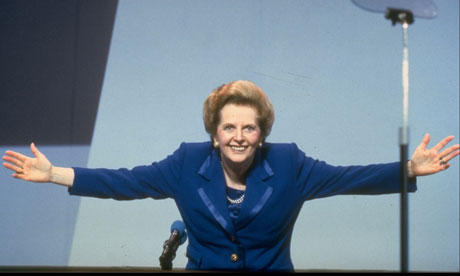
Margaret Thatcher 1925-2013

It probably would've been wiser for me to keep quiet. However, Margaret Thatcher
is going to be one of those people who will divide opinion for generations.
(Pic : The Guardian)
Well, "that day" has finally come. Margaret Thatcher has died. Although she was in ill health, and it was obvious she was – I'm not trying to be crass – in her final years, this news came out of the blue.
I'm not a ghoul, but I'd often wondered what I would end up writing when this happened. Would I even write anything at all? Should I write anything?

I'm just about old enough to remember the tail end of her premiership through to her resignation, but it's unquestionable that she left her impact on my adulthood, and the lives of everyone who's come after me.

There's so much I could focus on, but I think it'll be her economic policies that she'll be most heavily associated with in Wales.

Absolutely everything today – from housing, who we buy our energy from, where we work, even the way we get around on things like the railways and buses - was touched or influenced by her one way or another.

When she came to office, the UK was, as often described, a basketcase ripped apart by union self-interest, woeful economic policies (not helped by various energy disputes and crises) and manifest incompetence by people at the top of government.

She radically repositioned and restructured the British economy - fuelled by North Sea oil - overheating the south east of England in the process and purpetuating a slow, ongoing decline in the industrial parts of the island, which has only been reversed in a few cases like Manchester.

You could twist that into a positive too. People now work in comfortable offices, earning more money, buying more "things" and "stuff". They no longer have to worry about their own safety by having no choice but to take up some of the most unpleasant jobs imaginable. The lucky ones anyway.

That devastating legacy to Welsh heavy industry through the 70s and 80s eventually led to the destruction of individual lives those who missed out on the "new economy" - as a job vacuum was filled with welfare dependency and drugs.

At the time,  everything was reduced in worth to a simply tallying of how valuable it was. These losers in her redefined game of life, and Wales in general, became worthless. We've borne that label from the defeat of the miner's strike right through to the present.

So, when she left office, it was a different kind of basketcase she left behind – a nation-state slave to living in other people's pockets and a fostered individualist culture where everyone was now out to ask - "What's in it for me?"

I think it's safe to say that, as of 2008, that ideology has crumbled, despite outlasting Soviet Communism and completely destroying the old English left (Wales still retains it – just about).  It's also allowed politicians in Wales for decades - especially Labour - to point to her legacy as cover or to provide excuses for their own inaction.

However, people my age – deemed "Thatcher's children" - have grown up with it, and most of us actively embrace "me, me, me" regardless of our politics. As much as it embodies big banks, it also embodies stuff like reality television, things like Facebook/social media, mobile phone jingles, trendy city-centre apartments, hybrid turbo cars with big spoilers and it's the reason jobs like recruitment consultants exist.

Was she a good Prime Minister? Objectively, she was an excellent one. She was an ideologue and yes, a revolutionary, who knew precisely where she wanted to take the UK. She's going to be remembered as one of those great (as in important) historical figures that will divide opinion for as long as people have opinions.

Was she a good politician? The key difference between the two is that a leader of a nation has to maintain a detached objectivity from public feelings to be able to lead effectively – like a military officer. Politicians still have to care though, and have empathy. I think the fact so many of us fell off her coat tails as she enforced her revolution means she was a terrible politician. I don't think that's because she was incapable of caring, she probably just couldn't afford to care as there was too much at stake for her to reverse course.

Neither of that means she was a terrible person though, and I think it's wrong to think of her as evil, when all she was was a woman resolutely and pig-headedly committed to a set of core ideals and actions, believing with all her heart she was right even if those ideals were poisonous to some, yet the only answer to others.

Like it or not, she was in the right place at the right time. Like it or not, people voted for her again and again because they liked what she was doing - putting money in people's pockets and giving them "freedom of choice" over their "things" and "stuff".

Her legacy, in my eyes, will come down to those two words - "things" and "stuff."  That's what we've all been reduced to since, and what we will continue to pander to.

She's endured ill health during a rather frail old age, so she's been released from that now. I would've hoped she would've been given the dignity of a funeral in private so her body doesn't become a focal point for the inevitable ideological thrashing over how she's either Gloriana II, or an evil witch "milk snatcher."

Let her rest. Let her outdated ideals rest alongside her too.

Wednesday, 3 April 2013

The deal's done - so what next for Cardiff Airport?


I could've commented on this when Carwyn Jones made the original announcement back in December. I doubt he would've made that announcement unless an agreement was inevitable at the time, but it was worth waiting until the deal to buy Cardiff Airport was announced properly, which happened last week.

First thing's first, Cardiff Airport is important to Cardiff and its environs alone. As our capital, we should expect it to have decent air links – especially to be taken seriously for business. But this isn't economically essential for "Wales". North Wales has Liverpool and Manchester, mid Wales has Birmingham, while the far south east of Wales is probably within Bristol's catchment area anyway. Cardiff's catchment area should be everything west of Monmouthshire and south of Builth Wells – probably around 1.5-2million people.

I've touched on some of the issues surrounding Cardiff Airport and its future before, but let's be clear, once passenger figures start to reach 700,000-800,000 levels – which is entirely possible in the next 5 years based on the trends – there's a real possibility the whole thing could become so commercially unviable that closure could be an option. Something has to be done.

As far as I'm concerned this was the right decision. I'm pleased that the Welsh Government have taken some concerted and decisive action for once.

I can understand why the Tories are getting their knickers in a twist over this, as they're ideologically opposed to public ownership of anything, even if the airport will be "run commercially".

I'm also opposed to public ownership of things like airports, but I'm not opposed to public-private partnerships, not-for-profits or co-operative models of ownership and management. Sometimes that can be done completely within the private sector, sometimes – especially in the case of Wales - the state needs to help things along.


My biggest concern surrounds the Welsh Government hiding behind that old "commercial sensitivity/confidentiality" chestnut when questions were asked about this deal in the Senedd. When they finally revealed the numbers involved last week, my enthusiasm for this started to ebb.

I'm not a property expert or surveyor, but £52million seems a steep price tag for an airport that's barely keeping its annual passenger figures above the 1million mark. If I had to guess, I would've put the valuation at perhaps a half to two-thirds that.

Sion Barry also had a rather....optimistic....take on this in the Western Mail. I doubt Severnside airport is a goer now, and he seems to have ignored the presence of British Airways Maintenance, which is probably more important to the south Wales economy than the airport is.

Like it or not, it's done now. So what are the Welsh Government and the holding company put in charge of the airport going to do next?

Opportunities and threats


Cardiff's major trump card over Bristol is the length of its runway, which can accommodate larger aircraft, especially those used on long-haul flights. Air passenger duty for long haul flights could be devolved to Wales in the next million years, so there's a clear opportunity there to attract long haul flights to Cardiff.

That could take pressure off the London airports, with Cardiff Airport effectively acting as a mini "Heathrow West". That could expand Cardiff's catchment area, as well as save fuel for aircraft travelling from North, Central and South America, perhaps Australasia too (via Los Angeles).

Bristol might end up taking more "bucket and spade" short haul European flights as a result, but Cardiff should try and retain/attract some economically important air links to major European capitals. That might require a greater mix of airlines using the airport, and that was one of the first things the new chair pointed towards. I presume that's what Carwyn Jones and Edwina Hart have in mind too.

I think worries around transport - especially road transport - are overblown. People drive from the valleys to Bristol Airport because Bristol offers more choice in terms of flights and destinations. It certainly isn't easier to get to than Cardiff, and I think it's a lazy excuse so people can get around coming out and saying "Cardiff Airport is rubbish" to avoid appearing unpatriotic. That's no reason to ignore transport issues though.

Cardiff Airport - or should that be Rhoose village - already has a railway station, but it's about 2km from the terminal itself. There have been mooted proposals for a direct rail link to the airport terminal, but it's meeting opposition.

If that did happen, then I think there would need to be significant improvements from the west – that means train services to/from Swansea and west Wales being able to use the airport station. That would require significant junction/capacity improvements at Bridgend though, which aren't part of any Network Rail or Welsh Government plans.

The Welsh Government and civil service are very good at underpinning their plans with extensive - perhaps over the top - strategies and frameworks. Delivery is a whole other matter.

I'm starting to get worried, as there was – as the new chair has strongly hinted – no concrete business plan for the airport in place when the Welsh Government bought it. They're working on that now.

The Tories and Bristol Airport are going to whinge about this forever and a day. I'm actually surprised at the Conservative's stance on this, as it seems they'd be quite happy to let Cardiff Airport fall by the wayside and let Bristol take as much potential business traffic as possible. They're right to criticise the price tag, but at least the Welsh Government are doing something.

As for Bristol Airport, it's rather arrogant of them to assume south Wales should always remain within their domain. One leading reason they took off ahead of Cardiff was that they secured several low-cost carriers - like EasyJet - at the right time. The roles could very easily have been reversed.

When you weigh up all the variables, in many respects Cardiff should be the predominant airport in south west Britain. The reasons it isn't include persistent mismanagement and things like the Severn Bridge tolls. Fingers crossed that's about to change.

I don't think Carwyn Jones or Edwina Hart need be hung out to dry on this – yet – as they need a chance to see this though. They deserve friendly criticism on this and be given a two to three year window to be judged upon. If it fails, they'll need to take the can for it, but I'll give them credit for trying and being bold for once.

Plaid and the Lib Dems are right to ask for details of the Welsh Government's (and assorted partners) plans for the airport. They're being a sensible opposition about this, perhaps seeing the dire situation at Cardiff Airport for what it is. The Tories aren't, and come across as throwing a wobbler over very little.

But the wider issue remains. The Welsh Government wouldn't have spent £52million on an airport without some sort of "plan" or "strategy" underpinning that rather ballsy decision....would they?


Sunday, 31 March 2013

Senedd Watch - March 2013

  • Several Welsh Ministers took part in events marking St David's Day. First Minister Carwyn Jones visited Barcelona to encourage tourism. Leighton Andrews (Lab, Rhondda) took part in a promotional event in London. Dep. Minister for Housing, Regeneration and Heritage, Huw Lewis (Lab, Merthyr Tydfil & Rhymney) visited China. Business Minister Edwina Hart (Lab, Gower) visited Los Angeles to promote Wales as a venue for film and TV production, and mark the awarding of a “Hollywood Star” in honour of Richard Burton.
  • Plaid Cymru held their spring conference in Beaumaris, Anglesey. Leader Leanne Wood criticised the education system, saying it had changed from a “watchword of excellence” to a “graveyard of ambition.” She called for the Welsh economy to be (re)built from the “bottom up.” Parliamentary leader Elfyn Llwyd called for “parity with Scotland”, regardless of the 2014 independence referendum outcome.
  • Llywydd Rosemary Butler (Lab, Newport West) outlined an increase in the number of AMs to 80 in her submission to the second part of the Silk Commission, based on the “unavoidable scale of workload faced by members.”
  • The Welsh Liberal Democrats set out a “Home Rule” vision in their submission to Silk Commission; with devolution of policing, prisons, voting arrangements and energy. The Welsh Conservatives called for the devolution of broadcasting and energy to Wales in their submission, but omitted policing and criminal justice. Conservative MP Glyn Davies contradicted the Welsh Conservative stance by later saying that energy would be devolved “over my dead body” due to opposition to wind farms.
  • The Welsh Government said they would consider legislating for 40% of public appointments to be women. Sports Wales chair Laura McAllister said public appointments were “loaded towards the male experience.” Around 32% of public appointees in Wales are currently women.
  • The Welsh Government launched a consultation on whether laws would be required to combat horse abandonment and “fly grazing” after a spate of incidents across Wales. Deputy Minister for Rural Affairs, Alun Davies (Lab, Blaenau Gwent) promised a “zero tolerance approach” to the issue.
  • A BBC Wales investigation found truancy prosecutions in Wales rose by 700% to more than 500 cases between 2007 and 2011. The Welsh Government recently consulted on £120 fines for truancy, but Education Minister Leighton Andrews said fines were “just one aspect of national policy” to reduce truancy.
  • First Minister Carwyn Jones said he might personally “call in” proposals to move neo-natal services to the Wirral from north Wales as Health Minister Lesley Griffiths' (Lab, Wrexham) own constituency would be affected by the changes. On 30th March, he announced that he would look at “another model” of providing acute neo-natal care in north Wales.
  • Welsh Language Commissioner Meri Huws said her position had “not been undermined” by the Welsh Government's rejection of her proposed standards for Welsh language services in February 2013. A motion passed the Senedd, calling for a timetable for new standards to be issued in 2014.
  • The UK Government's submission to Part II of the Silk Commission rejected “radical changes” to Welsh devolution, but proposed teachers' pay and conditions and rail franchising be devolved due to deregulation in England. They also rejected devolution of policing, criminal justice and large energy projects.
  • The Communities, Equalities & Local Government Committee suggested a new “umbrella” Welsh heritage body – similar to English Heritage - be established in a new report. They also said the Welsh Government should consider the concerns of expert witnesses before proceeding with a merger of Cadw and the Commission of Ancient and Historical Monuments.
  • The Assembly's Health & Social Services Committee proposed that Mick Antoniw AM's (Lab, Pontypridd) Asbestos Disease Bill could be expanded in scope to reclaim costs for treating all industrial diseases.
  • Rosemary Butler AM said people in her Newport constituency faced “misery” awaiting further consultation on improvements to the M4 through the city. Welsh Government provisional proposals involve widening the Brynglas Tunnels, which would affect residents living above them.
  • Age Cymru asked the Welsh Government to draw up a policy on social care costs, following proposals to cap costs in England by the UK Government. The Welsh Government said they were “in conversation with key stakeholders” about their own plans.
  • Finance Minister Jane Hutt (Lab, Vale of Glamorgan) said UK Government cuts were “too deep and too fast” and “hampered efforts to boost growth.” She also warned that benefit claimants risked missing out financially by lack of internet access, and asked the UK Government to commit more funds.
  • Deputy Minister for Housing, Regeneration and Heritage, Huw Lewis, launched the Welsh Government's new regeneration policy. It'll carefully target regeneration funds into fewer projects, and work with existing Communities First areas – in particular coastal towns.
  • Welsh Secretary David Jones MP announced he'll lift a ban on AMs standing in both constituency and regional seats, lengthen Assembly terms to 5 years and ban AMs from being MPs at the same time. Boundary change proposals have also been dropped. Plaid Cymru and the Liberal Democrats described it as “overdue”, while Welsh Labour said the Assembly had not asked for the changes.
  • The Welsh NHS experienced a sudden surge in emergency admissions, which caused significant problems at Welsh A&E departments. The Welsh Government urged the public to “choose well”, while health experts warned that proposed hospital reorganisations could make the situation worse in the future.
  • As a result, Welsh Lib Dem leader, Kirsty Williams, said the Welsh NHS was “teetering in the brink”, while Darren Millar AM (Con, Clwyd West) described it as a “perfect storm for a cash-strapped NHS.” On March 28th, half of Wales' A&E consultants wrote to the Health Minister, warning that A&E departments were close to “meltdown” due to overcrowding.
  • The First Minister announced a cabinet reshuffle on March 14th. Mark Drakeford (Lab, Cardiff West) was appointed Health Minister, while various other roles were delegated/re-delegated amongst existing Welsh Ministers. On March 18th , the new Health Minister pledged to see through controversial hospital reorganisations, and on March 25th, he warned that some Local Health Boards could miss spending targets.
  • In a speech marking her first anniversary as Plaid Cymru leader, Leanne Wood said the economy was the most important priority for her party. She called for the devolution of the welfare system, improved transport links and announced she would stand in the Rhondda constituency in the 2016 Welsh General Election.
  • Swiss airline, Helvetic Airways, announced they would leave Cardiff Airport due to low demand. The Welsh Conservatives called on the Welsh Government to reconsider their bid to buy the airport, while Eluned Parrott (Lib Dem, South Wales Central) said that this shows, “the size of the task....to turn around the airport's fortunes.” The Institute of Welsh Affairs called for a reappraisal of the Severnside Airport scheme.
  • The value of Welsh exports fell by almost 30% in the final quarter of 2012 – the lowest quarterly figures since 2008. Most of the fall was accounted to falls in steel and petrochemicals output. Shadow Business Minister, Nick Ramsay (Con, Monmouth) described it as “deeply worrying.”
  • Chief Dental Officer, David Thomas, launched the Welsh Government's five year National Oral Health Plan. Although the numbers of children with tooth decay had fallen by 6% on 2007-08, he said the numbers were still “too high” at 41% of children.
  • Business Minister Edwina Hart announced a biosciences hub would be based in Cardiff Bay, as she launched a £100million biosciences fund. One of the first investments was £4million in wound healing research, which has been identified as a “niche speciality”.
  • Ken Skates AM (Lab, Clwyd South) called for local television stations to be scrapped following lack of interest in a Swansea-based station. He suggested the money be used on other media instead.
  • Unemployment in Wales rose by 7,000 in the three months to January 2013 to 125,000 - or 8.4%. Unemployment across the UK rose by 7,000 with falls in job seekers allowance claimants but a big rise in youth unemployment.
  • An extra £104million over the next two years was made available to the Welsh Government as part of the UK Chancellor's 2013 budget. An extra £161million was made available for capital expenditure, however revenue funds were cut by £57million. First Minister Carwyn Jones was derided by the Welsh Conservatives for dabbling in “casino economics” for suggesting the UK borrow more and reverse spending cuts.
  • Mortality statistics for Welsh hospitals were released to the public, and showed 11 hospitals (of 17) had higher than average mortality rates, with 5 of 6 major local health boards having a mortality rate above average overall. Officials described it as a “fire alarm”, while smaller, rural hospitals up for reconfiguration experienced mortality rates lower than larger hospitals.
  • First Minister Carwyn Jones told the Welsh Labour conference that although his party were in a strong position, they shouldn't ignore changing and adapting, including a devolution settlement that would “stand the test of time”. He defended NHS reorganisations, saying that the real threat to the NHS was believing that there was “no need for change”.
  • The McKay Commission recommended that MPs from Wales, Scotland and Northern Ireland could have their roles limited when it comes to legislation that only affects England or EnglandandWales. It's hoped this will help address the “West Lothian Question.”
  • Plaid Cymru warned, via Freedom of Information requests, that homeless people could be put up in bed and breakfast accommodation when a new “bedroom tax” takes effect. Former Minister for Housing, Huw Lewis, promised to end the use of temporary accommodation in 2011, and the numbers of homeless in B&Bs almost reached zero until homelessness began to rise.
  • A Cardiff University study showed Welsh Baccalaureate holders were 15% less likely to attain a higher-grade degree than those without, however they were more likely to be accepted at a Russell Group university. The Welsh Government said they wanted a more rigorous Welsh Bacc. From 2015.
  • A £400million cut to European structural funds for Wales was reduced to £60million following negotiations in Brussels. The First Minister said he was “disappointed” by the outcome, but pleased that a “fairer settlement” had been delivered. Plaid Cymru MEP, Jill Evans, described it as “devastating news” - though the cuts were less severe than feared.
  • The Welsh Government completed a £52million deal to purchase Cardiff Airport on March 27th. The Welsh Conservatives criticised the “1970s nationalisation” of the airport, while both the Liberal Democrats and Plaid Cymru asked to see more detailed plans.
  • Natural Resources and Food Minister, Alun Davies, said that easing pressure on livestock farmers affected by snowfalls during this month was an “urgent priority” and he was co-ordinating efforts with the Chief Veterinary Officer.

Projects announced in March include : A £4.4million Youth Entrepreneurship Service, a £90million EU investment in super fast broadband in West Wales & The Valleys, a new masterplan for Cardiff city centre, a £4.6million investment in Velindre NHS trust to provide new radiological treatment for lung cancer, a £40million apprenticeship creation scheme (as part of a budget deal between Welsh Labour and Plaid Cymru), plans for a £650million tidal lagoon in Swansea Bay and the twinning of a Nordic biomedical science research “village” with Wales.

Wednesday, 6 March 2013

Census 2011 : Disability, Carers & Health

People waddling on single crutches, mobility scooters and ex-miners, steelworkers and
factory workers shifted from the dole. That's the stereotypical image of vast swathes of Wales.
But it looks as if - despite relatively high numbers of long-term sick,
and "headlines of doom" - it's starting to change.

(Pic : South Wales Argus)


My next look at the 2011 census data focuses on the nation's health – in particular those with what are recorded as "long term limiting illnesses".

The most immediate concern with regard these numbers will be social security – which isn't devolved. This still has a massive impact on Cardiff Bay, as it affects policy and priorities in areas such as health, education, social care – all of which are devolved. It even impacts things like improving accessibility and participation in the arts.

Disability in modern Wales

A limiting illness is defined as a disease or disability that : "limits a person's daily activities and what they can do."

In the 2011 census, people were able to describe themselves as having a limiting illness that affects them "a lot", "a little", or no limiting illnesses. Long term limiting illness means all those ticking "a lot" and "a little". In the 2001 census it appears as though you couldn't note the severity.

First, let's look at the percentage population with a limiting illness. In 2011, an average 23% of the population in every Welsh local authority described themselves as having some sort of limiting disability. A slight majority of those described it as affecting them "a lot".

% of the population recording a "long term
limiting illness"
in 2011
(Click to enlarge)

The South Wales Valleys, Swansea and Carmarthenshire all have above-average levels of disabled people. We all knew that. There aren't any shocks here.


The highest percentages are in the Heads of the Valleys authorities – Blaenau Gwent (27.2%) Caerphilly (25.4%) and Merthyr Tydfil (26.9%). Alongside these, Bridgend (24.2%), Carmarthenshire (25.4%), and Rhondda Cynon Taf (25.9%) all have above average populations with disabilities.The local authority with the highest disabled population was Neath Port Talbot (28%).

In north Wales, only Conwy stands out in particular (24.3%). Rural Wales (with the exception of Carmarthenshire) generally has lower percentages of disabled people than urban/industrial Wales. Gwynedd stands at 20.5% for example, Vale of Glamorgan at 20.3% and both Powys and Ceredigion at around 21%.

Cardiff had the lowest percentage of disabled people overall (18%), closely followed by Flintshire (19.5%). Newport (20.8%) and Monmouthshire (20.2%) also had below average disabled populations.

Next it's worth looking at how this changed since 2001. Here's where the surprises creep up.

Change in the % population with a "long
term limiting illness"
2001-2011
(Click to enlarge)

The local authorities with the sharpest falls in disabled people compared to 2001 are generally those with the highest recorded populations of disabled people.


Merthyr Tydfil experienced the sharpest fall in the disabled population - by 3.1%. They are some way ahead of Neath Port Talbot (1.4% fall), Rhondda Cynon Taf (1.3% fall) and Blaenau Gwent (1.1% fall).

It's actually the relatively "healthier" local authorities that are experiencing rises in the numbers of disabled. Monmouthshire saw the sharpest rise at 1.1%, while Powys (1%), Conwy (0.8%) and Anglesey (0.7%) bucked the general trend of a fall in the "sick population".

The average fall per local authority was just 0.4%. However, the fact that the largest falls have been in areas often associated with high levels of disability, might indicate that perceived stereotypes associated with the Valleys are beginning to turn around – and rather quickly.

Unpaid Care

In the census, people were also able to say if they were providing unpaid care to someone in the household, as well as how many hours a week. A majority of people saying yes – 57% - did so for fewer than 19 hours per week. However, 28% of unpaid carers were doing so for 50 hours a week or more.

The most extraordinary thing about unpaid care across Wales is that it's fairly uniform. It averages around 12.2% per local authority, with little variation. Levels of unpaid care were, however, noticeably lower in Cardiff, (10.2%) Newport (11.4%) and Gwynedd (10.3%).

% of the population providing some sort
of unpaid care in 2011
(Click to enlarge)

Levels of unpaid care are, unsurprisingly, generally higher in areas with higher numbers of people with limiting illnesses – Neath Port Talbot records the highest of both. Even relatively "healthy" local authorities like the Vale of Glamorgan recorded around the average.

This could, therefore, be closely linked to demographics, with "older" areas being just as reliant on full time care as "less healthy" local authorities. I'll look at demography another time, so I'll come back to this then.

Some care is provided by local authority social services. This could mean that people with similar levels of need are treated the same by local authorities. That would result in roughly the same number of people "falling through the net" in each local authority. This could be because those people are judged to have specific conditions that wouldn't qualify for care, or there's an even spread of people with conditions that require constant care at home.

But it's worth highlighting that it works out that, in 2011, just over 100,000 people in Wales were providing more than 50 hours a week of unpaid care.


The healthy population

There's little point in going into too much detail here, as it's effectively just a mirror of the disabled figures. This just confirms that healthiest populations appear to be in rural Wales – as well as Cardiff & Flintshire – while the south Wales valleys lag.

% of the population without a "long term
limiting illness"
in 2011
(Click to enlarge)


It's worth underlining that, contrary to popular belief, the vast bulk of people in every Welsh local authority considered themselves "healthy".


The EnglandandWales "healthy population" was 81%. In Wales alone, the local authority average was lower at just under 77%. So although there's a difference in healthy populations between England and Wales, the difference perhaps isn't as massive as commonly believed.

Also, as noted further up, Wales is marginally "healthier" now that it was in 2001.


Are the Valleys getting healthier? Why? & How?

The youngest men who would've experienced working in Welsh deep
coal mines will now probably be in their 50s. Have excess deaths amongst
older cohorts reduced the numbers of long-term sick overall?
(Pic : BBC Wales)
The falls is disabled people in the Valleys should be welcomed, and are quite dramatic, although there's not much of a change Wales-wide. It's worth looking in detail at some of the reasons why this could've happened.

The pessimist in me suspects that people with ongoing illnesses associated with heavy industry have died in greater numbers since 2001. A similar argument to that I put forward with regard drops in Welsh-speakers in some parts of Wales.


It could well be that the census doesn't accurately record health, perhaps with good reason, as it would lead to claims of "snooping". It's unclear what conditions would be classed as "limiting". What about mental illnesses? As I know all too well you can function on the outside, but inside you can be absolutely crippled – and it does affect your day-to-day life.

What about cancers? They're limiting, but not long-term if you receive treatment. Diabetics can live a normal life, but it's still a long-term disease. The Welsh Government's own annual health surveys are probably a more accurate reflection of disability in Wales than this census, if I'm honest. Though there have been concerns raised there too by Mick Antoniw AM (Lab, Pontypridd). I'll come back to that another time.

Have improvements in things like diabetes
management lengthened "healthy life expectancy"?
(Pic : Cwm Taf NHS Trust)


Improved health screening and management of long-term illnesses could be another possible reason. The Welsh Government have introduced things like bowel cancer screening for the over 50s. Diseases like diabetes and cancer might be better managed now, even if there are still long waiting times and waiting lists for such things. Better management of diseases like arthritis might be extending "healthy life expectancy" by reducing pain experienced, making people feel healthier.


The optimist in me points to things like investment in local leisure centres and sport. All local authorities that experienced a fall in limited illnesses have invested in such things greatly since 2001. Merthyr opened a new leisure centre a few years ago, for example. Swansea has a new replacement for its famous leisure centre, Port Talbot will get a replacement for the Afan Lido in the future and a new sports centre is under construction in Ebbw Vale.

Related to this, you've seen an expansion of private gyms basing themselves in cheap industrial units. Also, there's been an explosion of "alternative"/"trendy" forms of exercise like zumba, roller derby and various pool-based exercises.
Could things like that have contributed to falls in long-term illnesses?


Another possibly good thing is improvements to the physical environment in the Valleys. There've been various land reclamation schemes on old mine workings and steelworks, water quality in Valleys rivers has improved dramatically and there's been an expansion of forestry land. Greenprint in action, perhaps?

Improved education/awareness about unhealthy lifestyles
has probably also contributed - especially in the young. However, that doesn't explain the worries about things like obesity. I'll come back to that later.


I think it's probably a mixture of both the pessimistic and optimistic viewpoints.


What else can we draw from this?

Economic link with disability – Look at the "healthiest population" map again. The areas with the healthiest populations almost exactly match the East Wales NUTS 2 region – where productivity (GVA) is significantly higher than the rest of Wales. The two arguably most productive parts of Wales – Cardiff and Flintshire – have the healthiest populations. Maybe if there was more focus on tackling this problem, we could overcome some of our economic problems too.

Neath Port Talbot has the highest rate of limiting illnesses at 28%
of the population. It also has one of the poorest records with
regard air pollution. Are the two linked?
(Pic : South Wales Evening Post)

Link between environment and poor health – Coming back to one of the points above. Take a look at the areas with the highest numbers of limiting illnesses. Clearly we're still living with a legacy of heavy industry, but the figures have improved in areas that have lost them, and remain high in areas that retain heavy industry (NPT, Pembrokeshire, Carmarthenshire), things like nuclear power plants (Anglesey) or large factories (Bridgend, RCT). I don't think it's a coincidence that the local authority with the highest levels of ill health – Neath Port Talbot - is also the area with one of the poorest records on industrial air pollution.


Wales is going to be hit disproportionately harder by cuts to the disabled – This has already been highlighted by the likes of the Bevan Foundation, Institute for Fiscal Studies and various campaign groups. It was also subject to a debate in the Senedd today. With a higher disabled population, cuts to things like accessibility and things like work fitness assessments will be, or are being, felt harder in Wales. However....

Wales isn't that unhealthy compared to the rest of the UK - Wales clearly does have a "sicker" population than the rest of the UK, but perhaps this is exaggerated. The difference is only 4% overall, dragged upwards by smaller pockets of extreme figures. The gap has closed....slightly.

Despite warnings about unhealthy lifestyles, it appears
as though large numbers of overweight and obese people in
Wales considered themselves healthy in 2011.
(Pic : NHS Wales)

False alarm on obesity and unhealthy lifestyles?
- Factoring in the numbers of people listed as overweight and obese (50-60% of the population), as well as things like smoking and alcohol consumption, it appears as though a fair chunk of people who are obese considered themselves healthy in 2011.
Maybe you really can be fat and "feel healthy" overall, or maybe we're all just a bunch of fibbers. Remember what I noted about the census perhaps being inaccurate on health.

The Assembly under-represents disabled groups – A lot of the discussion recently has been about gender balance, and I mentioned ethnic representation last time around. However, the biggest single group in Wales not currently represented in the Senedd (aside from [openly] LGBTs and people under 30) are the disabled. Some AMs will have ongoing long-term health problems, but nothing that limits their day-to-day activities the same way as a quarter of the Welsh population experience. I think it's time the Welsh Government seriously consider Lindsay Whittle AM's (Plaid, South Wales East) proposal for a Disabled Person's Commissioner.

Monday, 4 March 2013

Preventing deaths in the womb : Stillbirths inquiry


The UK currently has one of the worst stillbirth rates in Europe. In Wales – while the numbers of neo-natal deaths have fallen over the last few years - there are around four stillbirths every week (~150 per year).

That's shockingly high and a real eye-opener – probably because it's not a particularly nice thing to think about. I imagine it takes a terrible toll on prospective parents.

Last June, the Assembly's Health & Social Care Committee held a special one day inquiry into stillbirths, hearing evidence from medical professionals and charities like Sands (Stillbirth and Neonatal Death Society).

The committee reported back last week, making nine recommendations, summarised as :
  • Improved public awareness of the risks associated with stillbirths, as well as improved/targeted training programmes for health professionals dealing with stillbirths and stillbirth post-mortems.
  • The establishment of a "maternity network" to standardise care across Wales.
  • The Welsh Government should investigate providing more specialist foetal medicine consultations in Wales, as costs of providing services outside Wales are now said to be exceeding the costs of providing an indigenous service.
  • Improved clinical research into the causes of stillbirths.


Causes and risk factors

Stillbirths are deaths of a baby in the womb after 24 weeks. Deaths before 24 weeks are miscarriages. Babies that die shortly after birth are neonatal deaths. I touched on this in my post on abortion last year.

Most causes appear to be problems with the blood supply between mother and foetus, or problems with the placenta itself – including bleeding during labour. There are numerous medical conditions that could exacerbate this, like pre-eclampsia (high blood pressure during pregnancy).

There are also genetic and congenital abnormalities that can cause stillbirths. I'm familiar with them, but I needn't go into any details for reasons of taste. Some maternal infections are a cause too.

In terms of risk factors, having twins/multiple pregnancies is said to increase the chances of a stillbirth. There's a clear risk to older mothers, increasing above age 35 and doubling above age 40.

Overall lifestyle is another risk factor - as you might expect. Smoking more than 10 cigarettes a day during pregnancy doubles the risk. 16% of prospective Welsh mothers are said to smoke during pregnancy. Stillbirth rates are higher amongst obese mothers.

There's also a clear link with deprivation. Mothers living in deprived area are said to be 1.7 times more likely to have a stillbirth than one living in a less-deprived area.

Clinical & Public Awareness


Stillbirths are more common than cot deaths and conditions
like Down Syndrome, yet public (and clinical) awareness remains poor.
(Pic : ITV Wales)
Sands say that many parents who experience a stillbirth end up "shocked" at how common stillbirths actually are. Conditions like Down Syndrome and cot death are openly discussed, but awareness around stillbirths is quite low – simply because medical professionals don't have enough knowledge or training to deal with it.

There are said to be "warning signs" of a stillbirth, namely : reduced foetal movement and reduced foetal growth/weight gain.


Evidence from an obstetrics specialist suggests that clinical awareness is limited amongst medical professionals, and that medical schools are "reducing their obstetrics curricula rather than extending them."

The Chief Nursing Officer said prospective mothers need to be made more aware of risk factors, but "professionals have been reluctant to raise it." This is despite stillbirths being "ten times more common than cot deaths."

Bodies like the British Medical Association are keen to change this. A national Stillbirth Working Group has been set up to work with charities like Sands to oversee possible ways to raise public awareness.

Standards of care

The committee were "shocked" by the "failure of routine antenatal care to identify babies at risk of stillbirth." It's said that 1 in 3 stillbirths are simply down to poor standards of care. Specialists also said a third of stillbirths occur amongst babies "who are otherwise healthy" and would have survived if they were delivered before whatever complication caused their stillbirth.

It's been recommended that care be standardised across Wales through the creation of a clinical network (collaboration) - even via a "virtual" one. However, in an update about the Stillbirth Working Group, the Welsh Government said "there is no funding for an obstetric network." 

Identifying babies at risk


It's said high risk mothers are "readily identified", but identifying high risk babies in low risk mothers is an issue.

There's also an issue about delayed births/post-term delivery, which is another risk factor. Because of pressure on maternity services - from a number of different directions - some mothers might be delivering babies over two weeks past their due date. It's said that this may simply be because the mothers are reluctant for anyone to intervene. It's suggested delayed births should be closely monitored.

There's too much variance in monitoring reduced foetal movement and reduced foetal growth. Some medical professionals may have different ideas about what qualifies as either, or will have been trained differently. The Welsh Government say they're looking at successful practises in Scandinavia and are keen to introduce them across Welsh maternity units.

Staffing issues

There's a lack of specialist obstetricians. There's currently only two fully-trained foetal medicine consultants in Wales and both are based in Cardiff. Many patients have to travel to Liverpool or Bristol. However, contrary to popular belief regarding these things, it's said that providing a service in house would work out cheaper.

Although there was praise from Local Health Boards for how the Welsh Government determines staffing requirements, the number of midwives in Wales has fallen for three years in a row.

Equally important to this, but perhaps slightly unpleasant, is the issue of baby post-mortems. There's currently the equivalent of just one specialist "baby pathologist" in Wales. Parents are therefore reluctant to have babies undergo a post-mortem, as there's considerable delays and the body might have to travel across the country.

It's said that proper research into cot deaths reduced them by 70%. Post-mortems would provide a valuable opportunity to research causes of stillbirths, but medical professionals are said to be reluctant to "broach the subject" with parents – perhaps understandably.

Conclusions


Developmental biology is an interest of mine, that's why I decided to cover this in case you were wondering.

I think we conveniently forget how dangerous childbirth and pregnancy is - both to mothers and babies. Midwives and obstetricians aren't there for show, and they undergo intensive training to deal with all sorts of issues specific to pregnancy and childbirth.

You wouldn't want to get dental treatment from a GP, would you? Just as a shortage of dentists would impact oral health, shortages of midwives and obstetricians would affect childbirths. You might not think they're the most important members of NHS staff, but you'll appreciate them if you need them.

Pregnancy and childbirth have been romanticised into something "miraculous", as if played out on TV dramas as a few grunts, pushes and a baby appears. Nothing goes wrong, and it all ends with a mother cooing. Nope.

Neural tube defects - by themselves - are perhaps proof positive that a caring, infallible Creator doesn't exist. A foetus with anencephaly or harlequin icthyosis isn't a "miracle of life", it's a pretty big screw up. If deaths from things like that can be prevented by educating mothers or identifying mothers at risk – do it.

I was taken aback by some of the revelations in this inquiry, namely the lack of consistency in medical training – which is pretty serious! Some of the numbers involved were also unnerving, bordering on scandalous.

We're hardwired to want to protect babies, that's why moving things like neo-natal services and issues like stillbirths will tug at heartstrings. Increasingly, it feels as if maternity services are coming under strain in Wales as emphasis is shifted towards those nearing the end of their lives as we all live longer.

Well, those coming into the world are equally fragile. Hopefully this short, sharp, shocking committee inquiry will serve as the slap across the head that Lesley Griffiths and Local Health Boards need. The problem, as always, is the issue of where the resources are going to come from. It's probably worth it though.

I don't know how many "one day inquiries" have been held in the Assembly's history, but if they're as hard-hitting as this one, it should be done more often.

Sunday, 3 March 2013

A Clockwork Plaid

"What's it going to be then, eh?"

It starts with a phone call, "Meet at (undisclosed location) in three hours." Slowly but surely, delegates descend on the chosen site to terrorise another part of Wales.


The site is littered with VW camper vans adorned with smiley face stickers blasting out hardcore jungle. Many approached tooled-up, wearing white overalls and bovver boots in preparation for lashings of the old ultra-violence.

Yes, Plaid Cymru are holding another conference.

There was a roaring trade in Moloko plus Vellocet, and illicit lozenges – with slang names like Victory Vs, Fisherman's Friends and Altoids. I asked one reveller, whose eyes watered as they writhed to Dafydd Iwan vs Skrillex, what they took that evening."Everything!" they said. "The works – Tunes, Lockets. It's like a breath of fresh air!"

Just after midnight, a fresh legion of cycling woman emerge from Ty Gwynfor, travelling to all four corners of Wales, giving the impression of being in many places at once. Leanne Wood made her mind up about which constituency to stand in – all of them. This will enable your friendly neighbourhood Leanne to knock on every single door in Wales several times a day - with the goal of 1 trillion conversations by year's end.

Plaid's cloning centre hasn't been entirely fruitful. One of the Leannes was defective. She's proposing building coal-fired smoke machines in the Valleys, concreting over railways and turning them into private toll roads as well as a flat income tax.

After a speech to UKIP members in the Vale, they got so much Wood, that when they stood to sing "Tomorrow Belongs To Me" they were knocking over tables and pint glasses with their pitched tent crotches, primed for a bit of the old in-out real horrorshow. They don't really care whether it's Wales, Britain or Europe they screw over.

"Hi, hi, hi there! Viddy well, droogs!" Leanne holds aloft a new groundbreaking, paradigm-smashing document. Co-authored by Adam Price and Ffred Fflintstôn, entitled: Wales? Understanding Misunderstandation Yabber Dabber Doo 2023, it describes the new initiative in a 60-page nutshell full of nice-looking graphs and lines.

"By takin' the radical decision to encourage both support, and opposition to, our own policies, Plaid Cymru The Party of Wales will become the natural 'ome to all opinions," Leanne said. "By actively encouraging all views within-a party we'll....um....We put the party in party - right, right? Ymlaen!"

The police are quick to clamp down on scuffles. I asked one officer what strain these pop-up festivals do to police resources. He said, "We're not the sort to turn down the opportunity to give someone a slap, but the issue is that Wales has been waiting for a Messiah figure since England first beat us at rugby.

"You would think it doesn't need to be a single person. All it needs to be is a group of politicians with enough charisma, intelligence and good common sense to produce a workable plan towards Welsh independence, combined with a bit of patience from supporters and teamwork. You would think Plaid are close to ticking most of the boxes."

Some disagree. He points to people posing atop a bracken-covered hill, looking off into the distance with pensive, serious facial expressions. Force ten gales batter them, carrying what to their ears sounds like English laughter with each gust.

"Once one thinks they're the Messiah, someone else stands up like a meerkat thinking it's really them and that all others are sell-outs and apologists. It's as though they're all competing to be on the front of the cheesiest, most testosterone-poisoned Manowar album cover possible. It's the Red Bull talking, not Owain Glyndwr's ghost.

"You end up with twenty 'party leaders' doing that," he points to them again, "wondering why nationalists aren't supporting twenty incrementally different, understandably cynical but slightly brusque, clunky and electorally suicidal views on the same thing.

"From the outside it looks like being at a music festival full of hipsters."

As the event drew to a close, tensions rose amongst the delegates. I wasn't there when it kicked off, so I asked one seasoned veteran - wearing a necklace of vertebrae - their take on events.

"After an afternoon of passive-aggressive debate, we finally approved the motion – Picard is better than Kirk.

"Then, at the last minute, the Portmeirion branch threw in Sisko – saying he was better because once his wife got pregnant, he hid in a higher plane of existence as a statement on father's rights.

"The Plaid Women group stormed off when nobody endorsed Proposition Janeway. They spent the rest of the afternoon sulking and twitching away in a corner after eating caffeine-laced chocolate from a Central American co-op. Once they got wind of the reasoning for the Sisko amendment all hell broke loose."


Another person in the area at the time described the scene, "There was yellow, green and red everywhere. It looked like the inside of a clap clinic's bin.

"It was 'Crouching Tiger, Hidden Dragon' in rain jackets. I've never seen Trebor Extra Strong Mints used as a shiriken before. There's also something poetic about a Greenham Common veteran strangling someone to within an inch of their lives with a translation headset.

"'Threads' was the scariest thing I've ever seen until someone shouted out that 'Downton Abbey' was better than 'Borgen'. All bets were off," they pointed to a police cordon, developing a thousand yard stare."There's sights down there that will leave your soul screaming in the middle of the night."

They broke down in tears, "Why can't we all just get along for once?"

I caught up with the police officer I spoke to earlier, whose head was wrapped in a bloodstained bandage. "This is what happens when you give them too many E-numbers," he said. "I saw the Refreshers and Flying Saucers going around. We'll be here all night trying to get them to bed."

A dischevelled man descends the bracken-covered hill, wearing a deer carcass pelt, dragging a dead rat behind him attached to a piece of string. He runs a blog in Bridgend about damp cats and nationalism – Soggy Moggy Bloggy.

"My years of huffing paint thinner under a motorway bridge and snorting Sherbert Dips off a hooker's arse have convinced me that Welsh independence might be achievable in my lifetime," he said.

"If some people are perverse enough to enjoy Branston Pickle flavour, I believe it's their right to do so. Live and let live. However, it's both funny and terrifying at the same time how quickly an argument over crisp flavours can escalate into ABH," he sighs, shaking his head. "Doobie doob, a bit tired maybe, best not say more. Homeways is right ways, O my brothers."

He stumbles off into the distance, wearing carrier bags as shoes, rambling to himself about a fifteen-part blog on an independent Welsh crisp policy that nobody will read. He sprays something over his nose and mouth, stuttering, "Mr Sheen shines ump...teen....Hueh! Hueh! Hueh! Brrr!" He collapses, his eyes pointing in opposite directions.

Soon, the illegal political rave dispersed. A Senedd plenary debate was played over loudspeakers, causing some to fall asleep, sucking their thumbs as they were carried away.

As Leanne was loaded into the back of an ambulance, she gave a thumbs up, and managed a smile even though half her teeth had been knocked out.

"Aye!" she said. "Went really well this yur!"