This site is no longer updated

Please use the links in the sidebar to visit the new sites!

Thursday, 20 June 2013

Local Democracy Bill passed by the Assembly

Things are starting to wind down at the National Assembly as the summer recess approaches. The major business left largely consists of tying up loose legislative ends. At least four Bills are/were on course to be passed before July 19th .

There've been problems with Mick Antoniw's (Lab, Pontypridd) Asbestos Disease Bill, so its final vote has been delayed. There's also Peter Black's (Lib Dem, South Wales West) Mobile Homes Bill - due for a vote on July 10th - and the controversial Human Transplantation Bill, which is up for the vote on
July 2nd .

On Tuesday, another of those four laws was passed – the Local Government Democracy Bill.

The Bill, in its latest incarnation prior to Tuesday (pdf), had the following provisions :
  • Modifications to the Local Boundary Commission for Wales – Including its name (changed to Local Democracy and Boundary Commission), membership and introducing a ten year cycle to review electoral arrangements in each local authority and community.
  • Modifications to the Independent Remuneration Panel (which sets local councillor's pay) – Amendments will be made to the Local Government Measure 2011, which will change aspects of how/when the panel submits its annual report, and give the panel the power to make local authorities publish information relating to councillors' pay and expenses.
  • Political balance on Local Authority Committees – Makes political balance of membership of council committees a legal requirement.
  • Joint Standards Committees – Gives local authorities the power to establish collaborative standards committees to deal with codes of conduct and their violations.
  • Online presence for town and community councils – Every town and community council will be required to provide contact details and records of proceedings via the internet by May 2015.
  • Council Chairs and Presiding Officers – Allows councils to seperate the role of an elected presiding officer from the ceremonical civic "chair" of the local authority (i.e Ceremonial Mayor).

OK, that's pretty dry stuff.

Amendments were tabled by AMs (pdf) and Local Government Minister Lesley Griffiths (Lab, Wrexham), which were also voted on to create a final version of the Bill (pdf), which will now go to Bet Windsor for the official stamp of approval, barring any intervention by Westminster.

Most of the amendments related to wording. The significant ones were :

  • Amendment 3 - Peter Black AM & Rhodri Glyn Thomas AM (Plaid, Carms. E & Dinefwr) - Giving people reporting council proceedings "reasonable facilities". I'm not sure what that meant exactly. (Not Passed)
  • Amendment 5 – Ditto – Introducing Single Transferable Vote for local authority elections. (Not Passed)
  • Amendment 6 – Ditto – Provisions relating to the conduct of local authority elections, including election expenses. (Not Passed)
  • Amendment 7 – Ditto – No payments to returning officers except those in relation to carrying out their duties. So it closes the (rumoured) "pocket the savings" loophole with regard election costs. (Not Passed)
  • Amendment 54 – Lesley Griffiths AM – Brought in as part of a deal with opposition parties, it lays out the powers of the Independent Remuneration Panel with regard the pay of local authority chief executives. (Passed)

That agreement resulted Peter Black/Rhodri Glyn Thomas withdrawing their amendment (15) for setting maximum pay for "senior officers". Janet Finch-Saunders AM (Con, Aberconwy) kept it in as Amendment 9 which, as hinted, covered all senior officers, not just chief executives. (Not Passed)

"Local Democracy Bill" sounds like it would be meaty enough to send the proverbial equivalent of several columns of tanks over the Loughor, in order to liberate the Democratic People's Republic of Carmarthenshire. Nyet, comrades.

Echoing what Caebrwyn said yesterday, the reality is that it's quite a limp law, that deals mostly with administrative matters, was beefed up by opposition amendments (all of which failed to pass) and will likely mean nowt to the general public. The title makes it sound grander than it actually is, a bit like the Active Travel Bill.

It's understandable why the opposition and Welsh Government agreed to deal with local authority executive pay, following some rather embarrassing revelations over the last few months.

I'm not complaining, and it's without a doubt the headline part of the Bill. Executives shouldn't be paid so many more times their lowest paid worker's salaries. If we expect principles like those to eventually apply to private companies, we should expect them to apply to the public sector too.

What's not understandable, is why they've decided – in a law called "Local Democracy Bill" – to take powers away from local authorities. A sentiment echoed by others.

There's clearly frustration in Cathays Park and the Senedd about how services are being run at a local level. Although there's currently a review of local services taking place, Welsh Government and opposition alike are giving the the impression of being scared away from making root and branch reforms, and are instead trying to reorganise it via the back door – like the recent report recommending collaborative education authorities. I made my thoughts on local government clear(ish) earlier this year.

A lot has also been said recently about the media and public paying little or no attention to the Assembly, AMs and what the institution does. Here's a case in point. Try convincing the public at large that laws like these are important and a good use of AMs' time. Even I'm struggling.

Of course, it'll be very different on July 2nd .

Thursday, 13 June 2013

Wales : State of Innovation? Or doing the wrong things better?

In the last few weeks, a report entitled State of Innovation (pdf) - authored by Nesta's Matthew Gatehouse and Adam Price - was published as part of the Welsh Public Services 2025 programme.

It sets out a vision of a more innovative Welsh public sector which, considering it's proportionally large impact on the Welsh economy, could well become necessary if we want to see public services delivered more efficiently, and more imaginatively, in the backdrop of public spending cuts.

Why the public sector needs innovation

The report highlights a "triple vice":

  • Public spending cuts and austerity – The impact is likely to last for at least five years, probably more, affecting the general Welsh economy (due to more public sector employees). There's also the issue of "Offa's Gap" – a gap in economic productivity between Wales and the rest of the UK. So public services can't be based off the back of continuous economic growth filling coffers anymore.
  • An ageing and ill population – Rates of child poverty and chronic illness remain above UK averages. Wales also has a proportionately older population too, with the number of over-75s expected to increase by up to 80% by the 2030s.
  • Environmental and social pressures – We increasingly expect to do activities "on demand" and "on the fly" since the advent of things like social media - expecting the same flexibility from our public services. We're still using more than our fair share of natural resources despite commitments to "sustainability". This impacts the public sector, as much as the private sector and individual households.

What does public sector innovation actually mean?

The report says, "new ideas that work at creating public value". In English, I think that means improving how things are run, instead of simply throwing money at problems and hoping that'll work –  the usual way of doing things. "Working smarter", then.

The report describes three different types of innovation :
  • Incremental – Smaller changes to existing services over a longer period of time.
  • Radical – Significant changes to existing services, without altering the underlying purpose of those services.
  • Transformational "Ripping the whole lot up and starting again", with completely new services or methods of service delivery.
I think it's safe to say that the Welsh Government and civil service often opt for "incremental" change, or even not bothering with change at all, and rarely make the step up to "radical" innovation. Those "transformational" changes require new technologies, mind-sets and skills; so they might sound seductive, but might not always be the best option on the table.

Present Welsh public service innovation

Foundation Phase is given as an example of where the
Welsh public sector has been "innovative". Similar examples
are fleeting, however.
(Pic : npted.org)
Devolution is said to have been delivered off the back of "Made in Wales" solutions to long-standing problems in areas like the economy and health. However, there's lament at the lack of innovation. Instead – and I think we all know this, except the people at the top – we ended up with Westminster policies simply being "tuned" to Welsh needs. The civil service got used to doing things a certain way, without being as "stand alone" as Scotland and Northern Ireland.

Innovation in Wales extends to freebies and subsidised schemes. Low-hanging fruit, sometimes cheap to deliver, and politically successful for Welsh Labour. In other cases, there've been more dramatic changes, like the introduction of Foundation Phase, and the proposed organ donation opt-out law.

One key factor in all this was the Welsh Government's adoption of "partnership and persuasion", instead of aping the more hostile relationship between Westminster and those delivering public services on the ground in England.

There are said to be two "defining strengths" with regard innovation in the Welsh public sector :
  1. Political cohesion – Welsh public services are "closely knit", with the potential for a highly co-ordinated system for innovation, helped by pan-Wales bodies.
  2. Social sciences – Welsh universities produce "world-leading" social science research – for example, Cardiff's School of Planning. This has been added to via the creation of things like the Public Policy Institute, as well as independent bodies like the Bevan Foundation and Institute of Welsh Affairs.
However, there has been frustration in Cathays Park at the lack of progress made in delivering at a local level by councils and various public bodies. There are an awful lot of other roadblocks too, namely :
  • Organisational thinness – We haven't got the numbers to develop the "big" institutions needed to develop the right skills.
  • Lock-out – Small-c conservatism and insularity in the Welsh public sector, where everything is done "on the inside" since the "Bonfire of the Quangos".
  • Lack of citizen engagement – Service users are best placed to point out how things could work better, but aren't being asked, or aren't bothered enough to care.
  • Fragmentation – There's no single system to highlight successful innovations and share them between different parts of the public sector.

What are the barriers to public sector innovation?

These are all things anyone who follows Welsh politics closely will agree with. It makes for depressing reading, but most of you will be nodding along I'd expect.
  • Hierarchies and "silo mentalities" – Seeing radical ideas from "outside" as a threat, and operating in a way that creates barriers to sharing ideas between different parts of the public sector. There's very little mixing of academic research with practice.
  • Risk aversion – Public services staff seeing innovation as a threat to their job, or a challenge to the comfy status quo. The need to be accountable and a need for "certainty" means there's a disincentive to make major changes that could have a big pay off, but might not work.
  • No rewards"If it ain't broke...." mentality, meaning if a service is trundling along fine, it won't be tampered with by managers. Also, radical changes are often flagged up by the media and then opposed by service users, trade unions and politicians.
  • Short-termism – Public service staff work to fix immediate pressures and on administration, instead of "taking a step back and seeing if you can do things differently".
  • Politics – Contributes to short-termism by "demanding instant results" rather than more effective longer-terms solutions. The Foundation Phase is cited as an example, where the results won't be known for perhaps another decade.
Although these are general barriers that can happen everywhere, there are more Wales-specific problems too :
  • Higher proportion of people working in the public sector, who don't get rewarded for innovation and might fear their job is at risk by adopting riskier, untested methods of service delivery. Because of lower private sector employment, they might worry they won't find another job.
  • A lack of creative leadership in public management, who end up perpetuating the above.
  • Innovation is seen as a "distraction" from service delivery in Wales compared to England.
  • Auditing compares public services with existing "good practice" rather than taking into account radical and untested/unproven schemes. Staff said they end up trying to meeting audit checklists rather than coming up with new ways to deliver services. This might result in services improving, but only because of "doing the wrong things better."

What can be done?

That's actually the wrong question. One of the key tenets of the report isn't, "What could be done?" But more, "Wales is doing a lot already, it just isn't being exploited as it could be." It contained plenty of examples, but I decided not to go into them for the sake of brevity (LOL!).

In terms of specific proposals, there's a national action plan outlined as :
  1. Bringing "social science research and public service practice" closer together, with greater collaboration, generating the evidence base needed to put forward the case for more radical public service reforms.
  2. Making innovation skills a key part of public management training, in order to "create a cadre of leaders in Wales who create a new vision for public services." This would help turn innovation into workable projects.
  3. Engaging more independent bodies in public service innovation, to create a more "entrepreneurial culture" to drive up productivity, and develop enterprises to provide services within local communities.
  4. Incentivise partners in the private sector – especially technology – to turn Wales into a "global test bed" for innovations in public services. Examples include digital education and developing new technology in reaction to an ageing population.
There are also other proposals and unanswered questions, like :  funding innovation as a proportion of public sector spending (in the same way private companies invest in R&D), prizes for innovation and changes to how performances are measured to make "taking risks" more attractive.

Can Wales become a State of Innovation?

Ultimately, you'll have to ask Carwyn and the civil service. He's made small steps in that direction through the establishment of the Public Policy Institute, as covered by A Change of Personnel. I still remain sceptical about the remit of the "think tank that can't think", but I don't question the First Minister's sincerity. Maybe this report will be picked up there, who knows?

It's another report that, as Prof. Dylan Jones-Evans bemoans on Click on Wales, largely went under the radar. In all honesty though, it's incredibly hard to make reports like these interesting for the media or relevant to the public - even if said reports are excellent or important.

If posts like this get picked up by other people who have a bigger audience, or make people understand things better - great, I've done my job. That rarely happens as I'm preaching to the choir. I have the luxury of being able to do that, though – the mainstream media don't. But isn't that the problem in the first place?

And, "Doing the wrong things better" is the best summing up of Wales since devolution I've ever come across.

Saturday, 8 June 2013

Renting Homes White Paper

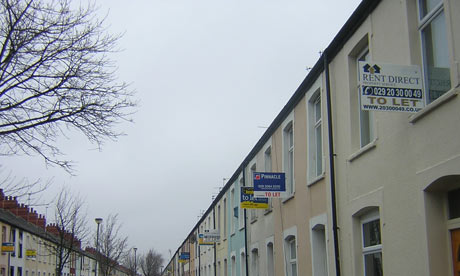
Proposed legislation to make renting simpler and more
transparent are outlined in the latest housing white paper
from the Welsh Government.
(Pic : The Guardian)
Back in May, Housing and Regeneration Minister, Carl Sargeant (Lab, Alyn & Deeside), launched a white paper (pdf) on proposed housing legislation, this time to do with renting.

Previous Housing Minister Huw Lewis (Lab, Merthyr Tydfil & Rhymney) launched a separate, but related, white paper in 2012. This is the first in-depth consultation to stem from those proposals.

The need for change

The Law Commission published a report identifying several areas of the rental market that needed reform, which a multitude of organisations and people had asked for over the course of several years.

Many renters aren't satisfied with being owner-occupiers, and are said to have lower life satisfaction compared to home owners. As I'll point out in my next look at the census (probably next week), Wales is increasingly becoming a nation of renters. Around 30% of Welsh households live in rented accommodation.

Renting has advantages, like flexibility when it comes to moving (i.e for work on short notice) and some level of legal security. However, when it comes to social renting, many people see differences between renting from a local authority, from a private social landlord – like a housing association – or from a fully private landlord.

There are currently loads of different types of residential rental tenancies, many of which were created via Westminster legislation to respond to specific problems like anti-social behaviour (Family Intervention Tenancies, Demoted Tenancies etc.). Many tenants don't understand, or just "skim over", their rental contracts due to the confusion.

The Welsh Government can't offer any sort of tax incentives - like those used in Germany and Australia - to promote long-term renting because they don't have the powers. However, then can use the law to simplify arrangements for tenants, and encourage investment in rental properties by "not placing too many barriers".

What are the proposed changes?

The current system of seven types of residential rental contract will be simplified into two :
  • A "secure contract", similar to local authority secure tenancies. These are said to have much greater protection for tenants, secured in law. It'll also mean that social housing tenants in the private sector and local authorities will have the same type of contract.
  • A "standard contract", similar to short hold tenancies used in the private rental market. This is said to have a lower level of security, but landlords would have the option to create more secure, long-term tenancies if they wish.

What are the other benefits?
  • Tackling anti-social behaviour – Conduct clauses will be inserted, as standard, into rental contracts, with tenants made aware of their responsibilities. Breaching the terms could lead to a possession order being issued by the landlord, which could lead to eviction.
  • Tackling domestic abuse – The above clause would include domestic violence. There'll be clauses to evict the abuser, without the victim needing to terminate their tenancy (as currently). The Welsh Government are working on a related Domestic Violence Bill, which hasn't been introduced yet. More from me once it is.
  • Flexibility in joint tenancies – Instead of joint tenancies ending when one person leaves, the remaining tenant will be able to "give notice" to their landlord, enabling them to have enough time to find a replacement.
  • Rights for young renters – People aged 16 and 17 will be given the same power to rent as an 18 y.o. This could be useful for youngsters leaving care, for example.
  • Succession rights – Carers of a tenant who dies, and who've lived in the rented home for at least 12 months, will have succession rights to the tenancy.
  • No mandatory eviction for serious rent arrears (for housing association tenants) – This effectively removes "Ground 8" from the Housing Act 1988 as a grounds for eviction, granting housing association tenants the same rights as local authority tenants.
  • Abolish 6 month moratoriums on evictions – This might prove controversial, but it's said that most contracts are a minimum of 6-12 months anyway. It could make it easier for tenants to look for a short-term rent or to house the homeless.
  • Including landlord repair obligations in rental contracts – Self-explanatory. They'll be written into every rental contract, hopefully improving the quality of rental accommodation.

It might look heavily skewed in favour of tenants, but landlords stand to benefit too. The new arrangements will be simplified – reducing administration costs – and provide greater certainty with regard rental terms. There'll also be much better ways to deal with things like sudden abandonment of rented properties, which is said to be a big problem.

Implementing the changes

The Welsh Government intend to introduce a Renting Homes Bill in 2015, becoming law in 2016, so this process still has some way to go. Consultation on the white paper closes on 16th August.

It's decided that existing tenants won't have to sign any new rental contracts straight away as a result of the changes. Instead, they'll be phased in. At the moment though, it's unclear what the measures will cost, and the Rental Landlords Association have claimed that the money used to introduce legislation and regulations could be better spent on expanding housing stock.

All those details will become clearer when the draft Bill is introduced, as said sometime in 2015.

A good set of proposals?

The changes, as outlined, appear to be largely common sense and long overdue. Renting was in desperate need of being simplified for tenants and landlords alike, and the proposed changes go a long, long way towards achieving that.

As I'll note shortly in another blog, renting is becoming increasingly important as house prices remain ridiculously high. I would have preferred German-style arrangements for long-term renting, but I accept that's beyond the Assembly's devolved competence, which is a shame. But if the changes work it might not be necessary.

My concern - as with all things housing related - is the law of unintended consequences, where "progressive" changes in Wales could result in English local authorities dumping their problems on our doorstep, instead of pressing Westminster to make these sorts of changes themselves. Hopefully though, this might clamp down on slumlords – and let's face it, they are slumlords - along the North Wales coast in particular and other parts of Wales.

It'll also clamp down on bad tenants. As long as the rules are fair, those changes are fine. But if they break those rules, and are subsequently evicted, there's still the question of where the bad tenants would go? We're not going to go down the road of creating ghettos on isolated estates made up entirely of evicted tenants, are we?

Thursday, 6 June 2013

The Internet on Trial

With extreme internet content once again in the spotlight, are arguments
surrounding "blocking sites/content" fundamentally flawed?
(Pic : BBC)
We'll all have been shocked by the murder of April Jones, which has resulted in the issue of extreme internet websites and online child abuse being raised again, after it was revealed during his trial that murderer Mark Bridger had searched for child abuse images on the internet.

At this week's FMQs, there was this (edited) exchange between Russell George and Carwyn Jones :
Russell George AM (Con, Montgomery) : In light of this horrific case (April Jones murder), there have been increased demands....across the UK, that internet companies such as Google should take tougher action to stamp out images of child abuse and pornographic sites online. What discussions have you had with the UK Government and other devolved administrations on this....to adopt a zero-tolerance policy in relation to such content?

Carwyn Jones : There are some that take the view that the internet should be as uncensored as possible. I do not take that view when it comes to....child pornography. I cannot see what advantage there is in allowing unfettered access to something that would be a crime if it were published in a magazine....I am willing to write....to the Prime Minister to ask him what his response might be....I would certainly....pursue this to the greatest extent that I can.

A few months earlier – on 5th February, Safer Internet Day - there's this related exchange during FMQs. Here's a edited version of what the First Minister said in response to an initial question from Gwyn Price, and follow ups from Bethan Jenkins (Plaid, South Wales West), William Graham (Con, South Wales East) and Rebecca Evans (Lab, Mid & West Wales) on the issue of internet safety and online content.
Initial Question, Gwyn Price AM (Lab, Islwyn) : Will the First Minister make a statement on what the Welsh Government can do to stop children accessing age inappropriate material online?

Carwyn Jones : Of course, we cannot stop it completely as we do not control the internet. However, we recommend....ISPs encourage parents to enable parental controls. We are working to ensure that resources are available for educating children on appropriate use of the internet.

We have worked with UK Safer Internet Centre to provide bilingual school packs....(lesson plans etc)....I know the Children's Commissioner is also working to raise awareness of the issue. One of the best ways of doing that is to ensure that....parents are able to be informed....of what can be done to restrict internet access to harmful sites.

It's difficult to restrict access in the home....It is often difficult to understand what age-appropriate content is. For example, the age certification system...for video games....is different for that for films. It's important we are in a position to educate children....and parents as well. Directors general within the Government have been asked to hold discussions....with a view to formulating.....a Welsh Government policy in terms of what is age-appropriate material....I will report back to Members about progress of that work.

It is important that parents understand what their children are accessing online....and what they're saying through websites like Facebook. The (Hwb e-learning) platform allows us to centrally host e-safety resources....available to all 3-19 year olds, and will also enable teachers to raise awareness of....online safety with pupils and parents alike.


I don't think there's much argument against what the First Minister said in both cases. It's clear he doesn't support a "clamp down" on the internet as an open forum. What he's referring to is child pornography and other online criminal activity. I think we'd all agree with that.

The First Minister - and the other AMs - mean well, and their calls for action are completely understandable.

However, the issue goes deeper than Google, and much deeper than simply blocking sites. Calling for search engines and ISPs to block content as if it's a magic cure is wide of the mark, because it shows a misunderstanding of precisely how it all works in the first place.


Beyond Google - The internet's dark underbelly


This is usually how criminal activity online is sourced and distributed
- and not a search engine in sight.
(Pic : The Australian)
Most criminal activity on the internet doesn't involve the "surface web" – webpages you can access via search engines. Criminal activity usually occurs on what's called the "deep web".

The only way you can access it is through anonymous networking using applications like Tor, or sharing illegal content via peer-to-peer (P2P) file-sharing. Search engine "bots" – which find content for sites like Google – simply don't work there. So hardly anything in the "deep web" actually makes it to the "surface" – including child pornography.


Paedophiles are caught out either when the content's found on their computer, they're identified via that content, or via "sting operations" carried out by the likes of the Child Exploitation and Online Protection Centre (CEOP).

Things like Tor and P2P are impossible to police. It's probably the main reason why wide-ranging blocks and filters haven't been introduced yet. It's very easy to get around, policing it would also be very resource intensive and the technological requirements are daunting.

To completely eliminate the problem, you would need to fundamentally change how the internet works. That could be by developing a Chinese-style "walled garden", where only approved sites are allowed - which would end the internet as an open forum and would be an extreme reaction. There's also blocking secure traffic, which would end internet shopping, gaming and banking overnight.

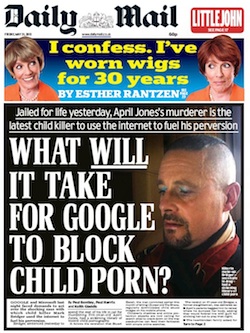
You simply can't look up extreme content via search engines like Google. In fact, the Internet Watch Foundation (IWF) has a blacklist to block sites, with co-operation from ISPs. The panicked thrashing about "making Google live up to their responsibilities" or "blocking child abuse sites" is unlikely to have any impact.


They can try it, but it won't work.
(Pic : blogistan.co.uk)
So, journalists writing exposés about the dark world of the internet - and how easily they could find child abuse images via Google - are either making it up, not looking at child pornography (but staged adult pornography) or doing it under the direct supervision of CEOP.

Also, under UK law, even looking at child pornography is a criminal offence. So journalists claiming they've seen it should be expecting a knock on the door then? Brown trousers at Daily Mail towers, surely?

If an automated filter were set up, it's likely to flag up "false positives" due to image labelling. An image of a child in a nappy might be blocked, while real child abuse – labelled with some encryption – would pass. A famous example being the temporary blocking of Scorpion's Virgin Killer album cover on Wikipedia (it's probably best not to look it up) by the IWF.

Basically, it's media campaigners pressuring people, politicians, search engines and ISPs to "try and do something", that's not likely to solve the underlying problem in the first place, and instead lead to the creation of a filtering system that will likely block "legitimate" content instead.
Like it or not - and however distasteful it might be - things like adult porn are legitimate. There are also plenty of ways you can block that already.

Looking for answers to the unanswerable questions

We all want to know "why"?
However, it probably doesn't lie on the internet, more in the
head of one sick individual.
(Pic : The Guardian)

I hate to say this - as I would like to see something done too - but it's all a load of poop. People and newspapers are embarrassing themselves by debating it in such 2 dimensional terms.

I think Carwyn got it right in his Feb 5th responses : better use of parental controls, better awareness, better reporting and flagging of criminal online content (including the system proposed by April's parents) and add top quality investigations by CEOP to that too.

In my opinion, many people look for the easiest way to explain activities that defy the boundaries of normal behaviour – and there's nothing that defies those boundaries quite like a child murder.

"Why?" is always the hardest question to answer in cases like that.

Children have been abducted, abused, raped and murdered long before the internet existed. The lack of an internet didn't stop Jimmy Savile, did it? Or the Moors murderers? Clamp down on the illegal stuff by all means, but blaming "the internet" is reminiscent of arguments that "video nasties", violent computer games and Marilyn Manson turned people into monsters. All largely disproven.

Ultimately, Mark Bridger killed April Jones because, for whatever reason, he knew what he was doing and wanted to do it – like all murderers. He just happened to be a paedophile as well, further adding to the revulsion, misery and outrage surrounding his heinous crime.

Wednesday, 5 June 2013

The Beast is Back - Welsh Government Progress Report 2013


Yesterday, the First Minister published the second annual progress report (available here in pdf), updating the Assembly and the rest of us on progress made in delivering Welsh Labour's Programme for Government.

The report itself, and its annexes, have both been slimmed down significantly and the report itself is surprisingly readable.

It's still "The Beast" when you factor in all the indicators. Therefore, I can still make Iron Maiden references, though the fact it isn't 666 pages like last year makes Carwyn something of a spoil sport.

The "excitement" pretty much ends there, as this is a post for the anoraks (and lazy Assembly staffers). Don't worry about me though, posts like this don't take as long as they might seem as it's basically just listing stuff.

As I said last year, the commitment to transparency is commendable, and I don't really question the First Minister's commitment to "delivery" either. Progress reports like these are, broadly speaking, a good idea. It's just the means of delivery that's the issue. More from me on that next week.

Reaction

As you can imagine, the First Minister was keen to emphasise his government's record at "standing up for Wales during difficult times", whilst acknowledging that other challenges lie ahead – most notably in the health service, some aspects of education and local government (once the cuts start to bite properly).

Opposition politicians were quick to point that the report is a "fig leaf", "self-congratulatory" and giving the mistaken impression that "all is well".

Both sides have a point. If Labour really want their record in goverment to be judged on things like water resource zone targets or new PCSOs, they're within their rights to do so I suppose. Just don't expect anyone to get too excited about that. People do notice things like class sizes, waiting lists and the general health of the economy though. There are also hardly any targets indicated whatsoever.

Like last year, it's up to you if things have gotten better or not. However, many areas have improved, albeit by small amounts in general. The indicators themselves though are fairly unambitious on the whole. Many have barely anything to do with the Welsh Government at all.

"Flat lining" is the general impression given by the report, with one or two exceptions in both directions.

Methodology


In a change from last year - and in order to slim down the length of the post - I'm only counting indicators that have "changed significantly" one way or another. The definition of "changed significantly" is subjective (in general +/- 1% change or its equivalent). So I suggest if you're really, really interested in this, you go through the report, annexes or indicators and decide for yourselves.

Unless stated otherwise, I'm comparing figures to the previous year (2011-12).
  • Once again, some indicators continue to only have one column of statistics to base delivery off (like this), or don't have any figures at all.
  • Some of the indicators are outdated – the data for attainment for 19 year olds dates from 2007 and 2008.
  • Some figures are exactly the same as those provided last year. Compare this post with last year's post and you'll see it for yourselves (if you can be bothered).
  • It appears many indicators have been subtly changed, I don't think that results in fair comparisons as it's effectively "changing the goal posts". For example, renewable energy production was counted in terms of kWh in 2012, this year it's as a percentage of total energy produced. I don't think it's that much of a problem in the grand scheme of things, but it's a concern.

Now, on to the main event....

Getting Better

Culture & Heritage
  • Visits to the National Museum rose by 34,000 on 2011.
  • The number of educational visits to CADW sites rose by ~13,300 on 2011.
  • The number of free swims taken up by the over 60s rose by ~60,000 on 2011.
  • 60.6% of conservation and maintenance work was completed on scheduled monuments by Q4 2012, compared to 52.2% in 2011.
  • An extra 8 libraries were refurbished between 2011 and 2012, bringing the total number to 87.

Economy & Transport
  • The percentage of the adult workforce qualified to the equivalent of 2 A-levels rose by 2% to 54% between 2012 and 2011.
  • The percentage of the adult workforce with a degree-level qualification rose by 1% to 33% over the same period.
  • The percentage of 19-24 y.o. NEETS fell from 22.9% in 2010 to 22.1% in 2011.
  • The number of visits to CADW sites, local and national museums rose by 800,000 between 2010 and 2011.
  • The number of rail journeys in Wales rose by 1.3million between 2009 and 2010 to over 27.2million.
  • The percentage of households with access to next generation broadband rose by 6% to 37% in 2012, however this remains the lowest rate of the Home Nations.
  • Jobs Growth Wales exceeded its target of 4,000 job opportunities - creating 6,000 - and are "on course" to meet targets of Skills Growth Wales II.
  • The number of apprenticeships offered via Young Recruits rose by 165 between 2011 and 2012.
  • Apprenticeship success rates rose by 3% between 2011 and 2010.
  • 2G mobile coverage now covers 99.2% of Wales in 2011, compared to 84% in 2010.

Education & Schools
  • The percentage of pupils attaining 5 A*-C GCSEs rose by 1.1% on 2011 (to 51.1%) - a sharper rise than England (0.4%), but still lagging behind overall (59.4%).
  • The gap in attainment for those in receipt of free school meals as KS4 (GCSE) closed by 1.6% between 2010 and 2011 to stand at a 33.2% points difference.
  • Post-16 "staying on" rates rose by 1.2% between 2010 and 2011 to 80.1%, but lag behind England overall.
  • The number of further education courses successfully completed rate rose by 1% to 82% in 2011 compared to 2010.

Environment
  • The percentage of electricity generated from renewables rose from 5% in 2010 to 7.9% in 2011.
  • The amount of gas used by Welsh households fell by more than 1,000 kWh between 2010 and 2011, while the amount of electricity fell by 70 hWh (could be a bad thing when you factor in fuel poverty).
  • The percentage of municipal waste recycled rose by 4.9% to 48.5% of all waste – the highest recycling rate of the Home Nations.
  • The percentage of water resource zones meeting target headroom requirements rose to 96% from 88% between 2010 and 2011.
  • The percentage of rivers, lakes and coastlines achieving a "good" ecological status rose by 2.7% between 2011 and 2012.
  • The area of woodland to be managed to UK Forest Standard rose by 23,000 hectares between 2012 and 2011, with significant rises since 2009.
  • 28 more Community Flood Plans were created between 2011 and 2012.
  • The percentage of journeys to work under 5 miles made by foot or by cycle rose by 6% on 2007 to 26% in 2010.

Equality, Housing, Communities & Poverty
  • KS2 and KS4 attainment rates for special needs pupils both improved between 2010 and 2011.
  • The percentage of ethnic minority households accepted as homeless fell from 8.8% in 2010 to 6.6% in 2011 (hinting at falling homelessness).
  • There were 285 fewer incidents of "hate crimes" in 2011 compared to 2010.
  • There were 7 more authorised gypsy & traveller sites in 2012 compared to 2011.
  • The percentage of assessed dwellings containing at least one "Category 1" hazard fell by 7% between 2010 and 2011.
  • The percentage of homeless families that include dependant children fell from 43% in 2010 to 41% in 2011.
  • 21,000 households had received help or advice about reducing energy bills as part of the NEST scheme.
  • Credit union memberships rose by ~5,500 between 2011 and 2012 to just under 60,000 members.
  • The number of statutory plans produced by local authorities has fallen from 88 in Q4 2011 to 31 in Q4 2012, reducing bureaucracy.
  • The net benefit of efficiency savings in local authorities from joint e-procurement (xchangewales) rose from £14.8m in 2011 to £18.5m in 2012.
  • The number of adults receiving direct payments rose to 3,200 in 2011 from 2,730 in 2010.
  • The percentage of children seen alone by social workers rose from 29.5% in 2010 to 33% in 2011.
  • The percentage of looked-after children experiencing more than once change of school in a year fell by 2% between 2010 and 2011 to 12.2%.

Health
  • The mortality rate for circulatory diseases (under 75s) fell to 68 per 100,000 from 71 per 100,000 people in 2011.
  • The number of hospital acquired infections remains generally lower in 2012 and 2013 than previous years, and significantly lower than pre-2009.
  • The number of emergency admissions for chronic conditions is around 800-1,000 per month lower in 2012 compared to 2011.
  • The percentage of GP practices reviewing their palliative care arrangements increased by 5% between 2010 and 2011 to 90.9% of practices.
  • The percentage of surgeries offering online repeat prescriptions rose from 18% in 2012 to 43% in 2013.
  • Teenage conceptions per 1,000 people fell from 36.9 in 2010 to 34.2 in 2011.
  • The percentage of children immunised against MMR rose by 2% between 2010 and 2011 to 93% overall, compared to 80% in 2003.
  • Seasonal uptake of flu vaccines for the over 65s rose between 2010 and 2011 but remain significantly lower than the rest of the UK.
  • The percentage of delayed transfers of care (for social care reasons) is generally lower in 2012 than in 2011.

Rural Affairs
  • Household incomes in rural areas remain marginally higher at 100.9% of the Welsh average.
  • The percentage of people employed in rural areas remains higher than the combined rural-urban average at 69.7% in 2012 – a rise of 1% on 2011.
  • The percentage of direct payments made to farmers by the end of December each year rose from 88% in 2011 to 97% in 2012 – compared to 75% in 2007.
  • The number of passengers using the BwcaBus community transport service rose by at least 10,500 between 2011 and 2012 to 23,800 passengers in total.

Safety
  • Drug-related deaths fell by 15 between 2010 and 2011 to 137 deaths.
  • Alcohol-related deaths fell by 35 over the same period to 459 deaths.
  • The overall crime rate fell to 63 per 1,000 people in 2011 compared to 68 in 2010 and 102 in 2003.
  • The percentage of people aged 16-59 taking Class A drugs fell to 2% in 2011, from 2.3% in 2010 and 2.9% in 2009.
  • The number of first-time entrants into the youth justice system in Wales fell by over 600 between 2010 and 2011.
  • The percentage of successful prosecutions for violence against women rose from 71.8% in 2010 to 74.8% in 2011.
  • The number of fires attended per 10,000 population fell from 67.8 in 2010 to 53.6 in 2011.
  • Road casualties fell by 213 between 2011 and 2012, with a 185 fall in serious casualties and a 28 fall in the number of fatalities.
  • The number of people supported by the All Wales Domestic Abuse and Sexual Violence Helpline rose to more than 3,100 in 2012, compared to just over 1,000 in 2011.
  • In 2012, 433 of the pledged extra 500 PCSOs had been recruited, compared to 47 in 2011.
  • The number of people with substance misuse problems benefiting from the European Social Fund peer-mentoring rose by 331 between 2011 and 2012.
  • Access to suitable custodial accommodation for young people rose by 2.9% between 2011 and 2012.


Getting Worse

Culture & Heritage
  • The number of children participating in arts activities fell by 1% on 2011 to 79%.
  • The number of visits to CADW monuments fell by 68,000 on 2011.
  • The number of free swims taken up by under 16s fell by ~61,000 on 2011.

Economy & Transport
  • The percentage of 16.-18 y.o NEETS in Wales rose from 11.5% in 2011 to 12.1% in 2012.
  • The value of tourism spend at CADW sites fell by ~£260,000 between 2011 and 2012.
  • The value of contract opportunities offered through Sell2Wales fell by ~£600,000 between 2011 and 2012 (could be seen as a positive if contracts are more attainable for smaller companies).
  • The number of beneficiaries of ReAct fell by more than 1,000 between 2012 and 2011 (possibly due to economic improvement).
  • The number of employees benefiting from the Wales Union Learning Fund fell by ~1,800 between 2012 and 2011.
  • The number of dangerous trunk road defects rose by 161 in Q4 2012 compared to Q4 2011.

Education & Schools
  • The number of further education institutions fell to 14 in 2011 (due to mergers) and is likely to be even less now. It's up to you if this is a failure or not, but it's a "negative".
  • The percentage of higher education institutions with incomes higher than the UK mean fell from 45% to 40% in 2010.

Environment
  • Levels of greenhouse gas emissions rose by ~3.5million tonnes between 2009 and 2010.
  • The number of properties benefiting from enhanced flood or coastal protection fell by ~500 between 2011 and 2012.

Equality, Housing, Communities & Poverty
  • The gap in attainment between girls and boys widened at KS4 between 2010 and 2011.
  • Incidents of sexual crimes rose by 70 between 2011 and 2010.
  • Men continue to have significantly higher employment rates (71.4%) than women (63.3%).
  • The number of homeless families with children living in bed and breakfast accommodation rose from 10 in 2010 to 30 in 2011.
  • The percentage of children living in combined material deprivation rose from 16% to 20% in 2009.
  • The percentage of households living in fuel poverty rose to 30% in 2012, from 26% in 2010.
  • The percentage of people attending arts schemes from under-represented groups fell by 0.4% between 2011-2012 and 1.5% since 2010.
  • The percentage of 19 year olds in education or training when leaving care fell from 48.1% in 2010 to 47.3% in 2011.

Health
  • There were 3,000 extra emergency admissions to hospital in 2011 compared to 2010.
  • The gap in life expectancy between the most and least deprived hasn't improved between 2008 and 2009.
  • The percentage of patients waiting less than 4 hours in accident and emergency departments was 85.9% in April 2013, compared to 88.6% in April 2012 and 92.1% in April 2007.
  • 56.1% of ambulances met the 8 minute category A response target in December 2012, compared to 64.8% in December 2011.
  • The number of cancelled operations was generally higher in 2012 compared to 2011, but much lower than 2002-2003.
  • The percentage adults who are overweight or obese rose by 1.2% to 58.5% of the population in 2012.
  • 97.4% of non-urgent cancer patients started treatment within 31 days in Q1 2013, compared to 99% in 2011.
  • 83.6% of urgent cancer patients started treatment within 62 days in Q1 2013 compared to 90.3% in Q4 2011.
  • The number of deceased organ donors fell from 67 to 52 between 2011 and 2012.
  • 91.4% of patients waited less than 26 weeks for referral to treatment in March 2013, compared to 94% in March 2012.

Rural Affairs
  • Only 6% of rural households had access to next generation broadband in 2012.
  • The number of herds losing their bovine TB free status increased on 2011 in 2012.

Safety
  • Recorded crime at railway stations rose from 1,054 incidents in 2011 to 1,114 incidents in 2012.
  • Access to suitable community sentence accommodation for young people fell by 0.5% in 2012.
  • The percentage change in average hours young offenders spent in suitable education, training or work-based activity once in a custodial or community sentence fell from 17.6% in 2011 to 11.7% in 2012.

Life for sale, or to use for your amusement. One less than careful owner. Requires extensive refurbishment due to blogging.

Monday, 3 June 2013

Assembly Integrated Transport Inquiry (It's good, seriously!)

A few weeks ago, the Assembly's Enterprise & Business Committee reported back on its inquiry into integrated transport in Wales. "Integrated transport" generally refers to how easily you can connect between different modes of public transport and your destination.

For example, Greater London has highly-integrated public transport thanks to initiatives like the Oyster Card, where you can simply hop on a bus straight after coming out of the Underground or railway station, without needing to buy a separate ticket for each.

The Committee (pdf) made a thorough and comprehensive 25 recommendations in total, summarised as:
  • Lobby the UK Government to devolve rail infrastructure powers (in line with Scotland), rail franchising and bus regulation. Also, use existing powers to "drive public transport integration."
  • Use planning rules to encourage integrated transport, via the proposed Planning Bill and the  the Active Travel Bill.
  • Investigate whether existing powers over bus services are used effectively, and move towards bus regulation, with improvements to passenger information.
  • Transport providers should co-ordinate their timetables, and "inter-modal integration" should be a key component of any new Welsh rail franchise contract from 2018.
  • Develop a fully-integrated ticketing scheme on all forms of transport (like the Oyster Card).
  • Give an update on progress made to improve access to public transport for disabled people, carried over from a previous inquiry by the Equalities Committee during the Third Assembly.
  • Expand the "BwcaBus" scheme to parts of rural Wales not currently serviced by scheduled bus services, and increase support for other community transport services.
  • Consideration be given to developing "Passenger Transport Executives" to deliver public transport services.

Next, there's the detail.

Powers & Planning

Some powers - like those over rail infrastructure and funding - aren't
devolved in line with Scotland, for example. This is said - even by
Government Ministers - to impact the delivery of integrated transport.
(Pic : Network Rail)
The Welsh Government wants a "fully integrated transport system" as part of its Programme of Government. University of South Wales' Prof. Stuart Cole - one of Wales' leading transport experts - pointed out that the current powers "severely limited" the Welsh Government's ability to come up with integrated transport solutions and invest in them. Although transport is "generally devolved", several key areas aren't, including:
  • Rail infrastructure and regulation of rail services
  • Registration and regulation of bus services
  • Public service vehicle (PSV) operator licensing

Prof. Cole called for the Traffic Commissioner's responsibilities to be devolved to Wales, as well as regulation of bus services (also called for by Passenger Transport Wales). Network Rail said devolution of rail powers would "potentially" improve integrated transport, but would be competing with other budgets.

Despite praise for Network Rail's administrative "devolution" to Wales, the former minister in charge of transport – Carl Sargeant (Lab, Alyn & Deeside) - pointed out that current rail legislation hampered his ability to deliver. He described devolution of bus regulation, rail powers and funding (in line with Scotland) as potentially "extremely helpful". The Committee concluded it would be difficult for the Welsh Government to deliver integrated transport without all of the right powers.

Concerns were raised that current Local Development Plans – like the controversial Cardiff LDP – weren't taking public transport seriously. Some expert submissions and witnesses described reopening old railway lines to serve big new residential developments as "needing to" happen, rather than merely"desirable".

Initiatives like the Active Travel Bill are designed to promote and enhance walking and cycling. Sustrans Cymru highlighted a lack of expertise, with lots of experience in local government when dealing with bus services, but not enough with regard active travel.

The bodies responsible for delivering and planning public transport are Wales' four Regional Transport Consortia – joint collaborations between local authorities. Witnesses said this model "works", but with room for improvement. Again, there are concerns about skills and expertise in local government, as well as variations between the differing boards.

The Welsh Government has the power to establish Joint Transport Authorities to deliver public transport on a regional level. Prof. Cole said he would prefer to see the transport consortia evolve to become these, with Network Rail coming to the same conclusion. Sustrans were sceptical, saying education (presumably to do with cycling) would fragment from transport functions. The WLGA said it might cost too much.

There's the option too of creating Passenger Transport Executives – like Transport for London and Transport for Greater Manchester. Wales doesn't currently have the power to create these, however.

Bus Services

First Group dismiss "quality contracts" due to concerns
about burdening local taxpayers.
(Pic : Simon's Bus Photostream via Flickr)
The inquiry looked at whether competition rules prevented bus companies integrating services with each other. First Group denied it did, however the Association for Transport Coordinators (ATC) said the rules led to "bus wars", while the threat of Competition Commission fines put bus companies off co-ordinating their timetables, actively discouraging co-operation. Presumably because there would be a danger of creating "monopolies" or creating the environment necessary for price-rigging.


The current arrangements are territorial, with one bus company saying bus operators were keen to "protect their turf" so to speak. The Chartered Institute for Logistics and Transport said bus companies want "light touch regulation", but competition has led to bus operators cherry-picking routes to maximise profits. They said a fully integrated bus network was, "not going to be done under competition."

First Group argued against the use of "quality contracts" – which would specify what bus services should be like and their operation – because it could destabilise bus operators and burden local taxpayers (to fund unprofitable, but "essential" services, presumably). Others, including transport consortia, agreed.

Prof. Cole said competition wasn't working properly, advocating "bus franchising" similar to the railways. The Welsh Government are intent on linking bus service funding to delivery, but have paradoxically cut bus funding by 25%.

Timetables, Ticketing & Passenger Information

Information about bus service changes are said to be "poor", whilst
real time information at bus stops is rarely found outside Cardiff.
(Pic : sketharaman.com)
Traveline Cymru is praised for its passenger information services, however the ATC said public transport information was "inconsistent and inadequate". It's said Traveline could be improved by becoming a "one stop shop" for travel information.

A lack of standardised travel information was a concern, one complaint suggested Ceredigion bus services "didn't have timetables!" Changes to bus timetables and services are said to be poorly relayed to the public. There were subsequent calls from passenger groups for more real-time information at bus stops (especially in rural areas) and at train stations.

Another complaint is the lack of co-ordination between bus and train timetables, meaning passengers could be left waiting for up to an hour to make a connection in some cases. Integrating the two would be difficult in rural areas with low service frequencies, and it's made worse as there's said to be very little communication between bus companies and Arriva Trains Wales towards doing this.

First Group were resolute that integrated timetables "don't work", and that while there would be benefits, linking timetables together "doesn't make sense". This claim was rejected by the committee, passengers, Arriva Trains Wales and various witnesses.

The ticketless "GoCymru" card is being trialled on some bus
services in Wales, with national roll out next year.
(Pic : Squidcard.com)

In terms of fares, Passenger Focus (and individual passenger responses) noted the complexity of fare systems and fares structures. The benefits of integrated ticketing – like the Oyster Card – were made clear. Oyster Card users in Greater London made up a third of public transport use in 1999-00, and it was pointed out that simpler ticketing results in a general "uplift" in public transport use.

Arriva Trains Wales are considering an integrated ticketing system, but are yet to decide if it'll be a smart card due to technological changes. The Welsh Government are introducing a smart card – GoCymru – to replace concessionary bus passes by 2014 on buses, and possibly 2018 on Welsh railways.

The committee concluded that passengers should be able to make journeys on multiple modes of transport with one ticket, based on a simplified price structure – effectively, a "Welsh Oyster Card" or equivalent.

Infrastructure

"Seemless" shift from one form of public transport to another
is said to be key to encouraging its use.
(Pic : © Eddie Reed via Geograph. Licenced for
reuse under Creative Commons Licence)
Witnesses pointed out the need to be able to transfer easily between buses, trains and taxis. It's seen as a key part of shifting people out of cars by reducing the inconvenience of changing from one form of transport to another.

Network Rail want to make the process of transferring from bus to rail "as smooth as possible", and support the creation of parkways/park and ride stations, linked to long-distance bus routes.

Passenger Focus also want car parking facilities improved at railway stations, something pointed out by other witnesses as an area to take advantage off once electrification is completed. Sustrans were against that, saying car parks fill up too quickly and are too large, and that improved facilities were needed for cycling and walking – on board and off public transport.

The UK rail industry needs to save £1billion, most of which is likely to come from staff redundancies – especially station staff. However, Arriva Trains Wales said they have no plans to close booking offices.

Accessibility for disabled people was raised by passengers, and examples were pointed out where one train station platform might be wheelchair accessible, but the other platform not. The committee wanted an update on progress made with regard an Assembly inquiry into disabled access to transport.

Community Transport

Community Transport schemes like Bwcabus are
key to providing services in areas abandoned by commercial
public transport operators.
(Pic : BBC Wales)
In areas poorly served by scheduled bus and train services, demand-led and voluntary community transport is often used instead. The BwcaBus scheme – where passengers pre-book the bus to pick them up/drop them off – is used in Ceredigion and Carmarthenshire. It's said to have been very successful, and it's suggested BwcaBus be rolled out to other parts of rural Wales.

However, integrating community transport with scheduled transport services is a problem, but commercial bus companies are aware of the benefits of community transport. It's particularly important for parts of Wales where there's been a "market failure" by commercial operators to serve the isolated elderly and disabled adequately.

Some community transport operators say, however, they're treated as "second class" by commercial operators, and overlooked as an alternative provider. Gwynedd is said to be a model of community and commercial companies working together.

Community transport operators were also facing difficulties, as Welsh Government funding was hanging in the balance, or operating on a rolling month-by-month basis. The committee concluded there needed to be more certainty on long-term funding for these services, as they enable people to remain independent for longer.

Conclusions


I have the virtual equivalent of tears of joy in my eyes.

Calling for devolution of the right powers, bus regulation, co-ordinated timetables, GoCymru (could become a "Welsh Oyster Card"), Passenger Transport Executives....

This report went under the radar unfortunately - and completely undeservedly. There's been a mass outbreak of common sense. Come, let us bask in its wonder.

It's excellent work. My hat goes off to the AMs and everyone involved. The Assembly and its committees have come under criticism recently, but we should all be able to point to this as an example of all that "dull" and "grim" debate having a purpose. I'd go as far to say it's one of the best reports I've come across since starting the blog. I don't think I can add anything other than say, "They've nailed it".

First Group don't come across well based on some of their evidence, it has to be said. Ask bus users in south west Wales and I'd imagine they'll won't need committee evidence to tell them that.

Now I'm going to demonstrate how easily it is to go from optimism to cynicism when it comes to Welsh politics and Welsh public policy. It's probably why people, even supposed enthusiasts like myself, are turning off politics in the first place.

Despite a brilliant report, with many sensible recommendations, you wake up and realise how slowly the civil service work, how reluctant Welsh Ministers are to take control of anything, the fact these things were staring AMs and Ministers in the face ten years ago without anything being done and the fact there's little money left.

Many of these recommendations are also reliant on Westminster benevolently granting us powers in areas Wales should, by rights, have powers over anyway under the spirit of devolution. So, think 2026, not 2016.

The Welsh Government will no doubt "agree", or "agree in principle", with the recommendations, but any action will either be bogged down by vested interests, diluted by compromises, or kicked into the long grass. Reasons will be found to not implement most of this.