
This site is no longer updated

Please use the links in the sidebar to visit the new sites!

Monday, 31 October 2011

Senedd Watch - October 2011

  • A 5p charge for single-use carrier bags came into force in Wales on October 1st. The money collected by the charge will be donated to charities that work in Wales. Business groups raised concerns that many traders are still confused about the scheme. Exemptions to the charge include bags used for medicines and some foods.
  • The National Farmers Union of Wales has said that farmers on lower quality land will miss out on subsidies under changes made to the Welsh Government's Glastir programme. NFU Wales President Ed Bailey, said that farmers have been "duped". Deputy Minister for Agriculture, Alun Davies (Lab, Blaenau Gwent), responded by saying the changes were recommended by an independent review group.
  • Leader of the Opposition in the Assembly Andrew Davies gave his first speech as Welsh Conservative leader at their annual conference in Manchester. He attacked Labour's record on health, saying Aneurin Bevan would be "turning in his grave" at planned £1billion cuts to health spending in Wales. He also criticised "freebies", called for a Cancer Drugs Fund and said that the Welsh Conservatives would support "sensible ideas" that boost the Welsh economy. Welsh Secretary Cheryl Gillan also attacked Labour in Wales, calling them "timid" and accusing them of "foot-dragging" over issues such as enterprise zones.
  • A Welsh language "virtual" university has launched to increase the number of students studying in Cymraeg at higher education. Coleg Gymraeg Cenedlaethol, which will work through existing universities, will offer a variety of different modules through the medium of Welsh, and hopes to have 100 lecturers on board by 2015.
  • Finance Minister Jane Hutt (Lab, Vale of Glamorgan) presented the Welsh Government's draft budget to the Senedd on October 4th. Health and Education have seen increases in their budgets while Housing & Heritage, Business and Environment have seen modest budget decreases. Five key Labour election pledges have been kept as part of the budget - including a Jobs Fund, and extra 500 PCSO's and the protection of universal benefits such as free prescriptions.
  • In response to the draft budget Plaid Cymru leader Ieuan Wyn Jones accused Labour of "raiding" the Assembly's reserves to meet manifesto commitments, leaving less money available for emergencies. Peter Black (Lib Dem, South Wales West) said the draft budget was "bare minimum" and "timid" while Paul Davies (Con, Preseli Prembrokeshire) said that the budget was "smoke and mirrors".
  • Meri Huws was named the first Welsh Language Commissioner by the Welsh Government - a role which will see the Welsh Language Board wound up as the result of the Welsh Language Measure passed in the 3rd Assembly. Bethan Jenkins AM (Plaid, South Wales West) raised concerns about how Meri - a former chair of Cymdeithas yr Iaith - will transition to her new role from the WLB.
  • BBC Wales outlined how they will save £10.7million as part of a UK-wide spending review by the BBC in London. There will be no cuts to news output, but some changes to political and radio coverage. Coverage of live events and sports with "high value" will be maintained. 100 jobs are expected to be lost.
  • The numbers of pupils achieving 5 A*-C grades at GCSE in 2011 rose slightly, with 49.6% getting the grades compared with 49.4% in 2010. The numbers at ages 16 with no qualifications at all has hit an all time low at just 0.7%.
  • Health Minister Lesley Griffiths (Lab, Wrexham), launched the annual winter flu vaccine awareness campaign, which encourages "at risk" groups - such as pensioners and those with underlying health conditions - to protect themselves.
  • Exports from Wales rose in value by 31.4% over the 12 months to June 2011 to stand at just over £13bn. Exports also rose in value for the other Home Nations, but Wales saw the fastest increase in value of exports and imports (which rose in value by 26.8%) of any nation or region of the UK over the period.
  • The European Union unveiled plans for the Common Agricultural Policy (CAP) from 2013. Some £260million is paid to Welsh farmers every year, and Farmers Union of Wales president Emyr Jones said that proposed changes would "destabilise" rural Welsh communities by taking agricultural land out of food production.
  • Education Minister Leighton Andrews (Lab, Rhondda), said that the University of Wales "requires a decent burial" after a series of scandals, including links with questionable foreign colleges and concerns about degree validation. On October 21st, the University of Wales merged with Trinity St David and Swansea Metropolitan to become University of Wales Trinity St David, ending the university's 120-year history.
  • Unemployment in Wales rose sharply by 16,000 in the three months to August 2011 to stand at 9%. UK unemployment rose by 114,000 to reach the highest level in 17 years at 8.1%.
  • The latest EU Objective One figures show that West Wales & The Valleys are one of several regions of the EU that have become poorer after two rounds of funding, with GVA per capita falling from 66.8% to 64.4% of the EU average in 2008. Labour MEP Derek Vaughan believes that this is because of mismanagement of EU funding. The European Commission said that although the figures are disappointing, the geography of the area and the global economic downturn are to blame.
  • A cross-party group of AMs won a vote on a motion for the Welsh Government to introduce a ban on "smacking" children in Wales. Issues remain regarding whether the Assembly has the power to amend criminal law. Deputy Minister for Children & Social Services Gwenda Thomas (Lab, Neath) ruled out any new legislation.
  • The Welsh Government is starting consultation on a proposed law that would require under-16's to have parental permission before getting cosmetic piercings.
  • 22 Local Safeguarding Children Boards (LSCB's), responsible for the protection of vulnerable children, will be replaced with six Safeguarding and Protection Boards which will have the added responsibility of vulnerable adults. Social Services Minister Gwenda Thomas said that 22 LSCB's was "not sustainable".
  • Local Government and Communities Minister Carl Sargeant (Lab, Alun & Deeside) pleaded for local councils to take a "forensic approach to their accounting" before deciding on possible council tax rises in Wales. The Welsh Local Government Association says that local councils may struggle to balance the books off the back of the draft budget - which allocated local government a below inflation 0.24% rise in their total budget of approximately £4billion.
  • The First Minister and the mayor of Chongqing, China signed a memorandum of understanding which is hoped will lead to industrial, social and cultural exchanges. The First Minister visited the China International Garden Expo, which included a showcase garden by the National Botanical Garden of Wales.
  • A deal has been agreed between the BBC and S4C over funding until 2017. The deal will include some BBC influence over S4C's direction, with a BBC Trustee appointed to the S4C Authority. However S4C will retain it's editorial and managerial independence. Cymdeithas yr Iaith dropped their campaign to boycott the licence fee, but remained unhappy, instead calling for broadcasting to be devolved to Wales.
  • An obesity expert called for the Welsh Assembly to levy a "fat tax" to help reduce the numbers of overweight and obese people in Wales. Dr Nadim Haboudi - a gastroenterologist - added that subsidising healthy foods could also be an option. The latest figures showed that 21% of the Welsh population is obese, compared to 26% in England and 22% for the UK as a whole.
  • A ban on unmanned tanning beds in Wales came into force on October 31st, with fines of up to £20,000 against businesses that flout the new rules.

Projects announced in October include a £1.9million scheme to encourage sustainability in Welsh National Parks, a £75million jobs fund that aims to create 12,000 jobs for youngsters, a £45million reorganisation of 4 schools in Penarth, a £5million Assembly land sale that could create up to 70 logistics jobs in Holyhead, a £7.5m revamp of Port Talbot Parkway railway station and a £6million refurbishment of the Glynn Vivian Art Gallery in Swansea.

Monday, 24 October 2011

Scotland the brave, Unionists the confused, Wales the nervous

The SNP held their annual conference in Inverness over the weekend. There's a video and link to the text of Alex Salmond's keynote speech over at Syniadau.

The other parties are pushing for a clear timetable for an independence referendum and called for clarification on other independence related issues, for example defence. The Scottish Government produced a white paper in 2009 called "Your Scotland, Your Voice" which addressed many key points albeit without detailed plans for each. This white paper has been conveniently ignored.

As for a timetable, my guess is that 2012 is a no-no as "Britishness" peaks through the Olympics and Diamond Jubilee. I think the impact of these things is over inflated anyway. Apparently there was a big "British" wedding earlier in the year, but all I can remember from it is a woman's small bum becoming big news. My gut instinct says that sometime in the second half 2014, when "Scottishness" hits a peak through the Commonwealth Games in Glasgow, would be the likely time. It's entirely the Scottish Parliament's decision when a referendum is held, and if Unionists want to win, it might be a good idea not to be seen to be lecturing Scottish politicians.

Also of interest, it appears as though Alex Salmond might be considering putting a "devolution-max" option on the ballot paper. This might well cost them a yes vote for independence, but it's a canny move by Salmond. A few months ago, I wrote a piece on the parallels between Scotland and Quebec, during one of the referendums there the Canadian Prime Minister went behind the Quebec nationalists back and put forward constitutional changes. Alex Salmond has now prevented David Cameron or anyone else from controlling the agenda or making a similar offer.

The only thing I can see David Cameron doing now to claw back some influence over proceedings is try prevent a multi-option referendum and push for a straight "in or out" vote. The irony considering today's motion in Westminster would be delicious. I think though that, for sheer pragmatic reasons, the UK Government would be satisfied with devolution-max - Conservatives and the Lib Dems could even support it - as long as it keeps British nuclear weapons on the Clyde and Scottish soldiers in the army the Union intact in some form.

Jim Murphy MP has asked "what does devo-max actually mean?" I've always understood it as the devolution of everything except defence, foreign affairs, macroeconomic policies like currency and some aspects of the constitution. Pretty straight forward stuff I think and well explained before.

Now Jim Murphy has a large head. I'm sure inside it resides a large brain - he certainly comes across as intelligent and articulate. I'm sure he knows what it means. Labour in particular have reasons to be worried about "devo-max". Firstly, the Labour party's baby – the welfare state – could find itself under the control of the SNP, joining Labour's other baby under SNP control – the NHS. Labour couldfind itself marginalised on traditional "Labour issues" both north and south of the border.

Secondly, devo-max could well justify another significant reduction in the number of Scottish Westminster MPs. That would not only make it harder for ambitious Scottish Labour personalities to climb the ladder in London, but would hurt the chances of an overall UK Labour majority for obvious reasons. Gordon Brown could very well have been the last ever Scottish UK Prime Minister. Not really that good for the union in the long term.

What does all this mean for Wales?

Gareth Hughes and Welsh Ramblings have discussed the possible implications. The first is that the Silk Commission could  be pushed to devolve economic powers such as tax varying to the Assembly – powers Welsh Labour have explicitly not sought. It could also mean the end to any possible reforms to Barnett - which will no doubt dismay both Plaid Cymru and Labour - but help keep Scotland in the Union.

Handling Alex Salmond with kid gloves is going to have a "negative" impact on Wales regardless. Alex Salmond isn't there to look out for anyone else but Scotland, and that's what makes him such a brilliant politician. There isn't any sort of "Celtic solidarity" when it comes to the nitty gritty issues.


The onus will be quite firmly on the Welsh Government to improve our lot in ways that really matter, instead of twiddling their thumbs thinking of tiny "quality of life" issues to resolve. If the Silk Commission does decide to give Wales similar economic powers to Scotland under devo-max, the Welsh Government would no longer have a half-empty toolbox.

We'll only get a real taste of what our AMs are made of when they start making decisions that would affect personal or business finances. It could make or break devolution in Wales, and those of us who support independence will be hoping more than many others that they are up to the task.

Thursday, 20 October 2011

The smacking ban and devolution

As you might have heard, a cross-party Assembly group put forward a motion proposing that the Welsh Government introduce new legislation to outlaw "smacking". The vote on the motion was won 24-15, but Social Services & Children Minister Gwenda Thomas (Lab, Neath) has ruled out any legislation.

As for my personal view on any potential ban, I'm firmly on the fence.

The state shouldn't mandate how children are disciplined in the home - it's a matter for parents alone - and I consider that an overriding principle.

On the other hand, resorting to violence to get children to cooperate - in my opinion -means the parent has "lost it", not the child. Using euphemisms like "smacking" detracts from the fact that corporal punishment is an outdated Victorian concept. There's something typically British about wanting to give someone a wallop (literally or metaphorically) when they do wrong - including children.

Though there is room to define "good practice", you end up creating another 40-page Assembly circular that only bureaucrats and politicians will read. Those who should read it – parents - will ignore it or won't even know it exists. You'll also be back at the first argument, going around in circles and providing cover for those parents who would use "discipline" as an excuse for poor parenting or even child abuse.

In EnglandandWales, "reasonable chastisement" is currently legal, provided it doesn't leave a mark. As usual with common law, the definitions and legalese leave it out of the realm of public understanding, and just creates work for solicitors and legal secretaries. The Scottish Parliament debated a full ban a few years ago but passed a watered-down version.

Welsh Select Affairs Committee chair David Davies MP (Con, Monmouth) has (quite correctly) raised concerns that any ban would encroach into criminal law - which isn't devolved and is an EnglandandWales matter. His personal views on the ban notwithstanding (he opposes it, quelle surprise), the devolution settlement is starting to strain.

I don't think this Labour government, with its commitment to children's rights, would walk away from a chance to introduce a smacking ban without there being underlying issues. Could said issues have prevented Gwenda Thomas from taking the Assembly's motion forward?

The Assembly and Welsh Government have previously introduced measures and regulations that could be classed as changes to criminal law and/or enable criminal prosecutions - the ban on shock collars for instance, or the law on single use carrier bags. If these laws can't be enforced properly or can be easily overturned by the likes of the Supreme Court, then Welsh laws are effectively useless, our AMs time wasted and it makes a mockery of devolution.

We elect our AMs on the basis that "protection and well being of children" (as written in Schedule 7 of the Government of Wales Act 2006) is a devolved Wales-only matter. If the Welsh electorate don't like what AMs are proposing we can vote them out in 2016.

If the constitution is hamstringing ordinary AMs and the Welsh Government from doing their jobs as they see fit, isn't it time for David Davies and Cheryl Gillan to seriously consider devolution of criminal justice and a separate Welsh legal jurisdiction?

All I can see them doing in the future is threatening to run to the Supreme Court every time the Assembly proposes something they don't like, using EnglandandWales as a massive loophole and ensuring they (and their roles) stay relevant.

Not good for devolution, not good for the constitution and certainly not good for effective and efficient governance in Wales.

If the Welsh Government are breathing a sigh of relief that they've escaped a "constitutional confrontation", just wait until the Organ Donation Bill....

Thursday, 13 October 2011

Throwing the baby out with the bathwater


I'm often critical of what constitutes a "scandal" in Wales these days. In the past few years we've had cigar smoking, iPods, Lib Dem administrative oversights and this week a provocatively expensive table. However the goings-on at the University of Wales have "shamed" the institution to such an extent that the proverbial last rites are being administered by Leighton Andrews.

What was once a federation of all of Wales' higher education establishments has withered to a rump of its former self. Most of its work appears to be in validating qualifications for various centres around the world – this isn't as unusual or as dodgy as it sounds. The institution which kicked off the scandal back in 2008 was the venerable Trinity College of the Bible and Theological Seminary in Indiana, which had its degrees validated by the University of Wales, but was not accredited by UoW or any US university either. Oh dear.

In the last few weeks BBC Wales revealed a separate visa scandal, now being investigated by the UK Border Agency. Students at a "centre" in London were exempted from working on MBA's, enabling them to apply for visas to stay in the UK, by purchasing "advanced" diplomas and seeing UoW exam papers in advance.

Despite announcing on October 3rd that they would stop validating other institution's degrees, several universities have called for the UoW to be wound up. UWIC is already rebranding itself as Cardiff Metropolitan University, while Wrexham-based Glyndwr University is seeking degree-awarding powers. All that will be left of the UoW it seems will be a tarnished brand, ruined reputation and a largely redundant registry in Cathays Park.

However eager people are to smack down the UoW, and however convenient this all is, the University of Wales still plays a critical role in the Welsh higher education sector. The Prince of Wales Innovation Scholarships (POWIS), run by the UoW Global Academy and funded by the EU and Welsh universities and businesses, aims to fund and attract high-achieving graduates to Wales to undertake research & development at Welsh universities and Welsh companies.

Although there's certainly an argument that we should be investing in Welsh graduates to do this kind of work, with research and development an increasingly competitive and vital part of the global economy, Wales should seize any advantages and opportunities that come along.

By suspending funding and reviewing the POWIS scheme, perhaps using the scandals as a bit of cover, the Welsh Government might have created a longer-lasting negative impact on Welsh higher education than anything the University of Wales might have done. UoW claims that POWIS has brought in £12.5million of investment in two years and exceeded expectations in product development and research projects - isn't that worth a measly £400k?

There are still many unanswered questions....

Wednesday, 5 October 2011

Draft Budget announced

The draft budget for 2012-13 was announced yesterday by the Minister for Finance Jane Hutt (Lab, Vale of Glamorgan).

In her statement to the Senedd she said:
"We have a responsibility to use all the levers we have to stimulate the economy against the backdrop of failing economic performance, with the UK Government having no credible plan for long term growth. Our vision for Wales is for a more prosperous economy with better, more efficient public services that equip people to fulfil their potential and maximise their contribution to society and the economy. "

Draft Total Departmental Budget Allocations   
(Change on 2011-12 Supplementary Budget)
  • Health & Social Services                                £6.47bn          (+£48m)
  • Local Government & Communities                £5.17bn          (+£15.8m)
  • Education & Skills                                           £1.96bn          (+£34.6m)
  • Housing, Regeneration & Heritage                 £514m            (-£16.7m)
  • Central Administration                                    £349m            (-£13.4m)
  • Environment & Sustainable Development     £327m            (-£2.9m)
  • Business, Enterprise, Technology, Science   £313m            (-£8.9m)

In the Draft Budget Narrative Jane Hutt also:
  • Says that in real terms the Welsh Budget will be £1.95bn lower in 2014-15 than in 2010-11, with a fall of £430m for 2012-13. It will also be £1.3bn lower on 2014-15 than the Welsh budget "peak" of 2009-10.
  • Says that capital spending will fall by 9.9% in 2012-13 - lower than the 28.6% fall in 2011-12. In real terms capital spending will be 50% less in 2014-15 than in 2009-10.
  • Accuses the UK Government of cuts that "go too far, too fast". However says that the Welsh Government is acting responsibly and will play it's role in deficit reduction.
  • Calls for borrowing powers for the Welsh Government and a "funding floor" as the first step towards a fairer funding model for Wales.
  • Presses the UK Government to modify their proposals to change End Year Flexibility.
  • Commits £25m per annum to create 4,000 jobs for 16-24 year olds (Jobs Growth Wales), part funded by Welsh and EU structural funds.
  • Commits to increased GP access measures such as Saturday opening.
  • Commits to the pledge to increase spending on schools by 1% above overall changes to the Welsh Budget, committing £27million for schools in 2014-15. Cash budgets for schools will grow by more than 5% over the budget period.
  • Commits £5million in 2013-14 and 2014-15 to Local Government and Communities to fund an extra 500 PCSO's.
  • Allocates an additional £5m (2012-13), £20m (2013-14), £30m (2014-15) to double the number of children in Flying Start.
  • Allocates an extra £287.5m over the next three years to the Welsh NHS but also says that the NHS needs to find savings of up to £250m a year, which has been done efficiently to date with saving of up to £300m found in both 2010-11 and 2011-12.
  • Protects universal benefits (free prescriptions, free school breakfasts, concessionary bus fares, free swimming schemes).
  • Says the Local Government and Communities Department will undertake a prioritisation exercise for National Transport Plan projects.
  • Will invest £89.4m in targeted support for business, £14.4m in youth entrepreneurship and start-ups, £18.1m for tourism marketing and £3.9m for "major events" - including a feasibility study for a Cardiff 2026 Commonwealth Games bid.
  • Commits £26.4m on "Welsh Learning" and establishing a Welsh Language Commissioner.
  • Says that staffing costs at the Assembly will fall by £20million by 2014-15 and the number of staff overall will fall over the period.

Nothing too exciting or overly dramatic there, some questionable decisions (like cutting the Business budget) but it's a difficult, if not a harsh, settlement. Whisper it quietly, but Jane Hutt's quite good at this....

Saturday, 1 October 2011

Senedd Watch - September 2011

  • The Welsh Government has unveiled a new blueprint for local government in Wales. The 22 local authorities will be placed in 6 "regional groups" with the intention of increased cooperation in the delivery of local government services. There will be no reduction in the number of councils or councillors. Peter Black AM (Lib Dem, South Wales West) has described this new blueprint as "reorganisation via the back door".
  • Former Rural Affairs minister Elin Jones AM (Plaid, Ceredigion) has announced she will run for the leadership of Plaid Cymru next year.
  • Every single local authority in Wales met tough waste guidelines for 2010-2011. Wales used less than 75% of it's landfill quota, with the aim of sending less than 50% of waste to landfill by 2013 compared to 1995.
  • Wales has reduced its greenhouse gas emissions by 23.3% since 1995 according to new figures. Environment Minister John Griffiths, (Lab, Newport East), noted that carbon emissions fell significantly in 2009, acknowledging that "the UK economic downturn was a major factor in driving down emissions during this period." Wales produced 7.6% of the UK's greenhouse gas emissions in 2009, significantly higher than its population share.
  • The Welsh NHS will be given the go ahead to use private hospitals to reduce waiting lists, with the Welsh Government saying that local health boards should "explore every option" to reduce them. Cardiff and Vale NHS trust is believed to be exploring plans for orthopaedic patients to be sent to private hospitals due to capacity issues. The previous Welsh Government ruled out the use of the private sector in the Welsh NHS.
  • Health Minister Lesley Griffiths, (Lab, Wrexham), hit back at the claims, saying that private hospitals would only be used as a "last resort" and that she "completely rejected the privatisation of NHS services."
  • Plaid Cymru held their annual conference in Llandudno. The party delegates voted to amend Plaid's constitution to explicitly support independence, support a moratorium on shale gas exploration as well as support non-payment of TV Licences in protest against changes to S4C's funding. Plaid's outgoing leader Ieuan Wyn Jones criticised Labour's record in Wales in his conference speech, saying Welsh Labour were "timid and unambitious" but adding that Plaid shouldn't turn down the chance to return to coalition government in the future. Former Llanelli AM Helen Mary Jones was elected party chair.
  • The First Minister travelled to New Zealand and met business leaders to highlight Wales as a place to invest, citing Pingar (Swansea) and Xero (various south Wales) as New Zealand businesses who are working in Wales. He also visited a Maori cultural centre in Auckland and received a traditional Maori welcome. The trip coincided with the start of the 2011 Rugby World Cup, being hosted by New Zealand.
  • Unemployment in Wales rose by 7,000 in the three months to September, though the unemployment rate remained unchanged at 8.4% compared to the UK average of 7.9%. Across the UK unemployment rose by 80,000, the sharpest rise for two years.
  • Four miners were killed in an accident at the Gleision Colliery near Pontardawe. Welsh Secretary Cheryl Gillan has promised a full investigation into the causes of the accident. The First Minister, who oversaw a round-the-clock rescue attempt, said "my heartfelt sympathy goes out to their families and friends in a community united in grief". Local MP, and Shadow Welsh Secretary, Peter Hain has set up a fund in the miner's memory.
  • The Assembly reconvened after the summer recess on September 20th and began with tributes to the victims, families and rescue workers involved in the Gleison Colliery accident.
  • The Welsh Government has announced five "enterprise zones" at Anglesey, Ebbw Vale, Deeside, St Athan and Cardiff. The zones will have business rate relief and possible tax breaks to expand in the future. Each zone will also be targeted at specific industrial sectors. The Minister for Business, Edwina Hart (Lab, Gower) also announced the creation of three new "sectors" in addition to six imposed by the Economic Renewal Plan. The new sectors are Farming & Food, Construction and Tourism.
  • Welsh Liberal Democrat leader Kirsty Williams launched an attack on Welsh Labour at the Lib Dem conference in Birmingham, accusing them of "frittering money away like a wayward teenager". She also criticised Labour's record on health, education and the economy.
  • Health Minister Lesley Griffiths unveiled her plans for the Welsh NHS, including a new strategy for maternity services and the creation of an independent group of experts to examine changes by local health boards. Opposition health spokesman Darren Millar (Con, Clwyd West) claimed that the latter is an attempt by the Health Minister to "shirk responsibility". This comes as Assembly statistics reveal that there were just under 9,000 complaints about health services in Wales in 2010-11, a rise of 10% on the previous year.
  • The UK Government is to centralise veterinary science testing services, which may result in the closure of laboratories at Carmarthen and Aberystwyth. This would leave Wales the only UK nation without a veterinary science testing lab.
  • The First Minister addressed the Labour Party conference in Liverpool, saying that Labour's success in Wales showed the party was "back in the saddle". He also defended free prescriptions and attacked the UK Government's austerity measures.
  • The First Minister unveiled Labour's Programme of Government for the term which includes new laws, extra PCSO's, extra apprenticeships, a new five-year Welsh language strategy and various measures to combat poverty and social injustices. Opposition leaders have been critical that the programme lacks set targets to measure success.
  • Deputy Minister for Skills Jeff Cuthbert (Lab, Caerphilly) is to lead a review into 14-19 year old qualifications in Wales, focusing on their value to employers and on vocational qualifications in particular.

Projects announced in September include : a UK Government proposal for a £500million rail link to/from Heathrow Airport which would enable direct rail services from south Wales, a £4million joint scheme between the Welsh Government and Sustrans for personalised travel plans in the Cardiff area, a £12million European research project into the bio energy applications of algae at Swansea University, a £12million public-private scheme to meet social housing needs, a biomass plant on Anglesey that will create up to 600 jobs, the £102million second phase of Morriston Hospital redevelopment in Swansea and a £15million joint EU-Welsh Government scheme to help 14-19 year olds with learning disabilities make the transition between education and employment.

Monday, 26 September 2011

Should a second language be compulsory at GCSE?

The Western Mail is reporting that CILT Cymru - the body for language teaching in Wales - believes that Welsh schoolchildren are falling behind their mainland European peers when it comes to learning a foreign language. They cite the number of pupils taking a full foreign language GCSE have fallen from 55% in 1995 to 29.6% in 2008.

As you might expect, some of the mouthbreathers that skulk around the Walesonline comments sections are pointing the finger at Welsh - probably because it's being taught at all rather than a compulsory subject at GCSE level.

For the record, I don't believe that Welsh should be compulsory post-14 in English-medium secondary schools
. I'll expand on my reasoning later in this post.

Mastering a Language

(For related and more in-depth look at the figures behind this, I seriously recommend this and other posts on Syniadau.)

It's said that it takes 10,000 hours to master a skill. There's no reason why this cannot include second languages. Also, some people will be naturally adept at picking up languages or linguistic skills in general, which may reduce the time. The reason people become fluent in a language is because they're immersed in it. All lessons in English-medium schools are as much English lessons as the subject being taught - and they certainly add up to 10,000 hours.

It's the same situation in Welsh-medium schools with regard Welsh, except these children (in many cases) are as likely to use English outside the classroom. That's true bilingualism.

At the moment, the Welsh GCSE short course - which the majority of GCSE students take to meet their "compulsory Welsh" requirement - consists of one or two hours of contact time A WEEK (not including homework). Welsh is compulsory in the same manner as Religious Education and PE are. It's something to fill a gap in the timetable, not a serious attempt at bilingualism.

Likewise, the full GCSE might be only be 3 or 4 hours of contact time a week.

This applies as much to modern foreign languages (MFL) as it does to Welsh. The way we teach children languages - except English - doesn't prepare them for fluency. Unless students take a MFL to A-Level or beyond, it's highly unlikely that they'll have anything other than a passing familiarity with the language.

My German GCSE would probably enable me to cope on a short trip, or even pick up a little bit extra from a phrase book or quick course, but it would never prepare me for business or to live there.

Bonjour, Guten Tag, Shwmae butt

Let's look at how languages are taught in outward looking internationalist countries mainland Europe.

France – A first and second foreign language are core compulsory parts of the French curriculum at all levels. A first foreign language (usually English or Spanish) is introduced in primary schools. Some schools still have Latin and Greek as optional subjects.

Germany – A foreign language is taught at every level in the German education system - usually English. Students choose from a wider variety of second languages at secondary level, and a second language is most times mandatory - sometimes even a third language - studied to the German equivalent of A-Level. Some German gymnasium (grammar schools) still teach Latin.

Netherlands – Schools teach English from between their equivalent of Years 3 and 6. Language education is a core - usually compulsory - part of the Dutch curriculum at all levels.

Finland
– Pupils are expected to learn two languages other than Finnish from age 7 right the way through the school system. There's a strong emphasis on reading (for pleasure) and communication skills from the outset.

The English Problem

There is no question, English is the international lingua franca (for now). Welsh students have an advantage of being able to speak it natively.

The - not necessarily arrogant - assumption that all you need is a good command of English to succeed internationally has helped create a blasé
attitude to foreign languages (including Welsh, which is a foreign language from a non-Welsh perspective). Why go through the hard graft learning a second language when you can take an "easier" GCSE instead?

In a way, the fact that many European nations choose English as the first foreign language to introduce to students has created this problem. This isn't because of the UK (with the exception of London), but the United States. How else would teenagers in Germany and France consume the latest Hollywood blockbuster or RnB hit without a decent grasp of English? Of course, they have dubbing and subtitle but it's not the same. English-language culture still has a big pull.

If foreign languages are ever going to take off in Wales - or indeed, the rest of the UK - these languages also need that pull. Welsh already has it to a certain extent, though you don't need to be a fluent Welsh speaker to enjoy the latest Welsh language music or watch S4C.

What can we do?
  • Introduce a third language at a much earlier age (around year 4), presumably a Romance language like French or Spanish due to the similarities with Welsh.
  • Teach Welsh, the "third language" and English along side each other in some lessons - especially those focusing on grammar and comprehension.
  • Introduce other foreign languages in Geography and History lessons in primary school. At least one of Arabic, Mandarin or Japanese should be explored.
  • Use sports stars, especially Premier League, La Liga footballers and French-based Welsh rugby internationals, to boost language uptake amongst boys in particular. Efforts to do this so far have been half-hearted.
  • A second (or third in the case of Welsh Medium schools) language should be a compulsory full GCSE choice - but this shouldn't have to be Welsh in English medium schools. English Literature, Religious Education (except faith schools), IT and PE should be dropped as a compulsory GCSE's to compensate.
  • Widen the choice of languages available at GCSE (i.e Mandarin, Portuguese, Japanese, Russian, Arabic, Hindi).

Proposed GCSE subject structure


Compulsory:

Mathematics
Double Award Science (or Separate Sciences)
English Language
Welsh First Language (WM Schools only)
Religious Studies (Faith Schools only)
Personal & Social Education (Not Examined)

Electives (Depending on facilities available to schools)

  • One Language other than Native Language(s)
Welsh, French, German, Spanish, Mandarin, Arabic, Hindi

  • One Technical, Scientific or Numerate Subject
Information Technology, Separate Sciences, Design & Technology, Textiles, Engineering, Business Studies, Accountancy, Economics, Electronics, Automotive Engineering & Design, Construction, Plumbing, Carpentry, Food Science

  • One Humanities Subject
Geography, History, Business Studies, Psychology, Sociology, Law, Politics, Philosophy, Economics, Classical Studies, Media Studies, Religious Studies, Physical Education, Care & Health, Tourism & Hospitality, Food Science

  • One Creative Arts Subject
English Literature, Welsh Literature (WM Schools), Art, Graphic Design, Music, Drama, Physical Education, Design & Technology, Media Studies, Food Science

  • First Free Choice

  • Second Free Choice (English Medium non-faith Schools Only)

Sunday, 18 September 2011

What is Wales? - The Higgitt Question revisited

This is in part a response to a response by Adam Higgitt to my original post a few weeks ago and a further expansion of the wider underlying issues.

Is Wales a nation, a region or an imagined community?

There's a hierarchy of human organisation that's naturally fallen into place for whatever reason. From the bottom-up, we have : individuals, families, communities, towns/cities, local authorities, regions/federal states, nations, "extended national/cultural families", continents/supranational organisations and a global community. To any Welsh nationalist, Wales is/should be explicitly a nation in this hierarchy, yet Wales remains/is treated as a region of the UK - albeit with clearly defined responsibilities devolved from the centre.

I don't want to get bogged down too much in the semantics of nationhood and identity. There's a civic Welshness, a civic Englishness, a civic Britishness and we are all Europeans, humans and members of the smaller communities in which we live.

I don't think there needs to be anything "special" about the Welsh to want full statehood. "Special" - in the wrong environment and context - can easily be fostered to become "better than" and "superior". All that there needs to be is a Welsh civic identity and a desire - by the majority - to have that identity fully expressed and recognised internationally as an equal to any other nationality – with the same voice, privileges and responsibilities.

I also, believe it or not, have a sense of Britishness (I'm sure other nationalists do as well) – a sense of "kinship" or "extended family" that might be equally applicable to the Nordic nations. In a UK context, it can be applied to Canada, Australia, New Zealand and the rest of the Commonwealth. Also, they show that you don't need a political union to remain "part of the family".

When I, as a nationalist, look at voting patterns for example, it's always from a national perspective and as a national dynamic - never as a region. Comparable to England, Scotland, Northern Ireland or any other nation as a whole (and as an equal) but not one of the regions of England.

Is there a civic "north east England-ness" in the same way as there is for Wales, England, the UK etc? Are comparisons between a region of a nation and a nation ever fully valid? Wales may share a lot with the north east of England, demographically, economically and psephologically but I'm sure there are other regions in Europe - and elsewhere - where Wales is equally comparable. For example : Wallonia, Silesia and Brandenburg. There are also several dozen full nation states Wales can be compared to.

Wales also has it's own "regions" – the north west of Wales isn't comparable to the south east in many ways but they share a civic identity, a cultural expression of it (via sport etc.), a contiguous territorial identity, a devolved national government and a common culture.

Does it do Wales any favours to be obsessed with the neighbours gardens while ignoring the rest of the street or the wider neighbourhood? Is Wales stuck in a British bubble?

Stretching the British constitution to breaking point

One of the UK constitution's strengths is that it has a fair bit of slack and hasn't been rigidly set down US-style. One of its weaknesses, is that compromises have the potential to leave the constitution in a tangled mess, or store problems for the future inadvertently. The asymmetrical nature of devolution is an example as is the complete ignorance of English national feeling.

The UK constitution has snapped before – in Ireland - for a multitude of reasons, none of which really apply to modern Wales, Scotland or England. What I fear, is that we are heading for a similar situation in the next 10 or 20 years. Tensions between the constituent nations of the UK originating from constitutional policies that were good at the time but no longer work or lose public support (i.e Barnett formula). The constitution could then be stretched so far (i.e. Independence-lite in Scotland) that it is effectively useless at holding the core together - like a rubber band that's lost its elasticity.

If there are moves to codify or solidify the UK's constitution, then it'll lose it's flexibility that's vital to make the government and legal system (in EnglandandWales at least) function properly. If nothing is done, then the tensions placed on it - for example the English Question or the (theoretical) repatriation of powers from the devolved nations to Westminster - could cause it to snap once again.

Independence for the UK nations is just one solution or possible outcome but not necessarily the "must have" solution.

Uti possidetis juris, sovereignty and devolution

Regarding my comment on a separate Welsh body of law – it's already happened. It very much "is" instead of "ought to". The Welsh Assembly has passed measures (and will in future pass Acts) that have changed - in Wales - the way health and social services are delivered, the planning system, laws governing the Welsh language, education, housing, the Welsh approach to the environment et al. The Welsh border is locked in legally and there is now a form of Welsh sovereignty. If these laws (and future ones) are to be enforced properly in the future it will require - with some inevitability - a separate legal jurisdiction to England.

Cross-border cooperation in its most basic sense, will have to be on the basis on two nations, not one EnglandandWales clump or some sort of cross-border "super region".

I gave environmental policy and government responses to climate change as an example where there are, or will be, different priorities between Wales and England. Responding to climate change isn't as simple as reducing carbon emissions and other greenhouse gases – it means whole scale change in public attitudes and behaviour, using resources more effectively and physically preparing for the impacts (i.e. Flood protection, civil defence, land management).

It can easily be accommodated by devolution, but in my opinion, with more powers devolved away from the centre, this makes a full, unitary, political union more redundant and restrictive - not more useful. It creates more completely avoidable tensions between differing and bickering layers of government. Half measures in areas such as energy policy and natural resources like water - especially when they are key parts of the Welsh economy - isn't a healthy situation, and are historical sore points.

Adam Higgitt is absolutely right that there can be policy/constitutional adjustment to reflect a multitude of different "local factors" , instead of a black and white choice between an over centralised British state and an over centralised Wales. There are plenty of examples around the world that do this without compromising on sovereignty or civic/territorial integrity - even in small nations i.e. the Swiss cantons, the Belgian communities or even the European Union itself.

My personal belief,  is that sovereignty resides with the individual and its political and governmental manifestations should get weaker with every step up the hierarchy. I certainly don't believe devolution has to stop at the Welsh level. I think Adam Higgitt and nationalists share an lot in common with regard how the constitution and sovereignty - in all its forms - can be perfected. We just have slightly differing ideas about where "Wales" would fit in - if it should fit in to it at all.

Any attempt to split Wales up, as a territorial contiguous nation, will be seen by nationalists as partition. That's not something the UK has had a good historical track record in.

Wales in Europe


Perfectly valid points are often raised about Wales' potential relationship with the European Union and whether Wales would cede sovereignty from one union to another. Is it a case of better the devil you know?

The EU is a very different beast to the UK. It has strength in numbers - yet doesn't massively infringe on individual national sovereignty thanks in part to a very weak civic European identity. Although there can be no doubt that it does exert a "control".

It has all the benefits of political union : freedom of movement, capital and trade for example that we currently enjoy in the UK in addition to currency union for the Eurozone.

The EU is also very good for smaller exporting nations (of which Wales is one) and small nations in general who've benefited a great deal from it, with many becoming very influential in European decision making, not to mention the rolling 6-month presidency of the European Council – dare I say it a "flotilla effect".

From a nationalist perspective, the UK is acting as a middle man, getting in between Wales and the EU. Why does Wales  have to be dragged along with the ebb and flow of Britain's fractious relationship with the EU? Influenced and dominated (by sheer weight of numbers) by eurosceptic English and British nationalism? Is that in Wales' best interests in the long term? I don't think it is.

Wales has inherent disadvantages being a "region" instead of a full member state Wales has fewer MEP's (4) than it would as an independent EU member (~8-12). Wales has no EU Commissioner, no member of the EU Council and plays no role in the big decisions. Instead Wales' role is relegated to regional groupings, while matters vital (or in some cases exclusive since devolution) to Wales' interests - like the CAP and Objective One - are done through the UK on our behalf. Why?

Smaller nations in Europe are no longer the play thing of the traditional great European powers (England [by extension the UK], Germany, France, Italy, Spain, Russia) that change hands depending on power politics. The EU has brought a stability and certainty for smaller countries that protects their sovereignty and treats them as equals.

It's a Europe of independent and sovereign nation states, not regions or any sort of half-way house.

Killing Wales through kindness

There is a certain logic to wealthier areas subsidising straggling areas. This happens within Wales to a certain extent via the Welsh Government's redistribution of locally-raised taxes. The question is whether - on the larger macroeconomic scale - this actually doing more harm to the economies of  straggling areas than good, and if this approach is only managing a decline than actually giving these areas an economic boost.

Wales has near Soviet-levels of public expenditure as a percentage of GDP by virtue of being a straggling area in a wealthy UK - propped up to a certain extent by big "UK" spends. This doesn't scream like an invitation to inward investors or somewhere to inspire confidence in entrepreneurs. As Wales becomes an ever smaller proportion of the UK's population , the pressures to replace the Barnett Formula could see the subvention heading from Westminster shrink.

Within Wales, the gap between the East and West is large, but it is in fact narrowing - thanks in part to sluggish growth in East Wales compared to the rest of the UK. Wales also has some unique problems in closing this gap compared to North and South England. West Wales is mostly rural and sparsely populated, with higher than average jobs in the public sector. The North of England can at least still rely on big centres of employment, and global cities like Birmingham and Manchester, to be drivers of the kind of growth that keeps their heads above water - or at least respectable in terms of GVA per capita.

UK economic policy backs winners at the expense of losers. UK social policy is perhaps the opposite.

The UK does have more than one global city. The Globalisation and World Cities Research Network lists London (Alpha), Birmingham, Manchester (Beta) Bristol, Edinburgh, Glasgow, Leeds, Belfast, Southampton (Gamma). Notice something about the list? Practically every single capital of a European nation is on the extended list. There's a big difference between England and Wales right there, and a massive one in terms of the economy.

Capital follows power and influence – the agglomeration effect. If Wales can use its national status to its advantage, why shouldn't we? If Wales really wants to follow an English examplem then Wales should reconsider the role of cities in economic development instead of trying to push water uphill.

There's no question that Wales need a more dynamic, more ambitious private sector and that there are endemic weaknesses within the Welsh economy that can be equally applicable to regions of England or in Europe (NE England and Brandenburg for example). Solving this problem doesn't necessarily mean "becoming more like England". I would like to think that Wales can adopt an approach that compensates for the lack of agglomeration, and re-balances the relationship between the public and private sector, without the "power struggle" between them that dogs "British" and English politics. My point about the Welsh middle/professional classes having a much bigger vested interest in the public sector is relevant to this.

In many respects, this will need full macroeconomic powers of an independent state, or at the very least a significant shift in economic sovereignty down to Wales from Westminster. Edwina Hart can tinker around the edges, but monetary/fiscal policy, taxation and things like welfare and employment laws play a much bigger role in the success and failures of the economy and individual businesses than grants and fast broadband.

Imagine having the most overbearing parents possible while living at home in your 40's. Wales is Timothy Lumsden from "Sorry".

Why culture matters

My comments on things like sport and culture were purely observations, but I don't think that makes them any less relevant to the "uniqueness" of Wales. Things like sport and the arts shape and define a nation and its identity. To ignore it would be to ignore the essence of Wales itself. It's not the most important thing on the list in terms of warranting independence, but it does provide the foundation for a national civic identity that - in nationalist opinion - underpins independence. It's our voice and deserves to be heard on the World stage as an equal.

The nonconformist issue of course is irrelevant now. It's important historically because the disestablishment of the Church of England in Wales acknowledged that there was a key difference between England and Wales as nations. It applied explicitly to a territory and nation of "Wales" and was controversial in doing so. Again, little things like this underpin a civic Welsh national identity and a uniquely "Welsh way of doing things".

It's agreed that the Welsh language is an important difference between Wales and England, Adam agreed that Wales should have custodianship of it. From a somewhat self-preservationary viewpoint, would Welsh speakers feel more comfortable being a 20-25% minority in 3million or less than (and ever shrinking) 1% of 60million+? Who can be heard effectively? Who can be pushed around more easily?

Equally, although English language is used as a medium, is there any reason why the English language culture of Wales - with its own idiosyncrasies - shouldn't belong to Wales either? Part of the reason Wales has such a weak media is that, in English-language culture, we've often looked east (or in some respects forced to look east) instead of building up our own version and providing a Welsh twang and a Welsh viewpoint to the Anglosphere. This is slowly changing with regards television and on the internet though.

Tuesday, 13 September 2011

Ieuan's swan song and Plaid's paradox

Ieuan Wyn Jones's legacy to Wales and Plaid Cymru runs far
deeper than high-profile air links and "WAG" managerialism. (Pic : BBC)
He's still got another few months as Plaid leader, but Ieuan Wyn Jones's speech at the Plaid conference last week was the start of a goodbye process. Who will replace him? We don't know. Judging by reports, there'll be no shortage of candidates. Elin Jones has thrown her hat into the ring, Dafydd-El Thomas too. There have also been rumblings about Leanne Wood, Llyr Huws Gruffydd, Simon Thomas and Jocelyn Davies since May's disappointing election results.


IWJ's legacy will be a bit of an odd one. He's arguably the most successful leader Plaid has ever had, yet this isn't the first time the party has moved quickly to replace him and descend into (justified) post-election naval gazing.


He was a successful Economy and Transport Minister in terms of delivering projects on time (if not quite on budget) and overseeing a complex (and controversial) review of post-WDA economic policy. He's an excellent manager, organiser and always seemed keen to listen. Yet he never seemed to have the confidence of the business community, and there have been more than a fair share of completely unfair accusations and labels thrown at the man.


"Ieuan Air" is a case in point. The outgoing Labour Second Assembly introduced the north-south air link in 2007 - before the election, and way before Plaid went into One Wales. Yet all of the negative fall out - the accusations that it's a waste of money (as though £1.5million would achieve anything near the same boost for north-south travel) or that the money should be spent subsidising the awfully-run Cardiff Airport - fell squarely on IWJ's shoulders.


In his own back yard, he was accused of doing too much "nation building" - improving north-south links that would shame a Central American banana republic. He also stood equally accused of not doing enough for Ynys Mon – like failing to wave the WAG's magic wand and turn Wales' most rural, most distant local authority - run by a cabal of bickering and incompetent Independents - into an economic powerhouse.


He's been labelled bland and uncharismatic, yet his speech to the conference was full of passion and vitriol - albeit in Welsh. He's clearly a far better public speaker in Welsh than English. That's a problem (though in an ideal world it wouldn't be a problem) if Plaid want to make head ways in the Valley and M4 corridor. It's a factor the party membership should consider when choosing a new leader.


His performances in the leader debates in April were pretty good - especially the first one. Yet he was always cut as something of a pathetic figure. A squeaky "Gog", who couldn't command physical presence (like Carwyn Jones and a lesser extent Kirsty Williams) or a lightly pompous academic respect (like Nick Bourne). Yet he was still a fine leader regardless. No infighting or party rebellions. Competent in government. A trustworthy and workmanlike face for Plaid.


He didn't get everything right. He had a tendency to waffle, a tendency to become obsessed with process over delivery (a Welsh problem if ever there was one) and never stood up for himself or his record in government when it mattered.


But there's absolutely no reason why he, or Plaid, shouldn't be proud of his contribution as leader.


Ieuan's legacy is everywhere: the construction of a £100m+ road in Port Talbot that will help regenerate the centre of the town, the Porthmadog and Tremadog bypass, the Church Village Bypass delivered after 30 years of waiting, several new and improved rail stations, a new Swansea bus station, a reduction in road casualties because of "nation building" safety improvements along the A470, platform extensions in the south Wales valleys, ProAct & ReAct keeping thousands of people in work and training during the worst recession since the 1930's (and Welsh unemployment not the worst of the UK's nations and regions for once) and a strong case made for future electrification of the south Wales mainline and valley lines.


He set the ball rolling for infrastructure improvements for the next 10-15 years. He also radically (in Welsh terms) changed the relationship between business and state that has existed unchallenged in Wales for 40 years – a conceived wisdom that handouts and grants dished out like swimming certificates to any business that wants one in a mobile globalised economy automatically leads to jobs and wealth creation.


I'm not the only one who disagrees with some of the outcomes of that, but he grasped a poisoned chalice and did his best to deliver in some pretty intolerable conditions and under fire from many different quarters.


History is going to be very kind to him.


The Plaid Paradox


There were a few other developments at the conference of note.


Firstly, the party have finally put "the i-word" into its constitution. We should be laughing at the reaction to this - especially from our Cheryl - that independence has been some sort of insidious "nats under the bed" plot Plaid have kept quiet for decades. I'm glad this nonsense has been sorted out once and for all. It's also prompted one of the best debates on Welsh independence for a long time on BBC Radio Wales which you can listen to here.


Secondly - and more importantly - the vote to support those evading TV Licence Fees in protest at the UK Government's proposals for S4C funding.


The good from this move is that Plaid are clearly a party who actually listens to and values its membership, they actually have a spine and that they are not ashamed to stand up and fight for what they believe in – things ordinary voters might want in a party.


And yet this is also the sign of a party driven by protest and the Welsh language, willing to ramp up illegal activity to make a point – things that will turn away many ordinary voters, and make Plaid look like nothing more than a large pressure group.


This is the "Plaid Paradox" : electable, yet unelectable at the same time.


The SNP have managed to reconcile the two (North Sea oil arguably being the SNP equivilant of the Welsh language) and that might be one of the reasons they've been so successful. Surely there's a "moderate" path Plaid can follow as well instead of being dragged to extremes?


No party should encourage or support illegal activity unless there is a clear injustice, oppression or predjudice being enacted or targeted at its members or supporter base that contradicts the existing law or constitution. As frustrating as the S4C situation is, I fail to see the "injustice", but what I do see is an opportunity.


Plaid could have come out of this calling for a new funding model – i.e. Welsh Government grant funding for S4C, combined with the licence fee - or even used this as leverage to devolve broadcasting (or at least Welsh-language broadcasting) to Wales. That would've not only made Welsh Labour look toothless and lazy, it would've made Plaid look like they were the only party genuinely standing up for Welsh interests and that they are willing to explore the issues and come up with clear and practical solutions.

Thursday, 8 September 2011

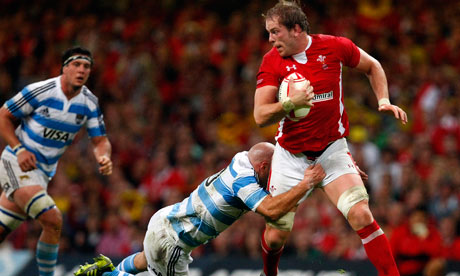
Rugby World Cup 2011 Predictions

Dere 'mlaen Cymru!..............
........until the quarter finals at least (Pic : Guardian)


The Rugby World Cup kicks off tomorrow, with all the home nations involved of course. I'm not much of a rugby fan to be frank - I'm more into football - but I believe I know just enough about the sport to make a prediction on the outcome.

The kick off times might be a bit inconvenient for the large European and African audiences, but the Antipodeans have had to deal with that every time the tournament has been hosted in the north - fair's fair.

Only five nations are realistic contenders for the trophy : New Zealand, Australia, South Africa, England and France. Many believe this World Cup is New Zealand's to lose. Call me lazy if you want, but I can go along with that.

A best case scenario for Wales and Ireland are kind draws in the quarter finals (depending on their results in their respective pools) that might open the door to the semi's or even the final itself but that's a long shot. Whether Scotland can get that far depends on their result against Argentina.

This Welsh side appear to be the best prepared ever for a World Cup. I think they can and will exorcise some Oceanian demons this time around....touch wood.

Pool A

New Zealand
France

==========
Tonga
-----------------
Japan
Canada

Pool B

England
Argentina

==========
Scotland
------------------
Georgia
Romania

Pool C

Australia
Ireland

===========
Italy
------------------
United States
Russia

Pool D

South Africa
Wales

===========
Fiji
----------------
Samoa
Namibia

Quarter Finals (winners in bold)

Australia v Wales
England v France
South Africa v Ireland
New Zealand v Argentina

Semi Finals

Australia v England
South Africa v New Zealand

Third Place Game

England v South Africa

Final

New Zealand v Australia

Monday, 5 September 2011

"The Higgitt Question" - A response from the man himself


Last month, I blogged about a discussion in a Wales Home comments section that stemmed from an article about the Welsh language by Blog Banw's Adam Jones. Imagine my surprise when Adam Higgitt himself took the time and effort to respond to my blog yesterday.

This was very much appreciated and a class act.


Due to Blogger's comments section limitations, I've decided to post Adam's response in full here because it deserves to be read. As you would expect Adam makes a brilliant case even if there are some parts I don't agree with. It certainly deserves a proper response and I will endeavor to do so in the near future.


A Background


The exact quote from Wales Home:
I find myself asking: what are these differences which are apparently so fundamental as to positively compel a completely different constitutional settlement and yet which cannot be described – by anyone?


Now I took "constitutional settlement" to mean many things: devolution, devolution-max, a new form of British federalism, American-style federalism, German-style federalism, confederalism and of course independence.


Adam's response implies he was referring exclusively to independence. My blogpost was trying to address any sort of difference between Wales, England and the rest of the UK that may warrant a "different" policy approach at a Welsh level or economically, historically (religion/non-conformism) or culturally (sport/culture) set Wales as a nation apart from England as a nation.


I summed this up as a question (and you could easily replace Wales and England with Scotland, Catalonia, Spain etc.)
What are the differences between Wales and England and why do they warrant a separate constitutional settlement?


Here's the original Wales Home article by Blog Banw


Here's my "Higgitt Question" blog from August.


Here's Adam Higgitt's response posted yesterday afternoon:


Owen


I’m sorry I’ve only just got around to seeing this, as a reply now seems somewhat tardy. However, since I’ve never before had a question named after me (and probably won’t again) I feel it’s in order.


I’m really pleased that you’ve given this answer, but I should add at the start of my reply (because, I’m sorry to say, this is a very long reply) that it wasn’t really the question I posed. What I was really seeking illumination on was: what is different about the Welsh as a people such that their own separate state is the optimum moral or practical solution? It is a subtle difference, but to my mind an important one. It strikes me that to be a nationalist one has to have some sort of conception of particularity or specialness of the people who comprise the nation in question: after all, if one didn’t believe that something that defined their group, it could not surely be a group?


It seems to me that this “root” question – what is special/different about the Welsh as a people – has to be addressed before any others. If not, you fall into the same circular trap that your response does at times (i.e Wales is different, therefore we should be treated differently). The problem with such circular argument is that it is incapable of deducing cause from correlation, and hence can’t get to the nub.


Your first “exhibit” – voting patterns - is a case in point. Wales’s more left-wing leanings are surely a function, not a cause, of an idea of Welsh peculiarity. Merely saying “Wales is a [more] centre-left nation” is a statement of bald psephological fact – it doesn’t address why this is so. There is another serious grievance with this in that, by only looking at nation-level voting patterns, you come up with the answer you want. The north east of England, for example, is an even more Labour-leaning part of the UK than Wales. So is the north west. Does this mean that both have a case to become separate states? What about Yorkshire and the Humber, which was more Labour-leaning until recently? What happens if Wales continues along the pattern of the last couple of elections (don’t forget that the Conservatives topped the poll in Wales in 2009) and exhibits a greater proclivity to vote Tory? Conversely, what about those parts of Wales, like the north east and south east coastal strips, that behave very much like (your notion of) England? Why should they be lumped in with the valleys and urban areas that vote Labour much the same as former coalfield areas and cities in England do? Welsh voting patterns, if you break it down, are a function of very conventionally British socio-economic factors, albeit operating counter-cyclically to the "mother" polity at times.


You say that Welsh and Scottish nationalism are less Eurosceptic than English and British nationalism. Perhaps so, but given all of those, with the exception of Scottish nationalism, are (presently) marginal electoral forces, I’m not sure what this helps to establish. The Welsh as a people appear to be only slightly less Eurosceptic than the English, and the embrace of Scottish and Welsh nationalism of Europe was, as we know, a tactical move, designed (in the sentiment of Dafydd Wigley) to remove the taint of separatism. It nonetheless raises an important question about a movement that wants independence from the British union but is outwardly enthusiastic about ceding a very large amount of independence to the European Union. But that’s probably for another discussion.


On public services, I think you have half a point. But this is difference born or Welsh relative rurality or sparsity of population. Any modern and intelligent constitutional settlement ought to be capable of adjusting policy to reflect such physical differences. Moreover, it’s only true in some parts of Wales. In others, there is the concentration of population much like urban areas of England. Surely what we need is not a choice between an all-UK approach or an all-Wales approach, but something that reflects the local reality? We need a more localist approach than either a centralised British or Welsh state can offer.


You then go onto suggest that “middle-Wales” is less upwardly-mobile and public-sector facing. Even if this is so, most agree that Wales needs a larger and more dynamic private sector, so the aspiration here is to be more like England, not less. Your point about prams and Adare street is a good one, but I don’t think this is to do with social leveling – it is merely a product of the fact that Wales is a country of 3 million rather than 60 million. Besides, didn’t I see pictures of David Cameron pushing a pram down his local high street recently?


As for Welsh social egalitarianism, I suspect this is more a working-class and less a national thing. Again, I’d suggest a comparison with England’s ex-coalfield areas, as well as her upland farming areas might be illuminating. I don’t believe the Welsh have a different idea about the type of people who ought to sit at the top table - in fact, what is striking about devolved politics is how often it seems to mimic British politics.


You are right that the composition of the Welsh economy is different from that of England’s. Actually, to be more accurate, it is different from London’s in the way you describe (England, by the way, doesn’t have several global cities, it has one; even Greater Manchester’s population is a mere one-quarter that of London’s, Leeds is one-tenth the size and Birmingham, while larger, is just another provincial European city. Belfast, for the record, is smaller than Cardiff and only slightly larger than Swansea). The economy of the north east of England shares a lot of similarities with Wales, The economy of the West Midlands is different from both London and Wales/NE England. The south west of England is different again. One size doesn’t fit all these different areas, but that doesn’t in itself mean they each need to be separate states, or that a UK-wide macroeconomic policy is incapable of meeting all those different needs, any more than an all-Wales macroeconomic policy ought to be flexible enough to cater for the prosperous south east and north east of Wales, and still take care of the Valleys and west Wales.


I can’t comment on your observations about matriarchy vs rule of law because I don’t know of any evidence to support them. But they are, at least, an attempt to identify something qualitatively different in the values, customs and sentiments of the Welsh as a people.


You are right about the Welsh language. Along with its associated culture, it is one of the very few things that is unambiguously distinctively Welsh. Of course, as you note, Wales is also very extensively English-speaking, and the English language is very much part of Welsh culture. Should Wales have “ultimate custodianship” of the Welsh language? I believe so. Does this require a separate state? I doubt that, and the existence of numerous bilingual and multilingual states suggests that it is not necessary.


As for sport, no it certainly isn’t as clear-cut as your opening sentences imply. I’m afraid that your following observations on culture and sport don’t strike me as especially valid or grounded in evidence. And they certainly don’t pass the “we therefore need a separate state” test. As for religion, I very much hope we have definitively moved beyond the era when peoples and states are divided according to religion.


Your comments on laws fall into the “ought” rather than the “is” category: it is something you hope to see as opposed to something that is in place and differentiates the Welsh.


On climate change, I find this analysis rather odd. Yes, Wales has certain natural assets that can be brought to bear in pursuit of a more sustainable mix of energy production, and devolution (with amendments) should be more than flexible enough to tailor policy accordingly. But on the broader picture, Wales, England, the rest of the British Isles and indeed most of Europe are in exactly the same position. What is needed here is greater co-ordination to reduce emissions. England’s additional need for climate change mitigation is a miniscule issue by comparison, and certainly doesn’t mean that Wales and England are incompatible as joint members of a political union.


On sub-national divisions, again I fail to see the point you are trying to make. Yes, attempts have been made to address the relative underperformance of west Wales and the Valleys, just as (in many cases exactly the same) attempts have been made to address similarly identified malaise in Merseyside, Cornwall and several other English regions. And I’m sorry to tell you that the gap between east and west Wales is also widening.


***


Please don’t get me wrong: there are important areas in which Wales as a whole is different from England as a whole. It is, by and large more rural and sparsely populated. It is more mountainous. It has commensurately poorer communications links. It has a greater proportion of relatively depressed post-industrial areas. And it has a unique and historic language and associated culture. But none of these, individually or collectively make the case for a separate Welsh state (as opposed to, say, a modern federal state) and none do justice to the real issue, namely the need for form of government that recognises the substantial differences that exist within Wales and within England and the commonalities that exist between parts of these two countries. A lot of problems you have described are functions of a historically over-centralised British state. I fail to see how these will be fixed by supplanting it with an over-centralised Welsh state.


Best


Adam