This site is no longer updated

Please use the links in the sidebar to visit the new sites!

Thursday, 31 May 2012

Senedd Watch - May 2012


  • A Welsh cabinet paper revealed that the Welsh Government are to prepare a PR campaign to explain changes to hospital services in Wales, suggesting changes will be “difficult and controversial”.
  • Health Minister Lesley Griffiths (Lab, Wrexham) was criticised by opposition parties for bringing forward £12.4million in contingency funds to enable Local Health Boards to meet financial targets. She denied claims it was a “bail out”, and the Welsh Government hailed the Welsh NHS “breaking even” as a “magnificent achievement.” It was later revealed by Conservative leader Andrew Davies, that preparations for the contingency funds were made between October and December, despite Lesley Griffiths telling Local Health Boards “not to expect any more bail outs.”
  • A consultation has opened, launched by Business Minister Edwina Hart (Lab, Gower) into a new innovation strategy for Wales. The strategy will encompass intellectual property, research and development, and product development.
  • Undercover investigations into tanning salons suggest that up to a third are ignoring age checks. Under 18s have been banned from using tanning beds in Wales since April 2011.
  • Professor Roger Scully from Cardiff University has suggested that there are too many councillors in Wales, suggesting a cut in the number of councillors and a switch to Single Transferable Vote in local elections.
  • Labour made big gains in the local elections held on May 3rd, taking overall control of ten local authorities – including Cardiff, Swansea and Newport. Plaid Cymru lost more than forty councillors, the Conservatives lost overall control of two councils and more than sixty councillors, while the Liberal Democrats suffered particularly heavy defeats in Cardiff, Swansea and Wrexham. Independents also suffered heavy losses, but remain in control of Pembrokeshire and Powys.
  • The Wales Coastal Path was officially opened on May 5th, with events held around the country. Wales is now the only country in the World that has a path around its entire boundary. It's hoped the path will become a major tourist attraction.
  • Health Minister Lesley Griffiths launched a 12-week consultation on a new Mental Health Strategy, which aims to tackle stigma and ensure equal access to services.
  • A campaign has been launched to encourage the Welsh Government to pay a “living wage” of £7.20, instead of the national minimum wage to help tackle child poverty.
  • Grants of up to £3,000 will be offered to student teachers to encourage them to move to further education colleges in time for the 2012/13 academic year. The scheme is aimed in particular towards science, engineering and mathematics subjects.
  • Education Minister Leighton Andrews (Lab, Rhondda) has written to every Catholic secondary school in Wales to remind them to “give a balanced perspective” on same-sex marriage. This happened weeks after it was revealed that Catholic secondary schools asked pupils to sign a petition against same-sex marriage laws.
  • The Welsh Government said that there was “no appetite” for an increase in the number of AMs to 80 from 60 after the Llywydd said she was in favour of such a move.
  • The Welsh Government  launched a consultation into its proposed Active Travel Bill, which will place a statutory duty on local authorities to provide safe cycling and pedestrian routes.
  • The Assembly's Task-Finish Group on the Media reported back after an extensive investigation. They recommended the creation of an independent media panel, the possible creation of a Wales-specific Channel 3 licence and wish to keep the future devolution of broadcasting under review.
  • Shadow Welsh Secretary Peter Hain MP, resigned his shadow cabinet position to concentrate on delivering a possible Severn Barrage. Owen Smith MP was appointed as his replacement.
  • Minister for Housing, Regeneration & Heritage Huw Lewis (Lab, Merthyr Tydfil & Rhymney) has set an “ambitious” target of 12,500 new “affordable homes” to be built over the next four years after unveiling a white paper on housing. Peter Black (Lib Dem, South Wales West) called for greater transparency. Llyr Huws Griffiths (Plaid, North Wales) welcomed the announcement, but questioned how the targets could be met.
  • Unemployment in Wales fell by 1,000 in the three months to May 2012, to stand at 9%. Across the UK, unemployment fell by 45,000 to 8.2%.
  • Education Minister Leighton Andrews unveiled a new five-year plan to tackle inadequacies in Welsh schools. The National Literacy Plan aims for Wales to reach the top 20 of PISA nations by 2015. This follows criticism expressed by Estyn that basic key skills were “poorly planned” amongst 11-14 year olds.
  • Welsh Language Commissioner Meri Huws has launched a consultation into improving services for Welsh-speakers. It recommends that Welsh-speakers should expect correspondence in Welsh as well as be able to access Welsh-speaking health and social care professionals.
  • Communities and Local Government Minister Carl Sargeant (Lab, Alyn & Deeside) has launched a white paper on the Welsh Government's proposed Local Democracy Bill, which would see a shake-up of the Local Boundary Commission for Wales, improve local election management, improve scrutiny procedures and improve access to information from community councils.
  • Unite Union leader Andy Richards shunned Plaid Cymru leader Leanne Wood's overtures towards creating a “progressive alliance” against public spending cuts. Welsh Labour also criticised her plans in a strongly-worded statement attacking her leadership and questioning Plaid Cymru's stance on trade unions.
  • Children's Commissioner Keith Towler said the Welsh Government's long-standing plan to eradicate child poverty by 2020 is unlikely to be achieved. Deputy Minister for Children & Social Services Gwenda Thomas (Lab, Neath) said that Labour remained “committed” to the pledge.
  • Welsh Secretary Cheryl Gillan unveiled a green paper on changing the election system to the National Assembly for 2016 – expecting to include reducing constituency AMs to 30, with 30 elected via the regional list.
  • Finance Minister Jane Hutt (Lab, Vale of Glamorgan) has unveiled the Welsh Government's new Infrastructure Investment Plan, which plans out a combined £3.5billion worth of capital expenditure schemes. Opposition parties criticised the number of repackaged announcements.
  • Plaid Cymru accused Labour of “downgrading” the express north-south rail services by reducing the number of services from two to one, saving £500,000. The Welsh Government said the “enhanced” service will now call at Wrexham and Flint.
  • The Welsh Government has laid the Food Hygiene Ratings Bill in front of the Assembly. The Bill, if passed, will require premises serving food to display their rating prominently. Health Minister Lesley Griffiths extended the scheme to include premises that prepare food, but don't serve it to the public.
  • The First Minister set up a task force to investigate improvements to Cardiff Airport, after a series of criticisms aimed at the airport's operators due to significant passenger falls over several years. The Conservatives described the task force as “too little, too late.”
  • The First Minister has released his first Annual Report which is part of his government's focus on delivery. The report lists several hundred indicators and progress, as well as action taken, towards improvements when necessary.
  • The Assembly's Petitions Committee has recommended that “buffer zones” of 1,500metres be placed around wind turbines to protect people living near them from noise.
  • Llywydd Rosemary Butler has presented a scroll as a gift from the National Assembly, with a message, to The Queen to mark her Diamond Jubilee celebrations next month.
  • A consultation has been launched into possible changes to qualifications in Wales. It could lead to new types of GCSE and A-Level, a “matriculation” qualification and new vocational, numeracy and literacy qualifications.

Projects announced in May include : A £24million revamp of the National History Museum at St Fagans, a £365million onshore wind farm in the south Wales Valleys and the creation of two new energy enterprise zones in Pembrokeshire and Gwynedd.

Wednesday, 30 May 2012

Scores on the doors - Food Hygiene Ratings Bill introduced


The latest piece of legislation from the Welsh Government was laid in front of the Assembly earlier this week. With several e-coli outbreaks still casting a shadow, the Welsh Government is taking steps to improve food hygiene. I've mentioned a new strategy on school toilets before, but this is something more significant.

What the Food Hygiene Ratings Bill aims to do

The bill is short, but sweet.
  • "Food authorities" (that is, by and large, local authority environmental health departments) will inspect "food business establishments" and give them a rating (from 0-5) based on Food Standards Agency criteria.
  • "Food business establishments" are defined as registered businesses that supply food direct to the public, or to other businesses.
  • "Food business establishments" will then be legally obliged to inform the public of their rating via a food hygiene rating sticker provided to them. They will have a right to appeal and be re-rated.
  • Stickers will need to be removed and destroyed when they become invalid.
  • It will become an offence, punishable by a fine of £200 payable within 28 days or a reduced £150 payable within 14 days for food businesses to:
  1. Fail to display the food hygiene sticker in the "location and manner prescribed"
  2. Display an invalid sticker
  3. Failing to retain a valid sticker
  4. Hands a sticker over to anyone other than a food authority authorised officer
  5. Fails to notify anyone of their food hygiene rating verbally
  6. Intentionally defacing/altering/tampering with a sticker
  7. Removing/destroying a sticker other than when they become invalid
  8. Food authority officers will have the legal power to enter a food business premises (at reasonable hours) to carry out a food hygiene rating, a re-rating, determining an appeal or enforcing requirements to display the sticker.
  • Fixed penalties will be paid to the Welsh Government, and retained to "improve food hygiene" in Wales.

Beefing up food hygiene in Wales

Now, once again, this isn't the most Earth-shattering legislation ever drawn up, however I suspect it's going to be incredibly effective, while minimising "red tape" to food businesses. It's fairly simple to understand, and Health Minister Lesley Griffiths (Lab, Wrexham) has ensured that it will cover all premises that prepare food.

It's expected that the new statutory requirements will come into force sometime in late 2013 if the bill is passed.

The 0-5 scores are already available, and simple to understand – you can find existing local ratings here at the Food Standards Agency website.

0 – Urgent improvement necessary
1 – Major improvement necessary
2 – Improvement necessary
3 – Generally satisfactory
4 – Good
5 – Very good

These ratings are used in England, Wales and Northern Ireland. Scotland has a different rating scheme – a simpler "pass" and "need for improvement" one.

Forcing businesses to display their food hygiene rating will, hopefully, help drive up food hygiene standards across Wales. "Scores on the doors" is as good as "name and shame". I wouldn't be surprised if this compulsory scheme is replicated across the UK, or even the EU, at some point in the future.

I just hope that it doesn't result in people seeking out those premises marked 0 to see if they can "handle it."

If I could make one change, it's that premises that are rated 0 can be closed down by authorities until they meet the criteria for getting a 1 or a 2.

Monday, 28 May 2012

Welsh Government Housing White Paper


Last week, the Minister for Housing, Heritage & Regeneration, Huw Lewis (Lab, Merthyr Tydfil & Rhymney) published the Welsh Government's white paper covering housing strategy, entitled "Homes for Wales".

It sets out several key delivery aims this Assembly term and beyond:
  • 12,500 new "affordable" homes of which:
  1.  5,000 will be empty properties brought back into use
  2.  500 will be cooperatively owned
  • Improve existing homes energy efficiency
  • Improve housing services to vulnerable people, including the vision of ending family homelessness in Wales by 2019

How it will all work

A new Housing Bill is due in 2013 as part of the Welsh Government's legislative programme. The bill would improve the private rented sector and prevent homelessness with the aim of, as I said, ending family homelessness by 2019.

Alternative models of finance are cited, with the £100million redevelopment of the Ely Bridge site in Cardiff – via a not-for-profit partnership if private and public sector companies – given as the flagship for a new form of co-operative home ownership. A "Welsh Housing Bond" is mentioned as a possible way of freeing up extra capital funding to build new homes, in addition to the investment mentioned in the recent Infrastructure Plan.

Several other bits of legislation, and levers are mentioned:
  • Peter Black's (Lib Dem, South Wales West) Member's Bill for Park and Mobile Homes
  • Local authorities will have the power to charge a higher rate of council tax on properties left empty for more than a year
  • Introduce new statutory duties for Gypsy & Traveller camps
  • A definition for "Community Land Trusts"
  • A bill on Tenancy reform sometime in the Assembly term

Recently, as part of the budget deal between Labour and the Lib Dems, the Welsh Government announced that they want to provide 95% mortgage guarantees for first-time buyers of new built homes.

Social housing rents are due to be standardised and more closely regulated. This aims to ensure that people are charged a similar level of rent whether they are renting from a local authority or a housing association.

Specific reforms planned for the private rented sector will include new standards, new licencing for private landlords (long overdue) and compulsory registering of private landlords.

A comprehensive assessment of homelessness services is included, which will require more cooperation and collaboration between relevant authorities, changes in definitions of homelessness and new duties placed on local authorities.

Closer examination

Local authorities already have statutory duties with regard finding accommodation for the homeless, and those with children are a high priority. Technically speaking, family homelessness shouldn't exist.

Aiming to end it by 2019 is a brilliant pledge, but digging below the surface, I doubt there are any families in Wales, or a tiny number, who are "functionally homeless" – that is without any roof over their head. Single people, and couples without children are a different matter.

The idea for co-operative home ownership is novel and wholeheartedly welcome. I'll be posting more thoughts on how Wales can develop its urban areas in the near-term. However, I hope that this new co-operative isn't the fudge of the rather complicated shared equity, which results in a resident paying both a rent and a mortgage. It won't work as long as house prices remain ridiculously high.

Releasing public sector land for just 500 new homes (whoop-de-doo) seems pointless, but every little helps I suppose.

One of the good pledges is to bring more empty properties back into use. 5,000 are earmarked. It's a good start, but it's nothing dramatic or radical.

It's sensible, but we don't know where most of the 22,000 empty private sector properties mentioned are. You have to make sure homes are in places people actually want to live.That in itself is a difficult balancing act:
  • Do you want to retain young people in rural areas?
  • Do you want to move people out of places like Cardiff into the Valleys?
  • Do you want to move people from the Valleys towards the M4 corridor? Or from rural north & mid Wales to the A55 corridor and Deeside?

They mention a pledge to "abolish the Housing Revenue Account Subsidy" (HRAS) system – which leads to Welsh local authorities returning large sums of money to the UK Treasury. However, HRAS is already due to be abolished sometime this year (in England at least). I'm not sure why the Welsh Government are so keen to advertise that they've been slow to act.

It's clear now that there's a cross-departmental link between the capital investment aimed at energy efficiency and housing. That's good, and something I like to see. However, it's ridiculous that a nation that's a net-exporter of energy, and with a massive potential for renewables has such a poor track record on fuel poverty. Aim higher than 100MW, please.

The private landlord reforms are the standout pledge. If they can pull that off, it'll be an excellent development. However, I have concerns – firstly that it might discourage people from becoming private landlords in the first place, possible reducing private rental supplies and secondly that any "fit and proper person" test for landlords won't be matched with a "fit and proper person" test for prospective tenants.

There are aims of tackling anti-social behaviour and domestic violence, but I see these as toothless without criminal justice powers to back it up.

On homelessness, I'm afraid that the Welsh Government's broadly positive aims to reduce it might be exploited by local authorities elsewhere in the UK to "dump their problems on us". Despite the trend of falls in homelessness numbers, the Welsh Government could inadvertently let the UK Government off the hook for their welfare and housing reforms, and being left to pick up the pieces and the price tag.

The key underlying issue not addressed

Housing in the UK, and in Wales, is far too expensive. No amount of state-aid is going to change that.

This week, Shelter Cymru have revealed that tenants face "administration" costs of £600. Hopefully the reforms to private tenancies announced in this white paper can lead to reforms here.

The white paper lists that the average Welsh salary is £23,800 and the average house price is £113,000. That's a house price/earning ratio of 4.7, much higher than the long-term average of nearer 3.5. Now if you could get it down to a ratio of 2.5-3, that would be what I would personally consider "affordable".

The new policy of providing 95% mortgages for first time buyers of new built homes, however incredibly specific that is, is short-termism. In the long-term, house prices in Wales, and probably the UK as a whole, are going to have to come down to a more affordable level, instead of using money to prop prices up, and burden first-time buyers with more mortgage debt that they other would be able to afford. It's a policy for house builders, not first-time buyers really.

The thought of taking any sort of action that reduces house prices however fills politicians with dread.

So how do you get the cost of housing to fall without spooking people? I've written on this before, but here's a summary of some ideas:
  • Dramatically increase supply – new towns, planned urban expansion in larger settlements.
  • Cheaper building materials – new forms of prefabricated and modular housing.
  • A planning revolution – Completely discount objections based on property values. A new Planning Bill is expected during the Assembly term, we'll see what happens there.
  • Land Value Tax – To promote development of "fallow land".
  • New models of ownership – Including those mentioned in the white paper.
  • Longer-term private rental agreements – Make renting for 30 years+ attractive. We'll see if the tenancy reform bill mentioned will add greater clout in this area.

Housing should, ideally, not be seen as a financial investment but as something purely functional. That's what happens in nations like Germany, for example. It's something Wales should probably aim to emulate in the long-term, and concentrate on other sectors of the economy besides construction to boost economic growth and prosperity.

Negative equity is a vote loser amongst "upstanding citizens" who have bought into it in good faith, however we don't need to continue to have our politicians prop up the biggest pyramid scheme in existence.

Thursday, 17 May 2012

Leanne's Greenprint for the Valleys

The core message of Leanne Wood's greenprint is self-sufficiency
- something the Valleys desperately need.
(Pic : United Welsh)

I've been meaning to do this for some time, but my break finally allowed me to get around to it. Seeing as Leanne Wood is appearing on Question Time tonight, now's as good a time as any to post it.

Back in March 2011, Plaid Cymru launched a consultation document, authored by Leanne Wood, called "A Greenprint for the Valleys". It wasn't a detailed policy document and is actually pretty short, but it does give you a good idea of what Plaid's economic vision for this part of Wales is.

The Rationale

There are 4 key parts that underpin the Greenprint:

  • The co-operative history in the Valleys
  • Peak Oil & resource shortages – prompting a focus on "sustainable development"
  • Locally-sourced goods and energy (as a result of Peak Oil)
  • A new mutualism – in particular finance

It also points out that there are many examples of good projects already – food co-ops and time banks for instance. However due to a reliance on grant funding, these schemes are unlikely to be sustainable in the long-term due to general cut-backs, or resources being spread too thinly across a wide area like the Valleys.

Time and Money


There are three examples of alternative financial models given :

  • Mutual loans to businesses that "make positive contributions to the community"
  • Local currencies – backed by sterling – that can only be spent in the local economy
  • Time banks – people receive credits for every hour they spend volunteering, that can be spent in the local economy

My criticism would be that, however good these schemes sound, I don't see how it would generate any tangible wealth in GVA terms. It would, at least, increase economic activity and see reinvestment of time and money in areas that badly need it.

That might trump the need for traditional wealth generation in the short to medium term. As confidence in these communities builds, so would the enterprising spirit, combined with with a far more cooperative, team effort. A friendlier capitalism could start here.

What can government do?

The paper suggests several things the Welsh government could do to stimulate this "new economy." Obviously these powers, time-scales and abilities would be enhanced by independence - just thought I'd add that.

  • Tailor public sector contracts to small local businesses – incorporating clauses for apprenticeships, environmental criteria, and making contracts smaller to enable local cooperatives, social enterprises and small businesses to bid for work. A point made in The Collective Entrepreneur.
  • Set "carbon budgets" linked to council tax to provide incentives to local councils to meet green targets. Hopefully this would lead to things like power stations being more spread out and improved recycling rates.
  • A programme to bring heritage and disused buildings back into public use as community facilities (i.e churches, chapels, pubs, schools, abandoned businesses). Set a target for every community of 10,000 to have a "fully accessible community building" running services, courses etc.
  • A legally binding action plan to protect wildlife, countryside and ecosystems.
  • Pilot areas, where measurable environmental aims are set (i.e a percentage of homes to be 0% carbon emitting within an Assembly term) – starting off small, then gradually increasing over time.

Green Infrastructure

It's important that this new "green economy" has the right infrastructure in place to enable it to function.

Renewable energy cooperatives are cited, with the The Green Valleys project in the Brecon Beacons given as the main example. A community-owned hydroelectric scheme is expected to produce 82% of the community's energy needs, will reduce its carbon footprint by 137% and was constructed and maintained entirely by community volunteers - led by a steering group with a "wide range of expertise".

The potential for schemes like this in the Valleys is enormous due to its geography : plenty of publicly owned forestry land, upland areas and fast-flowing rivers.

During the leadership campaign, Leanne Wood also produced a policy paper on renewable and clean energy, which you can read at Syniadau (along with a link to an academic paper from Cardiff University's Dr Calvin Jones).

The Greenprint also proposes:

  • New models of finance, including pooling of borrowing powers, EU funding and credit unions to create an Investment Fund to provide low cost loans towards micro energy generation and energy efficiency.
  • Promotion and support for local currencies (mentioned earlier).
  • A "community land bank", where the Welsh Government can offer long-term leases for food co-ops or energy generation – with a clear assessment of suitable sites.
  • Integrated transport – partially coming to fruition with the recent support for a "South Wales Metro". The re-opening of disused railway tunnels is also mooted, but it's unclear if it's for new rail links or for pedestrians/cycling.
  • A shift in car parking towards town centres by discouraging free parking at out of town sites.

Skills and Participation

An expansion of apprenticeships is highlighted, preferably via the new cooperatives, with the aim of contributing to "long term self-sufficiency". Also the creation of a "Green Construction College" linked to the University for the Heads of the Valleys initiative.

Funding for valley-based universities should be partially dependent on their support and co-operation with the new green economy.

 The Communities First network should be reformed and help coordinate local volunteering teams, putting "like-minded people in touch with each other".

Several examples are given of successful food-related projects that meet these ideals, including :

  • A direct-to-consumer food company in Scotland
  • Todmorden – a town in West Yorkshire that "aims to be self-sufficient in food by 2018"
  • Riverside Community Market in Cardiff, which has established a weekly farmer's market, food co-op and expanded to include new land in Cowbridge.

The creation of a open-to-all "green social network" is seen as a way to maximise participation, with a democratically elected board to oversee and drive projects. The paper says that government would need to be less tribal, more "hands off", open-minded and supportive – acting as an "enabler" instead of a top-down "enforcer".


Is it time for the Welsh Government to "back off"?
(Pic : Click on Wales)

I think this has been the big flaw since devolution in Wales – a top-down, managerial government in Cardiff, that has very narrow goals, and is far too focused on its own pet-projects that it's blind to innovation and "big-picture" thinking. Reforming the civil service (or more its attitude) would help.

Is it viable?

Traditional supply-side economics has let the Valleys down, leaving them look like - in economic and social terms - the victim of an ugly assault. This "greenprint" isn't an economic panacea. I don't see it generating wealth in the traditional sense, but what it could give is priceless – hope and a sense of ownership.

Both things have been taken away by the economy, Cardiff Bay and Westminster over a period that stretches far beyond 1979. If you can increase activity, get people working (even if it's voluntary) and create a new sense of purpose in the Valleys, then it could at least lead to a social recovery, if not an economic one.

What could be both a positive development and a problem is the creation of a two-stream economy in Wales – an economy based on traditional economics in the M4 corridor and the north East and a cooperative one in rural parts of Wales and the Valleys. This could widen the prosperity gap between West Wales & The Valleys and East Wales - while increasing economic activity and giving communities their self-respect back. Is that a trade-off that's worth it? Maybe it's not as simple as that.

While it's important to support those producing new supplies of food, retrofitting homes and building new power schemes, you have to remember all those grey factories and offices that dot the Valleys. They need help and support too - and perhaps - should even be encouraged to join the greenprint.


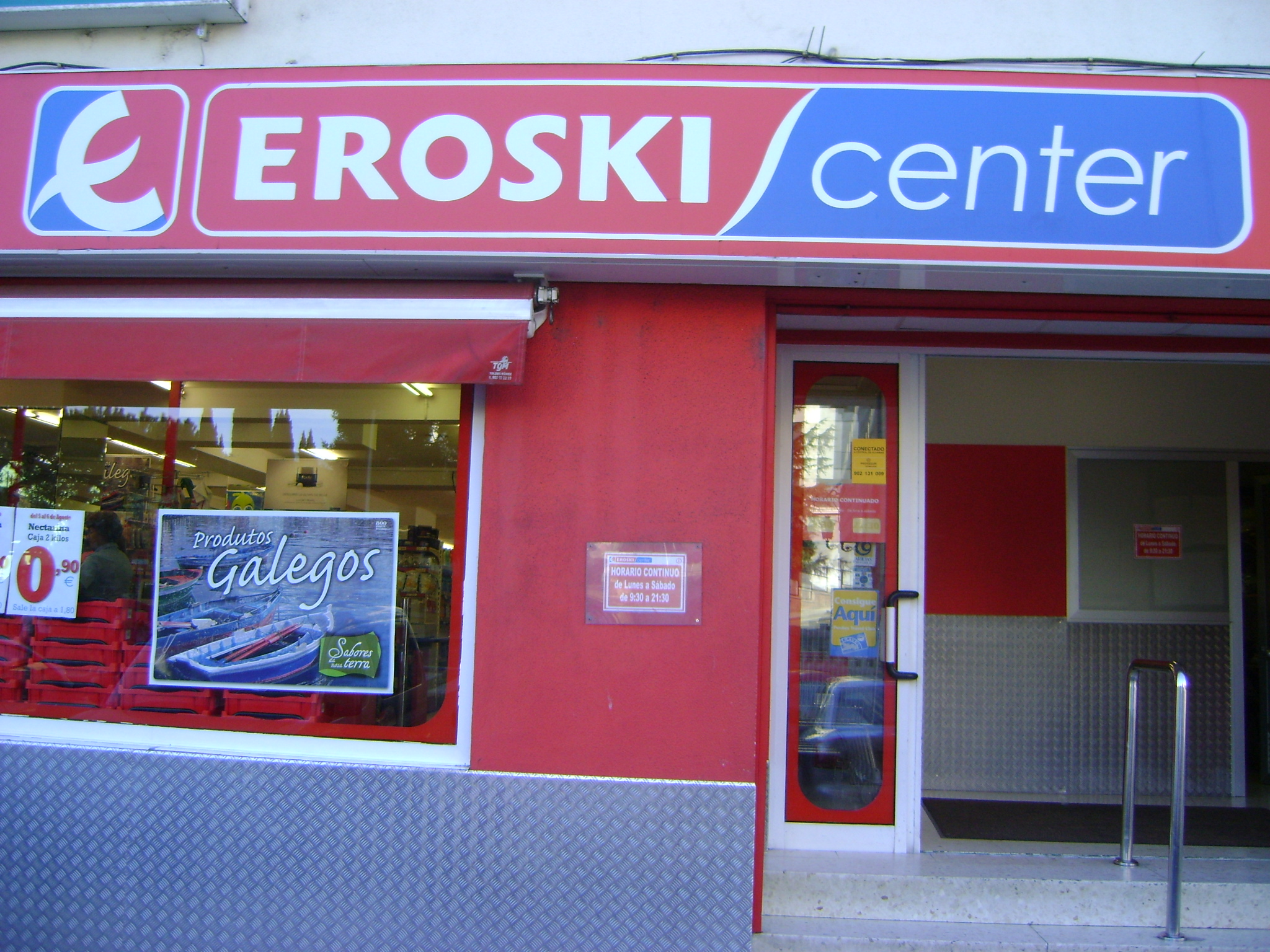
Eroski is a supermarket subsidiary of Mondragon - a Basque corporation
made up of hundreds of smaller, worker-owned co-operatives.
(Pic : Wikipedia)
It can work, and it can be serious business. It's been proven in the Basque Country. Mondragon Corporation – a federation of 200+ companies and co-operatives, employing some 84,000 people, had a €15billion turnover in 2010. It does everything from making consumer goods, banking, architecture, supermarkets and even has its own university.

That doesn't mean that this is some "utopian" solution to our own problems – Mondragon has enough problems of its own and is not free from criticism, usually from the left (see : Sharryn Kasmir's The Myth of Mondragon). Once a co-op reaches the size of Mondragon, does it "sell out"? Does it lose the sense of "ownership"?

Imagine if the Valleys had a Mondragon?

A banking arm based in Merthyr Tydfil, a manufacturing arm HQ'd at Ebbw Vale, an affiliated university, an energy company HQ'd at Hirwaun, a supermarket chain based in Caerphilly, a fashion chain in the Rhondda, an IT company in Cwmbran and a landmark headquarters north of the M4.

Now that would be something to see, wouldn't it.


Tuesday, 15 May 2012

Future of the Welsh media report

The Assembly's inquiry into the future has reported back -
with some interesting suggestions.
(Pic : Wikipedia)

It's a point raised time and time again – does Wales have the media necessary to hold our civic institutions to account?

With pressure being exerted on Welsh media outlets - for various reasons - it's vital that the perceivable decline is halted and turned around. No media. No accountability. No democracy.

The cross-party Task & Finish Group on the "future outlook for the media in Wales" reported back last week.

There were 23 recommendations, summarised as:
  • The establishment of an independent media forum, drawing on expertise from across the sector, to advise on all matters relating to the Welsh media. The devolution of broadcasting should be "kept under review". The forum should also consider alternative business models for the Welsh print media.
  • The Welsh Government should fully engage with the UK Government on matters such as the Communications Bill and non-devolved broadcasting issues - including introducing specific Welsh-language duties to Ofcom and laws relating to intellectual property rights.
  • The Welsh Government should make representations to the UK Government regarding the Channel 3 (ITV) licence, with the existing requirements to be kept as an absolute minimum for any company to be awarded the licence. The introduction of a Wales-specific Channel 3 licence should be considered.
  • The Assembly should keep the amount of political coverage provided by BBC Wales, and the funding arrangements for S4C, under review.
  • The Welsh Government should ensure, via the UK Government, that there is 97% digital radio coverage in Wales before any switchover, and they should continue to support community radio stations.
  • The Welsh Government should work with universities to foster innovation, define a purpose for the Creative Industries Sector panel and continue to implement the recommendations of the Hargreaves Review (about gaps in the creative industries sector).

Many of the responses to the group reveal interesting nuggets of information and ideas, including :
  • Issues surrounding the "fragmentation of audiences" with innovations like Smart TV
  • Broadcasting hasn't kept pace with the realities of devolution
  • The lack of accountability with regard the media in Wales
  • The negative impact of budget cuts at the BBC and changes to the running of S4C

Print Media

A lot of the publicity around this report surrounded the future of the print media. The National Union of Journalists (NUJ) were pessimistic, saying Welsh newspapers were "fighting for survival". There were a wide range of views from publishers, some suggesting reading habits have simply changed, while others trumpet weekly local newspapers as the future. Cymdeithas yr Iaith continue to call for a daily Welsh-language newspaper.

There were concerns expressed that newspapers have been far too optimistic when chasing online revenues, so consumers have now come to expect "free media".

Bloggers - sorry, "citizen journalists" - get a nod. We're "inadequate", and will never have the ability to "replace professional public interest journalism." I agree with that. Hobbies never trump something you get paid to do.

Golwg360 say that they aim to try and "combine professionalism with citizen journalism" and provide a "multi-media platform". That would be fantastic for the Welsh-language media, but we really need a counterpart (or several counterparts) in English.

The NUJ suggests that newspapers be considered "public assets" to which the Welsh Government can step in to rescue when threatened with closure. Bethan Jenkins AM (Plaid, South Wales West) suggested something similar on Wales Home, which prompted my last piece on this. Something I suggested then – a public subsidy for the press based on the Norwegian model – is given short shrift by the Minister for Housing, Regeneration and Heritage, Huw Lewis (Lab, Merthyr Tydfil & Rhymney), who says it would be a "difficult arena to become involved with." However, he doesn't rule it out, saying it could be "possible in the future."

Cuts, Broadcasting & Devolution

Could a Wales-specific "regional" ITV
licence be making a comeback?
(Pic: TV Ark)

On budget cuts, Huw expressed his concerns that the BBC's local services in Wales are under a "potentially disproportionate threat" in the broadcaster's "Delivering Quality First" initiative. More interestingly, he doesn't believe that the development of a media hub in Porth Teigr is "justification" for this reduction in investment.

There were particular concerns raised about S4C, Huw Lewis calling for a joint Welsh-UK independent review into the channel (not an entirely unwarranted suggestion), but remaining sceptical of "local TV", saying that it "detracts from what should be the centre of our concerns (national coverage)."


On accountability, many witnesses believed that it was important that public service broadcasters reported to the Assembly (it's suggested annually).

The recommendation of "keeping the devolution of broadcasting under review" is something of a cop-out. The NUJ expressed tacit support, Prof. Tom O'Malley (Media Studies, Aberystwyth University) called for the devolution of "a large part" to the Welsh Government, Prof. Ian Hargreaves (Digital Economy, Cardiff University) talked of a "federal opportunity" to reflect the "fact of devolved governments". Tinopolis' Ron Jones said that "meaningful and expressive scrutiny is best achieved at a local level". In his oral evidence, however, he said that devolution of broadcasting was, "not going to be politically deliverable" but that the current arrangements could be modified over several years in a way that "works for you (Assembly)".

Huw Lewis remained coy on the prospect of the devolution of broadcasting, giving a rather verbose deflection, tying the issue up in knots with typical Labour finesse without directly saying that he didn't want the powers (page 19 of the report) – Who? What? Where? Why? When? Johnny Ball reveals all.

A lot of what Huw Lewis said or suggested became recommendations in the report. For example, it was his suggestion that there needed to be 97% digital radio coverage before any switchover, and that the current minimum provisions in the Channel 3 licence should remain as a condition for licence renewal.

The suggestion of a Wales-specific ITV licence is interesting. It happens in Scotland and Northern Ireland (STV and UTV respectively), it's long overdue in Wales. Could the old HTV be making a comeback in the long term?

Creative Industries and the Economy

Could Porth Teigr in Cardiff compete with Media City UK?
(Pic : Porthteigr.org)
Wider economic issues are also addressed in the report, mainly referencing what the previous Welsh Government did regarding creative industries. Ieuan Wyn Jones (Plaid, Ynys Mon) established a Digital Wales Advisory Board, a Creative Industries Sector Panel (as part of the Economic Renewal Plan) and a Creative Industries Team to take this work forward. All this was largely in response to Prof. Ian Hargreaves report (linked above in the summary of the recommendations) which identified gaps in Welsh creative industries.

Many witnesses are described as being "concerned with the progress made by the Welsh Government". Cube Interactive said that the "pace of change has been slow by private sector standards." The lack of support for the Welsh film industry is also highlighted, with calls for an independent production fund. The current Business Minister, Edwina Hart (Lab, Gower) highlighted several of her own priorities for the creative industries in Wales, largely ensuring there was "bang for buck" from investment.

Edwina also said that the Welsh Government's high-speed broadband scheme was at the procurement stage, but that it should ensure 30Mb across Wales instead of "being sidetracked....into an immediate need for 100Mb."


The Institute of Welsh Affairs and Huw Lewis seemed excited by the possibility of a single "media hub" at Porth Teigr in Cardiff Bay, suggesting that it needs to be more than just "bricks and mortar" and needs to become a "critical mass" comparable to Media City UK in Manchester. There were reservations from Ron Jones, implying that media companies shouldn't be forced to base themselves in a single place because the government tells them to.


Conclusions

Co-operatives like Port Talbot Magnet prove
that alternative models of media ownership are viable.
(Pic : blogs.journalism.co.uk)
This is a pretty extensive, detailed and highly readable report. I recommend that if you want more expansion on my own summary, and other bits I haven't covered, then you should read it yourselves to make up your own mind.

Most of the recommendations are positive. The Assembly is now taking the issues and problems affecting the Welsh media much more seriously than any of us probably expected them to. There's broad agreement that "something needs to be done" and many of the witnesses - in particular Golwg360 and the Port Talbot Magnet - have shown that alternative models of media ownership are completely viable.

What I hope though, is that the Assembly and Welsh Government don't consider this report as "job done".


A lot of it comes down to money. Huw Lewis said himself that Wales is likely to be "disproportionately" affected by cuts to BBC local services. If anything, that should be a motivator for the devolution of broadcasting in the medium term. But as I said, the committee seemed reluctant to come out and say it, preferring instead to "keep it under review".

We also have to remember that "creative industries" and the "media" encompasses much more than TV, radio and newspapers. It includes films, gaming (which I've blogged about before), music/music production, advertising, general web design and classics such as magazines and literature. Those areas probably should have been included in more detail within the scope of the report.

The Welsh are a relatively creative people, but sadly we've always looked eastwards for vehicles of delivery, or to seek justification or approval. That doesn't mean that there needs to be a drawbridge mentality when it comes to the Welsh media. I think what we want most of all is to be noticed. It's a pretty damning indictment that nobody from the "British" print press - by which most Welsh people get their news - seems to have been called, or responded, to the committee.

Until the realities of devolution are acknowledged at the UK level, I don't think we'll ever get the kind of coverage we need to hold the Assembly, or other civic institutions, to account. Therefore, like many other things, we're probably going to have to do this one ourselves. That's better than waiting forever and a day for validation from the London Bubble, but it brings its own set of problems and issues that need addressing before we can think about devolving broadcasting or separate Channel 3 licences.

This report could - in the medium to long term - form the foundations for a Welsh broadcasting and media policy, but as always it comes down to will, incentives and innovation – both political and economic.

Saturday, 12 May 2012

Getting Wales on its bike

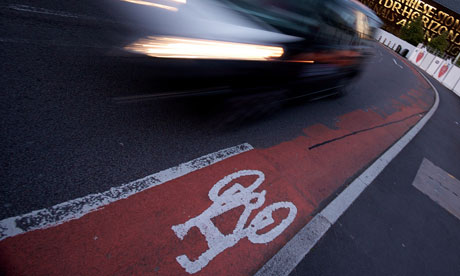
Although there's been successes in promoting leisure cycling,
what can be done to make cycling a mainstream form of transport in Wales?
(Pic : The Guardian)

Cycling is a cheap, efficient and enjoyable way to get around. Wales also has a fairly underplayed cycling heritage, producing World-class cyclists such as Nicole Cooke and Geraint Thomas. We also possess some truly fantastic mountain bike facilities, such as those in the Afan Valley, and more than enough opportunities for leisure cycling.

However, as a form of transport - not as a leisure activity - cycling isn't mainstream in Wales. Public transport is often the focus for attempts at "modal shift" from cars compared to cycling or walking. This has a wider impact on society beyond commuting.

There are several places in Wales - especially in the south - that are being closely monitored for air pollution. This BBC report from 2010 highlights fears that most of this is caused by car traffic. Air pollution is a major aggravator of respiratory illnesses. Could a wider shift to cycling improve all-round heath as well as reduce pollution?

It's a stereotype of sorts, but the Netherlands is often seen as the torch bearer for cycling society. In 2010, cycling accounted for 27% of all journeys, and the cycling rate was as as high as 59% within some urban areas like Groningen.

It wasn't always like this, as you'll see in this Youtube video that covers the history of cycling there. It took major social change and protest to see the kind of investment and infrastructure that sustained cycling's popularity in the Netherlands through the age of the car.

What could Wales do to get people out of cars and on to bikes?

Strategy

The Welsh Government is currently consulting on an Active Travel Bill, which would place a statutory duty on local authorities to maintain cycle and pedestrian paths. I'll cover that in more detail when the Bill is formally introduced. The Safe Routes to School initiative has seen significant investment in upgraded cycling and pedestrian facilities across Wales. In addition to this the Welsh Government has funded personal travel plans to promote new ways of getting around.


To date, much of the focus in Wales has been on developing interconnected long-distance cycle paths, usually but not always following disused railway lines. Some of these projects, like those in the Garw and Ogwr Valleys, have been community-led initiatives. Sustrans also have plans for developing something similar in the Ely Valley. These long-distance routes are fine, but I'm not sure if it's the right priority.

Cardiff was picked as a "Sustainable Travel City" by the previous Welsh Government. They have developed their own cycling strategy called "Enfys" (English : "Rainbow"). Being a relatively flat city, you would think that cycling would be a popular mode of transport – but it isn't really. Although the Enfys report states that car ownership levels are lower than the Welsh average, just 5.8% of people commuted by cycle in 2008. That's still way higher than the Welsh average (1.8%) which is the joint lowest level in the UK. Only around 1.7% of school pupils in Cardiff cycle to school.

It's hoped the development of "core routes" in Cardiff, in collaboration with Sustrans, will link schools, "major trip attractors" and residential parts of the city together. One of the things that stood out in the Cardiff plan, is how difficult many respondents to the survey felt cycling to the city centre was.

I imagine this is a similar situation in every major urban area in Wales and it's a big problem.

Persuasion

Cycling is arguably one of the most efficient form of transport for short journeys – for instance shopping, school or college, in many cases commuting too. In 2010, 71% of the working population of Wales worked in their home local authority, with the average commute being around 22 minutes – amongst the shortest commuting times in the UK. Travelling by cycle needs to be at least as quick and as hassle-free as this to really take off.

There are several things that stand in the way:

Climate – It rains a lot. People don't like to get wet. It's bad enough if you're on foot, but it's even worse if you're in the road getting splashed (or expecting to get splashed) by buses and cars. Having said that, the Netherlands isn't exactly a dry place either. Is this too lazy a suggestion?

Topography – You would think that the valley floors would be ideal for cycling, and indeed that's where most of the cycle paths are. However the streets are usually clinging to the side of the valleys and in some cases just too hard to ride a push bike up.

Street & Urban Design – The Active Travel Bill will likely address this, and there are several documents and strategies out there on street design. Unfortunately many of our older towns have archaic street layouts, with poor visibility for cyclists, pedestrians and motorised traffic.

Convenience –  Sitting in the comfort of a seat, pushing a few pedals, encased in a tonne of metal is far easier than pumping your legs trying to get up a hill. We also don't see many "utility cycles" capable of carrying baggage or groceries as we might on the European mainland.

The Times launched a campaign for safer cycling after
 journalist Mary Bowers was left in a coma following an accident.
In Wales, cycling road casualties remain erratic.
(Pic : The Times)


Safety
- Statistics for Quarter 3 2011 show that, while the overall number of police recorded road casualties in Wales continues to fall year on year - in fact Wales has some of the safest roads in Europe – the numbers for cyclist casualties are erratic, showing a mixture of falls and rises. Up to Quarter 3 2011, there were just over 400 cycling casualties, and the overall casualty numbers for 2011 are on course to be higher than 2010.


What are the practical steps, learning from Netherlands and elsewhere, that can be taken to make cycling more attractive?


Here are some of my own ideas.

Safety
  • Helmets should be mandatory for anyone cycling on a road without cycle facilities, with fines for those not wearing them. Segregated cycle lanes and cycle-friendly streets wouldn't be included.
  • Cycle paths should have minimum standards for lighting - perhaps with the use of solar studs.
  • Cycle paths should ideally be overlooked by property, and underpasses should be avoided where possible.
  • Where cycle paths cross a junction, the cycle path should be raised to the level of the pavement, with cyclists and pedestrians given right of way. There should be as clear a line of sight as possible for drivers.
  • Any road shared with cyclists on the same surface should have a 20mph limit. Exceptions could include major thoroughfares (i.e. Newport Road in Cardiff) until segregated facilities are constructed.
Cyclists taken seriously as road traffic
  • Cycle paths maintained to a minimum national standard, perhaps with a sliding scale "grading system". For example - a fully paved, Dutch-style segregated track would be grade A while a mud track through overgrown vegetation would be grade E.
  • Legal (and insurance) protection for the "weaker" party (pedestrians and cyclists) in the event of an accident. This is used in the Netherlands.
  • Mandatory cycling proficiency tests in primary schools (based on the Dutch "Verkeersexaman") as an essential part of road safety teaching.
  • A hypothecated tax on cycles and cycling equipment (safety equipment exempted) to pay for new and improved cycle infrastructure. Other taxes/levies could include parking spaces, congestion charges and residential parking permits.

Incentives
  • Cycling over these short distances should be quicker, or as quick, as travelling by car. That means cycling routes should be planned and developed to be as direct as possible.
  • Cycle loan schemes, cycle "scrappage schemes", or cycle vouchers for schools, to contribute towards cycling equipment. Perhaps this could be part-paid for through environmental taxes.
  • Moving the boundary for free school bus travel from 2 miles to 3 miles - or even further where there are "good" cycling facilities available. Those living between 1 mile and the outer boundary would be eligible for the cycle vouchers mentioned above.
  • Local and national government contributing significantly towards the cost of cycle parking facilities, and other facilities such as showers, at workplaces, schools, colleges and universities if they successfully increase use of public transport or cycling amongst students or workforce.

All this needs, above all else:

Infrastructure

I don't think Wales will ever be in the same position as the Netherlands, Denmark or other parts of Europe with regard cycling infrastructure, but there's no reason to stop the shift to public and "active" transport. There's no reason why - within major urban areas - we couldn't push for a 15-20% cycling rate within 30 years. That would require education, persuasion and massive investment in cycling and cycle-friendly infrastructure.

Using a part of the world I know well – Bridgend – here's an example of how I could see an urban network of cycle/pedestrian panning out. Not everything on this map needs to be done, but it does underline the potential.

A possible walking/cycling network for Bridgend
(Click to enlarge)
As you can see, I've linked the completed cycle routes together (ideally without interruption). I've also linked major trip attractors to one another : schools, the hospital, transport interchanges, industrial estates and suburban residential areas.

Bridgend town centre streets could become "shared surface", with a low speed limit. That could reverse some of the difficulties disabled people and the elderly have experienced being "dropped off" in the town centre, and formally allow cyclists to use the pedestrianised streets (if they didn't already), with cycling parking dotted around the town centre.

Ideally, a clearly signposted, largely segregated network, with reduced speed limits, like this would encourage parents in the suburban parts of the town to let their children walk or cycle to school without any real concern.

I've separated cycling infrastructure into two broad categories:

Cycle lanes on the road surface could be
considered "cycle friendly" infrastructure if well maintained.
(Pic : Wikipedia)

1. Cycle-friendly streets
  • "Shared surface" street layouts
  • Cycle lanes marked onto existing road surfaces
  • Authorised use of bus lanes by cyclists
  • Speed humps
  • 20mph (or less) speed limits
  • Advanced stop lines at traffic lights


The Netherlands is famous for its planned,
segregated cycling facilities.
(Pic : aviewfromthecyclepath.com)


2. Segregated cycling facilities
  • Dedicated cycle paths, or cycle/pedestrian shared paths
  • Dedicated cyclist signage and road signals (where appropriate)
  • Priority for cyclists at junctions and roundabouts
  • Segregated crossing facilities – underpasses, bridges or toucan & puffin crossings
  • Consensual crossings with cyclist/pedestrian rights of way (i.e zebra crossings)
  • Secure and monitored (formally & informally) bicycle parking facilities
  • Easy storage of cycles on public transport

Wales and the UK seem to opt more for "cycle friendly" infrastructure, but where there's the option for pre-planning for cyclists – for example 1960s and 1970s new towns or modern housing estates - segregated cycling facilities are becoming a more common feature. This is probably why nations like the Netherlands have such a good cycling infrastructure, as the "new town" was a key driver of post-war economic growth there.

What does independence have to do with any of this?

You might wonder - why I'm including this post in the Independence Index? That's a perfectly legitimate question.


There are several state functions that could be modified or reformed to give cycling a boost:
  • Road markings & signs
  • Traffic & vehicle regulations
  • Vehicle taxes/DVLA functions
  • The Highway Code
  • Rights of way (including definitions)
Creating new forms of cycle/pedestrian crossing, new signs
and signalsand new driving regulations would (most likely)
require independence.
(Pic : Fietsberaad.nl)

Something as simple as creating a new form of "consensual crossing" would be a major step forward. Like it or not, we're locked into a "British" road system where many matters are highly regulated from the centre. Powers could come from federalism or devo-max, but independence would be the ultimate way for a significant divergance from the "British" road system - and one modelled on a benchmark like the Netherlands - would be possible.

Cycling needs a culture shift – not just new laws - although that helps. Britain is a car-centric country and our addiction to four wheels is a much a statement of an Anglo-American "rugged individualism" as much as it is the most popular (and often best) way to get around.

A brand new nation could be the kind of shock needed to create a new ethos, not just on how we travel but a whole host of other things too. It's all part of the independence vision.

Thursday, 10 May 2012

School Standards & Organisation Bill

The new Bill is the latest move by the Welsh Government
to improve school standards inside & outside of the classroom.

A few weeks ago, Education Minister Leighton Andrews (Lab, Rhondda) laid this, the first of two Education Bills this Assembly term, in front of the Assembly. Consultation on the proposed Bill ended in January this year, attracting hundreds of responses, which you can see here.

It's quite a dull, lumbering piece of legislation, but it's the first "meaty" Bill laid before the Assembly since the 2011 referendum. I've already covered two previous bills – the Local Byelaws Bill and the Social Services Bill (which is yet to be drafted and laid). I've also mentioned the smaller National Assembly of Wales (Official Languages) Bill in passing.

Rationale

The goal of the bill is to "bring together, update and tighten standards and management" of Welsh schools. It will also localise decision making on school organisation and streamline several current processes – such as Governing Body meetings. There are also several other smaller, but somewhat significant, provisions such as the ability for schools and local authorities to have more flexibility over school meal prices.

The Bill has 4 key parts, which I'll now explore in some more detail.

1. School Interventions


  • There will be 8 grounds for intervention in "failing schools" covering : unacceptably low standards, failures in school management and governance and the placement of a school in "special measures" by school inspectors.
  • Local authorities and Welsh Ministers will be given the power to issue warning notices, or guidance, and intervene if a school has "failed to comply" for whatever reason.
  • Local authorities and Welsh Ministers can require failing schools to : collaborate with another school, appoint new (or interim) governors or advisers and suspend delegated budgets.
  • Welsh Ministers will be able to do similarly for "federated" schools as well as order the closure of a school if they are under "special measures".
  • Welsh Ministers will be able to intervene in local authorities if they : fail to comply with education functions, act unreasonably with regard education functions or fail to perform to an acceptable standard. Local authorities, as well as governing bodies, will be obliged to cooperate.
  • Welsh Ministers may issue school improvement guidance to "school authorities", but they have to lay a copy of any draft guidance before the Assembly. School authorities will be obliged to follow this advice.

2. School Organisation

  • Welsh Ministers must issue (and may revise) a School Organisation Code, and lay a draft before the Assembly.
  • Local authorities will be able to establish new community schools, special schools or maintained nursery schools. Any person may establish a voluntary school. No new foundation schools may be established in Wales, except foundation special schools.
  • Local authorities will be able to alter mainstream schools, including nursery's, with the consent of Welsh Ministers. They, and governing bodies, will also be able to propose discontinuing maintained schools.
  • Governing bodies will be able to change the category of a school (community school, voluntary aided, voluntary controlled school). However schools cannot change to voluntary aided status without satisfying funding criteria.
  • There will be no requirement to consult on the closure of small schools – the definition of which can be amended by Welsh Ministers.
  • Any change to the category of a school (with the above exception) must be put out for consultation – to which anybody may object within 28 days. Category 1 objectors being local authorities, religious bodies and local authorities in England adjacent to the area where a proposed change will take place. Category 2 objectors being governing bodies, school councils, AM's and MP's and FE colleges. Category 3 objectors being local councillors, school staff, pupils, parents and community councils.
  • Proponents of changes must implement them as they were agreed, but can delay changes for up to three years from the date of any approval. Proposals to discontinue a school can be brought forward by up to 13 weeks.
  • Welsh Ministers can order local authorities to use their powers to establish, alter or discontinue schools based on "excessive or insufficient provision" (school places). Again a 28 day objection period applies. Local inquiries may be held if there are any objections. Welsh Ministers will be able to approve, or make further proposals, depending on the outcomes of any inquiry.
  • Welsh Ministers can direct local authorities to consider if "regional provision" (collaboration) in special education is suitable. Again a 28 day objection period applies.
  • Welsh Ministers will have the power to restructure sixth form education. Once more there's an objection period of 28 days.
  • Welsh local authorities will be barred from proposing to establish schools in England.

3. Welsh Education Strategic Plans


  • Local authorities must prepare a "Welsh Education Strategic Plan" which will plan for Welsh medium provision, improve standards of WM provision, set local authority targets for WM provision and a report on progress made to attain those targets.
  • Welsh Ministers will approve these strategic plans, and suggest modifications. They may also make local authorities assess demand for WM education.
  • Welsh Ministers will be able to set the regulations relating to these strategic plans.

4. Miscellaneous School Functions


  • Local authorities must provide free breakfasts to primary school pupils on request of governing bodies.
  • Amendments are made to the Education Act 1996, which will give local authorities more flexibility in charging for school meals.
  • Local authorities must ensure "reasonable provision of independent counselling services" in secondary schools.
  • Governing bodies must hold parent meetings if there is a petition from : 10% of parents of pupils registered at the school, the parents of 10 primary school pupils or the parents of 30 secondary school pupils. However these meetings have to occur well within a school term, and no more than three of these types of meetings can be held in a single school year.
  • The duty to hold an annual parents meeting in the Education Act 2002 has been repealed.
  • The "code of practice" for relations between education authorities and schools in the School Standards and Framework Act 1998 has been repealed.

Conclusion


With this Bill, the responsibility to improve school standards is going to fall quite squarely on the shoulders of local authorities. Cardiff Bay is taking a slightly more hands-off approach, though it's disingenuous to suggest that Leighton Andrews - or any future Education Minister - won't be able to keep a close eye, or leash, on proceedings.

The grounds for intervention – by the Welsh Government or local authorities – will be crystal clear.

There are hints of a possible heavy-handedness : the closure of "small schools" without consultation (that could have a big impact in rural parts of Wales), reorganisation of sixth forms and forcing collaborative working.

It's unclear what impact the proposals for "flexible arrangements" for school meal prices will have either. I suspect Jamie Oliver will be popping across the Severn Bridge at some point in the future.

If this Bill is passed, it's not going to be a magic bullet that's going to set Welsh education back on the right tracks, but it does tidy up existing legislation, firing "a shot across the bows" to coasting or struggling schools, warning them that they need to consistently aim for better achievement.

This isn't the most significant piece of legislation ever written, but its aims are broadly welcome.

Monday, 7 May 2012

We need honesty on the Welsh NHS


There are two stories in the last week on the Welsh NHS that are ringing alarm bells for me.

Firstly, the cabinet paper on a possible public relations campaign with regard the centralisation of Welsh hospital services. Secondly, the conflicting reports between Betsan Powys (and others) and the Welsh Government on Local Health Board (LHB) financial results.

I've blogged before on Labour's plans for NHS reforms. I have to reiterate - I support the creation of "centres of excellence". It makes perfect sense. The primary aim of any reform of the health service should be to improve patient outcomes. The research carried out suggests that it could. All well and good.

It's obvious no district or general hospitals are going to close, and suggesting such is likely a ruse to make these reorganisations sound palatable. What's up in the air is which hospital services are going to be moved around or centralised and where.

These are the sorts of "reorganisation" decisions Hywel Dda LHB in particular (covering Ceredigion, Carmarthenshire and Pembrokeshire) have the unenviable task of sorting out. The Welsh Government will need to defend it on their behalf.

Here's the problem:

You have three hospitals providing the same services. Two hospital lose a service – for arguments sake, minor injuries units. How would you describe what has happened to those two hospitals?

Have they been "downgraded", or has one hospital become a "centre of excellence"?

One is the half-empty description. The other is the half-full description. Ultimately they mean the same thing. Suggesting anything different is an outright lie. It's disappointing to see that the First Minister has got the ball rolling in FMQ's last week:
Leanne Wood (Plaid, South Wales Central) :....Will you tell us, ahead of Thursday's local elections, whether your Government plans to downgrade hospitals or centralise core services?

Carwyn Jones (Lab, Bridgend)....From our point of view, we want to ensure that health services are safe and sustainable. No hospital is under threat. No hospital was ever under threat in Wales....

So some LHB's are actively preparing to reorganise hospital services - in essence taking away from some, keeping them at others - yet "no hospital is under threat"? Yeah, OK.

Some hospitals will be affected by these changes – that's inevitable. Arguing about whether they are "under threat" or becoming a "centre of excellence" is pedantic. At least be upfront and be honest about it. Explain to the public why it's the best option on the table. It should be easy to do so. The Welsh Government shouldn't have to use PR and euphemisms.

The Welsh NHS has become a political football since devolution. It's no longer a public service, but an ideology in itself. It's all Nye Bevan & miners co-ops, black and white images of church-like Victorian institutions with prim blue-uniform nurses and doctors in white coats – all wedded to a greater sense of Welsh collectivism. We're supposed to like the NHS the way it is because Labour in particular have made it such an inherent part of "Welshness" and "something to be proud of" - "our" greatest ever achievement.

Its conservation and protection has been drummed into so many skulls that any reforms – wherever and whenever they happen - are going to be bitterly opposed. These reforms are minor compared to what's happening in England, yet the protests are already starting.

Labour have simply left these reforms far too late, interrupted by the dropping of hospital centralisation as part of the One Wales coalition. Beds have been made, it's time to lie in them.

The second issue is more immediately worrying. Health Minister Lesley Griffiths (Lab, Wrexham) (has quite correctly) instructed LHB's to meet strict financial targets. She's on record in telling the LHB's, via the Assembly's Heath Committee, that they can no longer "expect handouts" due to strained finances.

The wider question remains though – what was the £290million saved in 2010-11 "without harming services" actually spent on in the first place?

Last Wednesday, the Welsh Government hailed the "remarkable achievement" of the Welsh NHS breaking even.

There's one small problem – it was bullshit.

Lesley Griffiths had to dip into next year's funding to the tune of £12.4 million to ensure that three LHB's met the targets she laid down. Like the issue of reorganisation, the news has been sugar-coated along the lines of "drawing down money from contingency funds."

Fair enough. If the LHB's need a bail out - do it. Just remember how silly you're going to look after telling them "not to expect any more handouts". We plebs hate it when politicians don't admit their mistakes. Don't let your pride get in the way of admitting you're wrong, or that a target or deadline has been missed.

The likelihood is that next year, the Welsh NHS will meet their targets - £12.4 million is a drop in the ocean compared to the £6billion+ Health and Social Services budget. The gap has closed dramatically and Lesley Griffiths deserves credit for that. However, these sweet little lies can quickly become big juicy sour ones down the line.

"The cuts"
are inevitably going to be the fall-back position for every single unpopular decision Labour makes – at local and national level - between now and whenever they get back into power in Westminster. It's good cover for centralisation plans, which have been on the cards since at least 2006, resurfacing during the tail end of the Third Assembly, and now on the cusp of finally be put into action.

Like it or not, Labour have both hands on the wheel for this. They can't blame Westminster.

Get this wrong – it'll be a catastrophic bungle if it does go wrong – and it should come back and bite the Welsh Government very hard, very fast, on the backside.

Because Wales loves the NHS, we do.