This site is no longer updated

Please use the links in the sidebar to visit the new sites!

Showing posts with label EU Parl. Show all posts

Wednesday, 3 August 2016

Done up like a kipper?

He might have backed Brexit, but where will Nathan Gill Remain?
(Pic : BBC Wales)

Update 17/08/2016 : Nathan Gill has made his choice - he's keeping both jobs. Bizarrely, he's leaving the UKIP Assembly group to sit as an Independent, but will remain a UKIP member, UKIP MEP for Wales and leader of UKIP's Welsh branch. You couldn't make it up. Do-do-dodododo-do-do-do-do.

Another Update 18/08/2016 : Just when you thought the hole couldn't be dug any deeper, Channel 4 News reveal this little problem....I may have to return to that once more details come out.


It's taken them just over three months, but – as widely anticipated – the signs are that the UKIP Assembly group is beginning to dismantle itself.

Monday, 1 June 2015

The In-Out EU Referendum Bill

Forty years since the last time the question was put to the public,
the UK is to be asked whether to remain a member of the EU.
(Pic : The Telegraph)
Last Thursday, the UK Government introduced a Bill setting out the arrangements for the forthcoming  referendum on the UK's membership of the European Union.

Sunday, 20 July 2014

End of Year Report 2014

As the legislative year comes to a close, it's time to take yet another
look at the performance of the Welsh Government and opposition.
(Pic : cityofcardiff.com)

Carwyn Jones (Lab, Bridgend)
First Minister & Minister for the Welsh Language

C+ overall; D Welsh language (C for effort)

Until the torrid last fortnight, the First Minister had rarely been seriously challenged in the Senedd - except on specific issues in Bridgend which could have been embarrassing, as well as stalled work on the Williams Commission. You can argue there should've been a full cabinet reshuffle this month as the splitting of Alun Davies' old portfolio is clunky - though it's been said a full reshuffle before 2016 is likely.

I believe the heart's there when it comes to the Welsh language. It's just Y Gynhadledd Fawr didn't tell us anything we didn't already know. Despite all that's been said there's been very little evidence of action, leading to the (rather ineffectual) protests from Cymdeithas yr Iaith. Welsh language campaigners have always been an awkward squad, but Carwyn's lucky it's not the 1960s anymore. I'm sure his recent Twitter "spat" underlines to him how much of an uphill battle he's got here.

You can argue that May's results were disappointing for Labour, who seemed confident they would take two seats without putting any work in. UKIP's surge caught them off guard and it's also reflected in recent polling which suggests Labour could lose seats in 2016.
They neglect the fact that a lot of people aren't happy with what they're doing in Wales and, yes, they're just as likely to lose votes to UKIP too.The opposition are were being held at bay, the economy is showing signs of recovery, the Welsh NHS is still the Welsh NHS we all know and are concerned about, while his calls for a UK constitutional convention continue to fall on deaf ears - presumably dependent on September's outcome. Steady as he goes.

Huw Lewis (Lab, Merthyr Tydfil & Rhymney)
Minister for Education

C+

There've been three big problems Huw Lewis has had to deal with with year, two of which he inherited. The first being the poor PISA results, which resulted in the extensive OECD investigation. The second was a significant increase in the amount spent to fund Welsh tuition fee policies. Somehow, Huw managed to kick a review of higher education funding into touch and we won't see the results of the Diamond Review until September 2016.

His response to January's GCSE marking row showed a willingness to act quickly under pressure and to accept criticism gracefully. His decision to create a separate law on special education needs also showed he was prepared to listen to committees and AMs. He has a lot on his plate, obviously, but I'd argue that he's coping with it relatively well. Education's still a results game, though.

Edwina Hart (Lab, Gower)
Minister for the Economy, Science & Transport

B

It's hard for Edwina Hart to take all the credit, but she's certainly playing a role in the fleeting semblance of an economic recovery taking place in Wales, with unemployment now below the UK average. The main developments in her portfolio this year have been the early groundwork laid for the South Wales Metro scheme – which is about 10 years overdue – and the creation of city regions. Another major coup was managing to get Pinewood Studios to set up a base in Wales.

She's a worker, not a shirker, but it remains to be seen if other flagship policies like her version of enterprise zones are going to bear fruit. Also – even speaking as a rather private person myself, and especially after Wednesday's announcement – I believe she needs to do more to keep the rest of the Assembly informed of what she's up to outside the chamber. She's a poor communicator, but good at her job.

Jane Hutt (Lab, Vale of Glamorgan)
Minister for Finance

C+

Quite a bit of work's been done to increase procurement from Welsh-based companies. Though it's disappointing that, in an election year, more hasn't been done/said regarding the future of EU funds in Wales, which even senior Labour figures are beginning to feel haven't been used wisely. I don't think Jane has been forceful enough on the "lockstep provisions" in the Wales Bill either, which has now simply become something to bash the opposition with.

These remain straightened times for the Welsh budget, and Jane Hutt is continuing to do a reasonable enough job without pulling any rabbits out of hats. She did, however, dish out a tough deal to Welsh local government and further education colleges in the 2014-15 budget which seemed harsh in some respects.

Mark Drakeford (Lab, Cardiff West)
Minister for Health & Social Services

D (C for effort)

Another year where the Welsh NHS stumbles from problem to problem.

It's clear Mark's made an impact, but not to such an extent that the issues plaguing health services have been turned around. We're still waiting for progress in ambulance response times, mortality rates and the future of certain specialist services. Considering his background, I would've expected him to have understood the need for evidence-based laws too, which is a shame.

He's so far resisted Welsh Conservative calls for a "Keogh-style inquiry". I'd agree that a full blown public inquiry is unnecessary because action is more important than another bloody panel or committee - but we're one big tragedy or scandal away from it.

Even if Mark remains the best-suited person for the job, his response (or lack of) to concerns from families affected by problems in Abertawe Bro Morgannwg health board, and campaigners from Pembrokeshire, verged on a high-handed arrogance which is – unfortunately – becoming typical behaviour from Welsh ministers.

Lesley Griffiths (Lab, Wrexham)
Minister for Local Government & Leader of the House

C+

In terms of local government, this year's been dominated by the budget cuts and the Williams Commission, both of which Lesley seemed to play second fiddle to the First Minister and Jane Hutt in terms of being the public face. Ultimately, it'll be her responsibility to implement those recommendations and manage angry council chiefs – which will be a challenge in itself.

I welcome the ongoing commitments made to increase transparency in local government - things like webcasts and social media use in council chambers. There was also a major report into improving the diversity of local government, though it remains to be seen if anything will actually happen as a result. The Welsh Government's reasonable track record in dealing with community safety continues with the pledge for 500 extra PCSOs met and sustained, albeit being an underwhelming pledge in itself.

Carl Sargeant (Lab, Alyn & Deeside)
Minister for Housing & Regeneration

B-

Carl's dished out quite a bit of regeneration funding, including (the slightly controversial) Vibrant and Viable Places. The Welsh Government clearly want results this time round and don't want to hand out grants and funds for the sake of it.

He's also overseen the passage of the comprehensive Housing Act. It's not everyone's cup of tea, but he's shown a clear commitment to reducing homelessness and an unyielding commitment to addressing domestic abuse – the new Bill being very much his baby, I suppose.

His management of the planning system is likely to become a thorn in his side, as controversy continues over Local Development Plans and opencast mining. The forthcoming Planning Bill looks set to centralise decision-making in light of planning still being – in many respects – only part-devolved. It's right to question whether Welsh priorities are relevant here or are being thrown aside as part of EnglandandWales?

Jeff Cuthbert (Lab, Caerphilly)
Minister for Communities & Tackling Poverty

C

A minister struggling to find a purpose, though that's not entirely his fault. He's done some good work on credit unions, which seem to become bigger year by year. However, cuts to Funky Dragon risk undermining the National Assembly's engagement with youth at large.

The Well-being of Future Generations Bill – which really should've been up there as one of the most important pieces of legislation in the Assembly's history – turned out to be a woolly disappointment. I was also surprised at his negative attitude to the "FinEdBill" which would, in part, complement his brief and what he's trying to do.

Presumably, policing will eventually fall under this portfolio (if it's devolved on time) and that will increase the visibility and importance of this cabinet position. Until then, although he means well he can't really do much and a lot of his ministerial functions seem to cross over with local government. It's a confused portfolio that needs a firmer sense of purpose more in chime with devolved powers as all the big levers are reserved to Westminster.

John Griffiths (Lab, Newport East)
Minister for Culture

C

This portfolio has certainly been the Welsh Government's blind spot due to the challenging environment caused by harsh cuts to local authority budgets and wider austerity – where the arts, sport and culture are almost always the first up on the chopping board; a situation that's continued unabated.

He's clearly getting out and about and seems to be balancing many plates with skill. John also seems keen to listen to the rest of the Assembly. But you get the impression he's under pressure to try and deliver things he knows he won't be able to deliver, so he sits on the fence too often. He was perhaps always more comfortable with the environment brief and that's probably why it was given back to him.

Alun Davies (Lab, Blaenau Gwent)
(Former) Minister for Food & Natural Resources

F

A mixed record - that displayed both his strengths and weaknesses - has been tarnished by a few moments of rank stupidity.

Theodore Huckle QC
Counsel General

B

He's been a busy guy it's fair to say, and now has two Supreme Court "victories" under his belt with the third case on the way. AMs are starting to make better use of their opportunity to question him in plenary, though Simon Thomas AM (Plaid, Mid & West Wales) remains the most likely person to put him on the spot.

After the big UK reshuffle, he's outlasted his Whitehall "adversary" Dominic Grieve QC, though that could be because the Prime Minister was getting fed up with losing court cases to the Welsh Government. It remains to be seen whether new Attorney General, Jeremy Wright, will be more forceful in future encounters. Until we have a reserved powers model, further call-ins of Welsh laws are inevitable.

Junior Ministers

Gwenda Thomas (Lab, Neath)
Deputy Minister for Children & Social Services

B-

The Social Services and Wellbeing Act 2014 is the most challenging and complex law since devolution, and the proposed bill on Social Service Regulation promised to be another one. It's led to the creation of a new National Adoption Service and guarantees minimum rights for carers – Wales' unsung heroes. Gwenda's also overseen the transfer of care for the elderly from hospital to the community – but this hasn't been done urgently enough, leading to negative story lines and serious failures in hospital care. Another solid, but very testing year.

Vaughan Gething (Lab, Cardiff S. & Penarth)
Deputy Minister for Tackling Poverty

C+

He suffers from the same problem as his reporting minister Jeff Cuthbert. It's a small department with a small budget but an important remit. It's hard to tell what Vaughan actually does, but it appears to boil down to the micromanagement of schemes like Flying Start – though he appears to be making very good progress there.

He's shown inside and outside the Senedd chamber that he's a very capable and confident public speaker – something of a rarity in Welsh politics - but he needs a bit more time in the ministerial incubator. He'll almost certainly be bumped up to a more senior cabinet position prior to 2016 in order to properly challenge him, as you get the impression he isn't being so at the moment.

Ken Skates (Lab, Clwyd South)
Deputy Minister for Skills

B+


A quiet success story, overseeing a significant increase in the number of apprenticeships and successful job applicants through Jobs Growth Wales, playing a big part in reducing overall unemployment levels – albeit with youth unemployment still remaining relatively high.There was recent criticism that Jobs Growth Wales isn't reaching those most in need of a job or training – but all in all he's performing well, added to by the recent announcement of a new 10 year plan to address skills shortages in the private sector.

It's good to focus on vocational skills and apprenticeships but the Welsh Government should start thinking about graduates and postgraduates. Cuts to Young Enterprise could be a backwards step and he seems too fond on using Assemblese. He definitely looks the more likely of the "newbies" to make the step up to a full ministerial post at the moment.

Opposition Leaders

Andrew Davies (Con, South Wales Central)

C+

I'm sure many people will disagree, but compared to previous years this has been a good one for the Leader of the Opposition. He had a very strong end to the Assembly year, and came into his own during the recent debate on safe standing.

I don't question for a moment his sincerity on the NHS. It's just after seeing what's happening in England, it's not as if the Conservatives can be trusted to run the NHS properly either. The failings are almost identical just with different numbers involved. The Welsh Tory housing proposals seemed, in some respects, odd and based off poor maths. While a campaign against junk mail seemed whimsical. He's also perhaps way too easy to wind up compared to the more calm disposition of the First Minister.

Back in February it looked like he was a goner after the sudden sacking of four shadow cabinet members (subsequently reinstated) over the "lockstep" row. He was criticised for both the sackings and the manner by which he did it, but as I said at the time he was left with no other choice.

He's been half-vindicated by recent developments with regard Scotland (they won't have a "lockstep"), further added to by David Jones' exit from UK cabinet. If that had rumbled on another year I would've been surprised to see him lead the Welsh Tories into the 2016 elections, but his position is arguably stronger than ever now.

Leanne Wood (Plaid, South Wales Central)

B- personally; C party

July 2013 : "My gut instinct tells me the coming year will be tough, but manageable".

I was probably right. Plaid had made little progress in the polls until recently but, to be fair, they haven't gone backwards either. They also managed to get another set of budget concessions though (alongside the Lib Dems), a convincing by-election win on Anglesey and are producing a steady stream of good policy ideas and proposed laws. Leanne also made the right decision to streamline her "cabinet".

You don't last in frontline politics for 40 years unless you've got something between your ears, so Dafydd Elis-Thomas AM (Plaid, Dwyfor Meirionnydd) was correct, just his usual self. The attack on UKIP at the party's spring conference was miscalculated, and in hindsight there's irony in that UKIP's strong performance saved Jill Evans' seat – to a great deal of relief, I'd imagine.

Plaid are now part of the same "establishment elite" anti-politics voters turning to UKIP are railing against, exemplified to a certain extent by the classic groupthink in relation to Michael Haggett. They can't keep counting on their increasingly demographically-squeezed heartland vote to sweep them home either, while they're always outnumbered in the south and north east.

Next year looks promising in terms of target seats, but if Plaid want to seriously challenge in 2016, they need to stop looking in the mirror - basking in their inflated self-esteem as a party - and see May's result as a much needed kick up the arse before the electorate kicks it for them. Pride comes before a fall and all that.

Kirsty Williams (Lib Dem, Brecon & Radnor)

B personally; D party

Kirsty Williams has consistently proven to be a capable stateswoman, arguably being the most effective opposition leader in terms of picking apart the Welsh Government. She also won a ballot and will introduce a law on minimum nursing levels in hospitals – and I'll come back to that when the Bill's introduced.

Unfortunately, her party's prospects aren't looking good due to the metastasis of the very deadly cleggoma and secondary infection of dannyalexanderitis. I suppose the most galling aspect of that is that Lib Dem AMs haven't really put a foot wrong and have usually been pretty good at holding ministers to account.

You can't really read much from the European elections as the Lib Dems have always performed poorly, but it's not looking good for them in 2015 or 2016. It would be a shame if Kirsty is left a party of one – losing very capable AMs in the process - as the Welsh electorate sends the clowns in to Cardiff Bay.

Special Mention : The latest Standards Commissioner report (pdf) showed that there were no admissible complaints about AMs in the year April 2013- March 2014. I don't know if they deserve a gold sticker or a trip to Folly Farm or something....


Saturday, 27 April 2013

The rise of Europe's far-right

Has a shift on the fringes of politics to far-right and populist conservative parties
in Europe been a recent phenomenon? Or is it more complicated than that?
(Pic : The Guardian)

Back in January, Human Rights Watch warned that far-right politics in Europe were becoming more mainstream. No specific causes were outlined, however this has – in my opinion – inevitably come about as a result of the European economic crisis, as well as more localised problems which haven't been properly dealt with since the end of the Cold War.

Goose steps over Europe


It's worth pointing out that shifts to far-right, or populist hard right politics in Europe aren't recent. Since the threat of Islamic fundamentalism was brought to the fore post-9/11 attacks, countries in Europe with small, unintergrated minorities have seen a noticeable shift to the right, perhaps in a panicked attempt to "protect themselves" through limiting things like immigration.

The first major shift in modern times was probably the Austrian Freedom Party (Freiheitliche Partei Ă–sterreichs [FP
Ö]) under the leadership Jörg Haider, who was killed in a car accident in 2008. The Freedom Party won 27% of the vote in the Austrian federal elections in 1999, winning 52 seats, and eventually formed a governing coalition with the conservative Austrian People's Party.

Did the success of  the FPO in 1999 "legitimise"
the far-right in European politics?
(Pic : Der Standard)

Although the FPÖ at the time were more populist that outright fascist, Jörg Haider had expressed sympathy for select Nazi policies, was accused of anti-semitism as well as having links with Holocaust deniers. The election of the FPÖ shocked Europe so much, that 14 nations introduced temporary diplomatic sanctions against Austria via the European Union. Eventually, the EU was forced into a rather humilating climb-down, but the precedent has been set, and it more than likely played a role in Haider stepping down from his role as party leader.

Despite an ongoing "professionalisation" of far-right parties like the French Front National and the BNP, this was probably the first time the far-right had been "legitimised" in Europe since the 1920s and 30s. This will, in my opinion, have had a knock on impact on other nations too.

Between 1998 and 2001, the populist anti-immigration Danish People's Party (Dansk Folkeparti) made a major breakthrough in the Folketing, winning 22 seats – a rise of 9. That's roughly the level of support they've remained at since, peaking at 25 seats following the Jyllands-Posten Mohammed cartoon controversy. They played ”kingmaker” in 2001, offering their support to enable a right-wing coalition government to be formed, in exchange for changes to Denmark's immigration rules – now amongst the strictest in Europe.

The right-wing Flemish nationalist Vlaams Blok (now Vlaams Belang) were effectively disbanded. They breached Belgian anti-racism laws, once proposing a form of segregation in parts of public life and expulsion of non-European immigrants. They peaked at 32 seats – near enough a quarter of all seats - in the Flemish Parliament in 2004.

The populist anti-immigration PVV played "kingmaker" following
the 2010 Dutch general election. A trend seen in other European countries.
(Pic : BBC)

Further north, in the Netherlands, the Party for Freedom (Partij voor de Vrijheid [PVV]) managed to win 24 seats in the lower house Dutch general election of 2010. Under the leadership of the charismatic Geert Wilders – something of a hard line spiritual successor to the assassinated right-libertarian Pim Fortuyn - they adopted a strong stance on Europe, Islam and immigration. Like the Danish People's Party, they were instrumental in government formation through something akin to a confidence and supply agreement.

The hilariously-named Liberal Democratic Party of Russia – whose policies, which are neither really democratic or liberal, hint that they would try to hunt down and eat our Lib Dems – somehow have 56 seats in the Duma. They want the Russian Empire back, and they wouldn't be afraid to use nuclear weapons to get it back either.

In the present, however, two of the more significant far-right movements are perhaps the most worrying.


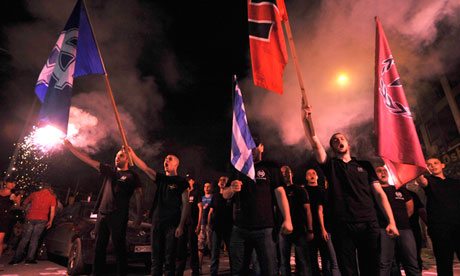
Golden Dawn - the first Nazis freely-elected in Europe since the 30s?
(Pic : The Guardian)

Between 2006 and 2010, Jobbik of Hungary came from nowhere to win 47 seats in the Hungarian Parliament. They once had a ”uniformed group” that probably fell short of an outward paramilitary organisation, though they were disbanded by the Hungarian courts. Although they strongly deny any racism against minority groups – including the Roma - in 2012, a Jobbik MP called for the creation of a ”list of dangerous Jews” who ”pose a threat to Hungarian national security.”

In Greece, since the torturous collapse of the country's economy, Golden Dawn won 18 seats in the Greek Parliament. They have links to hooliganism, and have been implicated in violent attacks against political opponents and ethnic minorities. Their election slogan in 2012 was, "Rid this land of filth." They're probably the closest Europe has come to freely-elected Nazi's since 1933.

It isn't all rosy

Despite all this, far-right parties and populist right-wing parties very rarely get into "power". They generally, at best, end up as small players in coalitions. Or – as in the Netherlands and Denmark – remain outside of government entirely, only popping up to get a few concessions to prevent centre-right governments collapsing. So, I think there is a natural "glass ceiling" when it comes to the far-right or populist conservatives.


Many of the parties I've mentioned have fallen back in recent elections. The PVV lost 9 seats in the last Dutch elections in 2012 for example. They were also responsible for that early election by withdrawing support for the ruling coalition, after a disagreement over austerity measures. Geert Wilders was blamed by the coalition partners and, ultimately it seems, the Dutch public for it.

Despite grabbing headlines, the overall performance of far-right
parties in many European nations states is poor.
(Pic : The Guardian)


Germany's National Democratic Party (Nationaldemokratische Partei Deutschlands [NPD]) have never performed well at all levels of government in Germany - perhaps understandably - with only a dozen or so elected representatives in state legislatures. In France, despite high-profile, highly-visible successes in Presidential and European elections, the Front National perform poorly at local, regional and national level, with only two Deputies. In Austria, the Freedom Party have never really attained the heights they did under Haider.

That's before mentioning the abject electoral performances of far-right parties closer to home.

I don't think there's anything more damning for liberal politicians than for the public to turn around and choose a far-right candidate over them. Barring legitimate concerns over some policy areas, it's the ultimate protest vote, boiling down to, "I'd rather vote for a Nazi(ish politician) than you." But I don't think many people voting for them really want a far-right (or in many cases far-left) politician to represent them, more give the "usual lot" a very big kick up the backside.

The far-right in Wales and the UK

Have the EDL been and gone?
(Pic : The Telegraph)
Naturally, I've got to position Wales in this somehow. Because we have a right-wing government in Westminster, the far-right in the UK, Wales included, is perhaps neutered. We've already seen a tightening of immigration rules - with negative effects on the Welsh NHS - and a level of right-euroscepticism from Tory backbenchers in Westminster.

Something both far-left and far-right parties and organisations share is a lack of ideological unity, or splits in support by people seeking an "ever purer" version of their politics.


Internal problems within the BNP have led to them suffering said splits in support. Some joined or forming new parties, with the National Front seeing a teeny-weeny resurgence, and the English Defence League probably stealing the BNP's thunder as the most vocal "far-right" organisation on the island of Great Britain. Even the EDL have probably come and gone, as attendances at their rallies - which once mobilised thousands - have been reduced to a hardcore.

The performance of far-right parties in Wales has been historically atrocious – though not quite as bad as Scotland – and I don't see that changing any time soon. There was a poorly-attended "White Pride" march in Swansea a few weeks ago, which is absolutely hilarious in context. Swansea is 94% white and that's one of the lowest percentages.

However, in terms of the "populist hard right", things might be changing and it would threaten the Welsh Conservatives more than any of the other parties.


With UKIP presenting a - you could almost say "secular" - non-racist way to express disapproval over policy areas like Europe and immigration, as well as a strident British Nationalism, I don't think the future of the far-right in Wales or the UK is rosy at all. Beyond Nigel Farage, UKIP don't really have much, though that could change. However, Nigel Farage could well be the BNP's executioner if he can convince enough people concerned over policy areas like immigration that he presents a creditable and socially-acceptable voice for them. That's probably the reason why there may be ex-BNP in UKIP.

The BNP's executioner? Do UKIP offer a "softer", "secular"
more socially-acceptable voice for those concerned about
immigration and Europe?
(Pic : BBC)
Those ex-BNP were probably sold a lemon "we're not racist" schtick when selected as paper candidates by the BNP, and some people's opinions will change over time. Some don't, and they'll probably embarrass UKIP. Opposing high levels of immigration or the EU - even if I don't agree with that - doesn't mean you're a racist as long as you present a reasonable argument. I do believe parties like UKIP have failed to do that, and they're far too reactionary.

But in my opinion, all that would be is a shift to a "populist hard right" similar to Denmark and the Netherlands. That would be much more preferable than a move to neo-fascist organisations seen in parts of eastern and southern Europe.

Again though, I don't think there's any chance of UKIP being in position to run anything larger than a rural English district council. Their aim will likely be to drag the Conservatives to the right, and the rest of us out of the EU.

The EU : A last defence against fascism?


This is the first major economic downturn parts of Europe
will have faced since the end of the Cold War....and they're struggling.
(Pic : Wall street Journal)
Many self-styled rebels in western Europe might wear Che Guevara t-shirts as a reaction to a free-market orthodoxy.
Many younger people in eastern Europe of voting age, will not have grown up under the iron jackboot of Soviet Communism, which was nothing more than fascism with a heart. They'll have probably been told stories of how brutal and repressive it was, and how its collapse left their newly-emerging nation states in a weak position.

Those in eastern, and perhaps southern Europe, look to relics of long-dead glorious empires and the social order that used to "exist" under ultra-nationalist dictatorships. Remember that the Axis in WWII consisted of more than Germany, Italy and Japan; it included plenty of puppet regimes in eastern Europe and the Balkans too.

This resurgence of the European far-right is not only the fault of the global financial sector, but the   mainstream, technocratic Christian and social democrats who dominate European politics.

In the west and south, they've failed to get a grip on issues like the high cost of living, they helped to prop up and create housing bubbles and in some circumstances they've mortgaged the future of their younger generations to pay off the mistakes of the present.

In the east, while the cost of living remains low compared to the west, they're just getting through the first major economic downturn since the fall of Communism. In some countries like Latvia, it's caused property bubbles to burst, while elsewhere they're experiencing double digit unemployment rates and high levels of poverty, used to exploit inter-ethnic tensions.

Meanwhile, EU institutions have become cumbersome and wasteful – perhaps in some circumstances causing more problems than they're supposed to solve.

The trouble is that as soon as mainstream politicians and parties are seen to be failing to address issues like those, at a time when things are tough and people are scared, charismatic individuals come to the fore offering simple soundbite solutions to complex issues. Sometimes they only offer a closed fist and a jackboot. When you've exhausted all avenues with "traditional" parties, what else have you got to turn to?

There's one firewall though. All those nations, by and large, still want to be "part of the club" when it comes to the EU, even if levels of scepticism and uncertainty about the EU itself are on the rise. If they shift towards fascism rather than a populist, UKIP-style "tough on crime and immigration" stance, it would generate enough disgust within the EU to trigger sanctions – be they economic or social – and that would play a role in bringing them back into line.

This is going to sound ridiculous, but for all its faults, we should start to position the EU in terms of it being the last line of defence for European liberal democracy.

Thursday, 10 January 2013

Asbestos Disease Bill

You can imagine breathing this in will cause a lot of damage.
Mick Antoniw's Bill will enable the Welsh NHS to claim compensation
for treating asbestos-related diseases.
(Pic : ecfia.eu)
Just before the Christmas recess, Mick Antoniw AM (Lab, Pontypridd) laid the second Member's Bill before the Assembly – the Recovery of Medical Costs for Asbestos Diseases Bill. For brevity I'm calling it the Asbestos Disease Bill.

Asbestos – Why is it such a problem?

Asbestos is a building material manufactured from minerals, which was once heavily-used in construction for insulation and its fire-resistance properties. Some types of asbestos release fibres when disturbed – deliberately or accidentally – but all asbestos causes some sort of health problem in humans.

Asbestos fibres, under a microscope, look like nettles (as you can see above). When breathed in, they cause mechanical or genetic damage to the respiratory system, and lead to diseases such as:
  • Lung cancer
  • Mesothelioma - A cancer of the protective linings (mesothelium) of the chest cavity and abdomen.
  • Asbestosis – Fibrosis ("scarring") of the lungs caused by asbestos fibres.
  • Pleural diseases – The pleura is a folded membrane which help the lungs slide across the ribs when breathing.

The time it takes for the symptoms to appear varies, but it's estimated that there are up to 4,500 deaths from asbestos-related diseases in the UK every year. Cases of asbestos-related diseases are expected to peak in 2016 and then start to fall.

Asbestos has been banned across the European Union, and in the UK since 1985 – though some types continued to be used until around 2000.Obviously, some people will have been exposed to asbestos on a routine basis if they worked in construction or manufacturing while asbestos was used.

Asbestos was commonly used in public buildings
during the 60s and 70s.
(Pic : BBC Wales)

As it was widely used in the construction of public buildings during the 60s and 70s, every now and again you'll have a situation like that at Cwmcarn High School last year. The whole school was shut when unacceptably high levels of asbestos fibres were found. Plaid Cymru recently estimated it would cost "hundreds of millions of pounds" to remove all asbestos from all Welsh schools.

Sometimes - with a cruel irony - asbestos is found in hospitals themselves, like Bronglais Hospital in Aberystwyth. Fortunately, it can be removed safely.

What does the Bill aim to do?

The overall aim of the Bill, is to enable the Welsh Government to recover costs for treating asbestos-related illnesses on the Welsh NHS from a person/company paying compensation for asbestos exposure.

There are numerous Acts of Parliament and regulations that determine who is liable for exposing employees to asbestos, and it's estimated that treating asbestos-related disease costs the Welsh NHS between £2-3million per year.

The Bill is described as an extension of the Social Care (Community Health & Standards) Act 2003, treating asbestos-related disease – in shorthand – as a "personal injury".


It's not proposing a new compensation scheme like miners diseases in recent years. It doesn't impact an individual's right to compensation either, or place any sort of levy on it. It would just ensure the Welsh NHS get compensation for treating diseases.

Any costs would be paid to the Welsh Government directly, and become part of the annual health & social services budget. I believe it's intended to use that money to help people suffering from asbestos diseases and their families.

A "tariff" system would be established – similar to that for road accidents - to determine the costs for treating asbestos disease patients. A scenario in the Explanatory Memorandum is given of 11 patients, and it's estimated the total cost of treating them is around £256,000, with an average cost - per patient - of £23,300.

The total cost of administering the system by Local Health Boards would be around £40-50,000 per year.

Practically all organisations dealing with asbestos disease, and relevant trade unions, supported the principles of Bill.

There was only one organisation that didn't – The Association of British Insurers.

Saturday, 8 December 2012

What Wales gets from the European Union

It's bloated. It's bureaucratic. Its budget is yet to be (formally) decided.
What does Wales actually get from EU membership?
(Pic : capreform.eu)
I don't think issues surrounding the European Union are, really, at the forefront of most people's minds. It does look as though an agreement on the EU budget for 2013 is imminent after an EU Commission climbdown, but the agreement for the budget between member states for 2014-2020 remains at an impass. These matters impact Wales whether we like it or not.

The EU budget

A few weeks ago, Conservative backbenchers and Labour MPs voted against a rise in the EU's budget, and passed an amendment calling for a real-terms cut. You can argue this is a reasonable stand – if national governments have to make sacrifices, shouldn't Brussels?

The relationship between Wales and the EU is slightly different than many other parts of the UK. Although the EU failed to agree a budget at their last summit, any cuts or freeze will be noticeable here. A failure to agree to a budget would put long-term projects at risk.

Plaid Cymru MEP, Jill Evans, spelt out some benefits of Wales within the EU, working out that every Welsh person is getting back £40 more than is put in. That roughly works out at Wales being £120million better off as a whole.

That doesn't sound like much, but I think the benefits are much wider. It's also fair to say that some of this money may well have been (perceivably) mismanaged. I said this a few months ago:
"EU-funds appear to be used for things like public realm improvements, or incredibly niche schemes, spreading funds far too thinly. In the period 2007-2013, £1.5billion has been spent on the public sector (mainly universities), £99million on the third sector (including ~£6.1million to the likes of AWEMA), and just £23million in the private sector."

It's also worth pointing out that the EU's own strict guidelines, regulations and rules mean that an awful lot of effort needs to go into getting the funds in the first place. That doesn't mean that some of the people bidding for these funds are always suitable. Note Jac o' the North's account on that.

It's also right to point out that seeing grants as the be all and end all solution in Wales, or a natural "Welsh way of doing things", is perhaps creating an incredibly damaging, short-term, dependant mindset.

A Jocelyn Davies AM (Plaid, South Wales East) motion passed the Senedd – including support from Welsh Labour AMs – that pressed the Welsh Government to "make representations" to the UK Government, opposing the budget cut.

Are (UK) Labour equally concerned about the "threat" posed
by UKIP as the Tories seemingly are?
(Pic : The Times)

Now, I don't know why Westminster Labour have decided to lurch towards euroscepticism-lite. Maybe they're just hardening their stance to appear "tougher on Europe" than they were in government to stave of a UKIP threat amongst the working class.

I don't have any truck with UKIP's views, but in terms of public debate, they've opened a window – even if it only lets in muck spreading wafts. They're eccentric - with a Colonel Blimp jingoism and a twee view of the UK's place in the world – but deserve to, and will, be taken seriously in 2014 and 2015. However, I think it's too soon to be building them up as an electoral force. Due to FPTP, the chances of them gaining MPs will be slim.

Welsh Labour are, seemingly, more pro-Europe that the Westminster party. They might be disciplined on the surface, but there's a history of differences causing "tensions". The first chinks in Tony Blair's armour came from Wales in the shape of Rhodri Morgan.

If Carwyn Jones were taken seriously as a head of government by his own party, instead of being seen as a loyal provincial governor, I'd put £10 on him verses Ed within two rounds.

It's also heartening that Welsh politicians can debate these matters of importance in a reasoned and mature manner, while British politicians try to out-clown each other in the Westminster lobby on News 24 trying to prove who wants to cut the most.

How does Wales benefit from EU membership?


Broader benefits

Jobs – The First Minister acknowledges that at least 150,000 jobs were based wholly or entirely on EU membership, and 50,000 were employed directly by companies from other EU member states. You could also suggest EU membership imperils Welsh jobs – especially if operations move to more attractive places in eastern Europe. It's also fair to say these jobs wouldn't disappear overnight if the UK left.

Free trade & membership of the world's largest economy – As I highlighted back in September, Wales is less reliant on the EU for our exports than the UK as a whole. But having free and open access to a market of half a billion people in one of the wealthiest parts of the planet (in spite of what's going on) is a no-brainer.

Carwyn Jones recently said that 50,000 people in
Wales were employed by companies based elsewhere in the EU -
including ~500 at (German-owned) Siemens Diagnostics in Llanberis.
(Pic : Daily Post)

Free movement
– Although the UK isn't part of the Schengen agreement, being able to move visa-free between large economies like England, Germany and France - as well as faster-growing economies like Poland - should be considered a huge benefit. It's a shame we tend to focus on those coming in instead of thinking about going out – in business terms especially. It also has spin offs like guaranteeing free health care in EU nations.

Peace & political stability – The timing of the EU being awarded the Nobel Peace Prize was...."amusing". The EU has developed a strength in its diversity - when it was once a weakness. Instead of Europe's great powers using smaller nations as chess pieces in their quest to dominate the continent (or further afield), disagreements are now thrashed out around negotiating tables in Brussels and Strasbourg. There's also a strong commitment to liberal democracy in all member states – though that's starting to slip in places like Hungary. It's just a shame the European institutions are so cumbersome, but maybe they need to be.

Harmonised pan-European regulations – Whenever we hear about EU laws, they are usually BS about straight bananas and weights and measures. What about mobile phone roaming? Environmental regulations? Standards on chemical safety and water quality? Car and air safety standards? Veterinary and agricultural standards? Cross-border crime fighting? It's also important to point out that the much-maligned European Court of Human Rights isn't part of the European Union.

Specifically important benefits for Wales

Agricultural Programmes – Includes the European Fisheries Fund, European Agricultural Rural Development Fund (worth about £195million to Wales between 2007-2013) and Common Agricultural Policy (CAP). The CAP alone is said to be worth £350million to Welsh farmers every year.

The Common Agricultural Policy is due for reform, but
without it, would Wales have much of a farming industry left?
(Pic : BBC Wales)

You can argue that farms shouldn't need subsidy, and should be encouraged to become more commercially viable – that's supposed to be amongst these funds main aims. These funds are in desperate need of reform – especially since EU enlargement - and make up a sizable chunk (€270billion) of the EU's total budget. I think attempts at reform have probably been blocked by the French and Spanish, who benefit disproportionately from the current arrangements. The UK does too, it has to be said.

Convergence Funds – Commonly referred to under the umbrella of "Objective One", or the more grand European Regional Development Fund (ERDF). These funds are worth up to £1billion over a 6 year period. It looks like West Wales & The Valleys might qualify again in 2013. That's not really good news, as convergence funds have to be match-funded by the Welsh Government and are a sign of a weak economy.

These funds have had a big impact on the university sector in particular. Jill Evans mentioned using EU funding to electrify the north Wales mainline recently, and that's the sort of project you would expect this money to be spent on. However, as noted earlier, I believe many of the projects over the last few decades have been well-meant, but haven't delivered anywhere near the outcomes – especially in terms of economic development and infrastructure – that West Wales & The Valleys desperately need.

"Objective One" is probably the most visible
sign of the EU in Wales. But is the money
being invested wisely?
(Pic : Ceredigion Council)

European Social Fund – Another branch of "Objective One". This is worth around £690million over six years. These funds are used on the "social schemes". For example : reducing economic inactivity, "social justice", up-skilling. But it also makes its way to the third sector, who haven't covered themselves in glory of late. The rules are incredibly specific and so full of hoops, that I doubt much money makes it to the front lines.

Specific Investment Funds – This includes the JESSICA framework (funds aimed at developing urban areas). It could be considered a branch of the main convergence funding. The Welsh Government have set up and Urban Development Fund and the Regeneration Investment Fund under this EU framework. It's supposed to be used on regeneration projects. In fact, a chunk of RIFW's cash is going to be spent on Neath town centre over the next few years. Again, the outcomes and management should be questioned. The JEREMIE initiative also helps/helped the Welsh Government's finance arm (Finance Wales) support small and medium businesses. It was/is worth £150million.

Erasmus– A pan-European exchange programme. Although it's said only 630 students (and 112 staff) from Wales have participated in the programme last year, compared to the all-UK figure (~12,000 participants) that's roughly what you would expect – perhaps slightly more than our population share. Cardiff University also hosted one of the largest overseas Erasmus contingents in the UK. Even brief periods living and studying in another EU state would obvious help cross-cultural understanding and – hopefully – international relations should they grow up to become business or political leaders.

What we also get, and what we'll get in the future

London Mayor, Boris Johnson, recently mooted a "pared down" relationship
with the EU - citing Switzerland and Norway. That might suit London, but
would it suit Wales, or the UK as a whole?
(Pic : BBC)

Bone-crushing levels of bureaucracy. No (Welsh) voice at the top tables. The pointless spectacle of moving between Strasbourg and Brussels. The ongoing "will they, won't they" fiscal union debacle. Nigel Farage. Uninspiring leaders at European level. And a voice for lunatics on the far-left and far-right in the European Parliament.

And it's fair to point out that there's significantly more subvention/subsidy from the UK that there is from the EU. We might be £40 better off in Europe, but thanks to leaky submarines, West Ham's new stadium and RBS – and other, more important things like social security – we're estimated to be about £4000 "better off" in the UK. Even if most of that is borrowed via the Treasury's credit card.

So although I clearly believe there are benefits to Welsh membership of the EU – via the UK at the moment – there's a need for reform.

The Lisbon Treaty went a long way towards doing that. It merged several institutions and created, in effect, a European constitution. But I think things are coming to a head due to the eurozone's fiscal problems.

My hunch is that the worst of the Euro fiscal crisis is behind us, but there's nothing ahead but a decade of stagnation. I think a new treaty is inevitable – probably creating a full fiscal union between eurozone members – and, ultimately, a "two-speed Europe".

Guess who'll be trundling along in the outside lane, indicating to take the next exit - with Wales in tow. Would that be in Wales' interests? It's a big question, and one that's perhaps too difficult to answer at the moment.

But, at the end of the day - whether you're Welsh, Slovene, German or French - we're all Europeans aren't we? If you even consider the British Isles a part of Europe. It appears the Leader of the Opposition in the Assembly doesn't.

Stronger together....