This site is no longer updated

Please use the links in the sidebar to visit the new sites!

Thursday, 31 January 2013

Senedd Watch - January 2013

  • Plaid Cymru MP Jonathan Edwards accused the Welsh Government of “shedding crocodile tears” after Severn Bridge car tolls rose to £6.20 on January 1st. A Freedom of Information request showed the Welsh Government lobbied in favour of a change to the toll formula which caused the rise.
  • In a related development, transport expert Prof. Stuart Cole argued that high Severn Bridge tolls were “no deterrent to tourism or inward investment” and argued in favour of using bridge tolls as a revenue raiser for transport schemes.
  • A “smart card” system for public transport fares across Wales has been delayed for five years, however they will come into use on buses in 2014, with a trial beginning in north Wales this month. The Welsh Government said renegotiation of the all-Wales rail franchise in 2018 is the reason for the delay.
  • University applications from Welsh students fell by 11.7% compared to 2012 according to UCAS statistics - the sharpest drop of the Home Nations. Only Northern Ireland saw a rise. Wales also lagged behind on the award of top degrees (firsts and 2.1s), but outperformed the rest of the UK in terms of graduates employed after six months, which stood at 91%.
  • Swansea City's promotion to the English Premier League is worth £58million to the local economy, and created/safeguarded around 400 jobs according to a Cardiff University report. Business Minister Edwina Hart (Lab, Gower) welcomed the report's findings, saying Swansea City's promotion “provided....rich opportunities to promote....economic development and tourism.”
  • Edwina Hart launched a network of “one stop shops” for micro and small business advice, which will operate from 11 sites. She said the “Business Wales service will compliment....support available through our Business Information Helpline and Business Wales website.”
  • Shadow Education Minister, Angela Burns (Con, Carms W & S. Pembs.), criticised some Welsh universities for offering places with low grade requirements at A-Level and GCSE. She said it,“sends out a message that (Welsh universities) have bargain-basement entry requirements and don't appreciate the value of academic rigour.”
  • Network Rail unveiled their strategic plan until 2019, setting provisional dates of 2018 for south Wales mainline electrification and 2020-2024 for Valley Lines electrification. Around £1billion has been committed towards both projects.
  • Plaid Cymru leader, Leanne Wood, called for the devolution of probation services following the UK Government's announcement that probation services for low-risk offenders could be outsourced to the private sector in EnglandandWales.
  • The Welsh Conservatives criticised the Welsh Government's decision to seek to purchase Cardiff Airport. Byron Davies AM (Con, South Wales West) said it was a “financial liability we don't need in this day and age.” Edwina Hart said negotiations were confidential and she “wouldn't provide a running commentary” on them. On January 30th, the First Minister told the Assembly's Business and Enterprise Committee that a deal was “close”.
  • A petition was handed in to the Assembly, with more than 22,000 signatures, calling for business rate relief for charity shops to be maintained. The Welsh Government said they were “sensitive to many viewpoints.”
  • Education Minister Leighton Andrews (Lab, Rhondda) launched a Masters in Educational Practice (MEP) module, which is intended to “drive up standards in schools” by supporting newly-qualified teachers via ongoing professional development.
  • The chair of the National Clinical Forum explained his modifications to a Betsi Cadwaladr Local Health Board report, which originally called hospital reorganisations in north Wales “unsustainable”. He admitted that his chances appeared to be “totally bizarre”, but believed the board responsible “didn't understand the proposals”.
  • The Welsh Conservatives criticised the Welsh Government for cutting funds for promoting Wales abroad for tourism. Suzy Davies AM (Con, South Wales West) said Labour had made “a massive own goal in failing to market Wales to our closest neighbours.” The Welsh Government said they were focusing on UK tourists, who account for 80% of tourist expenditure.
  • There were calls for “strong political leadership” over NHS reforms from Community Health Councils (CHCs). Disagreements on reforms between Local Health Boards and CHCs can be referred to Health Minister Lesley Griffiths (Lab, Wrexham), who has been criticised for her attitude to CHCs in the past.
  • A campaign was launched to cut down on waste of prescription medicines, which is claimed costs the Welsh NHS £21.6million over the last year.
  • Leighton Andrews was warned by Welsh exam board, the WJEC, that he could be damaging the exams system through his reforms. Qualifications Wales was created in 2012 as a new body for exam regulation and awards. The Welsh Government said the WJEC were “in denial.” The Welsh Government also confirmed that GCSE's and A-Levels would be maintained in Wales, despite reforms in England that would see them replaced.
  • The Assembly passed the School Standards and Organisation Bill on January 15th. Amendments mean that local authorities would decide school closures and mergers, instead of proposed determination panels.
  • Minister for Housing, Heritage and Regeneration, Huw Lewis (Lab, Merthyr Tydfil & Rhymney) described UK Government welfare reforms as a “social atrocity”. He was accused by a Liberal Democrat MP of the “lowest form of politics”. Plaid MP Jonathan Edwards supported the statement in principle, but said all but 10 Labour MPs abstained during the second reading of the Welfare Reform Bill which instituted the changes.
  • The Welsh Government launched a review of bank lending to small and medium sized enterprises, including the difficulties SMEs may face and alternative models of finance. The review will be led by Prof. Dylan Jones-Evans.
  • In related development, Plaid Cymru called for the creation of a state-backed “Bank of Wales”, which would provide funding to SMEs, based on German regional Landesbanken model. The Welsh Conservatives also proposed a similar scheme, but one that would allow SMEs to borrow public money via existing high street banks and post offices.
  • An education expert criticised Welsh Government progress on truancy rates as “painfully slow”. Prof. Ken Reid told the Assembly's Children & Young People Committee that promises made as a result of a 2008 report remained unfulfilled. The Welsh Government pointed to improvements in attendance rates in the last year.
  • The Welsh Government found £22million necessary to prevent 230,000 households in Wales paying council tax for the first time following changes to council tax benefits. Communities and Local Government Minister, Carl Sargeant (Lab, Alyn & Deeside), said the Welsh Government was “protecting the most vulnerable in our communities.” Opposition leaders welcomed the move, but described the handling as a “u-turn” and “shambolic”. Fresh council tax benefit regulations were approved on 22nd January following provisional regulations passed at the end of 2012.
  • Health Minister Lesley Griffiths announced the Welsh Government is to invest up to £82million in providing training to healthcare professionals. She said “high quality healthcare education is critical to support the delivery of health services in Wales.” The funding will help health authorities determine staff levels to maintain services beyond 2016.
  • Leader of the Opposition, Andrew Davies (Con, South Wales Central) proposed a motion for debate - signed by cross-party AMs - calling for the Welsh Government to lobby in favour of the introduction of “safe standing areas” in Premier League and Football League grounds.
  • Diabetes UK Cymru warned the disease could “overwhelm” the Welsh NHS, following a 9.4% increase in the numbers being treated in the last two years. The Welsh Government said diabetes treatment rates in Wales were comparable with “the best in Europe” and that a new diabetes delivery plan was in development.
  • Chair of the Assembly's Public Accounts Committee, Darren Millar AM (Con, Clwyd West), called for the Wales Audit Office to investigate a £2million heritage centre in Gwynedd following a BBC Wales investigation which showed the centre, and its land, was transferred to private landowners following its failure.
  • The Assembly unanimously passed the Food Hygiene Ratings Bill on January 22nd. Once granted royal assent, the Food Hygiene Ratings Act will make the display of food hygiene ratings compulsory. Regulations relating to the new law will be debated later this year.
  • Suicides in Wales rose by 30% in the last two years according to the Office of National Statistics, with the suicide rate amongst middle aged men the highest since 1981. The Samaritans said that the difference may be due to changes in how deaths are recorded.
  • Unemployment in Wales fell by 1,000 in the three months to November 2012. There was a 37,000 fall across the UK as a whole.
  • Prime Minister David Cameron promised an “in out” referendum on the UK's membership of the European Union should the Conservatives win the 2015 UK General Election. First Minister Carwyn Jones said it would create “years of instability”, while Plaid Cymru MEP Jill Evans pointed to the benefits of Wales within the EU.
  • First Minister Carwyn Jones gave a speech to Irish business leaders in Dublin, stressing the importance of Welsh-Irish trade – worth up to £1.5billion per year. He also wants to encourage more Irish businesses to invest in Wales “under the banner of the EU single market.”
  • Lesley Griffiths told the Assembly's Health Committee that the Human Transplantation Bill, which will create and “opt-out” organ donation system in Wales, will not include limb or face transplants.
  • Cardiff Airport saw a 16% drop in passenger numbers (-200,000) between 2011 and 2012 according to the Civil Aviation Authority, but with a small rally in December 2012. The Football Association of Wales also claimed the current state of Cardiff Airport was hindering a potential bid to host Euro 2020 games.
  • School inspectorate Estyn's annual report called for more help for more-able pupils. It also said fewer schools achieved “good” or “excellent” ratings compared with the previous year. The NUT also threatened industrial action over proposed literacy and numeracy assessments proposed by the Welsh Government.
  • The Welsh Government introduced the Social Services and Wellbeing Bill, which take carer's needs into consideration alongside those being cared for, create a national adoption service, grant social workers a power of entry with a court order and new eligibility criteria for social services.
  • UK Government plans to reduce the number of MPs in Wales from 40 to 30 were defeated in Westminster on January 29th. The plans will be postponed until at least 2018.
  • The Welsh Ambulance Service missed its response targets, with only 56.1% of life-threatening emergencies responded to within 8 minutes in December 2012, compared to a Welsh Government target of 65%. Welsh Liberal Democrat Leader, Kirsty Williams, said that the Ambulance Trust had to “work with increasingly strained resources.”
  • Research suggests onshore wind energy could create up to 2,000 jobs and generate up to £2.3billion for the Welsh economy if a 2,000 megawatt target is met by 2025. Campaigners point to differences is renewables energy policy between Scotland and Wales – where the Scottish Government have been more proactive.
  • Five Welsh local authorities were in the top 10 areas where the lowest proportion of people felt their health was “good” in EnglandandWales according to the latest census data. Health had only improved in three local authorities – Cardiff, Wrexham and Swansea.

Projects announced in January include : the shortlisting of north Wales for a “super prison”, £1.5million towards nine regeneration projects in the “Western Valleys” across 2012-13 and 2013-14, a £39million investment in faster broadband connections for schools, £5million towards flood protection to protect up to 1,000 homes, a new £25million bus funding scheme that will replace three existing service grants and £1.25million towards “improving public engagement” in local government.

Tuesday, 29 January 2013

Census 2011 : Losing our religion?

Is Wales turning its back on established religions?
What are we embracing instead?
In my second visit to the census data, it's time to look at another one of the more dramatic changes compared to 2001 – an increasingly secular Wales.

As a humanist scientist, who's put on record his support for a secular state, you would expect me to perhaps welcome that development. However, I think the picture's a little more complicated than that.

Believe it or not, I still think there's a place for religion - or at the very least some sort of personal worldview - which you can have even if you don't believe in God(s). It's just the warping of these beliefs or forcing them on non-believers that I object to.

What does the picture look like in Wales? And what might it mean for us as a nation?

Christianity

Wales is still, just about, a majority self-identifying Christian nation. However, the falls in the numbers identifying themselves as Christian are quite dramatic.

As you can see from this first map, all Welsh local authorities have a Christian majority (with the exception of Blaenau Gwent, which is just below 50%).

Christians as a % of the population per
local authority
(Click to enlarge)

The local authority average/mean Christian population was 72.6% in 2001. In the space of ten years that's fallen to 58.5%. The overall national figure is slightly worse at 57.6%. Flintshire has the highest percentage at 66.5%, with all north Wales local authorities – except Gwynedd – above 60%. The only obvious pattern is that rural Wales is significantly more Christian than urban south Wales.

That could be because they're "older" in demographic terms - and church attendances and adherence has traditionally been stronger amongst older generations. It could be that there's a stronger legacy of non-conformism in these parts of Wales.

How precisely has this changed?

The lowest fall in the Christian population compared to 2001 was a "mere" 12.3% in Monmouthshire. The average drop across all Welsh authorities was 14.1%, with 15%+ falls in seven local authorities – the sharpest in Bridgend at 17%.

These authorities already had some of the lowest percentage of Christians in general terms. Though it does appear, on the basis of both figures, that Christianity is holding up relatively well compared to the rest of Wales in the former county of Dyfed (Pembrokeshire, Ceredigion, Carmarthenshire).

Percentage change in the numbers of
Christians 2001-2011
(Click to enlarge)

I couldn't find any denominational breakdown of the figures, so it's hard to tell which particular church is losing the most members. Logically, you've got to presume it's the two big establishment churches – the Anglican Church in Wales and Catholicism.

The picture is also complicated as Wales' non-conformist tradition means there are more active denominations than other parts of EnglandandWales, except perhaps Cornwall and Greater London. These denominations, especially more evangelical ones (Baptists, Pentecostals), tend to be spread out a bit more and have small, but very loyal groups of worshippers.

Islam

The number of Welsh Muslims has more than doubled, from 0.7% of the population in 2001 to 1.5% in 2011- around 46,000 people. That's still pretty insignificant in the grand scheme of things nationally.

There's a local authority average/mean of 1%, however this is distorted by Cardiff (6.8%), Swansea (2.3%) and Newport (4.7%). Cardiff's Muslim population has increased by around two-thirds compared to 2001 (3.7%).

In nearly all other Welsh local authorities the Muslim community is comfortably below 1%, with the (perhaps surprising) exception of Gwynedd (1.1%).

Judaism, Eastern religions and Other religions

The largest religion in Wales other than
 Christianity or Islam is Hinduism.
(Pic : bhujmandir.org)
To be frank, other than Christianity and Islam the other religions are – in statistical terms – practically non-existent in Wales as a whole. But obviously they still have thousands of worshippers on the ground.
  • Jews – 0.1% of the population
  • Sikhs – 0.1%
  • Buddhists – 0.3%
  • Hindus – 0.3%
  • Other Religions – 0.4%

There have been concerns expressed about the terminal decline of Wales' Jewish population, however it appears to have held up compared to 2001, with only a small fall (~300) in the number of Welsh Jews, most of whom live in Cardiff.

However, Sikhism, Buddhism and Hinduism have all seen increases, but only Hinduism had more then 10,000 Welsh believers in 2011, with Buddhism close behind it. Once again, you're more likely to find worshippers of these faiths in the three main cities (Swansea, Cardiff, Newport). That could be down to students from India and China studying at Welsh universities, or that long-established communities have grown in that time, topped up with modest levels of immigration.

"Other Religions" have almost doubled. I'm not sure what would be included under this label, but presumable smaller religions like : Zoroastrianism (Cardiff's Iranian community), Shinto, Celtic Paganism/New Age Paganism, Wicca, Satanists and people putting down Jedis, Klingons, Football etc. If Welsh/Celtic Paganism made a comeback that would be....interesting. I don't think any of us need wake in a cold sweat over the Hounds of Annwn anytime soon though.

But, as all you heathens out there should know, there is only one true religion. Worship, brothers and sisters, at the altar of steel :


Irreligious & Religion not stated


The other dramatic change is the rise in the number of non-religious people. That doesn't mean exclusively that they're atheist, it could perhaps include the "not religious, but spiritual" people and agnostics. In fact, compared to 2001, the numbers not stating a religion (instead of non-religious) fell slightly.

Overall there was a combined average 13.2% rise in irreligious and non-stated per local authority. However, it's fair and right to point out that in 2011, no Welsh local authority had a non-religious majority. That's rapidly changing though

Percentage of the population irreligious or
religion not stated.
(Click to enlarge)

As you can see, the numbers of irreligious and non-stated religious are more heavily weighted towards the south Wales valleys than elsewhere.South Wales is now, arguably, amongst the least religious parts of the UK and in the next census, it will probably be Blaenau Gwent, Caerphilly or RCT that become the first Welsh local authorities to have a non-religious majority. That contrasts with north east Wales, where religions are holding up perhaps slightly better than the rest of the country.

In terms of how it's changed compared to 2001, the sharpest rises were again in the south of Wales. Bridgend, Caerphilly and Torfaen saw the joint-sharpest rises at 14.8%. Cardiff had the slowest rise at 11.6%, perhaps because there's a more diverse population there.

Percentage change in people describing
themselves as irreligious or religious not stated
2001-2011
(Click to enlarge)

It's hard to tell if these people have simply ditched the Christian label since 2001. It's also pretty hard to give any reasons precisely why there's been such a dramatic change.

I don't think scientific rationality has replaced faith to a great degree. I don't think it's because everyone has suddenly taken to dressing like vampires and listening to My Dying Bride either. I think it's probably that in some parts of Wales, a sense of faith tied to community has been replaced with a browbeaten fatalism, you could even say nihilism, as a result of the condition their communities have been in for decades.

If that were turned into a bottom-up secular communitarianism it could be a positive in the long run, but I think that's a big, big ask as it flies in the face of political and economic realities in Wales. I'd like to retain some hope that it could happen though.

What could this mean for Wales?

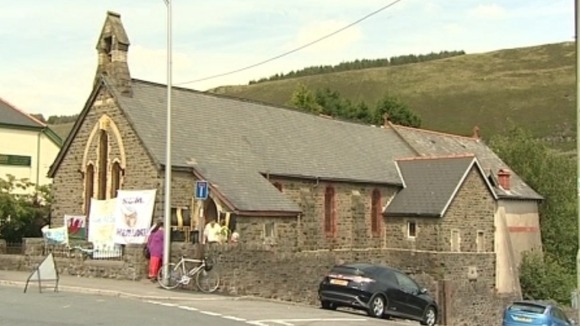
This is probably going to become an increasingly common
sight over the next 10-20 years unless Christian churches can
turn around the decline in attendances.
(Pic : ITV Wales)
Wales is still, for now, a "Christian country" – Although there have been colossal falls in the numbers of people identifying as Christians since 2001, they are still a healthy majority in Wales. Based on the trend, I don't think it's too outlandish to suggest that Wales will probably cease being a majority Christian country between the 2021 and 2031 censuses.

Churches need to take a look at themselves – I'm convinced the falls are terminal unless Christian churches adapt to life in the 21st century. That could come down to how worship is conducted. It looks as though the Church in Wales is starting to look at that, but will it be too little, too late? It might well come down to some core Christian beliefs no longer seeming relevant to younger generations in particular. Re-evaluating these beliefs and their interpretations might be a step too far for many denominations. I'm not sure if churches will be satisfied with a social role reduced to just conducting christenings, weddings and funerals.

Wales is rapidly secularising
– This could have massive social and political implications. It could mean changes in policy such as school "daily acts of worship" in the medium-term. It could perhaps mean that right-wing parties in Wales are going to have to become more socially liberal. It probably means that pseudo-religious phrases like "family values" and "moral majority" are going to have very little political clout in Wales. It also means a materialistic evidence-based approach to some public policy issues – abortion and same sex marriage for example – might be increasingly more palatable to the Welsh as a whole.

Question marks over the future and relevance of faith schools - I don't think this is that big an issue. As long as there is demand for faith-based education, then it'll be provided somehow, just like Welsh medium education. If both parents and pupils alike are questioning/rejecting faiths in increasing numbers, then you have to wonder what role faith-based schools are going to play in the future - perhaps their very existence in the long-term.

Considering Wales' history of non-conformism, it's (somewhat) understandable
that Wales is targeted by evangelical groups. However, attempts to
convert or create a "Bible Belt" aren't working and probably never will work.
(Pic : Yahoo News)

Attempts by Christian evangelicals to create a "Bible Belt" in Wales are doomed – We've seen a lot of groups come to Wales over the last decade, bringing some really quite hardcore "fire and brimstone" views with them under the guise of community work or missionary work. They've been targeting parts of west Wales in particular. Some even end up with public money, perhaps an excuse by local authorities to offload responsibilities. The hard evidence says this isn't working and they're not really converting many new people, perhaps just making the inevitable decline a little bit slower by being quick to adopt modern ways of proselytising.

Wales is still relatively monocultural – With the exceptions of Cardiff, Swansea and Newport, Wales remains fairly homogeneous compared to vast chunks of England. I imagine this will be reflected in the ethnicity figures as well, which will be my next port of call.

Thursday, 24 January 2013

Well, tonight thank God it's them instead of you

"Everything is fine. All is well. I'm doing a good job. Give me a pay rise.
.....Wait, what are you doing with those Kalashnikovs?"

(Pic : Verzio.org)
I want you to close your eyes....no wait, that won't work. Just read the description below and see what images this might conjure up in your mind.
  • Those with executive powers are appointed, not elected, and aren't accountable to anyone but themselves.
  • Internet access for democratically-elected representatives is selectively blocked.
  • The local print press is undermined with the tacit approval of the executive.
  • The elected body is a puppet to the executive and generally does whatever the executive wishes.
  • Meetings behind closed doors regarding freedom of the press are considered the height of transparency.
  • Steps are taken to make watching the elected body as uncomfortable as possible to the public.
  • The constitution is, generally, made up as they go along.
  • There's a gathering separatist element in some parts of the territory, unhappy with the way things are being run from the centre and willing to take the unprecedented step of breaking away from their control.
  • The executive and elected body consistently ignores condemnation from relevant watchdogs and authorities and seems to take very little action to remedy the situation.
  • They have a track record of co-operating with "dodgy" individuals and groups that others would turn their noses up at.

North Korea? Myanmar? No, Carmarthenshire obviously.

If this were a country full of brown people living in mud huts and carrying AK-47s, Michael Stipe would be painting lines on his face. Other celebrities would be diverted away from important matters - like deciding which disease is the most glamorous to support - to comment on it.

Morrissey would write something for The Guardian about how we're in no shape to criticise the regime because we eat burgers, while people will bathe in Poundland All Day Breakfasts to raise money for relief efforts.

Lenny Henry would be on the back of a 4x4 being driven down mud lanes in hilly areas after being smuggled across the border. Midge Ure would be thinking of lyrics for the charity single. It would probably go something like this:

There's a soggy biscuit council
Who are a persistent stain on democracy
Doobie, doobie, doobie doo
Why? Kev, Pam and Mark
Why?

Let's be hypothetical for a moment.

Let's suppose something really, really bad slimed its way out of Carmarthenshire County Hall at some point in the future. Something much worse than anything that's preceded it. A scandal on the scale of Jimmy Savile or Baby P. Something that makes the UK press sit up and take notice en masse. Not just The Guardian, but the major UK papers ordinary people in Carmarthenshire read, including "red tops".

They'll do some digging for stories around the side of the main piece. They'll stumble across blogs and the South Wales Guardian story. They'll find the council's track record over the last few years quite "interesting" I'd imagine. One of the first stories that'll pop up will be a blogger being arrested for trying to film a council meeting. What was she trying to find out? What were the council so desperate to hide?

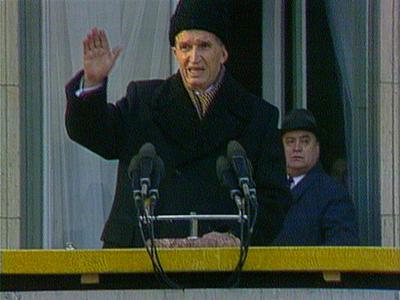
Fleet Street would have stories for months about "The Rotten Borough". It would take Ceausescu-esque levels of obliviousness to think that Carmarthenshire's PR department would be able to put any gloss on it. They'd probably try though.

Someone would be followed by cameras. Someone would have to make statements to the press on behalf of the council body that's politically accountable for all these deeds. Someone would have to justify any and all decisions made in that council chamber.

Kevin Madge (Labour) and Pam Palmer (Independent) are the public faces of what's happening in Carmarthenshire. They're accountable for all this nonsense - hypothetical or not. Maybe the press would turn their attentions to the devolved government in Cardiff Bay that didn't pay any attention to the warning signs and didn't do anything about it.

It probably won't happen, but I hope they're all prepared for that.

I'm starting to wonder whether some Welsh local councillors in ruling parties or coalitions are either naïve, sadists or are just incapable of thinking for themselves.

Do they think that if the heat is turned up enough, or if a scandal is big enough, that the executives aren't going to throw them to the wolves to save their own skins? "They voted for it." "They approved it." "I only offered a recommendation."

After it was so spinelessly decided to hand executive powers over to unelected officers, we've created the conditions necessary for, effectively, absolute monarchs. It's a system of monarchy right from the top to the bottom. Many haven't gone whole hog, others have. Like any good tyrant, they also have plenty of human shields in front of them to protect themselves.
It's not the chief executives standing for election, is it? Their head isn't on the block.

All you need is enough elected humps, combined with an unaccountable, paranoid executive hoisted up by a servile PR department with a commitment to blocking honest and upfront communication with the public. That increasingly describes many Welsh local authorities. In 2013. In a "democracy".

Before you think it's just "Crazy Carmarthenshire", there've been rumbles in Cardiff, Pembrokeshire, Caerphilly and Wrexham. Now Gwynedd too. Perhaps others that are being kept quiet. Lest we forget Anglesey as well.

It's not really a Labour problem then, but you have to wonder how a party with such electoral dominance here can be so inconsistent from county to county. You also have to question how and why some candidates are selected at local level.

Who are "officers" accountable to when they make mistakes? Who do they answer to full stop?

Why are "independents" even allowed to form groups to enable them to run a council by themselves or in coalition? What do they stand for? What are their agendas?

So, tonight thank God it's just Carmarthenshire. But it'll probably be you soon enough.

Monday, 21 January 2013

Network Rail's plans for Wales until 2019

A few weeks ago, Network Rail unveiled their Strategic Business Plan for 2014-2019. The overall aim of the strategic plan is to improve capacity (i.e. more carriages, longer platforms) and help meet UK Government targets to mitigate climate change and CO2 emissions.

They've already committed £874million towards Great Western Line electrification, and there's at least a further ~£350million in the pipeline for Valley Lines electrification.

The Great Western Line to Swansea will be electrified by 2018 and the Valley Lines by 2024 at the latest (it's likely to be sooner than that). A Welsh Government funded £45million improvement to North-South services should be completed by 2015.

The idea is that electrification will reduce maintenance costs (as the trains are lighter) and would enable current diesel trains to be replaced by "refurbished" electric ones, which have faster acceleration and would hopefully shave journey times.

The fact it takes so long to get from the heads of the valleys into Cardiff – a journey of 30 miles tops - is ludicrous and has been for decades. It takes an hour to get from Merthyr, Ebbw Vale and Rhymney to Cardiff Central, just over an hour from Treherbert and around 50 minutes from Maesteg. And that's before you factor in any possible delays.

Additional platforms are being provided at Cardiff Central and Cardiff Queen Street (the latter is currently under construction) which will enable more trains to and from the Valleys per hour. There's also new platforms planned/under construction at Pontypridd, Caerphilly and Barry. A passing loop will be constructed at Tir Phil on the Rhymney line, which will enable a half-hourly services to/from Rhymney itself.

I don't think there are any new stations planned over the next few years (by Network Rail or the Welsh Government) other than Energlyn (Caerphilly), Caerleon and Brackla (Bridgend). There's much more commentary on that at Plaid Monmouth.

There are also other strategic priorities:
  • Various resignaling projects across Wales, all delivered by 2017. North Wales resignalling should be completed by 2020.
  • Making the Welsh Marches Line (Newport-Shrewsbury) a "strategic freight route".
  • "Improving" services between Shewsbury-Aberystwyth, Cardiff-Manchester and along the north Wales coast.
  • Improving the track to allow heavier freight trains to use docks and freight terminals in south Wales (Cardiff, Barry, Wentloog)
  • Improve platform safety for vulnerable users (i.e. Elderly, disabled)
  • Develop an annual route vegetation clearance plan (i.e. prevent leaves on the line)
  • Reduce railway crime through improved fencing, public information, removing scrap and identifying "high risk level crossings".

The Assembly's Enterprise and Business Committee are currently undertaking an inquiry into integrated public transport. Obviously, as I said further up, electrification may improve journey times slightly as well as service reliability, helping the Welsh Government meet their own targets. Obviously I'll cover any committee report once it's produced, presumably sometime later this year.

They recently released a video of Nick Ramsey AM (Con, Monmouth) using buses and trains between Cardiff and Swansea to promote the inquiry. I found it funny for reasons I can't quite explain, I guess it's just my sense of humour.
"An epic journey of self-discovery. An exceptional piece of minimalist Welsh cinema. ****" - Oggy Bloggy Ogwr

As always though, Wales is a "special case" or "basket case".

As rail infrastructure funding isn't devolved, ours is on an EnglandandWales basis. Scotland's is separate. There is, however, a separate route plan for Wales which outlines Network Rail's plans here in more detail. Network Rail devolved itself - operationally - to Wales back in 2011.

So, the Welsh Government could fund a station, or a re-opened line out of their own pocket, but wouldn't have been able to carry out something as large or "new" as electrification. Devolution in action, everybody.

Scotland is planning to spend just over £4billion. Wales' proportional share of Network Rail's £37.5billion spend should be £1.87billion. Discounting the stretch of Great Western Line that's in England, and not including the resignalling works, I think it's safe to say it falls several hundred million pounds short of that.

If funding were devolved along the same lines as Scotland, and if the Welsh Government wanted to do it, I doubt Wales would be waiting so long for Valley Lines electrification to be completed. It probably would've been done years ago.

Tuesday, 15 January 2013

Accountability vacuum causing problems for Welsh Labour?

With Hywel Dda Local Health Board formally adopting
its hospital reorganisations today, is this the
start of an uncomfortable period for Welsh Labour AMs?
(Pic : BBC Wales)
I only saw these last week, but there are two videos (here and here) of Sandy Mewies AM (Lab, Delyn) talking with protesters outside a meeting in Connah's Quay back in September. The protesters were campaigning to save Flint Community Hospital, which has been outlined for closure by Betsi Cadwaladr University Local Health Board.

Although this was a while ago, I think this exemplifies a big problem with regard public service delivery. Sandy makes repeated claims, or implied, that it's "not to do with me" – a classic politician's line if ever there was one.

Right, OK, she doesn't come across too well in the videos. However, in this case, she's technically right and it's going to cause the Welsh Government and Labour AMs headaches in the coming years.

Who runs the Welsh NHS?

Local Health Boards (LHBs) actually run and administer NHS services in Wales. The LHBs are the ones overseeing hospital reorganisations and consultations on reorganisations. These are run by appointed officers and managers, but those higher up are practically anonymous.

Community Health Councils (CHCs) are supposed to represent the views of service users and the general public. Local councillors are represented on those boards – in a similar way to police and fire services.

The Welsh Government, and by extension Labour AMs - like it or not - are politically accountable for these reorganisations. But in practice they have very little say in what's being done. They can only scrutinise really, and that's – primarily - being led in the Assembly by opposition AMs.

Labour AMs have been quiet with one or two exceptions. Backbench Labour AMs seem unwilling to speak either for or against the LHB decisions, and that was one point raised by the Flint protesters. I'd draw your attention back to what's been said about Assembly plenary sessions.

I'm convinced that's just one reason reason why some public services in Wales are poorly run, because it's always someone else (Councillors, AMs, MPs) carrying the can, even if they had nothing to do with the decision-making.

So, the decision-making ability rests in one place, the accountability rests with the politicians. They should be joined together. I think that's what most people would call "a functioning democracy".

Say what you like about PCCs, but at least you can't say that of the police anymore.

What's going wrong with hospital reorganisations?

I've said several times that the changes make sense - primarily because of shortages of specialist medical staff. I should be explaining why the changes are needed. However, whenever I go to do so, some other bungle appears – whether that's by ministers, LHBs or someone else. I go back to banging my head against the desk, hoping to wake up one morning and find I'm only human left alive, or that Wales is sinking into the Irish Sea, so we can put all this madness of thinking we have a functioning country to rest.

It's been rushed – Perhaps that's with one eye on NHS budgets, which are under immediate strain, but many LHBs are using 12-week consultations (the bare minimum) for the public to judge changes that will last decades. In an ideal world, this would've been phased in over several years. Even if it is going to be, that's not the impression given.

People still don't understand what's happening – This is supposed to be the point of the consultations, and some LHBs have gone some way in explaining the changes to the public. However, some consultations have been poorly attended and if you mention "hospital changes" to anyone in the street, they'll probably assume that means "closure". In fairness, sometimes that is the case – especially smaller community hospitals like Flint. Today it was announced that a community hospital near Llanelli will shut.

"No hospital is under threat, and no hospital was ever under threat in Wales" - Carwyn Jones, First Minister's Questions, May 1st 2012.

People assume the worst about NHS changes because that's what Labour have been saying to them for decades, putting it constantly in a position of danger unless Labour are running it. Heh. It has to be said that some opposition AMs are making the job harder too, but that's....their job.

Bad news follows more bad news – Again, this isn't helping things. Stories about people being treated in ambulances, missed targets, negligence, poor standards of care, failures to recruit specialist staff and sexed-up documents. Today there was issues surrounding Hywel Dda LHB's handling of reorganisation. Yesterday, ITV Wales revealed Carwyn Jones himself redacted parts of a report into the death of Robbie Powell – which is pretty damned serious by itself.

So, the climate isn't ripe for dramatic, fundamental changes to hospital services in Wales at the moment.

Us - Now, we the public rarely help ourselves. I think there's an expectation that to get "proper care" you need to go to a "proper hospital". We rarely hear about advances in things like emergency medicine or home care, which might reduce the need for hospital visits. We also expect NHS staff to perform miracles. I wish more people would pay attention to Welsh Government advice on things like reasons to call 999 or go to A&E. You can find out more information here.

I don't usually disclose what searches lead here, but one that sticks in my mind was "emergency arse doctor rectal surgery port talbot". I don't want to know.

Labour's problem


I feel sympathy for Sandy Mewies' situation in the videos. I don't like to see that happen to an AM (or politician in general), as she's only (sort of) trying to do her job within the confines of the job description. She's been placed in an awkward position.

The decision-making process seems complicated. Basing this partially off Community Health Councils recent calls for "stronger political leadership", here's how I understand it:
  1. Local Health Boards run and administer NHS services and propose reorganisations.
  2. Community Health Councils negotiate the changes with the LHBs "on behalf of the public".
  3. If there's a disagreement, and only then, it gets referred to the Health Minister (Lesley Griffiths).

There seems to be very little direct role in reorganisations for AMs other than to ask questions in the Senedd, or organise protests and petitions.You can understand why an inability to actually do something about it is going to look like inaction to the public - Labour inaction in most cases - if they're not willing to speak out on government policy one way or another on behalf of constituents.

Ideally, the LHBs and CHCs would be democratically accountable for these decisions in some way shape or form – perhaps answering directly to the Assembly's Health Committee. That's something Elin Jones AM (Plaid, Ceredigion) suggested last year, and several times before that, with regard finances. I think it'll have to go further than that. There's no point in putting local councillors on the CHCs, as local authorities are generally run along this arrangement too.

But, ultimately, Welsh Labour seem quite happy with the arrangement as they've done little to change it, other than push for greater collaboration between varying authorities at local and regional level.

At the very least they should consider Elin Jones' suggestion now, or Sandy Mewies will only be the first Labour AM to (on record) get this treatment. If Labour handled it like this in England or Scotland they would be toast, but being Wales and seeing as the Chuckle Brothers down the M4 are rather unpopular at the moment, I doubt this is going to affect the party electorally.

I want them to get this right, because as long as the changes are reasonable I think we might see long-term benefits through the creation of "centres of excellence". But, yeah, at a fundamental level they're making a complete hash of it.

The thing is though, it's not entirely backbench AMs fault. But you better believe it's going to be their faces and names to it.

Thursday, 10 January 2013

Asbestos Disease Bill

You can imagine breathing this in will cause a lot of damage.
Mick Antoniw's Bill will enable the Welsh NHS to claim compensation
for treating asbestos-related diseases.
(Pic : ecfia.eu)
Just before the Christmas recess, Mick Antoniw AM (Lab, Pontypridd) laid the second Member's Bill before the Assembly – the Recovery of Medical Costs for Asbestos Diseases Bill. For brevity I'm calling it the Asbestos Disease Bill.

Asbestos – Why is it such a problem?

Asbestos is a building material manufactured from minerals, which was once heavily-used in construction for insulation and its fire-resistance properties. Some types of asbestos release fibres when disturbed – deliberately or accidentally – but all asbestos causes some sort of health problem in humans.

Asbestos fibres, under a microscope, look like nettles (as you can see above). When breathed in, they cause mechanical or genetic damage to the respiratory system, and lead to diseases such as:
  • Lung cancer
  • Mesothelioma - A cancer of the protective linings (mesothelium) of the chest cavity and abdomen.
  • Asbestosis – Fibrosis ("scarring") of the lungs caused by asbestos fibres.
  • Pleural diseases – The pleura is a folded membrane which help the lungs slide across the ribs when breathing.

The time it takes for the symptoms to appear varies, but it's estimated that there are up to 4,500 deaths from asbestos-related diseases in the UK every year. Cases of asbestos-related diseases are expected to peak in 2016 and then start to fall.

Asbestos has been banned across the European Union, and in the UK since 1985 – though some types continued to be used until around 2000.Obviously, some people will have been exposed to asbestos on a routine basis if they worked in construction or manufacturing while asbestos was used.

Asbestos was commonly used in public buildings
during the 60s and 70s.
(Pic : BBC Wales)

As it was widely used in the construction of public buildings during the 60s and 70s, every now and again you'll have a situation like that at Cwmcarn High School last year. The whole school was shut when unacceptably high levels of asbestos fibres were found. Plaid Cymru recently estimated it would cost "hundreds of millions of pounds" to remove all asbestos from all Welsh schools.

Sometimes - with a cruel irony - asbestos is found in hospitals themselves, like Bronglais Hospital in Aberystwyth. Fortunately, it can be removed safely.

What does the Bill aim to do?

The overall aim of the Bill, is to enable the Welsh Government to recover costs for treating asbestos-related illnesses on the Welsh NHS from a person/company paying compensation for asbestos exposure.

There are numerous Acts of Parliament and regulations that determine who is liable for exposing employees to asbestos, and it's estimated that treating asbestos-related disease costs the Welsh NHS between £2-3million per year.

The Bill is described as an extension of the Social Care (Community Health & Standards) Act 2003, treating asbestos-related disease – in shorthand – as a "personal injury".


It's not proposing a new compensation scheme like miners diseases in recent years. It doesn't impact an individual's right to compensation either, or place any sort of levy on it. It would just ensure the Welsh NHS get compensation for treating diseases.

Any costs would be paid to the Welsh Government directly, and become part of the annual health & social services budget. I believe it's intended to use that money to help people suffering from asbestos diseases and their families.

A "tariff" system would be established – similar to that for road accidents - to determine the costs for treating asbestos disease patients. A scenario in the Explanatory Memorandum is given of 11 patients, and it's estimated the total cost of treating them is around £256,000, with an average cost - per patient - of £23,300.

The total cost of administering the system by Local Health Boards would be around £40-50,000 per year.

Practically all organisations dealing with asbestos disease, and relevant trade unions, supported the principles of Bill.

There was only one organisation that didn't – The Association of British Insurers.

Wednesday, 9 January 2013

Do Assembly plenary sessions need a revamp?

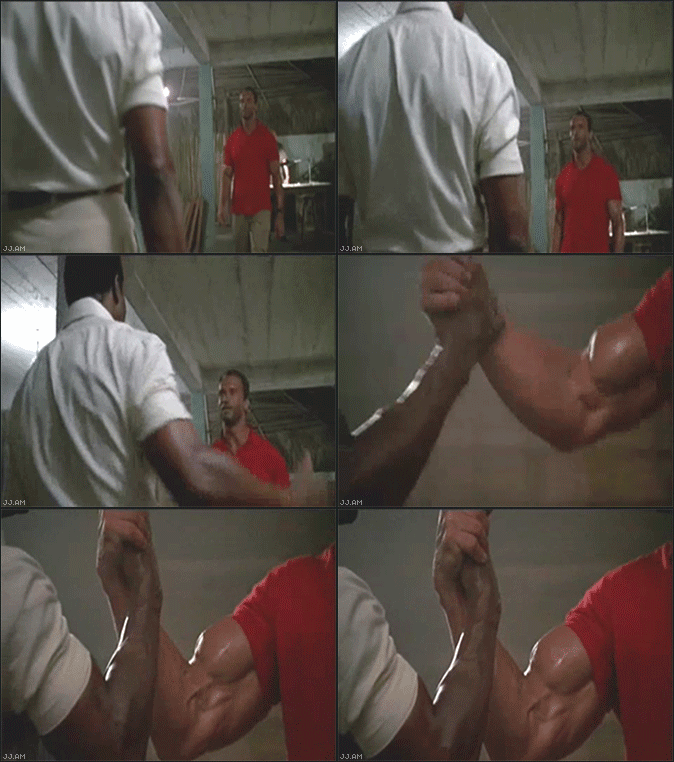
Will Carwyn and Andrew start arm wrestling over fishing boat regulations?
Do we need a more macho, confrontational Senedd?
I'm not convinced.
The National Assembly is back in session after Christmas, and the first big talking point is, unsurprisingly, about the Assembly itself - this time plenary debates, and First Minister's Jeopardy Questions in particular.

Both Leanne Wood (Plaid, South Wales Central) and Andrew Davies (Con, South Wales Central) raised concerns about how oral questions are answered in the Senedd by government ministers, and the procedures surrounding questions.

There was also the farce of an announcement being made by the Welsh Government via Twitter during the plenary session, while the First Minister himself wasn't providing any answer to a question relating to it. Whoop, whoop, whoop. Nyuk, nyuk, nyuk.

This little fact might take a few of you by surprise – I rarely watch Assembly proceedings, including FMQs.

I might watch the Senedd a half dozen times a year at most – if there's something important, like a big vote, or a debate on a subject that interests me. I use the Cofnod because I can search through it and it saves me time. I'm not around to follow Twitter feeds live, but I monitor other blogs too.

I say that as one of the more prominent, hardcore political anoraks in the whole country. To those who sit through them and who aren't paid to do so one way or another – I salute you. It's always comforting to know there's someone sadder than me out there.

Some might say that's an argument for not broadcasting it at all to save money or whatever, but you need an audiovisual record, simply to prove that transcripts and votes match what's said. It's also important to determine the tone by which questions are asked. I wish we had a Welsh C-Span or version of BBC Parliament, but I doubt that can be justified. Lest we forget S4C2.

I think AMs are unfairly criticised for the standard of debate. We have a very different system to Westminster. There's more consensus building and it seems as though they work on a first name basis. It's more casual. I prefer that. I reckon most AMs probably prefer that too.

I believe it's a bit more grown up than the "yah-boo" stuff in Westminster, but it might be a little too informal and relaxed. I think the Scottish Parliament balances it better.

I imagine one reason Andrew Davies, and other AMs, might want a shift to a Westminster "confrontational" style is because they have no indoor voice. As though shouting more loudly, and getting more worked up about something makes you stand out more. Perhaps that's right to a certain extent. However, it's hard to get excited about some of the stuff coming out of plenary or - if we're going to include written questions - how much Carwyn spends on Christmas cards.

We need to remember that the Assembly has a restricted scope within which to ask questions. Sometimes that means questions are very narrow or vague, leading to very narrow or glib answers. Look them up yourself and see how many times ministers are asked about "their priorities for X,Y, Z" or to "make a statement on X,Y,Z."

But I challenge anyone outside politics to put themselves in the position of an AM or Minister when criticising or defending policy. It probably looks easier than it actually is.

I'm reminded of my viva voce, where your dissertation is ripped apart in front of you by people who know what they're talking about. I imagine Assembly debate is a watered-down version of that, but week after week.

I don't think those criticising will have ever been challenged like that by someone of any real  standing before, and think it's a simple case of standing up and waffling on. AMs can't do that without looking like a plonker. Yet, I do think a minority of AMs do that occasionally, but not too often. No names mentioned.

However, the committees are as good as those in any of the other legislatures. I believe most of the AM's important work goes on there, not plenary. It's just not as "sexy". FMQs is just a fraction of the stuff that goes on in Cardiff Bay, but it's supposed to be the "highlight". It's not, is it? I'm not sure it ever has been, to be honest.

That's not to say there aren't any issues. The First Minister has a point when saying the opposition don't necessarily ask the right questions (from his perspective).

Carwyn Jones is a barrister. He's been professionally trained to use questions and answers to good effect. It comes naturally to him, maybe some other AMs too. That's not to say those AMs are smarter than the rest, just they know what makes a good question and they will know, instinctively, how to bat those questions away.

The trouble is, I believe he's become so used to that since becoming First Minister, he does it every bloody week. FMQs is a bit of a joke and part of the reason I don't watch it is, simply, questions aren't answered, they're generally thrown back at the questioner.
Carwyn seems bored of it, and I don't blame him.

The standard of debate, whilst not perfect, has improved substantially down the years – I can tell that from transcripts alone. The Lib Dems have always been good at it. Jocelyn Davies (Plaid, South Wales East), has made excellent use of motions during plenary over the last few months on her party's behalf. The Conservatives are more than capable of delivering a sucker punch every now and again.

Notice how I've left out one group – Labour backbenchers.

How many well thought out questions and debates have come from the Labour benches the last year or so? Questions that don't involve praising the front bench, latest policy initiative or attacking the UK Government (directly or indirectly)?

Before he became a Deputy Minister, Alun Davies (Lab, Blaenau Gwent) was quite good at it during the One Wales government.

A government should fear its backbenchers. One of Westminster's big plus points is that backbenchers wield quite considerable power. The same can be said of the Scottish Parliament. I'm not saying they should oppose everything for the sake of it, that would be stupid. However, effective critique of the government from their own side is the best way to hold said government to account. Ministers have to listen to them. I believe Labour backbench AMs hold far more power than they perhaps think they do, especially when there's no majority.

I don't think it comes down to abilities or skills, just that they're caught in an awkward arrangement and, perhaps, their questions duplicate one another. There's at least one glimmer of hope from the current lot – Mark Drakeford (Lab, Cardiff West). And even then, he's not perfect.

Maybe because there was such a high turnover of AMs in 2011, nobody wants to rock the boat in their first term. Some backbenchers could have their eyes on the front row, and don't want to ruin their chances with the boss.

Who's the most likely to make that step up at the moment? – Mark Drakeford.

Who's been, arguably, the most constructive critic of the Welsh Government this term from the Labour side? – Mark Drakeford.

That's not a coincidence. Think about it. Would a First Minister want to move a party loyalist nodding donkey to the front bench? Or one of the biggest, but friendlier, critics?

It wouldn't hurt opposition AMs, and their staff, reviewing how they present their arguments. But, far from criticising other parties for the standard of debate, I think Carwyn needs to turn around and look at his own people too.

Monday, 7 January 2013

Census 2011 : What's stunting Welsh?

As you probably all know, census data released at the end of 2012 showed a 1.8% decline in the Welsh-speaking population compared to 2001.

As far as I'm concerned, there are other issues and statistics that are perhaps more worrying – in particular working age people without qualifications and those with a long-term limiting illness. I'll return to those at a later date, as I doubt there's enough to work off as yet.

Today though, I'm going to sift through the numbers and patterns and try and come up with explanations for the decline.

The decline : Where? & By how much?

There are two key statistics here.

Firstly, Welsh-speakers as a percentage of the population. Using the raw figures provided by Syniadau, I've drawn up maps to illustrate the changes visually.

Welsh-speaking population per local
authority 2011
(Click to enlarge)

There's clearly a heartland consisting of Anglesey, Gwynedd, Ceredigion and Carmarthenshire, commonly referred to as "Y Fro Gymraeg". The Welsh-speaking population is comfortably above 40% in each of them, but only Anglesey and Gwynedd remain majority Welsh-speaking local authorities compared to 2001. That's the first worrying development.

However, counties like Conwy, Pembrokeshire, Powys and Neath Port Talbot form a looser "hinterland" where there's a sizable minority of Welsh-speaking residents (between 15-25% of the population).

Change in % of Welsh-speakers compared
to 2001
(Click to enlarge)

Next it's worth looking at how the figures have changed compared to 2001. Carmarthenshire and Ceredigion stand out in particular, with Carmarthenshire experiencing the sharpest fall at 6.4%. A vast bulk of Welsh local authorities saw falls over the period, however the fall is more marked in "Y Fro" and the "hinterland" than elsewhere. Neath Port Talbot saw the sharpest fall in south Wales for example at 2.7%.

You could argue the figures stood up well in south east Wales and south Wales central. The only local authority that saw a rise was Monmouthshire, while numbers held up in Cardiff, Caerphilly and Rhondda Cynon Taf. Though all local authorities saw falls in those able to read, speak and write Welsh.

Number of  Welsh-speakers per
local authority 2011
(Click to enlarge)
The second key figure is the number of Welsh-speakers in physical terms. A population percentage gives you a good idea of the "density" of Welsh-speakers, but in terms of actual numbers there's a more even spread.

As you might expect, the vast majority of Welsh-speakers live in Y Fro. Carmarthenshire has the most Welsh-speakers overall, closely followed by Gwynedd. But Swansea, Rhondda Cynon Taf and Cardiff have very large Welsh-speaking communities despite being outside Y Fro. Cardiff, in fact, almost has as many Welsh-speaking residents as Anglesey.

Next, the change in Welsh-speaker numbers compared to 2001.Ceredigion and south west Wales have seen the sharpest falls. However, falls in the north east – in particular Anglesey - don't seem that pronounced.

Change in the physical number of
Welsh-speakers compared to 2001
(Click to enlarge)

When you look at the south it's a different picture. The numbers have held up well in Bridgend, RCT and Newport, while there were increases in Vale of Glamorgan, Caerphilly, Monmouthshire and Cardiff. Cardiff seeing the sharpest rise at more than 4,000.

Overall, Wales has lost just over 20,000 self-identifying Welsh-speakers since 2001. That makes Cardiff's 4,000 rise quite an achievement, rather than something to be derided.


The decline : How? & Why?

"Rural down-sizers" appear to be just as likely to be
moving from other Welsh local authorities as
from England.
(Pic : Zoopla.co.uk)

Mortality
– Y Fro counties aren't only the most Welsh-speaking, but also amongst the "oldest". Based on 2012 mortality rates (6,236 per million) ~3,500 Welsh-speakers will have died in Wales each year, and ~35,000 since 2001. Clearly, there haven't been enough replacements for them. It's even worse in Carmarthenshire and Neath Port Talbot, where the percentage of people with poor health is way above the Welsh average. Logically, that would lead to more people dying younger at the top end of the demographic tree and proportionally more Welsh-speakers amongst them.

Migration patterns within Wales
– Using this tool from the ONS, you can see where people moving to Welsh local authorities are coming from. In Anglesey, most inward migrants came from Gwynedd. In Ceredigion the vast, vast bulk come from Welsh local authorities. It's similar in Carmarthenshire.


It's also the opposite. For example, 1080 people moved to Cardiff from Ceredigion, Gwynedd and Carmarthenshire. How many were Welsh-speakers? The odds are quite a few. Which local authority saw the sharpest rise in the physical number of Welsh-speakers again?

A non Welsh-speaking Welsh person moving to an Y Fro county is going to have the same effect on Welsh-speaking statistics as someone moving from England. That might be an uncomfortable fact for some nationalists, but it's the truth.

Inward migration
– There's a clear pattern of small numbers of people from a large number of English authorities moving to Wales. They don't look much in isolation on the viewer, but added together they do tot up to a significant number. Discounting those already here, English in-migration "tops-up" a decline in Welsh-speakers disproportionately. In addition, Carmarthenshire (especially Llanelli) has seen large numbers of eastern European migrants settling there since 2004. I'm willing to bet none of them can speak Welsh either. You can't ignore that it's a contributing factor, but it's simplistic to put all of the emphasis on this point alone.

Outward migration – What about those heading in the opposite direction? It's unclear how many Welsh-speakers there are resident in England (or I simply couldn't be bothered to find out), but there are, in many cases, at least as many Welsh people moving to England than there are incoming. The south, however, seems relatively self-contained. It's far more pronounced in Y Fro and counties like Powys, where it's perhaps easier to head east-west than north-south.

Has Blair government university expansion led to a more
transient Welsh-speaking population in their 20s?
(Pic : Austin Company)

Increased student numbers since 2001
– I actually think this is an overlooked, but key reason behind the proportional decline. I'm willing to bet a lot of the transient population are full-time students, including English students studying at Welsh universities and vice versa. Even if it's only a few thousand moving in either direction, it's enough to knock a big chunk off the Welsh-speaking population in sparsely populated counties in Y Fro and elsewhere. Even more so if they don't return.

Over-estimation of Welsh-speakers in 2001
– Maybe people then were caught up in the patriotic fervour of devolution and "Cool Cymru" and over-estimated their Welsh-speaking ability. Now the national question is settled to a certain extent, people might not be as keen to express their national identity through their ability in the language. It could also mean Welsh-learners no longer regard themselves as proficient in 2011 as they were in 2001 – probably through lack of use.

"O bydded i'r hen iaith barhau"

 If we're careful,  Welsh might have a very bright future indeed.
But the vast bulk of Welsh-speakers in numerical terms are older.
(Pic : Welsh Language Commissioner via Blog Menai)
(Click to enlarge)
There's one big glimmer of hope, but we'll have to be patient. Look at this graph from the Welsh Language Commissioner, also posted on Blog Menai.

The demography of Welsh-speakers is very heavily in favour of younger generations in practically all  local authorities. Perhaps that's due to the expansion of Welsh medium education. Perhaps Welsh-speakers are having more children or are more settled.

The drawback is that Wales is generally older in terms of sheer numbers. Migration by retirees (including within Wales itself) will have an impact, but simple demographics are the big issue here. If anglophone monoglot over 65s disappeared for whatever reason Logan's Run style, it's possible Wales would have a ~30% Welsh speaking population, Y Fro would be solidly Welsh-speaking and even places like Cardiff and Blaenau Gwent would have 20-30% of the population with some ability in Welsh.

I think the changes to the number of Welsh-speakers could be compared to an incoming tide. The first wave comes in a certain distance, then retreats. The next wave comes in even further and stronger, then retreats.

But there's still an awful lot left to do to, not to "preserve" the Welsh language, but ensure it remains a living language. The living bit is much, much more important.

End "Meta-Welsh" – Or, to put it bluntly, Welsh language activists have become so self-referential about Welsh itself, they've dropped the ball over the last 10 years. It shouldn't be reduced to something you talk about at a dinner party, a protest rally or in a seminar. Welsh shouldn't be some sort of geeky hobby for enthusiasts.

Would the future of Welsh be more secure if activists dropped placards and more of them
picked up a guitar or wrote Welsh-language novels and television/radio shows?
(Pic : ITV Wales)

If the future of Welsh is going to be constant arguments over status, "conservation", legislation and commissioners – nothing ordinary folk care about - we might as well give up now. It hasn't worked in Ireland, it won't work here.

Mainstream the use of Welsh – You should be able to buy your groceries in Pwllheli in Welsh – end of. The job of ensuring you can now rests with the Welsh Language Commissioner. There's no need to go over the top outside of Y Fro, but once a Welsh-speaking population reaches a certain level, or number, there should be an expectation that basic services would be available – and more importantly, used – in Welsh. Even if it's only a token "Derek the Weather" gesture.

"Cwl Cymraeg" – The future of Welsh lies with the Cyw crowd and 20/30-somethings, not the Dechrau Canu, Dechrau Canmol crowd. Although there are some "edgy" Welsh language artists out there, Welsh language culture as a whole gives the impression of being very conservative. Cymraeg needs a pulse. We need more contemporary Welsh language entertainment and literature to make it alive and appear like something monoglots are missing out on. It needs more slang, for example. It needs to be worth the artist's time though. Note the disagreement between Radio Cymru and musicians.


Change how Welsh is taught in English-medium (secondary) schools
- Welsh has to be desirable to speak and learn, and I don't think that comes down to compulsion. I think instead of the pointless, token Welsh language GCSE Short Course, it should become like the (proposed) Scottish-style "Welsh Studies".


It should be bilingual, but actually putting it in a context, be that historical, political, cultural or sociological. The emphasis on teaching Welsh (as a second language) should be heavily weighted towards English medium primary schools, where language teaching is a bit more effective as brains develop.

It's impossible not to like this. But when Cyw's viewers get older, they'll need more
Welsh-language media that reflects modern Wales. Welsh needs to become a little bit more ballsy.
(Pic : BBC Wales)
Promote the benefits of a bilingual education – This doesn't just include the obvious cognitive one of being able to speak more than one language, but employment, cultural and social opportunities. Most of the world is bilingual. Pupils attending Welsh-medium schools also learn English to native-speaker standards anyway. Secondary school pupils also learn other languages alongside Welsh and English as part of the curriculum – though both Plaid and the Conservatives have discussed introducing a third language at primary school level recently.

That little fact means it's easy to lock those who have "issues" with Welsh language education in very amusing circular arguments. I wish people would do it more often, and it makes it far easier to uncover their true motivation(s).

An Y Fro baby boom – If Welsh is going to survive as a living language, more children in the heartland need to be brought up in Welsh-speaking households, who in turn might move to other parts of Wales and top up Welsh-speaking communities there. More Welsh-speaking young people might put off elderly, anglophone white-flighters moving to rural Wales in the first place. But there's another big problem....

An Y Fro economic miracle – There are economic reasons for the decline of Welsh. With the economy of West Wales & The Valleys continuing to lag, and there being natural penalties for living in a sparsely populated area, there needs to be a reason to retain working-age people and provide them with jobs. I call this a "miracle" because that's the scale of the challenge. What industries could Y Fro specialise in? Energy? Agricultural science? It has to be more than seasonal tourist jobs.

Link planning (economic and social) and housing to the Welsh language
– This doesn't necessarily mean prioritising Welsh-speakers for housing. It could simply mean more cheaper, affordable housing and the creation of a "Welsh-speaking city" somewhere in Y Fro with enough clout to pull younger people towards it. That could be Aberystwyth, it could be Bangor, it could be a planned expansion of a town like Porthmadog.

Create a model for a successful Welsh-speaking infrastructure, learn from it, then replicate it elsewhere.